
01Summary
In a paragraph
If you only have 30 seconds.
The Frisian Pointing Dog, known internationally as the Stabyhoun, is a Dutch all-rounder with pronounced prey drive, strong family bonding and high stimulation needs. Those who keep this breed take on a dog that requires 90 to 120 minutes of active exercise daily, hunting-related enrichment and consistent guidance. Calm in the house, reserved towards strangers, cooperative in training, but not a dog that occupies itself.
02Introduction
What makes the Frisian Pointing Dog special
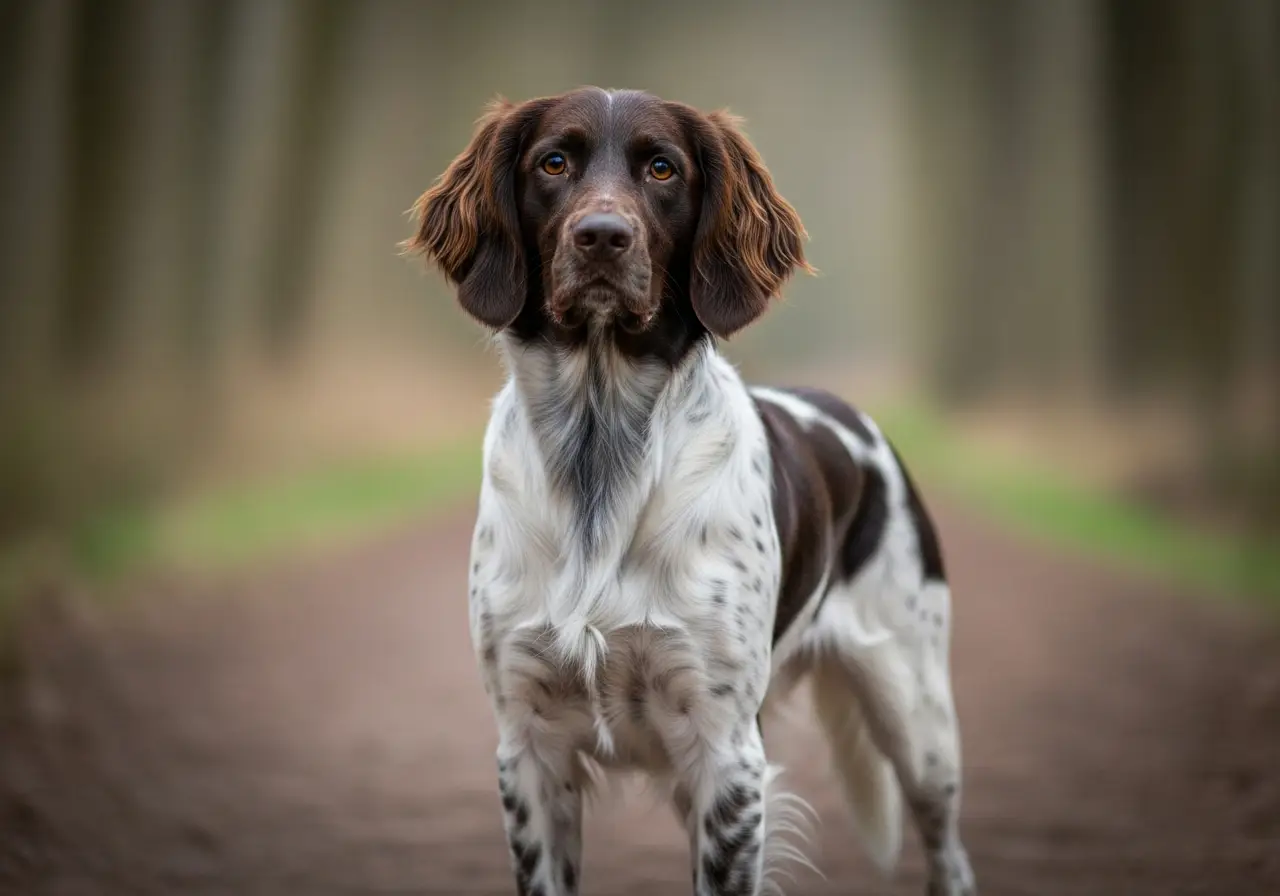
The Frisian Pointing Dog (Stabyhoun) is a Dutch all-round hunting dog, FCI Group 7, calm and suitable as a family dog, with a withers height of 55–63 cm.
03Profile
Key facts and suitability
- Origin
- Niederlande
- Original purpose
- Pointing dog in Friesland
- FCI
- No. 222 · Group 7 · Sektion 1.2: Kontinentale Vorstehhunde, Typ «Spaniel», mit Arbeitsprüfung
- height at the withers
- 48–53 cm
- Weight
- 20–25 kg
- Life expectancy
- 13–15 Years
- Coat type
- Long-haired
- Minimum exercise
- 90 min/day
- Puppy price
- 1'000–1'800 CHF
- Waiting period
- 9 months
- Sports
- Hunting · Field trials · Agility · Retrieving
04Temperament
How the Frisian Pointing Dog shows up in everyday life
Morning walks reveal what makes the Stabyhoun unique: The nose goes straight to the ground, and the dog works the terrain independently. If it picks up a scent trail, it pulls consistently; a recall without prior training foundation fizzles out. This is not an obedience problem, it is genetics.
Internally, meaning what the dog needs daily, the need for social contact is high. The Stabyhoun seeks closeness to its primary caregiver, wants to be included and reacts sensitively to isolation. Four hours alone is the maximum it tolerates without stress symptoms. Its need for mental work is equally pronounced: nose work, dummy training or search games are not extras, but a daily necessity.
Externally, meaning how the dog reacts to its environment, a different picture emerges. It initially approaches strangers with caution. It observes, assesses, then approaches on its own initiative. Anyone who pushes it for greeting receives withdrawal. This reserve is not mistrust, but breed-typical caution. With known people and its own family, it behaves openly and affectionately.
In everyday family life, it is a calm companion, provided its stimulation is adequate. After a long session of dummy training, it lies relaxed in its place. Without this session, it seeks occupation: garden, sofa, footwear. Calmness in the house is not automatic; it is the result of consistent stimulation outdoors.
It gets along well with children who respect the dog and handle it calmly. Hectic activity and loud commotion are more likely to overwhelm it than to excite it.
05Needs
What this breed needs daily
The Stabyhoun needs at least 90 to 120 minutes of active exercise daily, not just a walk, but exercise with a task. Free running in the terrain, dummy training, nose work or hunting-related enrichment meet its need for stimulation. A city walk on a leash does not replace this.
Its need for mental work is at the same level as its need for physical exercise. Mantrailing, search games, fetching exercises or structured obedience training are suitable formats. The dog works motivatedly if the task is meaningful and varied. Monotonous repetitions lead to disinterest.
The need for social contact is high. The Stabyhoun is not a dog that seeks distance from the family. It wants to be there, during cooking, working and walking. Being left alone must be built up gradually. Four hours is a realistic maximum for a well-conditioned dog; more puts it under lasting strain.
A rural or at least suburban environment with access to open spaces is advantageous. Keeping the dog in an apartment is possible, but requires disciplined planning: several sessions daily, fixed structures and reliable stimulation.
Training requires consistency and patience. The Stabyhoun is willful and independent; it tests boundaries not out of spite, but because its genetics are geared towards independent work. Positive reinforcement with clear structure works. Pressure and harshness lead to withdrawal or refusal. A stable recall in the presence of wildlife stimuli is the central training goal and requires consistent development over months.
Exercise
High
mental work
A lot
Social needs
High
training
Easy
06Sport & Mental and Physical Stimulation
What sports the Frisian Pointing Dog is suited for
Realistic in terms of physiology and genetics – not every breed suits every sport.
Structurally and physiologically suitable: Suitable for mantrailing, dummy work and tracking · CaniCross / bikejoring possible.
07Quick Check
08Suitability
Who this breed is suitable for – and who it isn't
✓Matches
The Stabyhoun suits active owners who can plan 90 to 120 minutes of structured exercise daily, not as an occasional exception, but as a fixed part of the day. Anyone who enjoys hunting-related enrichment, dummy training or nose work hits the nerve of this breed.
Families with children from about 8 years old, who treat the dog calmly and respectfully, get along well with the Stabyhoun, provided sufficient time for training and exercise is available. A garden or regular access to open spaces makes everyday life considerably easier.
Experienced first-time owners who are willing to receive professional guidance from a dog training school are also suitable, provided they take the hunting motivation of the breed seriously from the start. The dog forgives learning curves as long as the basic structure is correct.
Owners who spend a lot of time at home or work from home benefit from the Stabyhoun's strong bond orientation. The dog integrates well into a regulated daily routine with fixed exercise and rest phases. Those who understand its reserve towards strangers and do not view it as a problem, but accept it as a breed characteristic, will be rewarded with a loyal, cooperative companion.
×Doesn't match
The Stabyhoun is not suitable for owners who are regularly away from home for more than four hours without having a reliable care solution. Its depth of bonding makes prolonged isolation a stress factor, with corresponding consequences in behaviour.
Those looking for a dog that greets strangers openly and warmly are mistaken with the Stabyhoun. Its reserve towards unknown people is not a training deficit, but a breed characteristic. Those who view this as a problem or try to correct it by pushing create stress for the dog.
Households without access to open spaces and without willingness for daily, structured stimulation are unsuitable. A short city walk does not cover the exercise needs. Those who view exercise as an occasional leisure activity underestimate what this dog requires daily.
Owners looking for a low-maintenance companion dog without pronounced hunting instincts should consider another breed. The Stabyhoun's prey drive is genetically anchored; it can be guided, but not trained away. Those who have no plan for hunting-related alternative enrichment will end up with a dog that makes its own plans. This sensitive breed is also unsuitable for owners who rely on pressure-based methods in training.
10Line reality
Show line, working line, breeder market
The Stabyhoun does not have a pronounced separation between working and show lines, as is known for example with the German Shorthaired Pointer or Labrador Retriever. The breeding population is too small to establish parallel lines with significantly different performance profiles.
However, differences in hunting intensity exist within the breed. Dogs from litters where parent animals are actively used in hunting or dummy sports tend to show stronger working instincts and higher drive. Dogs from pure companion dog breeding may have a more moderate expression of endurance and hunting motivation, but remain typically strong-driven for the breed.
The NVSW (Dutch Association for Stabijhoun and Wetterhounen) places value on preserving the utility dog characteristics. The FCI standard requires a working test, which directs the breeding focus towards function rather than pure appearance. Anyone looking for a Stabyhoun should specifically ask the breeder about the use of the parent animals; this gives the most reliable indication of the expected drive profile of the puppy.
11Health · Reality
What you need to plan for medically with your Frisian Pointing Dog
The life expectancy of the Stabyhoun is 13 to 15 years, an above-average value for medium-sized dogs, which points to the comparatively careful breeding within the small population.
Breed-typical health risks include hip dysplasia (HD), epilepsy and heart problems. HD screening of parent animals is standard with reputable breeders. Concrete population-wide HD rates for the Stabyhoun are not comprehensively available in public literature; however, the NVSW recommends HD X-rays as a breeding prerequisite. Epilepsy occurs in the breed, precise prevalence data are missing in published research, which is another reason to ask the breeder about neurological abnormalities in the pedigree.
Preventive examinations that an owner should plan for: annual heart auscultation from the 5th year of life, HD check during growth age (12–18 months), regular dental checks and eye examination in case of abnormalities. The medium-length, slightly wavy coat requires thorough checking for ticks and awns after field work, especially in the ears and between the toes.
Overweight is an underestimated risk: The Stabyhoun is a working dog with high energy requirements that quickly gains weight with reduced exercise. Regular weighing and adjusted food quantities are preventive measures. According to a study by the Royal Veterinary College (RVC, 2022), overweight is one of the most common avoidable health problems in pointing dogs kept as pets.
12Structured data
Health by the numbers
Prone to diseases
Hip dysplasia, progressive retinal atrophy (PRCD)
Recommended health tests
Hip X-ray, DNA test for PRA, eye examination
13Myths ↔ Reality
What is often said incorrectly about this breed
Five myths, five realities, five sources.
“The Stabyhoun is so friendly that it warms up to everyone immediately.
The FCI standard explicitly describes the Stabyhoun as initially reserved towards strangers. This reserve is typical for the breed and not a training error. A well-socialised Stabyhoun remains polite but does not actively seek contact with unknown people. Anyone expecting an openly welcoming greeting dog will be disappointed.
“As a hunting dog, the Stabyhoun is only suitable for hunters.
The Stabyhoun is also successfully kept by non-hunters, provided its prey drive is channelled through hunting-related alternative activities such as dummy training, nose work or mantrailing. Without this stimulation, behavioural problems arise. The hunting instinct does not disappear; it must be guided.
“The Stabyhoun is robust and requires little veterinary preventive care.
Although the breed is considered relatively healthy, it has typical risks: hip dysplasia (HD), epilepsy and heart problems are documented. Regular check-ups and HD X-rays are recommended. A small breeding population also increases the risk of genetic bottlenecks, which is why reputable breeders insist on health tests.
“Because it is so calm indoors, little exercise is sufficient.
The Stabyhoun does indeed show calm behaviour in the house, but only if its need for movement and stimulation outdoors is met. A minimum of 90 to 120 minutes of active exercise daily is a prerequisite, not a recommendation. Anyone who underestimates this need will end up with a restless, destructive dog.
“The Stabyhoun is an easy dog for beginners without prior knowledge.
The FCI standard emphasises willpower and independence as breed characteristics. Patience and consistent training are explicitly described as essential. A first-time owner without experience with hunting-motivated dogs often underestimates the training effort, particularly when building a reliable recall in the presence of wildlife stimuli.
14animal welfare
The animal welfare perspective
Breeder market, designer versions, animal shelter reality — what no one writes in the puppy ad.
The Stabyhoun is not a trend breed, and that is an advantage. The low awareness protects the breed so far from the backyard breeder boom that has driven other breeds into quality problems. Nevertheless, there are also offers for the Stabyhoun that need to be critically assessed: puppies from abroad, without proof of health tests of the parent animals, at cheap prices and with immediate availability are a clear warning sign. A small breeding population makes genetic bottlenecks more likely, irresponsible breeding exacerbates this risk.
Designer versions or crosses with the Stabyhoun as a basis are rare so far, but not non-existent. Those who buy a "Stabyhoun mix" do not get a Stabyhoun, neither in character nor in health profile. The breed promise only applies to purebred dogs from documented breeding.
Problems arising from keeping a Stabyhoun are caused almost exclusively by under-stimulation. A dog with prey drive that receives too little mental and physical stimulation daily will develop behavioural problems: destruction, excessive barking, attempts to escape. These dogs often end up in rehoming situations, not because the breed is difficult, but because expectations did not match reality.
Rehoming an adult Stabyhoun is an option equivalent to buying a puppy. Adult dogs already show what they are: character, drive intensity and social behaviour can be assessed. The small population size means that dogs available for rehoming are rare, but they do exist. Breed-specific animal welfare contacts and the NVSW can serve as points of contact. Anyone open to an adult dog often makes a more informed decision than when choosing a puppy.
15Costs · Transparency
What this breed realistically costs
A Stabyhoun puppy from reputable breeding costs between 1,200 and 1,800 euros in Germany and the Netherlands. Offers significantly below this, especially from Eastern Europe without documentation, are associated with considerable health risks. The small breeding population and waiting times make bargains structurally unlikely.
The annual living costs for a medium-sized, active dog of this size realistically lie between 1,500 and 2,500 euros. Food for a working dog weighing 20–25 kg amounts to 600 to 900 euros per year, depending on quality and type of food. Grooming is moderately demanding: two to three times a year at the groomer or regular self-grooming with suitable tools.
Basic veterinary costs (vaccinations, parasite prevention, annual check-up) amount to 300 to 500 euros annually. In the event of illness or surgery, individual costs can quickly reach 1,000 to 3,000 euros. Pet insurance for this breed and size costs between 40 and 80 euros monthly, depending on provider, excess and scope of cover. For a breed with known risks such as HD and epilepsy, insurance is recommended.
16Puppy search
What you need to consider when choosing a breeder
- The Stabyhoun is a rare breed with a small breeding population; worldwide, there were around 6,000 dogs in 2013, with the focus being in the Netherlands.
- Waiting times of one year or more are realistic.
- Those who want a puppy immediately will rarely find success with reputable breeders.
- Reputable breeders provide proof of health tests: HD X-rays of the parent animals, heart examinations and, depending on the breeding association, epilepsy screening are standard.
- A breeder who does not provide this proof is not a reputable contact.
- The puppy should have been raised in a whelping box, not in a kennel.
- Inspections before purchase are mandatory.
- A reputable breeder enables contact with the mother and puppies in a home environment, asks questions about your own keeping situation and rejects buyers who do not suit the dog.
- Purchase pressure or immediate availability are warning signs.
- Placement via animal welfare organisations is rare for the Stabyhoun due to the small population, but not excluded.
- Adult dogs from rehoming offer the advantage that character and health status are already known.
- Platforms such as Petfinder or breed-specific animal welfare contacts are worth a look.
- A decision for an adolescent dog from abroad should only be made after personal inspection and verification of breeding conditions on site.
FAQ
Frequently asked questions about the Frisian Pointing Dog
Is Frisian Pointing Dog suitable for beginners?
Frisian Pointing Dog is considered suitable for first-time dog owners.
Is Frisian Pointing Dog a family dog?
Frisian Pointing Dog is considered suitable for families with good socialisation and species-appropriate care.
How much exercise does Frisian Pointing Dog need?
At least around 90 minutes of exercise per day. As an active breed, more so — plus mental stimulation.
What is the size and weight of Frisian Pointing Dog?
Fully grown, Frisian Pointing Dog reaches about 48–53 cm at the withers and weighs around 20–25 kg.
What is the life expectancy of Frisian Pointing Dog?
The life expectancy of Frisian Pointing Dog is approximately 13–15 years.
Which diseases are common in Frisian Pointing Dog?
Hip dysplasia, progressive retinal atrophy (PRCD)
17Breed clubs
Official breed clubs in DACH
19Related
Similar breeds – and their differences
You might also be interested in
Participate
Do you have a good photo of your Frisian Pointing Dog?
We are looking for expressive images for our breed profiles. Submit yours; the editorial team reviews every submission before publication.
Does this breed suit you?
Same breed standard as the Drentsche Patrijshond. Good-natured Dutch hunting dog, suitable as a family dog.