
01Summary
In a paragraph
If you only have 30 seconds.
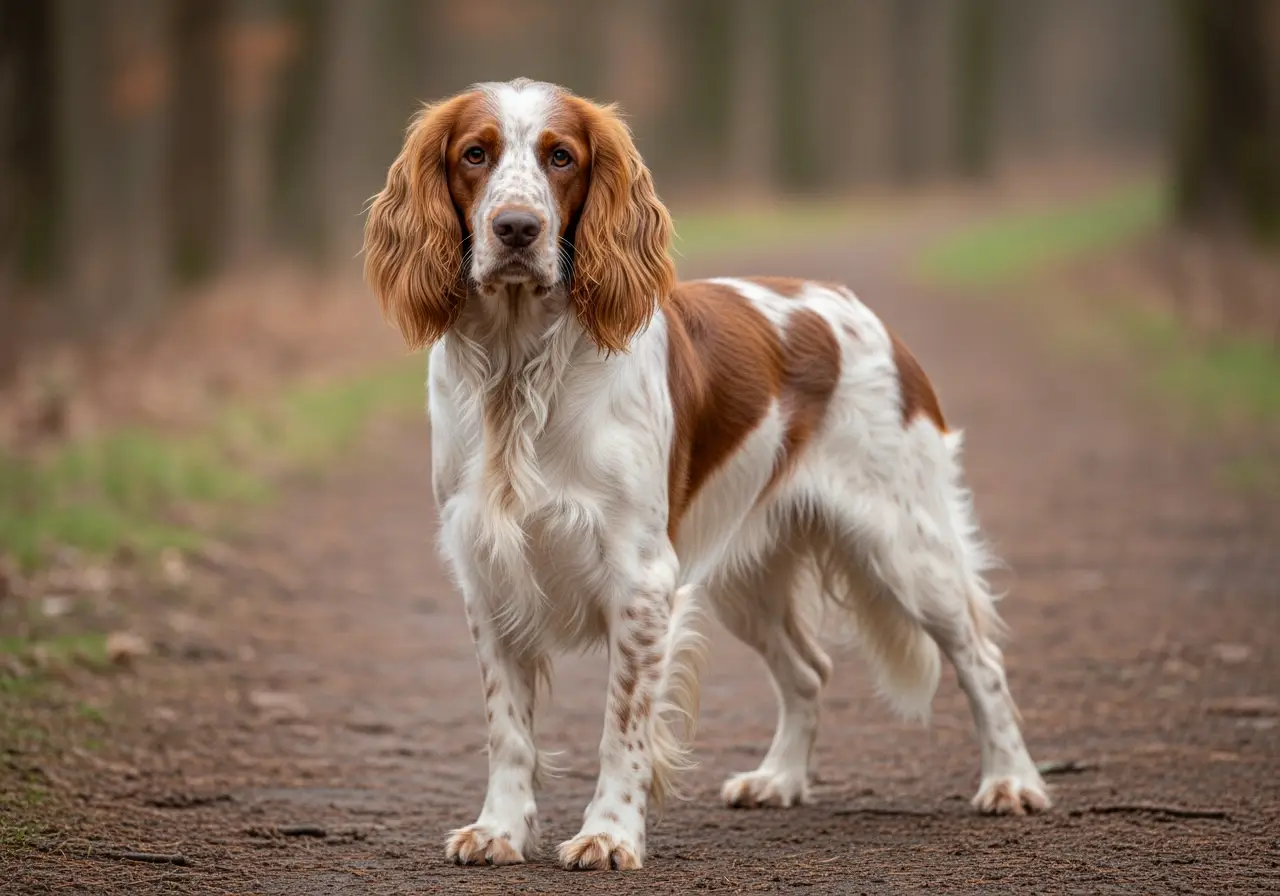
The French Spaniel is one of France's oldest continental pointing dogs, versatile, enduring and with a pronounced prey drive. In everyday life, it proves cooperative and balanced, provided its needs for exercise, nose work and close bonding are met. Anyone keeping it purely as a companion dog underestimates its genetic predisposition. In active, structured hands, it develops into a reliable partner.
02Introduction
What makes the French Spaniel special
The French Spaniel (Épagneul Français) is one of the oldest pointing dogs in France, FCI Group 7, versatile and balanced, withers height 55–61 cm.
03Profile
Key facts and suitability
- Origin
- Frankreich
- Original purpose
- Pointing dog and retrieving
- FCI
- No. 175 · Group 7 · Sektion 1.2: Kontinentale Vorstehhunde, Typ „Spaniel", mit Arbeitsprüfung
- height at the withers
- 55–61 cm
- Weight
- 20–25 kg
- Life expectancy
- 12–14 Years
- Coat type
- Long-haired
- Minimum exercise
- 90 min/day
- Puppy price
- 1'000–1'800 CHF
- Waiting period
- 9 months
- Sports
- Hunting · Field trials · Retrieving
04Temperament
How the French Spaniel shows up in everyday life
The morning walk reveals what defines the Épagneul Français: the nose goes straight to the ground, the body switches into a concentrated search pattern. It does not work wildly or frantically; it works methodically. Anyone watching it understand that this dog is looking for a task, not just exercise.
Internally, what the dog needs: The need for social contact is high. The French Spaniel closely orients itself towards its primary caregiver and actively seeks cooperation. Left alone for more than four hours, it reacts with restlessness. The need for mental work is equally pronounced: nose work, retrieval tasks or structured dummy training are part of daily basic care, not an optional extra. The prey drive is genetically hardwired; it can be guided, but not switched off.
Externally, how the dog reacts: Towards strangers, it shows itself open and friendly without being intrusive. The FCI standard describes it as balanced and gentle, which is reflected in everyday life. It generally gets along well with other dogs. It accepts children if the interaction is respectful and it has opportunities to withdraw.
Important: A high need for social contact does not mean that it interacts equally with every person. The close bond applies to its primary caregiver; strangers are tolerated in a friendly manner, but the willingness to cooperate is directed towards the owner. Anyone who understands this difference handles the dog better.
In the house, it is calm and pleasant with sufficient stimulation. If stimulation is lacking, it starts searching on its own, in the garden, in the house, on the walk. This is not misbehaviour, but the result of unused capacity.
05Needs
What this breed needs daily
The French Spaniel needs at least 120 minutes of active stimulation daily, and this is the minimum, not the average. Pure running rounds are not enough. The dog needs tasks that engage its nose and mind.
Forms of movement: Free work in the terrain, dummy training, mantrailing and nose work best correspond to its genetic makeup. Hunting training is the most obvious option for owners with a corresponding background. For non-hunters, scent dog work, search and rescue sports or structured search games offer meaningful alternatives.
Mental stimulation: The need for mental work is at a high level. A working day without thinking tasks leaves a restless dog. Short training sessions with clear tasks (retrieval on command, search games with changing hiding spots, nose work in different environments) should be planned daily.
Need for social contact: The dog strongly orients itself towards its primary caregiver. It needs active interaction, not just presence. Passive togetherness in the same room does not fully satisfy its need for social contact. Being left alone for more than four hours is problematic without prior habituation and enrichment offers.
Structure: Clear, calm guidance with positive reinforcement corresponds to its learning style. It responds well to consistency without pressure. Hunting impulses must be built up in a controlled manner from the start; recall under distraction is not a given and requires targeted training.
Exercise
High
mental work
A lot
Social needs
High
training
Medium
06Sport & Mental and Physical Stimulation
What sports the French Spaniel is suited for
Realistic in terms of physiology and genetics – not every breed suits every sport.
Structurally and physiologically suitable: Suitable for mantrailing, dummy work and tracking · CaniCross / bikejoring possible.
07Quick Check
08Suitability
Who this breed is suitable for – and who it isn't
✓Matches
The French Spaniel suits active owners who can plan at least two hours daily for exercise and structured enrichment, and not as an exception, but as part of everyday life.
Hunters and hunting-active owners: The breed was bred for hunting use. Anyone who handles the breed in its original function receives an enduring, cooperative partner with a fine nose and steady pointing.
Sportively active owners with experience: Anyone who brings experience with pointing dogs or other high-drive breeds and is willing to seriously engage in nose work, scent dog work or dummy training can handle the Épagneul Français even without a hunting background.
Families with structure and space: Families where at least one person devotes sufficient time daily to stimulation, where a garden or regular access to open terrain is available, and where children are accustomed to respectful interaction with dogs, provide the dog with a suitable environment.
Owners with patience for rarity: The breed is rare outside France. Anyone looking for a puppy must expect waiting times and possibly an import. This willingness is part of the profile of a suitable owner.
×Doesn't match
The French Spaniel does not suit owners who underestimate its prey drive or confuse its willingness to cooperate with contentment.
Owners with little time: Anyone who is regularly away from home for eight or more hours and cannot organise a dog sitter or day care does not provide this dog with sufficient basic care. The high need for social contact and the limited tolerance for being left alone of a maximum of four hours are not negotiable factors.
First-time owners without support: Anyone who has no experience with high-drive dogs and does not wish to use a supporting dog training school with hunting dog competence underestimates the training effort. The gentle character tempts one to underestimate the prey drive, a mistake that shows in off-lead work.
Owners looking for a pure companion dog: Anyone who wants a dog that is satisfied with walks and company makes the wrong choice with the Épagneul Français. Without nose work and tasks, it develops restlessness and independent searching behaviour.
Anyone who equates "friendly with strangers" with "easy to handle for everyone": The openness towards strangers is an external reaction; it says nothing about the internal need for structure, guidance and stimulation. This confusion leads to being overwhelmed on both sides.
10Line reality
Show line, working line, breeder market
The Épagneul Français is still primarily bred and used as a working hunting dog in France. A pronounced separation between working and show lines, which is clearly visible in other breeds, such as the Labrador Retriever or the English Springer Spaniel, does not exist for the French Spaniel in this form.
Breeding is oriented towards the FCI standard with working test. This means: breeding approvals are linked to proof of performance in reputable breeding clubs. The Club de l'Épagneul Français and its national partner associations emphasise that the breed retains its hunting function. Pure beauty breeding without a working test is not provided for in the breed club.
Outside France, particularly in the DACH region, the breeding base is so small that line differentiation is hardly statistically measurable. Interested parties should specifically ask for proof of performance of the parent animals when choosing a breeder and check whether the breeder belongs to the Club de l'Épagneul Français or a recognised national association.
Regional differences in breeding focus exist within France, but for buyers in the DACH region they are less relevant than the fundamental question of health testing and the hunting suitability of the parent dogs.
11Health · Reality
What you need to plan for medically with your French Spaniel
The French Spaniel is considered a robust breed with a life expectancy of 12 to 14 years. Reliable cross-breed studies with large case numbers specifically for the Épagneul Français are limited due to the small population size outside France; this must be taken into account when interpreting health data.
Hip dysplasia (HD): HD is documented in continental pointing dogs. Reputable breeders carry out hip X-ray examinations on both parent dogs and disclose the results. Buyers should review the X-ray reports of the parent dogs before purchase. An HD examination of the puppy itself is only meaningful in adulthood (from 12 months onwards).
Ear infections: The long, hairy ears promote moisture and restricted ventilation, a known risk factor for otitis externa. After water work or swimming, the ears should be checked regularly and dried. Chronic ear infections can lead to permanent damage without preventive care.
Eye diseases: According to the existing breed profile, rare but documented. Eye examinations of the parent dogs are standard with reputable breeders.
Overweight: The Épagneul Français is an active working dog. With sufficient mental and physical stimulation, overweight is not a typical breed problem. With lack of exercise, for example after injuries or in old age, the risk increases. Weight should be checked regularly; the FCI standard specifies a guideline of 20–25 kg.
Preventive care: Annual veterinary check-ups, ear checks after water work, HD screening of the parent dogs and eye examinations are the most important building blocks for preventive care.
12Structured data
Health by the numbers
Prone to diseases
Hip dysplasia, progressive retinal atrophy
Recommended health tests
Hip X-ray, eye examination
13Myths ↔ Reality
What is often said incorrectly about this breed
Five myths, five realities, five sources.
"The French Spaniel is calm enough for apartment living without much stimulation.
The FCI standard describes it as a pointing dog with enthusiasm for hunting. Without sufficient exercise and scent work, it develops independent searching behaviour and restlessness. At least 120 minutes of active stimulation daily are not a recommendation, but a prerequisite.
"As a gentle breed, it is easy for first-time owners.
The balanced character masks the pronounced prey drive. Without experience in handling hunting dogs and without structured training, the prey drive can become uncontrolled. Experience with pointing dogs or a supporting dog training school with hunting dog competence is recommended.
"The French Spaniel is an all-round family dog like any other.
It is primarily a working hunting dog. In everyday family life, it can integrate well if its stimulation needs are met. Suitability for families is a consequence of sufficient enrichment, not a basic characteristic that exists independently of this.
"Because it is rare, it must be particularly healthy.
Rarity does not protect against breed-typical diseases. Hip dysplasia (HD) and ear infections are documented in the Épagneul Français. Reputable breeders carry out HD X-rays and eye examinations. The rarity of the breed also makes statistical recording of health data more difficult.
"A pointing dog without hunting use can compensate for its drive through walks.
Walks do not replace hunting-related or scent-oriented stimulation. The Épagneul Français needs structured scent work, dummy training or mantrailing to channel its working drive meaningfully. Pure exercise without mental challenge is not enough.
14animal welfare
The animal welfare perspective
Breeder market, designer versions, animal shelter reality — what no one writes in the puppy ad.
The French Spaniel is a pronounced rarity in the DACH region. This rarity has a direct consequence: the market for irresponsible breeding is small, but not non-existent. Anyone searching for the breed online occasionally comes across offers without breeding club affiliation, without health certificates and without working trials of the parent dogs. The low level of awareness does not automatically protect against quality problems in breeding.
Backyard breeder market: Offers without HD reports for the parent dogs, without membership in a recognised breed club and without the opportunity to see the mother dog in her rearing environment are warning signs, regardless of how rare the breed is. The rarity increases pressure on buyers to act quickly. This pressure is a known pattern among backyard breeders.
Designer versions: There are currently no widespread designer crosses under their own brand name for the Épagneul Français. This may change if the breed gains in popularity. Buyers should ask critical questions regarding unusual designations or colour variants that do not correspond to the FCI standard.
Breeding and keeping-related problems: The breed is not brachycephalic and has no extreme breeding characteristics. The main risk lies in keeping: a pointing dog without sufficient mental and physical stimulation develops behavioural problems that lead to surrender. Keeping-related problems are more common than breeding-related ones for this breed.
Adoption as an equivalent option: Since the Épagneul Français rarely appears in animal shelters in the DACH region, adoption via specialised gundog rescue stations or French breed protection organisations is a realistic alternative. Anyone willing to take in an adult dog often receives a dog with a known temperament and completed socialisation. This is not a compromise; it is an informed decision.
15Costs · Transparency
What this breed realistically costs
The purchase price for a puppy from a reputable breeder with breed club affiliation, health certificates and working trials of the parent dogs is between 1,500 and 2,500 EUR/CHF in the DACH region. Imports from France can incur additional transport and import costs of 200 to 500 EUR. Offers significantly below 1,000 EUR without certificates are a warning sign.
Running costs per year: Food for a dog of this size (20–25 kg) costs between 600 and 1,200 EUR/CHF annually, depending on quality. Grooming is moderate; regular brushing of the feathering is your own responsibility, professional grooming occurs less frequently (approx. 100–200 EUR/year).
Veterinary costs: Basic care (vaccinations, parasite prevention, annual check-up) amounts to 300 to 600 EUR/CHF per year. Ear infections, as a more frequent health issue, can cause additional costs of 100 to 300 EUR per treatment cycle. An HD examination in adulthood costs between 150 and 300 EUR depending on the practice.
Insurance: Pet health insurance with surgical cover costs between 40 and 100 EUR/month depending on the provider and scope of benefits. Given possible HD treatments, surgical insurance is recommended.
16Puppy search
What you need to consider when choosing a breeder
- The Épagneul Français is rare outside France.
- Anyone looking for a puppy should expect waiting times of a year or more.
- This waiting period is not a disadvantage; it provides time to get to know the breeder and assess your own suitability.
- Reputable breeders can be identified by the following criteria: membership in the Club de l'Épagneul Français or a national partner association (e.g., Verein für Französische Vorstehhunde e.V.
- in Germany), available hip dysplasia (HD) X-ray reports for both parent dogs, eye examinations of the parent dogs, the opportunity to visit the mother dog in her rearing environment, and the breeder's willingness to answer questions regarding working trials of the parent dogs.
- Warning signs: No proof of health examinations, no club membership, puppies available at any time without a waiting list, sale without a personal conversation.
- Adoption as an equivalent option: Specialised gundog rescue stations and French breed protection organisations occasionally place adult dogs with known temperaments.
- This is not a stopgap solution; an adult dog with completed socialisation often offers more planning security than a puppy.
- No named breeder recommendations; the official breed clubs maintain current breeder lists.
FAQ
Frequently asked questions about the French Spaniel
Is French Spaniel suitable for beginners?
French Spaniel is considered suitable for first-time dog owners.
Is French Spaniel a family dog?
French Spaniel is considered suitable for families with good socialisation and species-appropriate care.
How much exercise does French Spaniel need?
At least around 90 minutes of exercise per day. As an active breed, more so — plus mental stimulation.
What is the size and weight of French Spaniel?
Fully grown, French Spaniel reaches about 55–61 cm at the withers and weighs around 20–25 kg.
What is the life expectancy of French Spaniel?
The life expectancy of French Spaniel is approximately 12–14 years.
Which diseases are common in French Spaniel?
Hip dysplasia, progressive retinal atrophy
17Breed clubs
Official breed clubs in DACH
19Related
Similar breeds – and their differences
You might also be interested in

Participate
Do you have a good photo of your French Spaniel?
We are looking for expressive images for our breed profiles. Submit yours; the editorial team reviews every submission before publication.
Does this breed suit you?
One of the oldest pointing dogs. Rare in D-A-CH. Balanced character, also suitable as a family dog.