
01Summary
In a paragraph
If you only have 30 seconds.
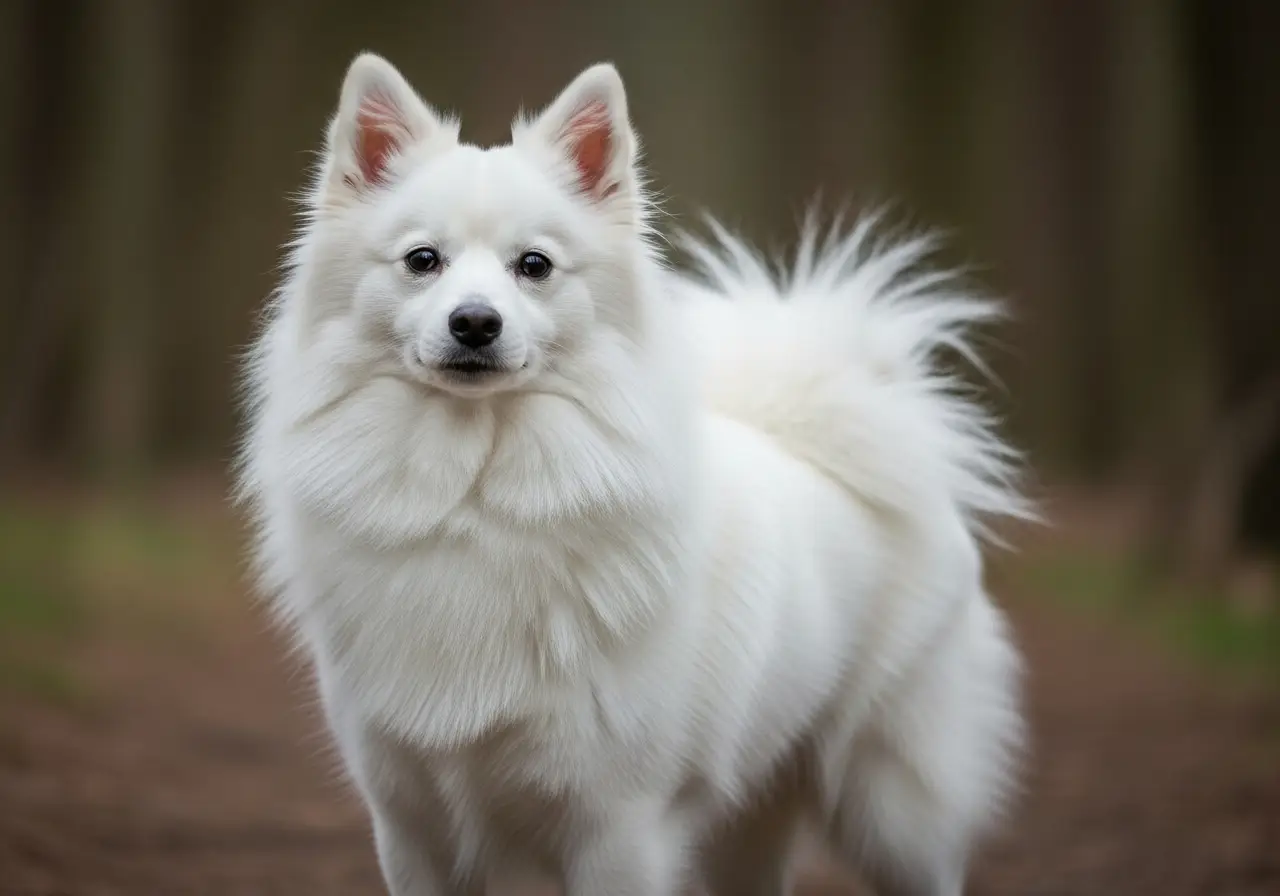
The Japanese Spitz is a pure white, compact companion dog with a Nordic appearance and pronounced alert behaviour. It seeks close family bonds, reacts warily to strangers, and requires consistent training from the start. Anyone who underestimates barking behaviour or neglects impulse control work fundamentally underestimates this breed. With a life expectancy of 12 to 15 years, it is a long-term companion.
02Introduction
What makes the Japan Spitz special
The Japan Spitz is an elegant white Japanese companion dog, FCI Group 5, with a self-cleaning coat and longevity, standing 30–38 cm at the withers.
03Profile
Key facts and suitability
- Origin
- Japan
- Original purpose
- Companion dog
- FCI
- No. 262 · Group 5 · Section 5
- height at the withers
- 30–38 cm
- Weight
- 5–10 kg
- Life expectancy
- 10–16 Years
- Coat type
- Doppel
- Minimum exercise
- 30 min/day
- Puppy price
- 1'200–2'200 CHF
- Waiting period
- 9 months
- Sports
- Agility · Obedience · Tricks
04Temperament
How the Japan Spitz shows up in everyday life
When you come home, the Japan Spitz announces your arrival loudly, not out of aggression, but out of genetically anchored alertness. Those who understand this as a greeting ritual and do not work early on with a clear stop signal will have a dog within a few months that comments on every postman, every passing bicycle and every doorbell.
Internally (i.e. in what the dog needs from itself), the Japan Spitz shows a high need for social contact. It actively seeks closeness to its reference persons, follows them through the apartment and reacts sensitively to mood changes in the household. Being left alone for several hours without prior gradual preparation reliably leads to restlessness or barking in this breed.
Externally, that is in its reaction to external stimuli, the Japan Spitz behaves with vigilance up to reserve towards strangers. It is crucial to distinguish between these two axes: a high need for social contact does not mean that the dog greets every visitor joyfully. It forms a close bond with its family but initially keeps its distance from unknown people.
In everyday life with children, keeping the dog works well if the interaction is respectful and calm. Hectic, loud situations can put the dog on high alert. With other dogs, it generally shows itself to be compatible, provided that socialisation was started early and broadly.
The Japan Spitz gladly engages in mental work in the form of trick training, nose work or structured search games. A walk without a mental component is not sufficient for stimulation on its own.
05Needs
What this breed needs daily
The Japan Spitz requires at least 60 to 90 minutes of active exercise daily. This includes not only walks but also play and training sessions that challenge the dog. Pure off-leash areas without interaction do not replace structured enrichment.
Mental stimulation is not a bonus for this breed, but a basic need. The requirement for mental work is in the medium range; the dog benefits from trick training, simple nose work exercises or fetching tasks. Two to three short training sessions per day of 10 to 15 minutes each are more effective than one long session.
Barking behaviour requires a reliable stop signal from the very beginning. Anyone who postpones this training will later be working against an entrenched habit. Impulse control exercises, such as waiting positions at the door or during feeding, belong to the basic repertoire.
The Japan Spitz has a high need for social contact. The dog requires several hours daily in the company of its key people. Being left alone can be built up but should be trained step by step, starting with a few minutes and increasing slowly over weeks. Four hours are considered a realistic maximum for a well-trained dog; more is possible but requires consistent building up.
Keeping the dog in an apartment is possible if exercise and enrichment are ensured. A garden is no substitute for active stimulation. The breed tends to bark more when under-stimulated, which is an indication of unmet needs, not a character flaw.
Exercise
Medium
mental work
Medium
Social needs
High
training
Easy
07Quick Check
08Suitability
Who this breed is suitable for – and who it isn't
✓Matches
The Japan Spitz suits owners who can plan 60 to 90 minutes of active exercise and additional training time daily. Families with children from about 6 years old, who ensure calm and respectful interaction with the dog, get along well with this breed.
Owners who enjoy trick training, nose work or structured everyday training will find a willing partner in the Japan Spitz. The breed is also suitable for first-time owners if they are prepared to work consistently on impulse control and barking behaviour from the start, ideally accompanied by a dog training school.
People who spend a lot of time at home or work from home meet the breed's high need for social contact well. Anyone who regularly receives visitors should factor in the reserved reaction towards strangers and work on socialisation early.
The Japan Spitz is also suitable for seniors with an active lifestyle and sufficient time for training and company. What matters less is the owner's age than the willingness to integrate structure and consistency into everyday life.
×Doesn't match
The Japan Spitz does not suit owners who tolerate barking behaviour as a harmless quirk or have no interest in active stop training. Anyone who misunderstands and encourages the breed's vigilance as a guard dog quality will reinforce behaviour that quickly becomes a burden in everyday life.
People who are regularly away from home for more than four hours daily and cannot organise a dog sitter or day care do not meet the breed's need for social contact. The Japan Spitz is not a dog that bridges being alone without problems.
Anyone who equates the high need for social contact with general friendliness towards strangers will be surprised by the dog's reserved reaction to visitors. This confusion of the internal and external behavioural axes leads to erroneous expectations.
Households with very young children, where calm and respectful interaction is not yet reliably ensured, as well as owners without time or interest for regular training should not choose this breed. The Japan Spitz forgives inconsistency in training less than breeds with a lower activation level.
10Line reality
Show line, working line, breeder market
The Japan Spitz is bred exclusively as a companion dog today; a differentiation into working and show lines, as exists for example in the Labrador Retriever or German Shepherd Dog, is not established in this breed. FCI Standard No. 262 does not provide for a working test, and breeding focuses primarily on exterior and temperament traits.
Regional differences in breeding do exist nonetheless. Japanese breeding lines, originating from the breed's country of origin, are considered true to type and are deliberately used by specialised breeders in Europe. European breeding lines (particularly from Scandinavia, where the breed has a wider distribution than in the German-speaking area) may vary slightly in body structure and coat texture without departing from the FCI Standard.
In the German-speaking area, the breeding base is narrow. This means for interested parties: The selection of reputable breeders is limited, waiting times for puppies are common, and imports from Europe are not uncommon. Anyone looking for a Japan Spitz should use the breed clubs, such as the Swiss Club for Spitz Dogs or the Association for German Spitz Dogs, as the first point of contact to find breeders with verifiable breeding documentation.
11Health · Reality
What you need to plan for medically with your Japan Spitz
The Japanese Spitz is considered a robust breed with a life expectancy of 12 to 15 years. This places it in the upper range for dogs of its size class. Breed-typical diseases are known but moderate compared to many other companion dogs.
Patellar luxation, the dislocation of the kneecap, is among the more frequently documented orthopaedic problems in small to medium-sized dogs. According to an analysis by the Orthopedic Foundation for Animals (OFA, as of 2023), the prevalence of patellar luxation in small dog breeds ranges between 7 and 15 percent depending on the study. No large-scale breed-specific studies exist for the Japanese Spitz; breeders should have parent dogs tested for patellar luxation.
Eye problems, particularly progressive retinal atrophy (PRA), are described in the breed. Before buying a puppy, it is advisable to obtain proof of a recent eye examination of both parent dogs by a specialist vet for ophthalmology.
The dense coat requires intensive care, especially during the twice-yearly shedding periods. Neglected undercoat can lead to skin irritation. Overweight is a real risk for this breed, as the dog tends towards inactivity when under-stimulated; regular weight checks at the vet are advisable.
Preventive examinations: annual general check-up, eye check with an ophthalmologist every two years, patella check if signs of lameness appear. Vaccination protection and parasite prevention according to the current STIKO vaccination schedule of the VDH (as of 2024).
12Structured data
Health by the numbers
Prone to diseases
Patellar luxation, progressive retinal atrophy, generally robust
Recommended health tests
Patella screening, eye examination
13Myths ↔ Reality
What is often said incorrectly about this breed
Five myths, five realities, five sources.
„The Japan Spitz grooms itself; the white coat requires little effort.
Although the topcoat of the Japan Spitz is dirt-repellent and less prone to matting than in other long-haired breeds, this does not change the care effort during shedding. Twice a year, the breed loses its dense undercoat in considerable amounts. Regular brushing, daily during shedding phases, is essential to avoid mats and skin problems.
„As a small dog, the Japan Spitz requires little exercise.
The Japan Spitz is a lively, enduring companion dog with an exercise need of at least 60 to 90 minutes daily. Insufficient stimulation often manifests as increased barking, restlessness or destructive behaviour. Body size and exercise needs do not directly correlate in this breed.
„The Japan Spitz is a good guard dog due to its alertness.
The FCI Standard describes the Japan Spitz as a companion dog, not as a protection or guard dog. The pronounced alert behaviour, i.e. indicating strangers or changes, is a breed trait that quickly turns into excessive barking without training. Protection instinct or sharpness are explicitly undesirable in the standard.
„The Japan Spitz is unsuitable for dog beginners.
The breed is considered eager to learn and cooperative. For owners who are willing to implement consistent training and impulse control work from the start, the Japan Spitz is manageable even without prior experience. Problems arise not from lack of suitability, but from inconsistency or from coddling alertness and barking behaviour.
14animal welfare
The animal welfare perspective
Breeder market, designer versions, animal shelter reality — what no one writes in the puppy ad.
The Japanese Spitz is one of the rarer breeds in the German-speaking area. This has a direct effect on the breeding market: because demand exceeds the limited breeding base, incentives arise for dubious providers who sell puppies without pedigree registration, without health tests of the parent dogs, and without a socialisation concept. Platforms such as classifieds portals are often the entry point.
Identifying features of backyard breeding: no pedigree registration with the VDH, SKG or ÖKKV, no proof of eye and patella checks of the parent dogs, puppies available for collection before eight weeks of age, multiple litters available simultaneously, no personal conversation before purchase. Anyone who buys a puppy under these conditions bears the health and behaviour-related risks alone.
Designer versions of the Japanese Spitz (e.g., crosses with other small white breeds marketed under fantasy names) exist on the fringes of the market. They are neither FCI-recognised nor documented in their health baseline.
Keeping-related problems with the Japanese Spitz often arise from underestimated barking behaviour. According to animal welfare associations, surrenders to shelters or rescue organisations often occur because owners have not trained alert behaviour early on and it has become a burden in everyday life, for example in rented flats.
Adopting an adult Japanese Spitz from animal welfare or a breed rescue organisation is an equivalent option to buying a puppy. Adult dogs come with an assessable temperament, and the care effort during the settling-in phase is predictable. Points of contact are specialised Spitz rescue stations and the VDH breed rescue.
Anyone who decides on a puppy should plan barking training and impulse control from the first week onwards, not as a reaction to a problem, but as a preventive investment.
15Costs · Transparency
What this breed realistically costs
A puppy from a reputable breeder with VDH or SKG pedigree registration costs between 1,200 and 2,000 euros in the German-speaking area. Offers significantly below this, especially under 800 euros, often come from backyard breeding without health tests. Experience shows that the owner recovers the difference between a reputable and dubious purchase through vet costs.
Annual living costs range from 1,500 to 2,500 francs or euros depending on keeping conditions. This includes: high-quality food (approx. 600–900 CHF/EUR/year for a dog of this size), grooming materials or occasional trimming visits (approx. 100–200 CHF/EUR/year), basic equipment (one-off approx. 300–500 CHF/EUR) and annual vet preventive care (approx. 150–300 CHF/EUR without special treatments).
Pet insurance for a Japanese Spitz costs between 30 and 70 CHF/EUR monthly depending on the provider and scope of benefits. Given possible eye surgeries (PRA treatment: 500–2,000 CHF/EUR) or patellar luxation operations (1,500–3,500 CHF/EUR), insurance is a calculable safeguard.
16Puppy search
What you need to consider when choosing a breeder
- Reputable Japan Spitz breeders can be found through the Verein für Deutsche Spitze (VDH member) or the Schweizerischen Club für Spitze (SKG member).
- Both associations maintain stud books and require breeders to meet minimum standards for health tests and socialisation.
- Characteristics of a reputable breeder: The parent animals have been tested for patellar luxation and eye diseases (PRA), with the results available in writing.
- The breeder asks questions about the planned keeping conditions and refuses a sale if the conditions do not match.
- Puppies leave the litter no earlier than eight weeks, are vaccinated, dewormed and microchipped.
- A personal visit to the breeder is possible and desirable.
- Warning signs: puppies without papers, multiple litters at the same time, no viewing appointment, handover at a neutral meeting point, pressure for a quick decision.
- Adopting an adult Japan Spitz through animal welfare organisations or breed rescue groups is an equally valid alternative.
- Adult dogs are assessable in their temperament, and the care effort can be planned realistically.
- Contact points are listed on the breed club websites upon request.
FAQ
Frequently asked questions about the Japan Spitz
Is Japan Spitz suitable for beginners?
Japan Spitz is considered suitable for first-time dog owners.
Is Japan Spitz a family dog?
Japan Spitz is considered suitable for families with good socialisation and species-appropriate care.
How much exercise does Japan Spitz need?
At least around 30 minutes of exercise per day.
Does Japan Spitz suit an apartment?
With enough exercise and enrichment, Japan Spitz can also be kept in an apartment.
What is the size and weight of Japan Spitz?
Fully grown, Japan Spitz reaches about 30–38 cm at the withers and weighs around 5–10 kg.
What is the life expectancy of Japan Spitz?
The life expectancy of Japan Spitz is approximately 10–16 years.
Which diseases are common in Japan Spitz?
Patellar luxation, progressive retinal atrophy, generally robust
17Breed clubs
Official breed clubs in DACH
19Related
Similar breeds – and their differences
You might also be interested in



Participate
Do you have a good photo of your Japan Spitz?
We are looking for expressive images for our breed profiles. Submit yours; the editorial team reviews every submission before publication.
Does this breed suit you?
White, elegant companion dog. Despite silky coat, self-cleaning. Lively but manageable.