
01Summary
In a paragraph
If you only have 30 seconds.
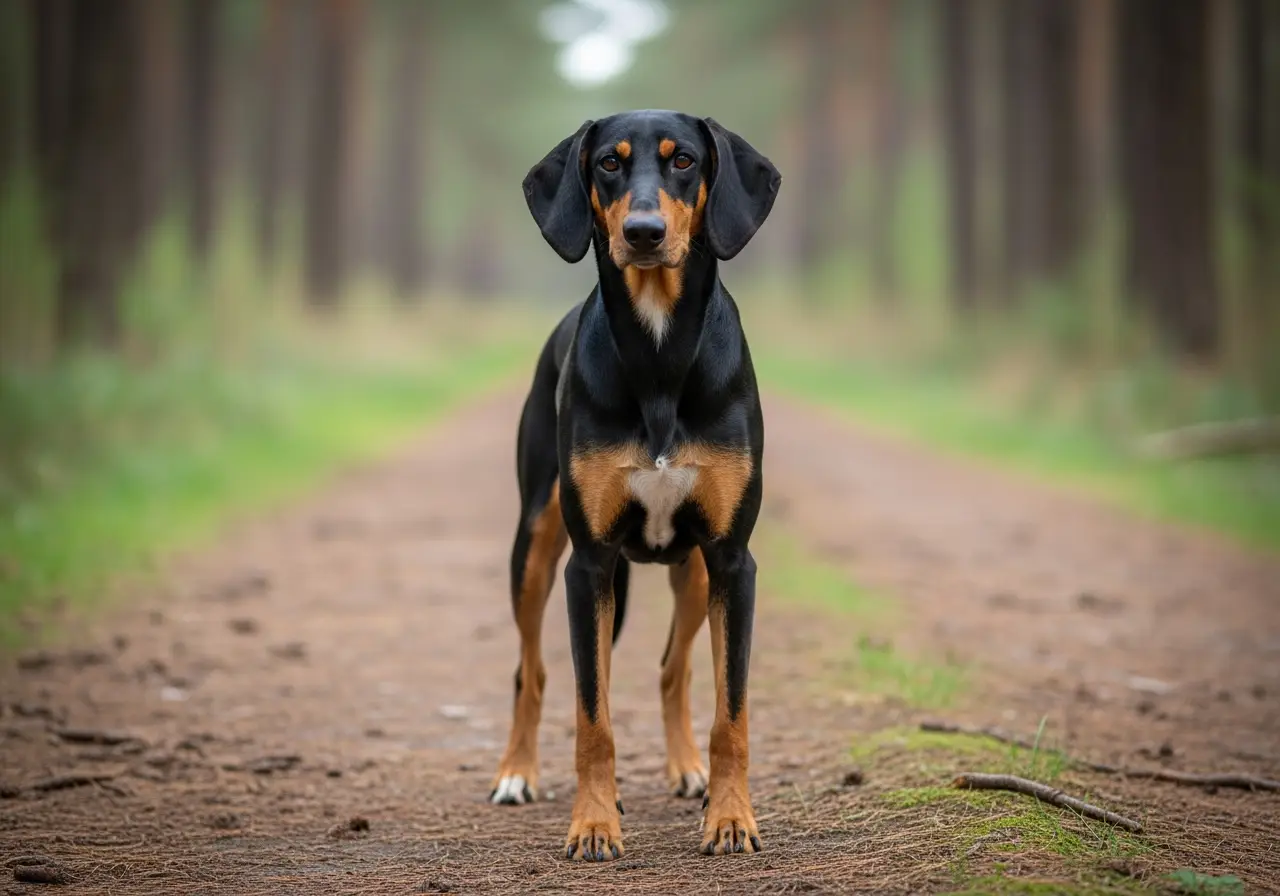
The Hellinikos Ichnilatis is a Greek scent hound with centuries-old specialisation in hare hunting in rocky mountain terrain. Its exercise needs are high, its prey drive deeply rooted in its genetics, and its independence in the terrain pronounced. Anyone who wants to integrate this dog into a low-exercise or urban daily routine underestimates what this breed actually demands.
02Introduction
What makes the Hellinikos Ichnilatis (Greek Scenthound) special
The Hellinikos Ichnilatis (Greek Scenthound) is a rare Greek scenthound, FCI Group 6, enduring and heat-tolerant, with a withers height of 45–55 cm.
03Profile
Key facts and suitability
- Origin
- Griechenland
- Original purpose
- Hare hunting in Greece
- FCI
- No. 214 · Group 6 · Section 1.2
- height at the withers
- 45–55 cm
- Weight
- 17–20 kg
- Life expectancy
- 11–13 Years
- Coat type
- Short-haired
- Minimum exercise
- 90 min/day
- Puppy price
- 600–1'200 CHF
- Waiting period
- 12 months
- Sports
- Hunting · Tracking
04Temperament
How the Hellinikos Ichnilatis (Greek Scenthound) shows up in everyday life
During the morning walk, the Hellinikos Ichnilatis shows what its genetics mean: The nose goes straight to the ground, the body follows the scent trail, and the owner follows the dog if no secured terrain is available. This independence is not a training problem, but the result of centuries of selection for independent tracking work.
Internally, what the dog needs: The need for movement amounts to at least 120 minutes daily, with a significant portion as active nose work or hunting-related enrichment. The need for mental work is high; a dog that is not allowed to use its nose will find other ways. It tolerates being left alone for up to about four hours, provided the need for movement has been met beforehand. Being left alone for longer means restlessness and vocalisation for most specimens of this breed.
Externally, how the dog reacts to its environment: It shows itself neutral to reserved towards strangers, rarely intrusive or aggressive. It is not a dog that greets every visitor joyfully, but also not a dog that reacts sharply. With conspecifics, it is generally tolerant, especially if socialisation has taken place early and consistently. These two axes must not be confused: A high need for social contact with one's own family does not mean that the dog appears open and warm towards strangers.
In the house, it appears calmer than expected, as long as its daily needs are met. Anyone who sees it on the sofa in the evening should not forget what happened in the field in the morning.
05Needs
What this breed needs daily
The Hellinikos Ichnilatis requires at least 120 minutes of active movement daily, and this does not mean a leisurely walk. Running sessions in extensive terrain, tracking work and hunting-related enrichment such as mantrailing or scent trail work best correspond to its profile.
A rural environment is almost a prerequisite. Off-leash walking without secured terrain is not realistically sustainable for most owners due to the pronounced tracking instinct. A fenced property or regular access to secured areas is part of the basic equipment.
The need for mental work is high. The nose is the primary sense organ of this dog; forms of enrichment that involve nose work are not an addition, but a central component of daily stimulation. Mantrailing, scent trail work or structured search games offer meaningful alternatives to active hunting.
The Hellinikos Ichnilatis tolerates being left alone for up to about four hours if the need for movement has been met beforehand. Longer absences without supervision are incompatible with the well-being of this breed.
The need for social contact with its own reference group is pronounced. A dog of this breed kept in permanent isolation or under-stimulated will develop behavioural issues. Contact with conspecifics has a positive effect on well-being, particularly if the owner themselves is unable to meet the entire exercise requirement alone.
Exercise
Very high
mental work
A lot
Social needs
Medium
training
Demanding
06Sport & Mental and Physical Stimulation
What sports the Hellinikos Ichnilatis (Greek Scenthound) is suited for
Realistic in terms of physiology and genetics – not every breed suits every sport.
Structurally and physiologically suitable: Suitable for mantrailing, dummy work and tracking · CaniCross / bikejoring possible.
07Quick Check
08Suitability
Who this breed is suitable for – and who it isn't
✓Matches
The Hellinikos Ichnilatis suits owners who can provide at least two hours of active exercise daily in extensive, preferably rural terrain. Hunting-oriented owners with experience in handling scent hounds will find an enduring, high-performance partner in this breed.
The breed is suitable for owners with access to secure open land or a fenced property, as off-lead exercise without security remains permanently problematic due to the strong desire to follow scents. Those who actively engage in tracking work, mantrailing, or hunting-related dog sports provide this dog with meaningful enrichment.
Experienced owners who have already dealt with independently working dogs and bring realistic expectations regarding recall when encountering wildlife are well-prepared. Households in rural areas or on the outskirts of cities with direct access to forests and fields correspond to the living environment this breed requires.
Families with older children from about ten years old, who actively participate in dog life and can keep up physically, are also suitable, provided the adults take responsibility for handling and consistently meet the exercise needs. A second degree in scent hound behaviour is not necessary, but basic knowledge of drive-controlled dogs is a prerequisite.
×Doesn't match
The Hellinikos Ichnilatis is not suitable for owners who can or want to devote less than two hours daily to active exercise. Anyone who is away from home for eight hours and has not organised reliable dog care underestimates the need for social contact of this breed.
Urban living situations without access to extensive terrain are incompatible with the profile of this dog. Anyone who relies on off-lead exercise in parks and does not have secure areas available will permanently encounter limits due to the pronounced desire to follow scents.
Anyone who mistakes the dog’s external reaction, neutral to reserved towards strangers, for a lack of socialisation and tries to force openness through social pressure is acting against the nature of this breed. It would be equally wrong to interpret the calm household demeanour as a sign of low exercise needs.
First-time owners without prior experience with hunting-motivated dogs are overwhelmed by this breed, not because of aggression or unpredictability, but because of the specific requirements for management, terrain security and enrichment. Households with small animals such as rabbits or cats should very carefully consider cohabitation, as the prey drive can be active even in a domestic environment.
10Line reality
Show line, working line, breeder market
In the German-speaking region, the Hellinikos Ichnilatis is bred exclusively in a single line: as a working dog with hunting suitability. A differentiation between show line and working line, which exists prominently in other breeds such as the Labrador Retriever or the German Shepherd Dog, is not relevant for this breed; the breeding base in Germany, Austria and Switzerland is too small for independent lines to have developed.
The FCI standard requires a working test, which means that breeding animals must demonstrate their working performance. In practice, the few specimens available in the DACH region come from specialised hunting dog breeds that select for performance traits such as tracking fidelity, vocalisation and endurance.
Regional differences within Greece, for example between mainland and island breeds, are documented but play hardly any practical role for acquisition in the German-speaking region. Anyone looking for a Hellinikos Ichnilatis will generally be confronted with a dog whose breeding line is primarily oriented towards hunting performance. A distinction according to purpose of use is therefore largely unnecessary; the dog you receive is a working dog.
11Health · Reality
What you need to plan for medically with your Hellinikos Ichnilatis (Greek Scenthound)
Reliable breed-typical health data for the Hellinikos Ichnilatis hardly exist in the German-speaking region. The breeding population is too small to enable statistically meaningful surveys on HD/ED rates or hereditary diseases. This does not mean that the breed is free from health problems; it means that the data simply do not exist.
The life expectancy is given in specialist literature as approximately 10 to 12 years, which is plausible for a medium-sized scent hound of this build. Comparable medium-sized scent hound breeds reach similar values.
As a working dog selected for endurance and terrain suitability, the breed is considered robust. Nevertheless, the following preventive examinations are recommended: X-ray examination of hips (HD) and elbows (ED) in breeding animals, ear checks (drooping ears increase the risk of otitis externa), and regular dental checks. In hunting dogs, injury risks due to terrain and contact with wildlife are added.
The risk of being overweight is low in sufficiently exercised individuals. In dogs whose exercise needs are not met permanently, the risk of being overweight and the associated secondary diseases (joint stress, metabolic problems) increases significantly.
Before purchasing a puppy, health certificates for both parent animals should be reviewed. Due to the small breeding base, there is an increased risk of inbreeding effects; the inbreeding coefficient should be actively requested from the breeder.
12Structured data
Health by the numbers
Prone to diseases
Hip dysplasia, generally robust
Recommended health tests
Hip X-ray
13Myths ↔ Reality
What is often said incorrectly about this breed
Five myths, five realities, five sources.
The Hellinikos Ichnilatis is a calm domestic dog that is content with little exercise.
The FCI standard explicitly describes the breed as very active when hunting and suitable for any terrain. The daily need for movement amounts to at least 120 minutes of intense stimulation. A calm household behaviour in the apartment masks the actual need for stimulation; unfulfilled drive for movement manifests itself in restlessness, vocalisation and destructive behaviour.
The pronounced prey drive can be completely eliminated through consistent training.
The tracking instinct of the Hellinikos Ichnilatis has been genetically selected and consolidated over generations. Training can structure the handling of this drive and promote impulse control, but it does not eliminate the basic predisposition. Off-leash walking without secured terrain remains a permanent risk for this breed, regardless of training level.
As a rare breed, the Hellinikos Ichnilatis is particularly healthy and free from hereditary diseases.
The rarity of a breed says nothing about its health status. A small breeding population can, on the contrary, increase the risk of inbreeding effects. Reliable breed-specific health data hardly exist for the Hellinikos Ichnilatis, as the breeding base in the German-speaking region is minimal. Before purchase, health certificates of the parent animals and a veterinary examination of the puppy are essential.
The Hellinikos Ichnilatis gets along easily with cats and small animals in the household.
The breed was selected for the pursuit of game. The prey drive is not directed exclusively at hares in the wild; small animals in the household can also be perceived as prey. Co-habitation with cats or small animals requires careful, early socialisation and is not successful in every individual case.
14animal welfare
The animal welfare perspective
Breeder market, designer versions, animal shelter reality — what no one writes in the puppy ad.
The Hellinikos Ichnilatis is a pronounced rarity in the German-speaking region. It practically does not appear in animal welfare contexts; the few specimens existing in the DACH region almost invariably originate from specialised hunting dog breeding programmes. Rescue organisations rarely hold this breed in their stock.
Backyard breeder market: Because the breed is rare and little known, there is no significant backyard breeder market for the Hellinikos Ichnilatis. The risk of acquiring a puppy from uncontrolled breeding is lower than with popular breeds, but not zero. Anyone seeking a dog of this breed who finds listings on dubious platforms should check particularly critically: proof of origin, health certificates of the parent animals and personal contact with the breeder are minimum standards.
Designer versions: Crossbreeds or designer variants of the Hellinikos Ichnilatis do not exist in any relevant quantity on the DACH market. This is an advantage; anyone seeking this breed will generally find a dog that complies with the FCI standard.
Keeping-related problems: The biggest animal welfare problem with this breed is not breeding, but keeping. A Hellinikos Ichnilatis kept in an urban apartment without sufficient exercise and nose work suffers from chronic under-stimulation. Vocalisation, restlessness and destructive behaviour are the consequence, and often the reason why dogs are surrendered. Anyone who acquires this breed out of interest in an exotic or rare dog, without knowing its exercise and activity profile, acts against the well-being of the animal.
Rescue as an option: Since animal welfare organisations rarely hold this breed in stock, rescuing a Hellinikos Ichnilatis in the DACH region is unlikely, but not excluded. Anyone open to an adult dog can enquire with specialised hunting dog rescue organisations or via the VDH. An adult dog has the advantage that character and health status are already easier to assess than with a puppy.
15Costs · Transparency
What this breed realistically costs
The purchase price for a puppy from reputable breeding in the DACH region is estimated at between 800 and 1,500 EUR; exact market prices are difficult to determine due to the extreme rarity of the breed. Anyone who finds significantly cheaper offers should critically assess the reliability of the source.
The annual living costs for a medium-sized dog of this size class (45–55 cm, 17–25 kg) are typically between 1,500 and 2,500 EUR, depending on food choice, grooming needs and leisure activities. The coat of the Hellinikos Ichnilatis is short and easy to care for; grooming costs hardly arise.
Basic veterinary care (vaccinations, parasite prevention, annual check-up) costs on average 300 to 600 EUR per year in the DACH region. In addition, possible costs for preventive examinations (hip dysplasia X-ray: approx. 150–300 EUR) and treatment costs for hunting-related injuries, which are not uncommon in actively used hounds, must be considered.
Pet health insurance is recommended; annual premiums for a dog of this size start at around 400 EUR depending on the provider and scope of cover. Anyone who uses the breed for hunting should additionally consider hunting liability insurance.
16Puppy search
What you need to consider when choosing a breeder
- As the Hellinikos Ichnilatis is extremely rare in the German-speaking region, finding a puppy is more involved than with popular breeds.
- The VDH maintains a breeder database through which contact can be made with recognised breeders.
- Reputable breeders work with working tests, provide health certificates for the parent animals and enable a personal visit to the litter.
- Characteristics of reputable breeding: The parent animals are tested for HD and ED.
- The breeder asks questions about the planned use and living situation.
- Puppies are given away no earlier than eight weeks of age.
- A purchase contract and pedigree are handed over.
- The breeder is reachable after the purchase.
- Warning signs: No personal visit possible, no health certificates, puppies under eight weeks, sale via anonymous online platforms without proof of breeding.
- Adopting an adult dog is an equally valid option.
- Specialised hunting dog rehoming organisations or contact via the VDH can help here.
- An adult dog offers the advantage that character and health status are already easier to assess.
- Anyone open to this option should actively consider it.
FAQ
Frequently asked questions about the Hellinikos Ichnilatis (Greek Scenthound)
Is Hellinikos Ichnilatis (Greek Scenthound) a family dog?
Hellinikos Ichnilatis (Greek Scenthound) is considered suitable for families with good socialisation and species-appropriate care.
How much exercise does Hellinikos Ichnilatis (Greek Scenthound) need?
At least around 90 minutes of exercise per day. As an active breed, more so — plus mental stimulation.
What is the size and weight of Hellinikos Ichnilatis (Greek Scenthound)?
Fully grown, Hellinikos Ichnilatis (Greek Scenthound) reaches about 45–55 cm at the withers and weighs around 17–20 kg.
What is the life expectancy of Hellinikos Ichnilatis (Greek Scenthound)?
The life expectancy of Hellinikos Ichnilatis (Greek Scenthound) is approximately 11–13 years.
Which diseases are common in Hellinikos Ichnilatis (Greek Scenthound)?
Hip dysplasia, generally robust
17Breed clubs
Official breed clubs in DACH
19Related
Similar breeds – and their differences
You might also be interested in
Participate
Do you have a good photo of your Hellinikos Ichnilatis (Greek Scenthound)?
We are looking for expressive images for our breed profiles. Submit yours; the editorial team reviews every submission before publication.
Does this breed suit you?
Very rare Greek scenthound. Almost exclusively kept for hunting on Crete. Hardly to be found in D-A-CH.