
01Summary
In a paragraph
If you only have 30 seconds.
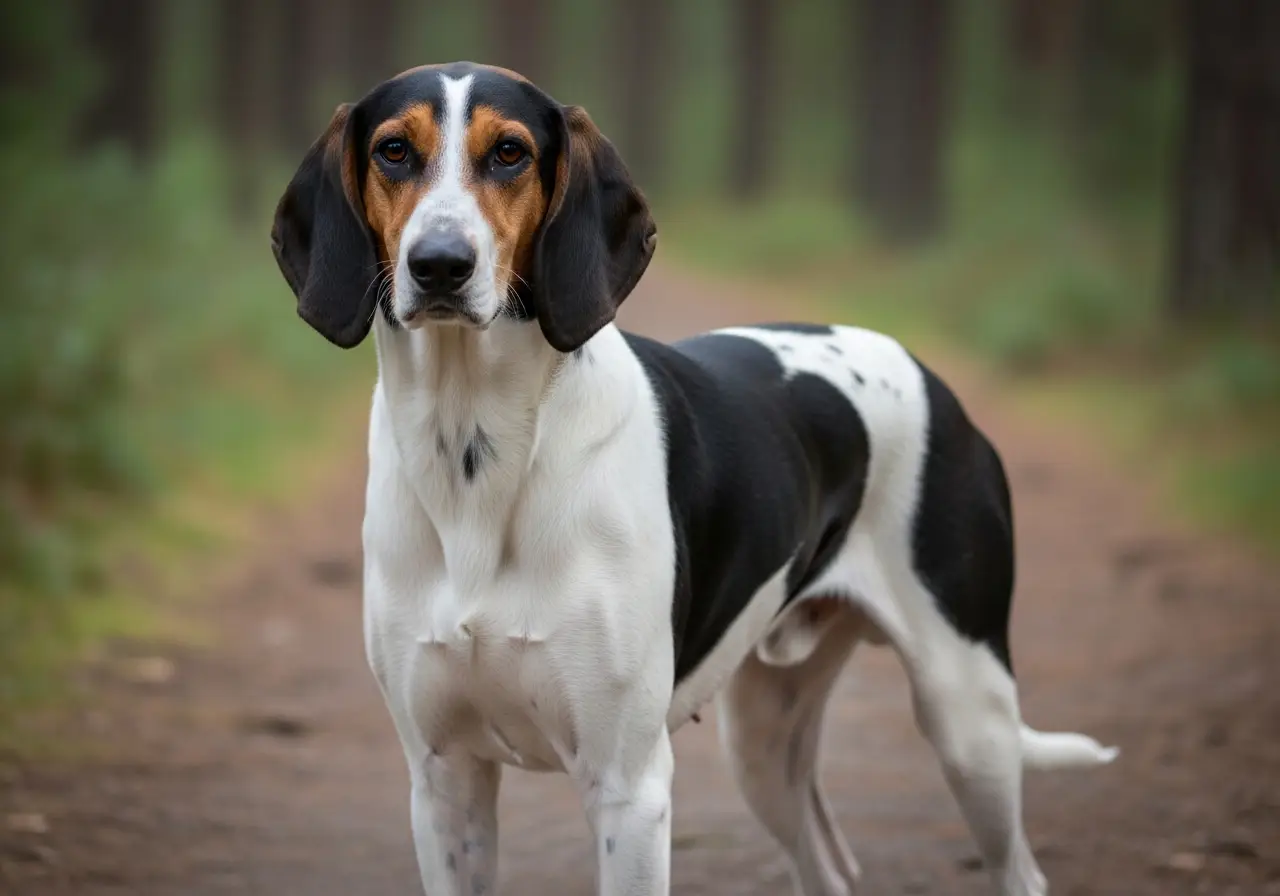
The Haldenbracke is a Norwegian scenthound that was selected in the 19th century for hare hunting in snow. Its prey drive is genetically ingrained, and its exercise needs amount to at least two hours of intense mental and physical stimulation daily. Anyone keeping this breed requires a rural environment, experience with scent-oriented dogs, and a realistic understanding of recall reliability in open terrain.
02Introduction
What makes the Halden Hound (Haldenstøvare) special
The Halden Hound is a rare Norwegian scent hound, FCI Group 6, bred for hare hunting on snow, withers height 50–63 cm.
03Profile
Key facts and suitability
- Origin
- Norwegen
- Original purpose
- Hare hunting in Norway
- FCI
- No. 267 · Group 6 · Section 1.2
- height at the withers
- 50–63 cm
- Weight
- 20–27 kg
- Life expectancy
- 11–13 Years
- Coat type
- Short-haired
- Minimum exercise
- 90 min/day
- Puppy price
- 700–1'300 CHF
- Waiting period
- 12 months
- Sports
- Hunting · Tracking · Mantrailing
04Temperament
How the Halden Hound (Haldenstøvare) shows up in everyday life
On the morning walk, the Haldenbracke shows two clearly separable sides. Indoors, it lies relaxed, seeks physical contact with its primary caregiver, and usually reacts openly to neutrally to visitors; the external axis (friendliness towards strangers) is distinctly pronounced with a score of 4 out of 5. Outdoors, the same female dog or male dog switches to another mode: nose to the ground, concentration on scent trails, baying as soon as a trail is picked up.
These two poles must not be confused. A high need for social contact (3 out of 5) and a friendly basic attitude towards people do not mean that the Haldenbracke remains controllable in open fields. On a fresh hare trail, the dog is practically unreachable for recall signals; this is not an upbringing problem, but the result of over a hundred years of selection for precisely this behaviour.
In everyday life with other dogs, the breed is generally tolerant. It was selected for hunting in loose packs, which promotes social compatibility with conspecifics. The Haldenbracke tolerates being left alone for up to about four hours, provided its need for movement has been met beforehand; longer periods typically lead to restlessness and vocalisation.
The need for mental work is high (4 out of 5). Nose work, Mantrailing or hunting-related enrichment such as tracking fills the mental gap that simple walks leave open. Anyone who ignores this need will end up with a dog that seeks its own entertainment, rarely to the delight of the household.
05Needs
What this breed needs daily
The Haldenbracke requires at least 120 minutes of intensive exercise daily. This does not mean leisurely city strolls, but rather stimulation with a speed component: extensive cross-country runs, bikejoring on field paths or controlled tracking work. The need for movement is maximally pronounced at 5 out of 5, a value that means in practice that bad weather or a full schedule are not acceptable reasons for reductions.
In addition to physical exercise, the breed requires structured nose work. The need for mental work is 4 out of 5. Tracking, Mantrailing or hunting-related exercises such as following drag trails meet this need most directly. Pure obedience exercises without a scent component are insufficient.
The need for social contact is 3 out of 5; the Haldenbracke requires regular contact with its primary caregiver, but it is not a dog that must constantly stick to people. Contact with conspecifics has a positive effect on well-being; a second dog or regular encounters with other dogs are recommended, but not an absolute requirement.
The breed tolerates being left alone for up to about four hours if its need for movement has been met beforehand. Longer phases without enrichment and social contact lead to signs of frustration.
The environment must be rural or at least on the outskirts of a city with direct access to extensive terrain. Free running without security measures is not realistic due to the pronounced prey drive; a secured area or a long line are not an option in everyday life, but standard practice.
Exercise
Very high
mental work
A lot
Social needs
Medium
training
Demanding
06Sport & Mental and Physical Stimulation
What sports the Halden Hound (Haldenstøvare) is suited for
Realistic in terms of physiology and genetics – not every breed suits every sport.
Structurally and physiologically suitable: Suitable for mantrailing, dummy work and tracking · CaniCross / bikejoring possible.
07Quick Check
08Suitability
Who this breed is suitable for – and who it isn't
✓Matches
The Haldenbracke suits owners who can plan at least two hours of active exercise in the terrain daily, not as an occasional exception, but as a fixed part of everyday life. A rural living environment with direct access to forest or field paths is almost a prerequisite.
Experience with hunting-motivated dogs is crucial. Anyone who has already kept a hound, scent hound or bloodhound type and knows the characteristics of trail-oriented breeds will find in the Haldenbracke an enduring, socially pleasant companion. Owners actively involved in hunting with a valid hunting licence can make meaningful use of the breed's genetic potential.
Households with older children from about ten years of age who actively participate in dog training are also suitable, provided the adults take the lead and the need for movement is met in a structured way.
Anyone who practises nose work or Mantrailing as a leisure sport will find in the Haldenbracke a breed with high intrinsic motivation for exactly these activities. The need for mental work and the enjoyment of scent tasks make it a capable partner in these disciplines.
×Doesn't match
The Haldenbracke does not suit owners who are away from home for more than four hours daily and do not have a reliable dog care plan. Anyone who relies on spontaneous breaks in the exercise programme underestimates the structural needs of this breed.
City dwellers without direct access to secured terrain or extensive green spaces will quickly encounter practical limits; free running in the city park is not responsible with a dog of this prey drive strength. The breed requires infrastructure, not a compromise model.
Anyone who interprets the Haldenbracke's friendliness towards people as a signal for general controllability in open terrain makes a mistake that clearly separates the two axes of temperament: social openness and recallability on a trail are two different traits. Anyone looking for a dog that reliably stays by their side in the terrain should choose a different breed.
First-time owners without prior experience with hunting-motivated dogs will be overwhelmed by the Haldenbracke, not due to aggression or social incompatibility, but because of the management effort required by the prey drive in everyday life. Owners who wish to avoid intensive nose work or hunting-related enrichment also do not sufficiently meet the breed's need for mental work.
10Line reality
Show line, working line, breeder market
The Haldenbracke is still primarily used as a hunting dog for hares in Norway today. A formal separation into working and show lines, as documented for some other breeds, does not exist for the Haldenbracke with comparable sharpness; the population size is too small to establish parallel breeding directions.
In Norway, breeding is oriented towards working use: dogs are entered in hunting trials, and tracking performance feeds into breeding selection. This means that puppies acquired from Norwegian lines in Central Europe generally bring a high hunting potential, regardless of whether the owner hunts themselves.
In the German-speaking region, the breed is so rare that no independent regional breeding line can be spoken of. The few active breeding establishments work closely with Scandinavian associations. Anyone looking for a puppy in Germany or Austria will most likely receive a dog with direct ties to Norwegian working dogs.
For the owner, this means: For this breed, the hunting profile is not a matter of line, but of the breed standard as a whole. A Haldenbracke from show breeding with reduced drive practically does not exist, which distinguishes it from breeds such as the Labrador Retriever, where show and field lines diverge significantly.
11Health · Reality
What you need to plan for medically with your Halden Hound (Haldenstøvare)
The Haldenbracke is considered one of the healthier hunting dog breeds. According to the Norwegian Kennel Club (NKK), life expectancy is 11 to 13 years, with well-exercised dogs receiving regular veterinary preventive care often reaching the upper end of this range.
Reliable health statistics for the German-speaking region hardly exist due to the small population size. Some data is available for Norway: hip dysplasia (HD) occurs but is not classified as a primary breed-specific problem. Before purchase, X-ray results for both parent dogs should be available; an A or B rating according to the FCI scheme is considered the minimum standard for reputable breeding.
Ear infections (otitis externa) are a recurring issue in the Haldenbracke. The drop ears and tendency to work in wet terrain promote moisture in the ear canal. Regular ear checks after every field outing and veterinary cleaning if necessary reduce the risk. Chronic ear problems may indicate an underlying condition (allergy, anatomical narrowness) and should not be treated only symptomatically.
As a scenthound with high exercise needs, the Haldenbracke is susceptible to overuse injuries in paws and joints if puppies are exercised intensively too early. Orthopaedic load should be increased gradually and under control until the 18th month of life.
Recommended preventive examinations: HD screening of parent dogs (mandatory), annual ear check, dental check from the 5th year of life, and weight monitoring, as scenthounds tend to gain weight when inactive.
12Structured data
Health by the numbers
Prone to diseases
Hip dysplasia, generally robust
Recommended health tests
Hip X-ray
13Myths ↔ Reality
What is often said incorrectly about this breed
Five myths, five realities, five sources.
Due to its friendly nature, the Haldenbracke is an uncomplicated family dog for any household.
Friendliness towards people does not mean that the breed easily fits into every daily routine. The pronounced prey drive, the need for at least two hours of exercise daily, and the low recall reliability upon contact with game place high demands on experience and infrastructure. Families without a rural environment and an understanding of hunting quickly reach their limits.
Scent hounds like the Haldenbracke can be reliably recalled with enough training.
The trail orientation of the Haldenbracke has been genetically selected; it is not a training error, but the breeding goal. On a fresh hare trail, the response to recall signals drops to nearly zero. Specialist associations for scent hounds recommend consistent field management (long lines, secured terrain) rather than attempting to condition recall under game contact.
The Haldenbracke is a robust breed without significant health problems.
Compared to many fashion breeds, the breed is considered healthily stable; nevertheless, ear infections due to floppy ears and exposure to wet terrain are a recurring issue. Hip dysplasia (HD) occurs occasionally. Due to the small population size outside Norway, reliable health statistics for the German-speaking region are hardly available, which is another reason to demand health certificates for the parent animals before purchase.
Because the Haldenbracke appears calm indoors, short walks suffice as exercise.
The calm indoor behaviour is not a sign of low exercise needs, but an expression of a breed that regenerates between working phases. If the daily need for stimulation is not met, typical signs of frustration appear: barking in the apartment, destructive behaviour or restlessness. Two hours of intensive exercise plus nose work are considered the minimum.
14animal welfare
The animal welfare perspective
Breeder market, designer versions, animal shelter reality — what no one writes in the puppy ad.
The Haldenbracke is practically non-existent in animal shelters in Germany, Austria, and Switzerland, as the total population in the German-speaking region is too small. However, this does not mean that animal welfare aspects are irrelevant.
Hunting dogs in general are surrendered disproportionately often when owners underestimate their prey drive. This pattern also applies to the Haldenbracke: an owner who acquires the breed due to its friendly demeanour and elegant appearance, without knowing its hunting profile, will face a dog whose needs they cannot structurally meet after just a few months. The surrender then occurs not out of malice but from being overwhelmed, an avoidable scenario if the initial information is accurate.
In terms of backyard breeding, the Haldenbracke is less affected than popular breeds due to its rarity. Nevertheless, offers occasionally appear online without a VDH stud book number, without health certificates for the parent dogs, and with unclear origins. Anyone acquiring a puppy from such a source risks not only health problems but also supports a breeding practice that ignores breed standards and animal welfare.
Designer versions or hybrid forms of the Haldenbracke do not currently exist to any significant extent, which is an advantage of its low popularity.
Placement as a viable option: anyone wishing to take in an adult scenthound may occasionally find dogs through specialised hunting dog placement organisations that have been surrendered from hunting households. An adult dog has the advantage that character and prey drive are already assessable, a relevant factor in a breed where the hunting profile is so dominant. Contact with Norwegian or Scandinavian hound associations can help in the search for placed dogs.
15Costs · Transparency
What this breed realistically costs
A puppy from reputable VDH breeding costs between 1,200 and 1,800 EUR in the German-speaking region based on experience. Offers significantly below this without a stud book number and health certificates are a warning sign.
Annual living costs consist of: food (high-quality dry food or BARF for a medium-sized scenthound) approx. 600–900 EUR/year, care (ear cleaning, nail trimming, occasional bathing after field outings) approx. 100–200 EUR/year, basic equipment (lead, long line, collar, transport box) one-off approx. 200–400 EUR.
Basic veterinary costs: annual preventive examination including booster vaccinations approx. 150–250 EUR. Ear treatments for recurring infections can cost 80–200 EUR per treatment series. Pet insurance (surgery insurance) costs 20–50 EUR/month depending on the provider and excess, and is recommended for a breed with active field work.
Total costs in the first year (including acquisition and initial equipment): realistically 2,500–3,500 EUR. From the second year: 1,200–2,000 EUR/year, depending on health history and insurance model.
16Puppy search
What you need to consider when choosing a breeder
- Reputable Haldenbracke breeders are rare in the German-speaking region.
- The VDH maintains an up-to-date breeder list under breed ID 233.
- A breeder affiliated with the VDH is subject to the association's breeding regulations: health examinations of parent animals, litter inspection and minimum standards in puppy rearing are mandatory.
- The following criteria characterise a reputable source: written HD findings for both parent animals are available, the breeder asks questions about the living situation and refuses to sell if the profile does not match, the puppies grow up in a household environment and are examined by a vet and vaccinated before handover.
- No reputable breeder gives away puppies before the 8th week of life.
- Warning signs: no breeding book entry, no viewing appointment on site, payment before viewing, multiple litters available simultaneously, no questions about the buyer's living situation.
- Placing an adult dog through hunting dog organisations or Scandinavian hound associations is a viable alternative.
- An adult dog allows for a more realistic assessment of prey drive and social behaviour, which are relevant factors in this breed.
- Anyone unsure whether the Haldenbracke fits their daily routine should contact an active owner or breeder before purchasing and ideally complete a trial day in the field.
FAQ
Frequently asked questions about the Halden Hound (Haldenstøvare)
Is Halden Hound (Haldenstøvare) a family dog?
Halden Hound (Haldenstøvare) is considered suitable for families with good socialisation and species-appropriate care.
How much exercise does Halden Hound (Haldenstøvare) need?
At least around 90 minutes of exercise per day. As an active breed, more so — plus mental stimulation.
What is the size and weight of Halden Hound (Haldenstøvare)?
Fully grown, Halden Hound (Haldenstøvare) reaches about 50–63 cm at the withers and weighs around 20–27 kg.
What is the life expectancy of Halden Hound (Haldenstøvare)?
The life expectancy of Halden Hound (Haldenstøvare) is approximately 11–13 years.
Which diseases are common in Halden Hound (Haldenstøvare)?
Hip dysplasia, generally robust
17Breed clubs
Official breed clubs in DACH
19Related
Similar breeds – and their differences
You might also be interested in
Participate
Do you have a good photo of your Halden Hound (Haldenstøvare)?
We are looking for expressive images for our breed profiles. Submit yours; the editorial team reviews every submission before publication.
Does this breed suit you?
Rare Norwegian scent hound. Kept almost exclusively for hunting. Primarily distributed in Scandinavia.