
01Summary
In a paragraph
If you only have 30 seconds.
The Greater Münsterländer is a high-performance continental pointing dog, bred for field, forest and water, and this shows in every aspect of its character. Anyone who keeps it without hunting-related enrichment underestimates a dog with genetically anchored willingness to work and an exercise need that goes far beyond the average. Two hours of exercise daily are not a luxury, but a minimum requirement.
02Introduction
What makes the Grosser Münsterländer special
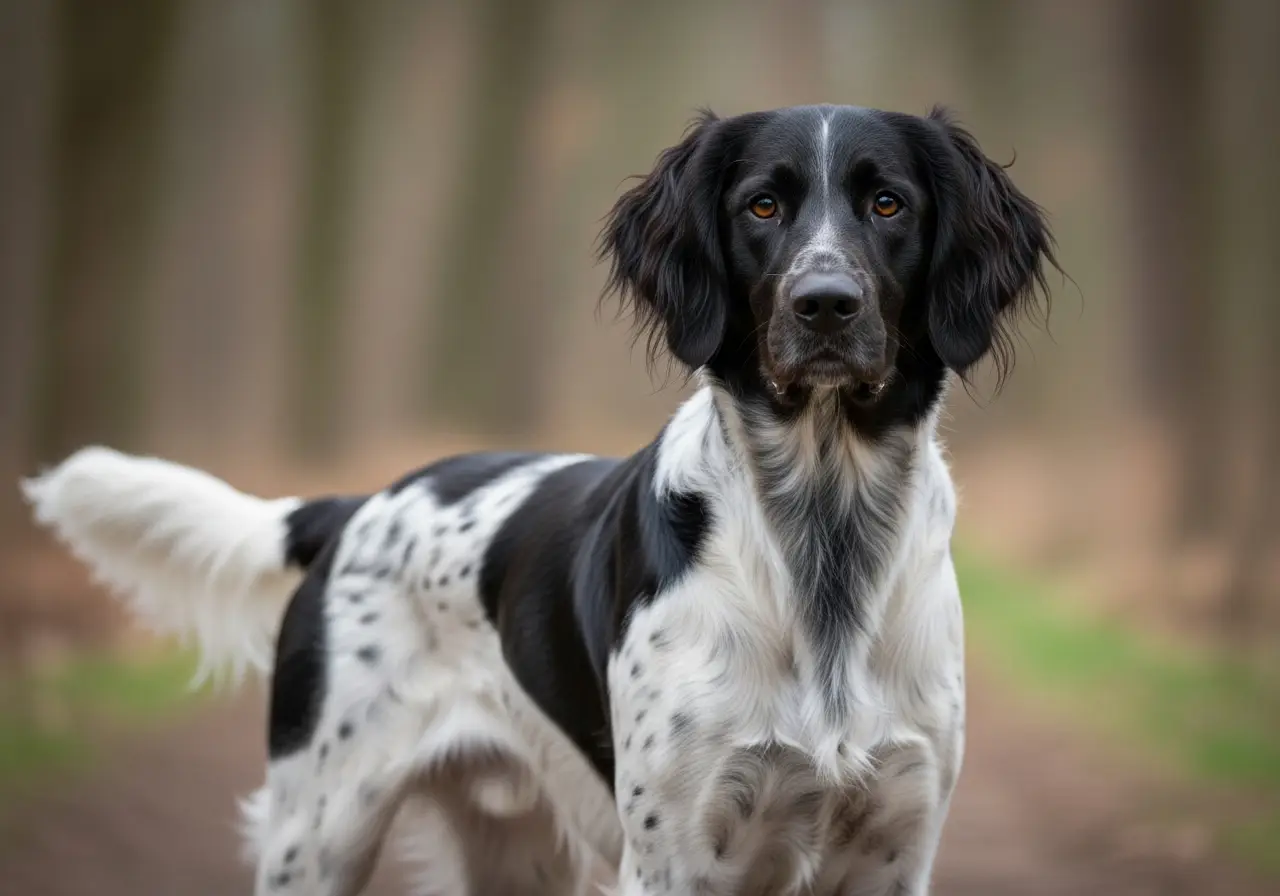
The Grosser Münsterländer is a versatile German hunting pointer, FCI Group 7, black-and-white and suitable as a family dog, withers height 60–65 cm.
03Profile
Key facts and suitability
- Origin
- Deutschland
- Original purpose
- Versatile hunting dog in the Münsterland
- FCI
- No. 118 · Group 7 · Section 1.2
- height at the withers
- 60–65 cm
- Weight
- 25–35 kg
- Life expectancy
- 12–13 Years
- Coat type
- Long-haired
- Minimum exercise
- 90 min/day
- Puppy price
- 1'200–2'000 CHF
- Waiting period
- 9 months
- Sports
- Hunting · Field trials · Agility · Retrieving · Tracking
04Temperament
How the Grosser Münsterländer shows up in everyday life
On a morning run through the forest, the Greater Münsterländer shows what it is: it works the environment systematically, paces in front of the owner, picks up every scent. This is not exuberance; this is pointing behaviour that has been selected for over generations. Anyone who does not plan for this will experience a dog that makes decisions on its own initiative.
Internally (i.e. at the level of what the dog needs from itself), the Greater Münsterländer is demanding: high exercise requirement (at least 120 minutes daily, intense), pronounced requirements for mental work and a need for social contact that demands genuine presence. It should not be left alone for longer than four hours, and even then only if it has been sufficiently stimulated beforehand.
Externally, i.e. in its reaction to its environment, the Greater Münsterländer presents itself as significantly more accessible. It usually behaves openly and friendly towards strangers, without being intrusive. However, this openness must not be confused with a low need for social contact: a dog that greets strangers friendlily still requires intensive daily work with its primary caregiver.
At home, it seeks the closeness of its family. After a long session in the field, it lies down and rests, but only then. A Greater Münsterländer that is physically and mentally under-stimulated will find its own enrichment: in the garden, on furniture or through constant searching and restlessness. The prey drive is not a switch that can be turned off; it is the basic programme of this breed.
05Needs
What this breed needs daily
The Greater Münsterländer requires at least 120 minutes of intense exercise daily, and this does not mean a leisurely walk, but active work: free running in secure terrain, dummy training, nose work or hunting-related enrichment. An owner who does not plan this time in a structured way fundamentally underestimates the breed.
Mental work is not an addition, but an equally mandatory duty. The Greater Münsterländer was selected for complex hunting tasks: pointing, indicating direction, retrieving from water, tracking. These aptitudes demand expression. Dummy training, mantrailing, scent work or participation in working tests are suitable formats. Anyone who does not possess a hunting licence will find a meaningful alternative in organised dummy clubs.
The need for social contact is high. The Greater Münsterländer is designed for a close bond with its primary caregiver; obedience is a central breeding goal. This means: it requires genuine shared time, not just physical presence. Being left alone is possible, but should be built up early and systematically. More than four hours daily are not a permanent solution for most representatives of this breed.
A rural or at least suburban environment with direct access to nature and off-lead areas significantly eases keeping the dog. Keeping in an apartment is possible in principle, but only if exercise and enrichment are ensured consistently and daily. A garden alone does not replace structured stimulation.
Exercise
Very high
mental work
A lot
Social needs
High
training
Medium
06Sport & Mental and Physical Stimulation
What sports the Grosser Münsterländer is suited for
Realistic in terms of physiology and genetics – not every breed suits every sport.
Structurally and physiologically suitable: Suitable for mantrailing, dummy work and tracking · CaniCross / bikejoring possible.
07Quick Check
08Suitability
Who this breed is suitable for – and who it isn't
✓Matches
The Greater Münsterländer suits owners who can plan at least two hours of active time with their dog every day, not occasionally, but as a fixed routine. Hunters or dog sport enthusiasts who use the dog in its original function create the optimal conditions.
Active non-hunters are also suitable if they are prepared to seriously pursue hunting-related enrichment: regular dummy training, scent work, or Mantrailing within an organised framework. Families with children from around eight years of age, in which at least one person takes primary responsibility for training and stimulation, can live well with this breed, provided that daily life offers sufficient exercise and structure.
A rural or suburban environment with access to off-lead areas and nature is advantageous. Owners with prior experience of hunting-motivated or high-drive dogs are clearly at an advantage: they understand drive management, building a stable recall, and the importance of consistent handling without pressure. Those who enjoy genuine collaboration with their dog and see this breed as a partner, not a decoration, will find an enduring, willing companion in the Greater Münsterländer.
×Doesn't match
The Greater Münsterländer does not suit owners who can devote less than two hours daily to intensive exercise and enrichment. Anyone who is away from home for eight hours and has no reliable dog care plan will structurally overwhelm this breed, regardless of good intentions.
Anyone who judges the Greater Münsterländer as an uncomplicated everyday dog because of its friendly nature towards strangers confuses external reaction with internal need. Openness towards people does not mean that the dog requires little stimulation; quite the opposite is true.
City dwellers without access to off-lead areas or nature will quickly reach their limits. First-time owners without experience of high-drive dogs should also weigh the decision carefully: the pronounced prey drive requires consistent drive management, which demands experience and patience. Anyone who views dog ownership primarily as a passive experience (the dog walks alongside, always comes back, needs hardly any guidance) will not be happy with this breed. The Greater Münsterländer demands active handling every day.
10Line reality
Show line, working line, breeder market
The Greater Münsterländer is bred exclusively as a working dog in Germany; the breed officially does not know of a strict separation between working and show lines, such as exists for example with the German Shepherd Dog. The Association of Greater Münsterländers e.V. (VGM) mandates working tests for breeding approval: dogs must demonstrate hunting aptitudes before they are approved for breeding. This ensures a basic uniformity of type.
In practice, differences nevertheless exist between lines that are more oriented towards show success and those bred primarily for hunting use. Dogs from actively hunted lines generally show a more intense drive, higher stamina in the field and more pronounced obedience. Dogs from lines with a focus on shows may appear more homogeneous in exterior, but vary in hunting intensity.
Anyone wishing to use a Greater Münsterländer as a working hunting dog should specifically look for breeders whose dogs are regularly entered in working tests (VGP, HZP, VJP). For non-hunters who want to use the dog in dog sports or dummy training, both lines are basically suitable; the drive is present in any case and must be channelled.
11Health · Reality
What you need to plan for medically with your Grosser Münsterländer
According to the Verband Große Münsterländer e.V., the life expectancy of the Greater Münsterländer is on average 11 to 13 years, a typical range for medium-sized hunting dogs.
Hip dysplasia (HD) is the most frequently documented orthopaedic condition in the breed. Reputable breeders have parent dogs X-rayed for HD and submit the results to the stud book. Elbow dysplasia (ED) occurs less frequently, but should also be discussed during breeding consultations. Anyone buying a puppy should view the HD and ED reports of both parent dogs, not just ask about them.
Ear infections are a common but avoidable problem: the floppy, hairy ear pinnae create a warm, moist environment that favours yeast and bacteria. Regular ear checks, especially after water work, and early veterinary treatment at the first signs (scratching, head shaking, odour) prevent chronic cases.
Eye diseases such as progressive retinal atrophy (PRA) are known in the breed but not widely prevalent. Breeders who pay attention to eye health have parent dogs examined ophthalmologically.
Overweight is an underestimated risk for this breed: Greater Münsterländers that are not exercised sufficiently tend to gain weight, which puts strain on joints and the cardiovascular system. The amount of food should be regularly adjusted to the actual activity level. Preventative check-ups with the vet, at least once a year, are standard for this breed.
12Structured data
Health by the numbers
Prone to diseases
Hip dysplasia, eye problems, heart problems
Recommended health tests
Hip X-ray, eye examination
13Myths ↔ Reality
What is often said incorrectly about this breed
Five myths, five realities, five sources.
„The Grosser Münsterländer is a family dog that can also be kept without hunting without problems.
The Grosser Münsterländer has been selected for hunting performance over decades. Its pointing, retrieving and tracking abilities are genetically anchored. Without adequate stimulation (dummy training, nose work, hunting-related enrichment or actual hunting work), many dogs develop behavioural problems such as excessive searching, restlessness or destructive behaviour. A pure family keeping without structured work is not a sufficient solution for most representatives of this breed.
„Two walks a day are enough for a Grosser Münsterländer.
The FCI standard describes the Greater Münsterländer as a versatile hunting dog with stamina for field, forest and water. The actual exercise requirement is at least 120 minutes of intense physical activity daily, supplemented by mental stimulation. Two short walks do not come close to meeting this need and often lead to frustration and restlessness in the household.
“The Greater Münsterländer is easy to train because of its friendly nature.
The Greater Münsterländer shows a high willingness to learn and cooperate, which facilitates training. At the same time, its prey drive is strongly pronounced and can significantly impair obedience in situations involving wild game stimuli. A reliable recall and consistent drive management require experience and continuous work. For first-time owners without prior experience with hunting-motivated dogs, the breed presents a clear challenge.
“Long-haired dogs are demanding in terms of care; the Greater Münsterländer is no exception.
The coat of the Greater Münsterländer is indeed long and dense, but naturally prone to little matting. Regular brushing, especially after work in rough terrain or water, suffices in most cases. The ears deserve special attention: the floppy, well-furred ear pinnae favour a warm, moist environment and thus the risk of ear infections. Regular checks are more important here than elaborate grooming.
“Greater Münsterländers are aggressive towards other dogs.
The FCI standard describes the character of the Greater Münsterländer as lively, without nervousness. With sufficient socialisation, the breed generally shows a tolerant attitude towards conspecifics. Aggression towards other dogs is not a breed-typical trait, but an indication of socialisation deficits or insufficient stimulation. As a hunting dog traditionally used in groups, social compatibility is a breeding goal.
14animal welfare
The animal welfare perspective
Breeder market, designer versions, animal shelter reality — what no one writes in the puppy ad.
The Greater Münsterlander ends up in animal welfare shelters less frequently than many popular breeds, but it does end up there. The most common reason: owners have underestimated the need for exercise and the prey drive. A dog that requires two hours of intensive stimulation daily and does not receive it will develop behavioural problems that are difficult to manage in everyday life. Destructive behaviour, excessive barking, running away when triggered by wildlife – these are not character flaws, but symptoms of structural under-stimulation.
On the puppy market, there are suppliers who sell Greater Münsterlanders without proof of working tests for the parent dogs. This is legal, but it contradicts the breeding objectives of the VGM. Anyone buying a puppy from such a source does not know which hunting instincts the dog possesses or whether health examinations (HD, ED, eyes) have been carried out. The price difference between a reputable pedigree puppy and a puppy from non-club-affiliated breeding is often several hundred euros; follow-up costs for health problems can be many times that amount.
Designer versions or crosses with the Greater Münsterlander are hardly widespread on the market, which is an advantage. The breed is not a trend product, which limits the backyard breeder market.
Adopting an adult Greater Münsterlander from animal welfare organisations or via the breed club is an equally valid option. Adult dogs have the advantage that their character and drive intensity can already be assessed. Breed-specific animal welfare organisations and the VGM occasionally rehome dogs that have been surrendered due to dissolution of keeping conditions or situations where they were overwhelmed. Such a dog requires a settling-in period and clear structures, but often offers a very close bond if basic needs are met consistently.
15Costs · Transparency
What this breed realistically costs
A puppy from reputable breeding affiliated with the VGM costs between 1,200 and 1,800 euros in Germany (as of 2024). Puppies without affiliation to a breeding association are sometimes offered at lower prices, but the lack of health examinations for the parent dogs can lead to considerable veterinary costs later on.
The annual living costs for a Greater Münsterlander realistically lie between 1,500 and 2,500 euros. This includes: high-quality food (approx. 600–900 euros/year depending on the form of feeding), grooming (brushing, occasional trimming, approx. 100–200 euros/year), basic equipment (leash, harness, transport box) as well as dog training school and training (approx. 300–600 euros/year, especially in the first two years).
Routine veterinary costs (vaccinations, parasite prevention, annual examination) amount to approx. 300–500 euros/year. In the case of orthopaedic problems (HD treatment, physiotherapy), individual costs can quickly reach 1,000–3,000 euros.
Dog health insurance (surgery insurance) for this breed and size class in the DACH region costs between 30 and 80 euros per month, depending on the excess and scope of benefits. Given the active use in rough terrain, surgery cover is advisable.
16Puppy search
What you need to consider when choosing a breeder
- Reputable breeders of the Greater Münsterländer are usually organised within the Verband Große Münsterländer e.V.
- They provide proof of working tests for the parent dogs, disclose HD and ED X-ray results, and allow a visit to the litter before handover.
- The puppies grow up in a household and are socialised at an early stage.
- Warning signs of dubious offers: no proof of breeding club membership, no health certificates for the parent dogs, handover before the eighth week of life, sale without personal contact or opportunity to view, multiple litters available simultaneously.
- Rehoming an adult Greater Münsterländer through the breed club or a breed-specific animal welfare organisation is a fully valid alternative.
- Adult dogs are easier to assess in terms of character and drive intensity than puppies.
- The VGM has contacts for dogs available for rehoming; making an enquiry there is worthwhile.
- No reputable platform recommends individual breeders by name.
- Searching via the official VGM website (grossermuensterlaender.com) and the VDH breeder service offers a structured starting point.
FAQ
Frequently asked questions about the Grosser Münsterländer
Is Grosser Münsterländer suitable for beginners?
Grosser Münsterländer is considered suitable for first-time dog owners.
Is Grosser Münsterländer a family dog?
Grosser Münsterländer is considered suitable for families with good socialisation and species-appropriate care.
How much exercise does Grosser Münsterländer need?
At least around 90 minutes of exercise per day. As an active breed, more so — plus mental stimulation.
What is the size and weight of Grosser Münsterländer?
Fully grown, Grosser Münsterländer reaches about 60–65 cm at the withers and weighs around 25–35 kg.
What is the life expectancy of Grosser Münsterländer?
The life expectancy of Grosser Münsterländer is approximately 12–13 years.
Which diseases are common in Grosser Münsterländer?
Hip dysplasia, eye problems, heart problems
17Breed clubs
Official breed clubs in DACH
19Related
Similar breeds – and their differences
You might also be interested in
Participate
Do you have a good photo of your Grosser Münsterländer?
We are looking for expressive images for our breed profiles. Submit yours; the editorial team reviews every submission before publication.
Does this breed suit you?
Versatile, gentle hunting dog. Also popular as a family dog. Black-and-white markings.