
01Summary
In a paragraph
If you only have 30 seconds.
The Deutsch Drahthaar is a pointing dog bred consistently for hunting performance, with a tough character core and exceptionally high workload requirements. Anyone who keeps it without a hunting or equivalent task underestimates its genetics. The breed demands experienced leadership, a structured daily routine and a clear concept for mental and physical stimulation, on a daily basis, not occasionally.
02Introduction
What makes the German Wirehaired Pointer special
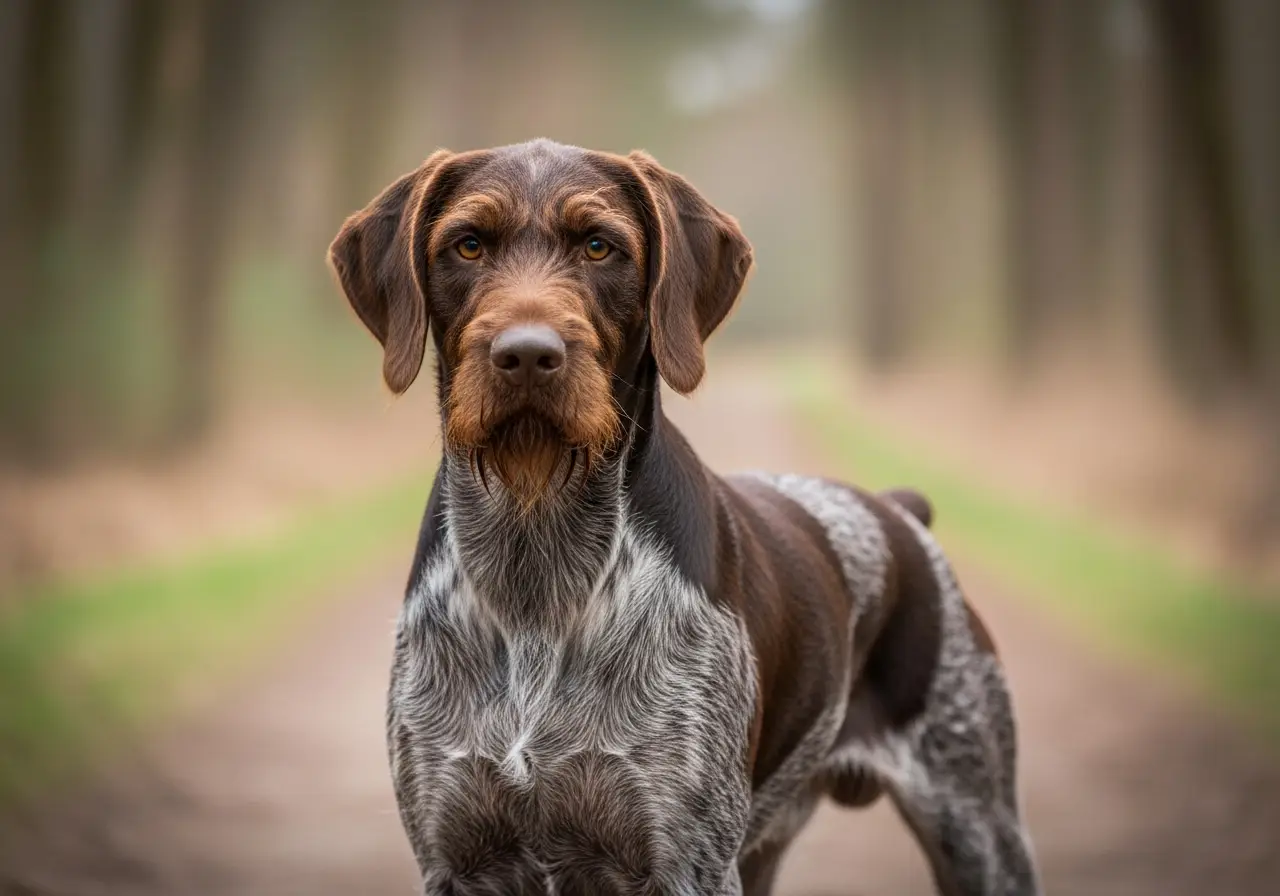
The German Wirehaired Pointer is Germany's most versatile hunting dog, FCI Group 7, with a rough coat and a tough core character, shoulder height 57–68 cm.
03Profile
Key facts and suitability
- Origin
- Deutschland
- Original purpose
- Versatile hunting dog for all types of game
- FCI
- No. 98 · Group 7 · Section 1.1
- height at the withers
- 57–68 cm
- Weight
- 20–32 kg
- Life expectancy
- 12–14 Years
- Coat type
- Wire-haired
- Minimum exercise
- 120 min/day
- Puppy price
- 1'200–2'000 CHF
- Waiting period
- 12 months
- Sports
- Hunting · Field trials · Scent work · Retrieving · Swimming
04Temperament
How the German Wirehaired Pointer shows up in everyday life
During the morning run in the forest, the German Wirehaired Pointer does not behave like a companion dog trotting alongside you. It works: its nose goes to the ground, its body tenses, and at the scent of game it immediately switches to search mode. This instinct cannot be switched off; it is the result of over a century of consistent performance breeding.
At home, it shows a close bond with its primary caregiver. It seeks closeness, observes routines and registers moods precisely. However, this high need for social contact does not mean that it is open and warm towards visitors. It meets strangers with vigilance, sometimes at a distance — this is not a deficiency, but breed-typical behaviour according to the FCI standard. Anyone who confuses these two axes — close family bond on the one hand, reserve towards strangers on the other — will experience surprises during the first visit.
On an evening without prior stimulation, the German Wirehaired Pointer is not a relaxed sofa companion. It seeks enrichment, tests boundaries and becomes restless. On an evening after a tracking session or structured dummy training, it lies down and sleeps deeply.
Its need for mental work is exceptionally high. Nose work, retrieving, pointing exercises and obedience training at performance level are part of the daily basic care, not an extra. Anyone who underestimates this will get a dog that finds its own tasks: in the garden, in the household or on the next walk without a lead.
05Needs
What this breed needs daily
The German Wirehaired Pointer needs at least 120 minutes of active exercise daily, and this is the lower limit, not a recommendation for good days. In addition, there is structured work that challenges its mind: tracking work, retrieve training, pointing exercises, dummy training at performance level or comparable tasks. Without this cognitive component, under-stimulation occurs, even if the dog appears physically exhausted.
Its need for mental work is to be classified with the highest value. The breed has been selected over generations to make independent decisions in the field; this characteristic requires an outlet. If that outlet is missing, the dog finds it itself.
The tolerance for being left alone is a maximum of four hours, provided the dog has been sufficiently stimulated beforehand. Longer absences without stimulation reliably lead to stress behaviour.
A rural environment with access to open spaces is advantageous, but not essential; what matters is the stimulation concept, not the postcode. Anyone who lives in the city and offers structured work daily keeps the dog more species-appropriately than a country dweller who leaves it to its own devices in the garden.
Socially, the German Wirehaired Pointer needs a clear, consistent primary caregiver with experience in handling performance-oriented dogs. It registers inconsistency in handling immediately and exploits leeway. A supporting dog training school with gundog-specific experience is not an option for owners without a hunting background, but a must.
Exercise
Very high
mental work
A lot
Social needs
Medium
training
Demanding
06Sport & Mental and Physical Stimulation
What sports the German Wirehaired Pointer is suited for
Realistic in terms of physiology and genetics – not every breed suits every sport.
Structurally and physiologically suitable: Suitable for mantrailing, dummy work and tracking · CaniCross / bikejoring possible.
07Quick Check
08Suitability
Who this breed is suitable for – and who it isn't
✓Matches
The German Wirehaired Pointer suits owners who can offer at least two hours of structured stimulation daily, both physically and mentally. Hunting handling is the gold standard: anyone who holds a hunting licence and regularly uses the dog in the hunting grounds fulfils the basic conditions naturally.
Owners without a hunting background are suitable if they can present an equivalent concept: dummy training at performance level, tracking work, mantrailing or search and rescue dog work. Half-hearted leisure activities are not enough.
Suitable are also active people in a rural or semi-urban environment who have experience with performance-oriented or high-drive dogs. Anyone who has already handled a pointing dog or gundog understands the independence of this breed and can cope with it.
Families with children from about ten years old are possible if the adults clearly take on the leading role and the dog is stimulated daily. The German Wirehaired Pointer is not a child's playmate; it is a working partner that expects respect and structure. Visitors and strangers in the household should not come as a surprise: the breed reacts with reserve, and this requires active expectation management.
×Doesn't match
The German Wirehaired Pointer does not suit owners who are away from home for eight or more hours daily and cannot present a reliable dog care plan. Anyone who believes that a long evening walk compensates for an unstructured day fundamentally underestimates the work requirement of this breed.
Households keeping a dog for the first time are generally overwhelmed by the German Wirehaired Pointer. The breed tests inconsistency immediately and needs a primary caregiver who offers handling not situationally, but permanently.
Anyone who equates the dog's high need for social contact with openness towards strangers will experience disappointment: the German Wirehaired Pointer bonds closely with its family, but remains vigilant to reserved towards strangers. This combination requires active socialisation and clear expectation management, not passive hoping for habituation.
City owners without access to open spaces and without a structured stimulation concept should not choose this breed. Anyone looking for a calm, adaptable companion dog will find a more suitable match in other breeds. The German Wirehaired Pointer is not a dog that adapts to its owner's daily life; it demands that the owner adapts their daily life to the dog.
10Line reality
Show line, working line, breeder market
With the German Wirehaired Pointer, there is no pronounced separation between show and working lines, as is known with the German Shepherd Dog or the Labrador Retriever. The Verein Deutsch-Drahthaar has linked breeding approval from the outset to passing hunting performance tests. Anyone who acquires a puppy from recognised VDD breeding therefore basically receives a dog with a tested working background.
Nevertheless, there are differences within the breed: dogs from breeding lines with intensive trial use — such as Association Hunting Trial (VJP), Autumn Breeding Trial (HZP) or Association Field and Water Trial (VFWP) — generally show higher drive intensity and greater independence than dogs from breeding lines that meet the minimum requirements but do not select for top performance as consistently.
This difference is relevant for owners without a hunting background: a dog from a high-performance breed with multiple tested parent animals places higher demands on workload and handling than a dog from a breed that primarily focuses on temperament balance and suitability for family life. Asking the breeder about the test results of the parent animals provides insight into which dog actually suits your own capabilities.
11Health · Reality
What you need to plan for medically with your German Wirehaired Pointer
According to figures from the Verein Deutsch-Drahthaar, the life expectancy of the Deutsch Drahthaar is an average of 12 to 14 years, an above-average range for large dogs, which is attributed to consistent performance selection.
Hip dysplasia (HD) and elbow dysplasia (ED) are the most common orthopaedic problems in the breed. According to VDD evaluations, breeding animals are X-rayed for HD and ED before approval; only dogs with ratings of HD-A or HD-B (clear or transitional form) receive breeding approval. Nevertheless, HD findings occur in the total population, a reason to actively ask the breeder for the X-ray results of both parent animals.
Eye diseases, particularly progressive retinal atrophy (PRA), are documented. Reputable breeders have breeding animals examined ophthalmologically. Thyroid problems (hypothyroidism) are also observed in the breed, although no reliable prevalence figures specific to the Deutsch Drahthaar are available.
The rough coat reliably protects against injuries in the terrain, but requires regular checks for burrs, ticks and skin irritations, especially after use in tall grass or undergrowth.
Preventive measures recommended include: HD/ED screening of the parent animals before purchasing a puppy, annual veterinary check-ups, an eye examination by an ophthalmologist every two years and weight monitoring, as the dog tends to gain weight when under-stimulated.
12Structured data
Health by the numbers
Prone to diseases
Hip dysplasia, eye problems, heart problems
Recommended health tests
Hip X-ray, eye examination
13Myths ↔ Reality
What is often said incorrectly about this breed
Five myths, five realities, five sources.
"The German Wirehaired Pointer is a robust all-rounder; it adapts to any household.
The German Wirehaired Pointer has been selected exclusively for hunting performance for over 120 years. Its prey drive, need for movement and willingness to work are deeply rooted in its genetics. A household without a hunting or equivalent task regularly leads to behavioural problems such as destructive behaviour, excessive barking or uncontrolled chasing. Adaptability to arbitrary forms of keeping is not a characteristic of this breed.
"The wire-haired coat cares for itself; you hardly need to do anything.
The rough topcoat reliably protects the dog from weather and injuries in the terrain, but requires regular care. Professional trimming is required twice a year to remove dead hair and maintain the coat structure. If the coat is shaved instead of trimmed, it permanently loses its protective texture. In addition, regular checks of ears, paws and undercoat are necessary.
"Anyone without a hunting licence cannot keep a German Wirehaired Pointer.
A hunting licence is not a legal prerequisite for keeping a German Wirehaired Pointer. However, the Verein Deutsch-Drahthaar and experts explicitly recommend that owners without a hunting background demonstrate an equivalent workload concept, such as dummy training at performance level, tracking work or mantrailing. Without structured work, the dog's well-being suffers considerably.
"The German Wirehaired Pointer is naturally friendly towards all people.
The FCI standard describes the German Wirehaired Pointer as firm, controlled and balanced, not as open or sociable towards strangers. It behaves watchfully to reservedly towards strangers. This trait is typical of the breed and not a training error. Good socialisation during the puppy phase mitigates excessive reserve, but does not eliminate it.
"120 minutes of walking daily are sufficient.
Pure exercise in the form of walks does not meet the needs of the German Wirehaired Pointer. In addition to physical stimulation, the breed requires intensive mental work: tracking, retrieving exercises, pointing work or comparable structured tasks. If this cognitive component is missing, the dog shows signs of under-stimulation despite sufficient exercise.
14animal welfare
The animal welfare perspective
Breeder market, designer versions, animal shelter reality — what no one writes in the puppy ad.
The Deutsch Drahthaar belongs to the breeds that are rehomed via animal shelters or breed rescue organisations at an above-average frequency, not due to aggression problems, but because of underestimated workload requirements. The main reasons for surrender are uncontrolled hunting behaviour in urban environments, destructive behaviour due to under-stimulation and owners being overwhelmed who had expected a "robust family dog".
On the puppy market, there are providers who sell Deutsch Drahthaar puppies without VDD breeding approval or without proof of hunting performance tests for the parent animals. These puppies are not necessarily worse, but the buyer waives the most important quality assurance that distinguishes this breed from others: the proof of performance. Anyone who acquires a puppy without VDD papers does not know what actual drive they are dealing with.
Designer crosses with Drahthaar content, such as "Drahthaar-Labrador mixes", are occasionally marketed as a more family-friendly alternative. Such crosses are genetically unpredictable: the prey drive of the Drahthaar can fully manifest, even if the coat appears softer.
Anyone looking for a Deutsch Drahthaar will find information via the VDD and the Swiss Pointing Dog Club SVC about dogs in emergency situations or from dissolved hunting operations. An adult dog from rehoming has the advantage that character and drive intensity are already assessable, a relevant factor for a breed with such a high work profile. Rehoming and purchasing from reputable breeding are equally valid ways to obtain a species-appropriately kept dog.
15Costs · Transparency
What this breed realistically costs
A puppy from recognised VDD breeding typically costs between 1,200 and 1,800 EUR or CHF in Germany and Switzerland. Offers significantly below this often come from breeding without proof of performance; the risk of subsequent health and behaviour-related costs increases accordingly.
The annual keeping costs consist of food (high-quality dry food or BARF for a dog of this size: approx. 600–1,000 EUR/year), grooming via professional trimming (twice a year, approx. 80–150 EUR per session), basic equipment, leads, transport crate and hunting or training accessories.
Basic veterinary care (vaccinations, parasite prevention, annual check-up) costs approx. 300–500 EUR/year. Orthopaedic investigations for suspected HD or ED can cost an additional 300–800 EUR. Pet insurance with surgery cover costs approx. 50–100 EUR/month for this breed and size class, significantly reducing the financial risk in the event of operations.
Anyone keeping the dog without a hunting licence should additionally factor in course fees for dummy training or tracking work: 20–60 EUR per session, depending on the provider and region.
16Puppy search
What you need to consider when choosing a breeder
- A reputable breeder of German Wirehaired Pointers is a member of the Verein Deutsch-Drahthaar (VDD) or a recognised national partner association such as the Schweizerischer Vorstehhund-Club (SVC).
- Breeding approval requires that both parent dogs have passed hunting performance tests; this proof is the most important quality feature and should be actively requested.
- Reputable breeders present HD and ED X-ray reports of the parent dogs, allow a visit to the litter in its familiar environment and ask questions about your own keeping situation.
- Anyone who asks no questions and wants to take the puppy immediately sends a warning signal.
- Warning signs of dubious offers: missing VDD papers, no performance certificates for the parents, puppies under eight weeks old, handover at a neutral location, suspiciously low prices or several litters available simultaneously.
- Rehoming an adult Deutsch Drahthaar via the VDD, the SVC or specialised hunting dog rescue organisations is an equally valid option.
- Adult dogs from dissolved hunting operations or relocation situations are often well-trained and come with an assessable profile.
- No specific breeder recommendations by name; points of contact are the official association websites.
FAQ
Frequently asked questions about the German Wirehaired Pointer
Is German Wirehaired Pointer a family dog?
German Wirehaired Pointer is considered suitable for families with good socialisation and species-appropriate care.
How much exercise does German Wirehaired Pointer need?
At least around 120 minutes of exercise per day. As an active breed, more so — plus mental stimulation.
What is the size and weight of German Wirehaired Pointer?
Fully grown, German Wirehaired Pointer reaches about 57–68 cm at the withers and weighs around 20–32 kg.
What is the life expectancy of German Wirehaired Pointer?
The life expectancy of German Wirehaired Pointer is approximately 12–14 years.
Which diseases are common in German Wirehaired Pointer?
Hip dysplasia, eye problems, heart problems
17Breed clubs
Official breed clubs in DACH
19Related
Similar breeds – and their differences
You might also be interested in
Participate
Do you have a good photo of your German Wirehaired Pointer?
We are looking for expressive images for our breed profiles. Submit yours; the editorial team reviews every submission before publication.
Does this breed suit you?
Most versatile German hunting dog. Hardly suitable as a pure companion dog – needs hunting use or intensive work.