
01Summary
In a paragraph
If you only have 30 seconds.
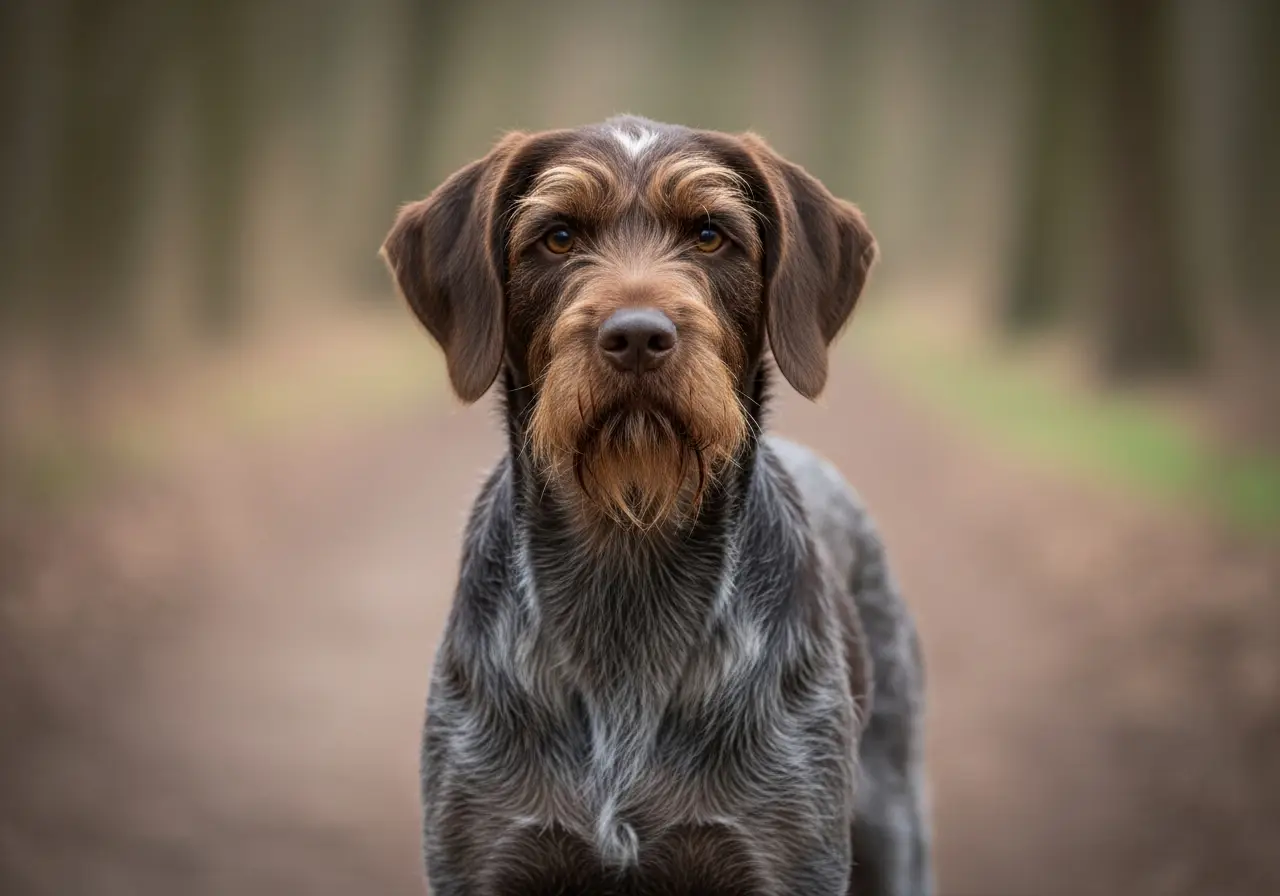
The Korthals Griffon is a versatile hunting dog from FCI Group 7 with a wiry coat, pronounced pointing and prey drive, and a withers height of 56 to 67 cm. In the home, it shows a calm and bond-oriented nature; in the field, it requires at least two hours of active exercise daily plus structured nose work. Anyone who does not meet these basic conditions will end up with a frustrated dog, not a relaxed companion.
02Introduction
What makes the French Rough-Coated Pointing Dog Korthals special
The Korthals Griffon (French Rough-Coated Pointing Dog) is a versatile hunting dog, FCI Group 7, with a rough coat and a withers height of 56–67 cm.
03Profile
Key facts and suitability
- Origin
- Niederlande/Frankreich
- Original purpose
- Versatile hunting dog
- FCI
- No. 107 · Group 7 · Section 1.3
- height at the withers
- 50–60 cm
- Weight
- 23–27 kg
- Life expectancy
- 12–14 Years
- Coat type
- Wire-haired
- Minimum exercise
- 90 min/day
- Puppy price
- 1'200–2'000 CHF
- Waiting period
- 9 months
- Sports
- Hunting · Field trials · Scent work · Retrieving · Swimming
04Temperament
How the French Rough-Coated Pointing Dog Korthals shows up in everyday life
When the Korthals comes home after a long day in the field, it lies down, calm, without drama. This image deceives about its actual needs: The calmness is the result of genuine stimulation, not a baseline state.
Internally, what the dog needs: The Korthals has a high need for social contact. It actively seeks the closeness of its primary caregiver, follows them through the apartment and reacts to exclusion with restlessness. At the same time, it demands intensive physical exercise and mental work every day. Nose work, dummy training or hunting guidance are not extras, they are basic care. Anyone who denies this will experience a dog that finds its own enrichment: in the garden, on the sofa, in the trash can.
Externally, how the dog reacts: Towards strangers, the Korthals shows a neutral to reserved attitude. It does not bark reflexively, but observes carefully. This reserve is not mistrust, but typical pointing dog behaviour: wait, assess, then decide. With other dogs, it is compatible with early and consistent socialisation. However, its prey drive remains present at all times; on a walk in the forest this means: leash, until the recall under wildlife stimulus is reliable.
These two poles (high need for social contact internally, selective openness externally) must not be confused. A Korthals that is affectionate towards its family is therefore not automatically open to every visitor.
05Needs
What this breed needs daily
Exercise: The Korthals needs at least 120 minutes of active exercise daily, not a walk at walking pace, but exercise with a task. Cross-country runs, swimming, extensive field work or structured dummy training count towards this. On rainy days or in winter, this need does not decrease.
Nose work and mental stimulation: The need for mental work is at a high level. Mantrailing, nose work according to the Schutzhund principle or hunting guidance with pointing exercises are suitable formats. Pure physical exhaustion without a mental component is not enough; the Korthals needs both.
Social inclusion: The need for social contact is high. The Korthals does not tolerate permanently isolated keeping. Being left alone can be built up, but should not regularly exceed four hours daily. A dog that is left alone permanently develops stress symptoms.
Environment: A rural or at least suburban environment with access to open land is advantageous. Pure city living without daily access to fields, forest or water presents a considerable challenge and requires a very high level of commitment from the owner.
Guidance: The Korthals reacts sensitively to pressure, but needs clear, consistent structures. Training works best with positive reinforcement and clear body language. Inconsistency with wildlife stimuli or recall quickly backfires in open land.
Exercise
Very high
mental work
A lot
Social needs
High
training
Medium
06Sport & Mental and Physical Stimulation
What sports the French Rough-Coated Pointing Dog Korthals is suited for
Realistic in terms of physiology and genetics – not every breed suits every sport.
Structurally and physiologically suitable: Suitable for mantrailing, dummy work and tracking · CaniCross / bikejoring possible.
07Quick Check
08Suitability
Who this breed is suitable for – and who it isn't
✓Matches
The Korthals suits owners who can plan at least two hours of active exercise in open land daily, not as an occasional exception, but as a fixed daily structure. Hunting experience or at least willingness for hunting-related enrichment (dummy training, nose work, mantrailing) is a realistic prerequisite.
Suitable for active individuals or couples with a connection to nature and a flexible daily routine, who dedicate several hours to the dog every day. Families with children from about eight years old are also suitable, provided sufficient exercise and clear rules are anchored in everyday life.
Owners with a garden or direct access to fields and forest benefit considerably. Anyone who is active in a hunting community or wants to guide the dog for hunting will find in the Korthals a partner that was bred specifically for this task.
As the Korthals reacts reservedly towards strangers, it suits households with manageable visitor numbers or owners who are willing to work on socialisation early and consistently. Experience with high-drive dogs is not a must, but a clear advantage.
×Doesn't match
The Korthals does not suit owners who are away from home for more than four hours daily and do not have a reliable dog care plan. Its high need for social contact and the necessary daily stimulation cannot be postponed to weekends.
Not suitable for owners who equate the Korthals’s calm home character with a low need for exercise. Anyone looking for a dog that is content with a short city walk will be permanently overwhelmed by the Korthals, and the dog by everyday life.
Anyone who regards prey drive as a trainable problem that resolves itself over time should choose a different breed. The pointing and hunting instinct is genetically ingrained and requires active management, not ignorance.
Keeping the dog purely in a city without regular access to open space places a considerable burden on the dog. Owners who expect an open, uncomplicated attitude towards strangers will also be disappointed by the Korthals’s selective reserve; this is not a training error but typical of the breed.
For first-time owners without experience with high-drive or hunting-motivated dogs, the Korthals is a demanding choice that strictly requires attendance at a dog training school with experience in pointing breeds.
10Line reality
Show line, working line, breeder market
The Korthals is today predominantly bred from hunting-oriented breeding lines. A pronounced separation between working line and show line, as exists for example with the German Shorthaired Pointer or the Labrador Retriever, is less pronounced in the Korthals; the breeding population is too small to establish parallel lines with clearly different profiles.
In France, the country of origin for FCI registration, the focus has traditionally been on hunting performance. There, Korthals are regularly used in field trials and versatility tests. In Germany and Switzerland, the breeding base is also oriented towards hunting, although individual breeders also place value on temperament traits for companion dog keeping.
Anyone who acquires a Korthals from an active working dog breeding receives a dog with high drive to work and pronounced nose performance, which in everyday life without hunting guidance requires correspondingly intensive alternative enrichment. Anyone specifically looking for a Korthals as a companion dog should explicitly ask the breeder about the hunting intensity of the parent dogs and critically accompany the puppy's development.
Field trial lines in the narrower sense do not exist to any significant extent for the Korthals in the German-speaking region. The breed remains a working dog with clear work orientation, regardless of whether the owner hunts or not.
11Health · Reality
What you need to plan for medically with your French Rough-Coated Pointing Dog Korthals
According to the Griffon-Club e.V., the life expectancy of the Korthals is an average of 12 to 14 years, a typical range for medium-sized hunting dogs.
Hip dysplasia (HD) is the most frequently documented orthopaedic condition in the breed. Reputable breeders have both parent dogs radiologically examined for HD before breeding; an HD-free or HD A/B result for both parents is a minimum standard. Elbow dysplasia (ED) occurs less frequently but should also be documented in the breeding approval protocol. Cross-breed data from the OFA (Orthopedic Foundation for Animals) show HD rates of 10–20 % in related pointing breeds, depending on the breeding line (OFA database, status 2023).
Eye problems — including entropion and progressive retinal atrophy (PRA) — have been described in the Korthals but are not comprehensively documented. An ophthalmological examination of the parent dogs before mating is recommended.
The wiry coat protects the dog in rough terrain but carries an increased risk of foreign body inclusions (burrs, thorns) in the ears, eyes and paws, especially after field work. Regular checks after every outing are mandatory.
Overweight is rare in Korthals dogs with sufficient mental and physical stimulation but can occur with inactive keeping. The ideal weight is 23–27 kg according to the FCI standard; regular weight checks at the vet are advisable. Preventive examinations once a year, and every six months from the seventh year of life onwards, are considered standard.
12Structured data
Health by the numbers
Prone to diseases
Hip dysplasia, eye problems
Recommended health tests
Hip X-ray, eye examination
13Myths ↔ Reality
What is often said incorrectly about this breed
Five myths, five realities, five sources.
The Korthals is suitable for less active owners due to its calm nature in the house.
Calmness in the house is a result of sufficient stimulation, not an indication of low exercise needs. The Korthals needs at least two hours of active exercise plus structured nose work daily. Without this stimulation, it shows signs of frustration such as destructive behaviour or excessive barking.
As a hunting dog, the Korthals is difficult to integrate into family life and is distant.
The Korthals forms a close bond with its primary caregiver and core family. Its need for social contact is high; it actively seeks proximity to familiar people. Reserve towards strangers is a separate trait and must not be equated with a lack of family bonding.
The rough coat of the Korthals is maintenance-free and requires little care.
The wiry coat of the Korthals requires regular trimming, usually two to three times a year. If the coat is clipped rather than trimmed, it loses its characteristic protective function against wetness and cold. Regular checks of the ears and beard area are also required.
The pronounced prey drive of the Korthals can be completely suppressed through consistent training.
The pointing and hunting instinct of the Korthals is genetically anchored and not a training error. It can be channelled and directed into orderly paths (e.g., through dummy training, mantrailing or hunting guidance) but not eliminated. Anyone who ignores this drive risks uncontrolled bolting upon contact with wildlife.
The Korthals is a common breed and easy to find through breeders.
The Korthals is one of the rare breeds in the German-speaking region. The breeding population is small, litters are limited, and waiting times of one to two years are realistic. Anyone looking for a puppy quickly risks ending up with unscrupulous providers.
14animal welfare
The animal welfare perspective
Breeder market, designer versions, animal shelter reality — what no one writes in the puppy ad.
The Korthals is a rarity in German-speaking animal welfare circles. The total population is small; surrenders do occur, but not to the extent observed with popular breeds such as the Labrador or the German Shepherd.
When Korthals dogs are surrendered, the reason in most cases lies in a misjudgement of their need for exercise and activity. Owners who interpreted the breed’s calm home character as an indication of low needs reach their limits after a few months. The dog then shows signs of frustration (destructive behaviour, excessive barking, restlessness) that are misunderstood as character problems, although they simply stem from under-stimulation.
Backyard breeders and opportunistic breeders exploit the rarity of the breed as a sales argument. Anyone offering a Korthals puppy without a waiting period, without access to the HD/ED papers of the parent dogs and without asking questions about the intended use is operating outside reputable breeding standards. The low awareness of the breed makes it difficult for potential buyers to recognise dubious offers.
Designer versions or hybrids with Korthals ancestry exist in isolated cases, without the specific characteristics of the breed being preserved or tested. Such offers should be assessed with particular caution.
Rehoming an adult Korthals through animal welfare organisations or breed club contacts is an equally valid option to buying a puppy. Adult dogs have the advantage that temperament and drive intensity are already assessable, which can be a real benefit for a high-drive breed like the Korthals. The Griffon-Club e.V. and the Schweizerische Vorstehhund-Club SVC occasionally rehome surrendered dogs and are the first point of contact.
15Costs · Transparency
What this breed realistically costs
A Korthals puppy from reputable breeding, with HD/ED screening of the parent dogs, a pedigree and vaccination record, costs between 1,200 and 1,800 EUR in Germany and CHF in Switzerland. Offers significantly below this range without corresponding breeding documentation should be viewed with scepticism.
The annual living costs consist of: food (high-quality, for medium-sized active dogs) approx. 600–900 EUR/year, grooming and trimming approx. 150–300 EUR/year (depending on self-performance), basic equipment in the first year approx. 300–500 EUR.
Veterinary costs: Annual preventive examination incl. vaccination booster approx. 100–200 EUR. In case of illness or orthopaedic assessments (HD X-rays, eye examination), individual costs of 200–600 EUR are realistic. Dog health insurance for a Korthals costs approx. 40–80 EUR/month depending on the provider and scope of cover (as of 2024, DACH market).
Additional costs arise from dog training school (recommended, especially in the first year): approx. 200–400 EUR for a basic course. Hunting training or specialised nose work courses can cost a further 300–600 EUR/year. Overall, total costs of 3,500–5,000 EUR are realistic in the first year of ownership, excluding unforeseen veterinary costs.
16Puppy search
What you need to consider when choosing a breeder
- Reputable Korthals breeders can be reached via the Griffon-Club e.V.
- (Germany) and the Schweizerische Vorstehhund-Club SVC (Switzerland).
- Both clubs maintain breeder lists and set minimum standards for breeding approval and health examinations.
- Characteristics of a reputable provider: Both parent dogs have been tested for HD and ED, with results available in writing.
- The breeder asks questions about the planned daily routine and the buyer’s experience.
- Puppies are raised in a household environment and are at least eight weeks old, vaccinated and dewormed before being handed over.
- A waiting period of several months to over a year is normal for this rare breed.
- Warning signs: No proof of health examinations for the parent dogs, immediate availability without a waiting period, no personal conversation before purchase, sale via classifieds portals without club affiliation.
- Rehoming an adult Korthals through breed club contacts or animal welfare organisations is an equally valid alternative.
- Adult dogs allow a more realistic assessment of drive intensity and temperament, which is an advantage for a hunting-oriented breed.
- rundum.dog does not provide specific breeder recommendations; the club websites are the most reliable point of contact.
FAQ
Frequently asked questions about the French Rough-Coated Pointing Dog Korthals
Is French Rough-Coated Pointing Dog Korthals suitable for beginners?
French Rough-Coated Pointing Dog Korthals is considered suitable for first-time dog owners.
Is French Rough-Coated Pointing Dog Korthals a family dog?
French Rough-Coated Pointing Dog Korthals is considered suitable for families with good socialisation and species-appropriate care.
How much exercise does French Rough-Coated Pointing Dog Korthals need?
At least around 90 minutes of exercise per day. As an active breed, more so — plus mental stimulation.
What is the size and weight of French Rough-Coated Pointing Dog Korthals?
Fully grown, French Rough-Coated Pointing Dog Korthals reaches about 50–60 cm at the withers and weighs around 23–27 kg.
What is the life expectancy of French Rough-Coated Pointing Dog Korthals?
The life expectancy of French Rough-Coated Pointing Dog Korthals is approximately 12–14 years.
Which diseases are common in French Rough-Coated Pointing Dog Korthals?
Hip dysplasia, eye problems
17Breed clubs
Official breed clubs in DACH
19Related
Similar breeds – and their differences
You might also be interested in
Participate
Do you have a good photo of your French Rough-Coated Pointing Dog Korthals?
We are looking for expressive images for our breed profiles. Submit yours; the editorial team reviews every submission before publication.
Does this breed suit you?
Versatile rough-coated hunting dog. Suitable as a family dog if sufficiently occupied with hunting activities. Good-natured and eager to learn.