
01Summary
In a paragraph
If you only have 30 seconds.
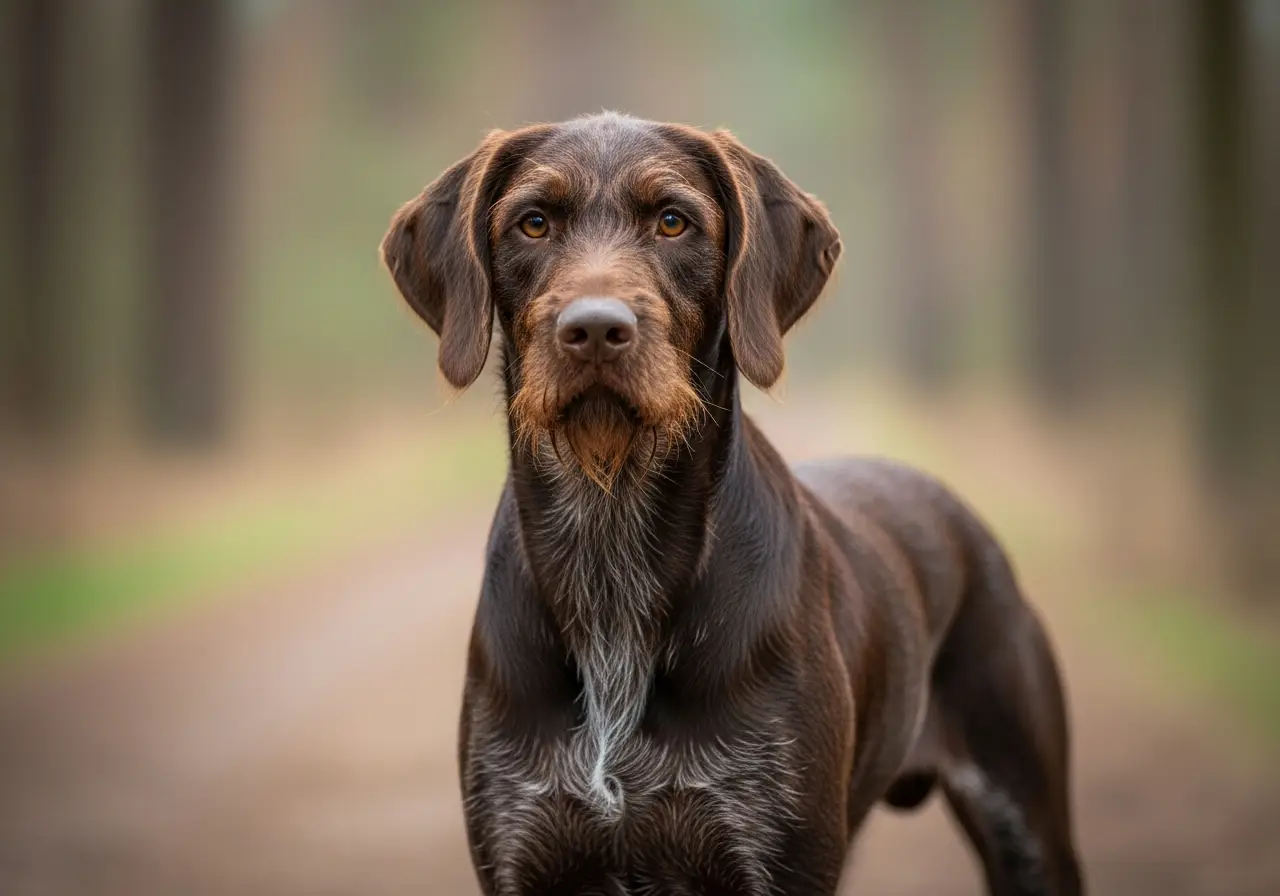
The Bohemian Rough-haired Pointer is a Czech pointing dog bred equally for field, forest, and water. Anyone who keeps it takes on a dog with genetically anchored willingness to work: pointing, retrieving, and nose work are not leisure options but daily needs. In the house, it shows itself calm and people-oriented; outside, it demands consistent guidance and genuine stimulation. Without both, frustration arises on both sides.
02Introduction
What makes the Bohemian Rough-haired Pointer (Cesky Fousek) special
The Cesky Fousek (Bohemian Rough-haired Pointer) is a versatile Czech pointing dog, FCI Group 7, with rough coat and a withers height of 58–66 cm.
03Profile
Key facts and suitability
- Origin
- Tschechien
- Original purpose
- Pointing dog, tracking dog, retrieving
- FCI
- No. 245 · Group 7 · Section 1.3
- height at the withers
- 58–66 cm
- Weight
- 22–34 kg
- Life expectancy
- 12–15 Years
- Coat type
- Wire-haired
- Minimum exercise
- 90 min/day
- Puppy price
- 1'000–1'800 CHF
- Waiting period
- 9 months
- Sports
- Hunting · Field trials · Retrieving · Scent work
04Temperament
How the Bohemian Rough-haired Pointer (Cesky Fousek) shows up in everyday life
When returning home, the Bohemian Rough-haired Pointer shows a joyful but not overwhelming greeting. It seeks contact but does not impose itself. In the house, it lies down calmly after a round of enrichment, provided its need for movement and work is met. This calmness is no coincidence but the result of sufficient stimulation.
Here, the two behavioural levels separate clearly: The internal need of the Cesky Fousek is high. It requires daily intensive nose work, retrieving exercises or hunting-related enrichment, not as a bonus but as basic provision. Anyone who underestimates this need will experience a different dog: restless, searching, hard to focus.
External behaviour towards strangers is reserved to neutral. The Cesky Fousek is not a dog that enthusiastically greets every visitor. It observes first and makes contact if it deems it appropriate. This reserve is not mistrust but breed-typical sobriety. Anyone expecting a dog that warmly welcomes strangers immediately will be disappointed.
On a walk in open terrain, the prey drive shows itself immediately: the nose goes to the ground, attention switches to the scent. Without reliable recall and clear guidance, the drive takes control. The Cesky Fousek works cooperatively with a primary caregiver who communicates consistently and clearly; it reacts sensitively to pressure but equally to inconsistency.
With children who handle dogs calmly and respectfully, it shows patience. Toddlers in play mode can overwhelm it, not out of aggression but because it responds to sensory overload by withdrawing.
05Needs
What this breed needs daily
The Cesky Fousek requires at least 90 to 120 minutes of active movement daily, not as a leisurely walk but as targeted work. The type of stimulation is decisive: nose work, retrieving, tracking or hunting guidance directly engage its genetic willingness to work. Pure distance without a mental component is insufficient.
The need for mental work is high. A Cesky Fousek that is physically stimulated but mentally under-challenged develops restlessness and searching behaviour in everyday life. Dummy work, Mantrailing or structured nose games can partially meet this need, but hunting guidance remains the most species-appropriate form of stimulation.
The need for social contact is also pronounced. The dog builds a close bond with its primary caregiver and requires regular, active contact, not just physical presence. Being left alone is possible but should be built up early and gradually. A maximum of four hours alone is realistic as a guideline; longer periods require a care solution.
A rural environment with access to fields and forest is advantageous. Keeping in an apartment is possible with consistent daily stimulation but demands significantly more planning effort from the owner. A garden does not replace active enrichment.
Training requires consistency without harshness. The Cesky Fousek reacts sensitively to pressure; positive reinforcement with clear boundaries shows the best results. An accompanying dog training school with experience in hunting dogs is recommended, especially for owners without prior knowledge of pointing dogs.
Exercise
High
mental work
A lot
Social needs
High
training
Medium
06Sport & Mental and Physical Stimulation
What sports the Bohemian Rough-haired Pointer (Cesky Fousek) is suited for
Realistic in terms of physiology and genetics – not every breed suits every sport.
Structurally and physiologically suitable: Suitable for mantrailing, dummy work and tracking · CaniCross / bikejoring possible.
07Quick Check
08Suitability
Who this breed is suitable for – and who it isn't
✓Matches
The Cesky Fousek suits owners who spend at least two hours of active time with the dog daily, a considerable part of which involves targeted nose or retrieving work. Hunters with regular use in their hunting ground meet this need most directly. Active dog sport participants who practice dummy work, Mantrailing or tracking at a high level can also provide meaningful stimulation.
The breed is suitable for owners in rural or suburban environments with access to fields and forests. Families with children from around eight years of age, in which at least one person takes primary responsibility for training and stimulation, are suitable, provided that the dog's need for work is genuinely met in everyday life.
Those who already have experience with pointing dogs or other high-drive breeds will find a cooperative, eager-to-learn dog in the Cesky Fousek. First-time owners with a high willingness to train, access to an experienced dog training school, and a realistic assessment of the time commitment can also keep the breed, provided they inform themselves beforehand about the hunting-related requirements and take them seriously.
×Doesn't match
The Cesky Fousek is not suitable for owners who can or want to spend less than 90 minutes a day on active enrichment. Anyone who is away from home for eight hours and does not have a reliable care solution will structurally overwhelm the dog, regardless of how much affection is present.
The breed is not suitable for owners looking for a calm companion dog for occasional walks. Anyone who chooses the Cesky Fousek because of its calm nature in the house, without considering the underlying need for work, confuses result with characteristic. This confusion is one of the most common reasons for surrenders in this breed.
City dwellers without access to open land and without a willingness for daily excursions into suitable terrain should not choose this breed. Owners who expect an open, sociable dog towards strangers will also be disappointed by the reserved basic attitude of the Cesky Fousek; this reserve is typical of the breed and cannot be completely changed through socialisation.
Households with very small children under five years of age, in which a quiet retreat for the dog cannot be guaranteed, are also unsuitable. The Cesky Fousek needs the opportunity to withdraw from stimulating situations.
10Line reality
Show line, working line, breeder market
The Cesky Fousek is one of the few pointing dog breeds where a split into working and show lines has largely remained absent to this day. Breeding is almost exclusively performance-oriented, the FCI standard requires a working test, and reputable breeders adhere to this. A type bred purely for conformation does not exist in significant numbers.
This means in practice: anyone who acquires a Cesky Fousek from reputable breeding receives a dog with an active prey drive and high willingness to work, regardless of whether it is used for hunting themselves or not. The genetic makeup is largely uniform across the entire breed.
Regional differences between Czech and Slovak lines exist but are of little relevance for owners in the German-speaking region. More decisive is whether the breeder places value on health tests and uses the parent dogs in practice. Breeders who regularly present their dogs at association trials give a more reliable indication of working quality than pedigree details alone.
In the German-speaking region, the breeding base is narrow. The Club Cesky Fousek Böhmisch Rauhbart e.V. coordinates breeding and facilitates contact with tested breeders. Anyone looking for a puppy should inquire directly through the association and plan for waiting times of one year or more.
11Health · Reality
What you need to plan for medically with your Bohemian Rough-haired Pointer (Cesky Fousek)
The Cesky Fousek is considered a robust working breed with relatively few breed-typical hereditary diseases. The life expectancy is 12 to 14 years, a typical value for medium-sized pointing dogs.
Hip dysplasia (HD) occurs in the breed but, according to information from the Club Cesky Fousek Böhmisch Rauhbart e.V., is kept at a moderate level through consistent breeding selection. Reputable breeders X-ray both parent animals before mating and disclose the results openly. A puppy without HD findings for the parents should not be acquired. Elbow dysplasia (ED) is less documented but should be investigated by a vet if signs of lameness appear.
Eye problems are described in isolated cases. An ophthalmological pre-examination of the parent animals is recommended, but not standard in all breeding lines. When buying, it is worth specifically asking about eye examinations.
The ear is prone to inflammation due to the close-fitting flap, especially after water and forest work. Regular ear checks, at least weekly, significantly reduce the risk of chronic otitis. Veterinary treatment costs for ear problems are among the most common ongoing costs for this breed.
Overweight is rare in sufficiently stimulated working dogs but can develop quickly with inactive keeping. The energy requirement of an actively managed Cesky Fousek is significantly higher than that of a little-exercised dog, and the amount of food must be adjusted accordingly. Regular weight checks by the vet, at least once a year, are recommended.
12Structured data
Health by the numbers
Prone to diseases
Hip dysplasia, generally robust breed
Recommended health tests
Hip X-ray
13Myths ↔ Reality
What is often said incorrectly about this breed
Five myths, five realities, five sources.
Due to its calm nature at home, the Bohemian Rough-haired Pointer is an uncomplicated family dog without special effort.
Calmness at home is a consequence of sufficient stimulation, not a baseline state. A Cesky Fousek that cannot meet its work requirements will develop behavioural issues such as excessive barking, destructive behaviour or restlessness. The FCI standard explicitly describes it as an all-purpose pointing dog with innate characteristics for field, water and forest work; these traits do not disappear through apartment living.
The rough coat of the Cesky Fousek is maintenance-free and requires no regular care.
Although the wire hair robustly protects against weather and undergrowth, it requires regular trimming so that the topcoat retains its protective function. The beard and ears are particularly prone to dirt accumulation and must be checked and cleaned regularly. Untreated ears can lead to chronic inflammation.
Due to its pronounced prey drive, the Cesky Fousek is aggressive towards other dogs.
Prey drive and social behaviour towards conspecifics are two different behavioural levels. With good socialisation, the Cesky Fousek generally shows tolerant behaviour towards other dogs. Its prey drive is directed at game, not at conspecifics. Nevertheless, the pronounced prey drive requires consistent recall training and leashing in uncontrolled environments when off-leash.
Only hunters can keep a Cesky Fousek; without a hunting licence, the breed is not suitable for keeping.
A hunting licence is not a legal prerequisite for keeping the dog. What matters is whether the owner can meet the dog's working needs. Dummy work, Mantrailing, tracking or nose work in dog sports can channel the prey drive meaningfully. However, these alternatives rarely reach the intensity of real hunting work; those without access to hunting must realistically plan for the extra effort required for alternative stimulation.
The Cesky Fousek is a very common breed and easy to find through breeders or animal shelters.
In the German-speaking region, the Bohemian Rough-haired Pointer belongs to the rare breeds. The number of reputable breeders is low, and waiting times for a puppy are usual. In animal welfare, the breed hardly appears at all. Anyone looking for a Cesky Fousek should contact recognised breeding associations early on and avoid shortcuts through unverified sources.
14animal welfare
The animal welfare perspective
Breeder market, designer versions, animal shelter reality — what no one writes in the puppy ad.
The Bohemian Rough-haired Pointer practically does not appear in German-speaking animal welfare organisations. The breed is rare, the breeding base small, and organised mass breeding hardly exists. This is initially good news, but it also means that interested parties should not expect quick availability.
The actual animal welfare issue with this breed is not a problem of overbreeding, but one of keeping: the Cesky Fousek is occasionally given away because its need for work was underestimated. Owners who expected a calm, adaptable companion dog reach their limits when the dog channels its working energy elsewhere. These surrenders are avoidable through honest prior information before purchase.
Designer versions or trend crosses hardly exist for this breed. The Cesky Fousek is not an Instagram dog and is unlikely to become one. This protects the breed from the upheavals that trend waves have triggered in other breeds.
Anyone looking for a Cesky Fousek should consider rehoming as an equally valid option, even though the likelihood of finding one through animal welfare organisations is low. Contacts with breed clubs and breeders can occasionally point to dogs being given away that are seeking a new home due to keeping reasons. These dogs are often already trained and represent a sensible alternative to a puppy for experienced owners.
If you decide on a puppy, you should buy exclusively from breeders who are members of the Club Cesky Fousek Böhmisch Rauhbart e.V., can prove health tests for the parent animals, and raise the puppies in a hunting or active environment. Breeders who give away puppies without a waiting period and without asking about the intended use are a warning sign.
15Costs · Transparency
What this breed realistically costs
A puppy from reputable breeding costs between 1,200 and 1,800 euros in the German-speaking region. Offers significantly below this should be scrutinised critically; for a rare breed with a small breeding base, low prices are often an indication of missing health tests or insufficient rearing conditions.
The annual keeping costs for an actively managed Cesky Fousek are typically between 2,000 and 3,500 euros. Food for a medium-sized, active dog amounts to 600 to 1,000 euros per year, depending on quality and food type. Grooming and trimming cost 150 to 300 euros annually if carried out professionally.
Basic veterinary costs (vaccinations, parasite prophylaxis, annual examination) amount to 300 to 500 euros per year. Ear treatments can incur an additional 100 to 300 euros annually, depending on frequency. Pet insurance for this breed costs between 40 and 90 euros monthly, depending on the provider and scope of cover, and is recommended given potential surgery costs for HD or other diseases.
Hunting training, dummy training, or dog sport courses are another cost factor that should not be considered optional for this breed: 300 to 600 euros annually is realistic.
16Puppy search
What you need to consider when choosing a breeder
- A reputable breeder of Cesky Fouseks asks questions before selling, about everyday life, experience with dogs, and planned use.
- Anyone who does not ask questions has no interest in the puppy's welfare.
- This is the first and most important identifying feature.
- Specific criteria for reputable breeding: Both parent animals are X-rayed for HD, and the findings are communicated openly.
- The mother is on site and shows a balanced temperament.
- The puppies grow up in an active, stimulating environment, not in a kennel without human contact.
- The breeder is a member of the Club Cesky Fousek Böhmisch Rauhbart e.V.
- and can provide proof of association tests for the parent animals.
- Waiting times of six to twelve months are normal for this rare breed.
- Anyone who finds a puppy immediately should check the origin particularly carefully.
- Adopting an adult dog through the breed club is an equally valid option.
- Adult dogs are easier to assess in terms of temperament than puppies, are often already basic-trained, and are frequently the easier entry point for experienced owners.
- Inquiries to the Club Cesky Fousek Böhmisch Rauhbart e.V.
- at https://www.cesky-fousek.de are the recommended first step, regardless of whether a puppy or an adult dog is sought.
FAQ
Frequently asked questions about the Bohemian Rough-haired Pointer (Cesky Fousek)
Is Bohemian Rough-haired Pointer (Cesky Fousek) suitable for beginners?
Bohemian Rough-haired Pointer (Cesky Fousek) is considered suitable for first-time dog owners.
Is Bohemian Rough-haired Pointer (Cesky Fousek) a family dog?
Bohemian Rough-haired Pointer (Cesky Fousek) is considered suitable for families with good socialisation and species-appropriate care.
How much exercise does Bohemian Rough-haired Pointer (Cesky Fousek) need?
At least around 90 minutes of exercise per day. As an active breed, more so — plus mental stimulation.
What is the size and weight of Bohemian Rough-haired Pointer (Cesky Fousek)?
Fully grown, Bohemian Rough-haired Pointer (Cesky Fousek) reaches about 58–66 cm at the withers and weighs around 22–34 kg.
What is the life expectancy of Bohemian Rough-haired Pointer (Cesky Fousek)?
The life expectancy of Bohemian Rough-haired Pointer (Cesky Fousek) is approximately 12–15 years.
Which diseases are common in Bohemian Rough-haired Pointer (Cesky Fousek)?
Hip dysplasia, generally robust breed
17Breed clubs
Official breed clubs in DACH
19Related
Similar breeds – and their differences
You might also be interested in
Participate
Do you have a good photo of your Bohemian Rough-haired Pointer (Cesky Fousek)?
We are looking for expressive images for our breed profiles. Submit yours; the editorial team reviews every submission before publication.
Does this breed suit you?
Versatile Czech pointing dog with rough coat. Suitable as a family dog if sufficiently occupied with hunting activities. Rare in the D-A-CH region.