
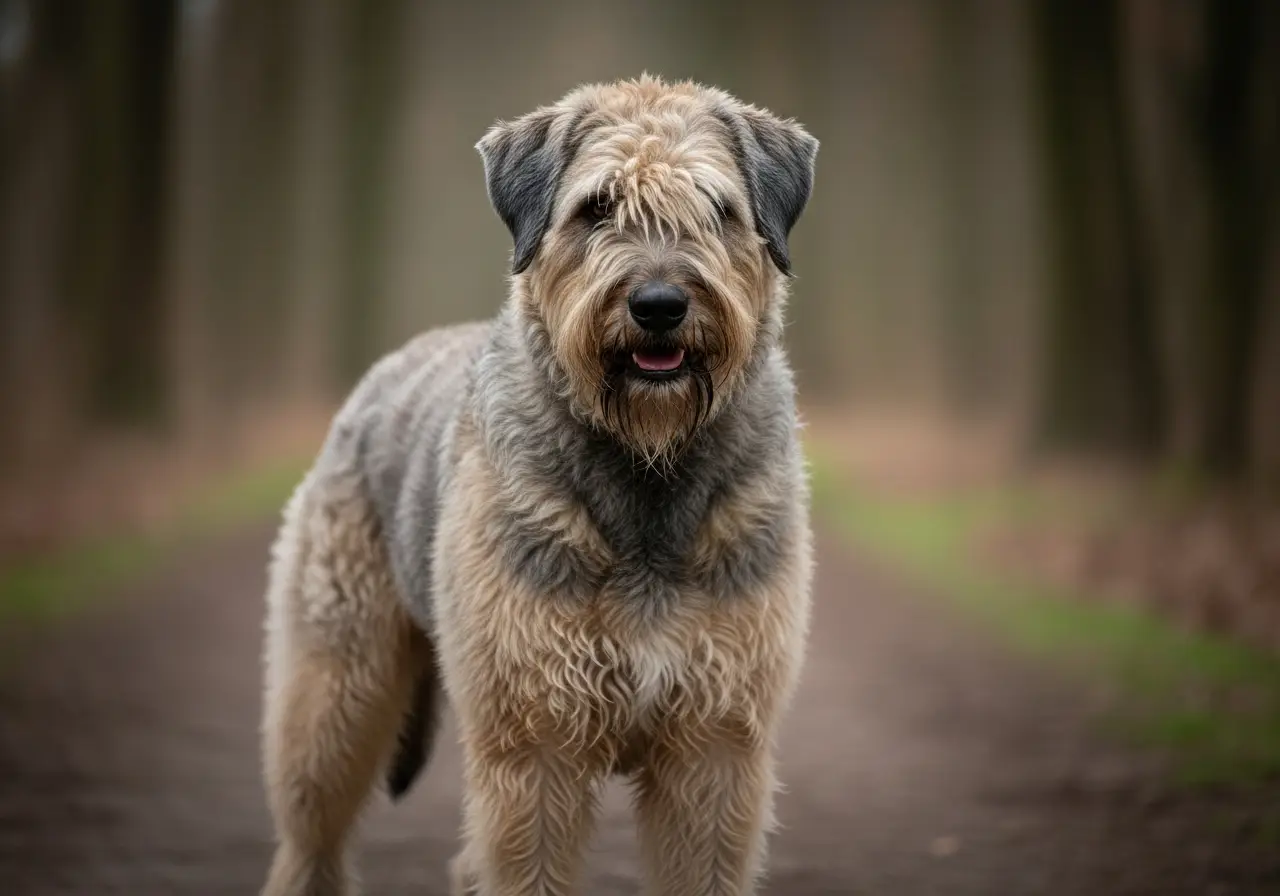
01Summary
In a paragraph
If you only have 30 seconds.
The Bouvier des Flandres is a Belgian working dog with a pronounced guarding instinct, high exercise needs, and the willingness to make independent decisions. It demands experienced owners with a clear leadership structure, consistent training, and at least 90 to 120 minutes of active stimulation daily. Those who meet these conditions receive a loyal, resilient dog with a life expectancy of 10 to 12 years.
02Introduction
What makes the Flandish Sheepdog special
The Flandish Sheepdog (Bouvier des Flandres) is a powerful Belgian working dog, FCI Group 1, versatile and robust, with a withers height of 59–68 cm.
03Profile
Key facts and suitability
- Origin
- Belgien
- Original purpose
- Herding livestock, police and military dog
- FCI
- No. 191 · Group 1 · Sektion 2: Treibhunde
- height at the withers
- 59–68 cm
- Weight
- 27–40 kg
- Life expectancy
- 10–12 Years
- Coat type
- Wire-haired
- Minimum exercise
- 120 min/day
- Puppy price
- 1'500–2'500 CHF
- Waiting period
- 9 months
- Sports
- Protection dog · Agility · Obedience · Scent work · Draft dog sports
04Temperament
How the Flandish Sheepdog shows up in everyday life
When returning home, the Bouvier des Flandres greets its primary caregiver calmly and attentively, no exuberant jumping, no constant barking. It observes, registers, and categorises. This behaviour is not disinterest but an expression of its deliberate character.
Internally, what the dog needs: The need for social contact is high. The Bouvier bonds closely with its family and demands active inclusion in everyday life. Being left alone for more than four hours is problematic without prior gradual preparation. Mental work is not a bonus but a requirement: nose work, basic protection exercises, tracking, or structured obedience training belong in the weekly programme.
Externally, as the dog reacts: towards strangers it behaves reservedly to dismissively. It does not allow itself to be touched by unknown people unless the primary caregiver has signalled permission. On a walk, it observes passers-by without reacting immediately, but upon perceiving a threat, it quickly switches to a state of alertness. This combination of high need for family contact and low tolerance for strangers must not be confused: a close family dog is not automatically a sociable dog.
In everyday life with children, the Bouvier works well with clear rules and sufficient socialisation; however, its herding instinct can lead it to try to control children during play. This requires consistent supervision, especially in the first few years. With other dogs, it is compatible if socialised early, but shows tendencies towards dominance towards conspecifics of the same sex.
05Needs
What this breed needs daily
The Flandrian Shepherd Dog needs at least 90 to 120 minutes of active exercise daily, not just walking, but stimulation involving changes of direction, tasks and physical exertion. Jogging, cycling, cross-country running or structured freedom training on secure terrain cover this need better than simple leash walks.
Mental stimulation is equally important as physical exercise. The need for mental work is high (scale 4 out of 5). Suitable formats include tracking, nose work, basic protection exercises (IPO/IGP), obedience training with task complexity or agility. Simple fetch games without a thinking component are not sufficient.
Being left alone is possible up to four hours with gradual preparation. Longer absences without alternative care lead to frustration, which manifests in destructive behaviour or vocalisation.
A house with a secure garden is advantageous but does not replace structured stimulation. The garden serves as a supplement, not a substitute for active enrichment. Keeping the dog in an apartment is possible if the daily exercise need is consistently met.
Training must be consistent, calm and fair. The Bouvier reacts sensitively to uncertainty in leadership and tests boundaries if they are not clearly defined. Attending a dog training school with experience in working dog breeds is particularly recommended during the first two years of life. Early loose-leash walking is due to its physical strength not an option but a must.
Exercise
Very high
mental work
A lot
Social needs
Medium
training
Demanding
06Sport & Mental and Physical Stimulation
What sports the Flandish Sheepdog is suited for
Realistic in terms of physiology and genetics – not every breed suits every sport.
Structurally and physiologically suitable: Suitable for herding work, treibball and coursing · CaniCross / bikejoring possible.
07Quick Check
08Suitability
Who this breed is suitable for – and who it isn't
✓Matches
The Flandrian Shepherd Dog suits owners with proven experience in handling independent working dog breeds. Specifically: people who have already handled a dog with guarding instinct or herding instinct and are familiar with consistent, calm training.
Active individuals or couples with a flexible time budget, who can plan 90 to 120 minutes for structured exercise daily, are well positioned. Owners who engage in dog sports (IGP, tracking, search and rescue work) will find a capable partner in the Bouvier.
Families with children from about ten years of age, in which all family members are familiar with handling a strong, watchful dog and consistently adhere to clear rules, are also suitable. A prerequisite is secure outdoor space.
Owners who are prepared to actively manage the reservedness towards strangers (i.e., introducing visitors, not forcing the dog into social situations and anticipating its reactions) are well positioned with this breed. Those living in a rural or suburban environment and able to provide regular field work for the dog best meet its needs.
×Doesn't match
The Flandrian Shepherd Dog does not suit first-time dog owners. Its assertiveness, guarding instinct and high need for stimulation regularly overwhelm novice owners without guidance from experienced trainers; this is evidenced by the most common reasons for surrender at rehoming centres.
People who are away from home for more than eight hours daily and cannot organise alternative care do not meet its need for social contact. Anyone expecting a well-socialised Bouvier to react openly and warmly towards strangers misunderstands its external behavioural axis: reservedness towards unknown people is not a training deficit but a breed characteristic.
Households with very young children under six years of age should factor in the pronounced herding instinct: the Bouvier tends to control movements, which can lead to conflicts in play situations.
Anyone looking for a calm companion dog without intensive enrichment or underestimating grooming makes the wrong choice with this breed. Owners who insist on off-leash freedom in public spaces without a reliable recall are also ill-suited for the Bouvier.
10Line reality
Show line, working line, breeder market
In the German-speaking region, there are two recognisable breeding directions for the Bouvier des Flandres that differ in temperament and usage profile.
Working line dogs are bred for protection work, police and military service, as well as IGP sport. They show higher drive intensity, stronger guarding instinct, and more pronounced readiness to react to stimuli. These dogs require owners with clear experience in drive management; they are demanding for normal family life without a dog sport context.
Companion-dog-oriented lines, often from Belgian and Dutch breeding with a focus on show success and temperament tests, show a somewhat calmer basic temperament while retaining the guarding instinct. The need for movement and stimulation remains high in both lines; however, the intensity of the drives varies significantly.
Anyone buying a Bouvier des Flandres should clarify before purchase which breeding direction the puppy comes from and observe the parent dogs in everyday life. A puppy from a working line in a household without a dog sport context is a frequent source of overwhelm on both sides. The German Bouvier Club of 1977 e.V. provides information on the stud book and line affiliation of registered litters.
11Health · Reality
What you need to plan for medically with your Flandish Sheepdog
The life expectancy of the Bouvier des Flandres is 10 to 12 years. This places it in the average range for large working dog breeds.
Hip dysplasia (HD) and elbow dysplasia (ED) are the most common orthopaedic problems. The German Bouvier Club of 1977 e.V. mandates an HD/ED X-ray examination for breeding approval. Breeders who do not provide these examination results should be avoided. According to data from the VDH health register (as of 2022), the prevalence of HD in large herding dog breeds is between 15 and 25 %, with breed-specific Bouvier data in the DACH region being limited due to the small population size.
Eye diseases — particularly cataracts and progressive retinal atrophy (PRA) — occur in the breed. An ophthalmological examination of the parent animals by a specialist vet must be requested before purchase.
The dense double coat predisposes to skin irritation and eczema if care is lacking. Regular brushing and trimming reduces this risk.
Overweight is an underestimated risk in this breed: The Bouvier appears more voluminous due to its coat than it actually is. Regular weight checks at the vet, at least once a year, are recommended, as overweight worsens HD symptoms.
Preventive examinations: HD/ED X-rays (parent animals before breeding), eye examination (ECVO-certified), annual general check-up, dental check. In cases of lameness, visual abnormalities, or skin changes, a veterinary assessment should be initiated promptly.
12Structured data
Health by the numbers
Prone to diseases
Hip dysplasia, eye problems
Recommended health tests
Hip X-ray, eye examination
13Myths ↔ Reality
What is often said incorrectly about this breed
Five myths, five realities, five sources.
„The Bouvier is so calm and moderate, it can manage without much exercise.
The calm impression at home is deceptive. The FCI standard explicitly requires working ability as a breeding goal. Without at least 90 to 120 minutes of active exercise daily plus mental stimulation, Bouviers des Flandres develop frustration and control behaviour. Calm behaviour in the household is an expression of balance, not of low need.
„With good socialisation, it becomes open and friendly towards strangers.
Socialisation reduces overreactions but does not change the genetic basic profile. The Bouvier des Flandres is naturally reserved towards strangers; this is not a training error but breed character. Anyone expecting an approachable greeting dog chooses the wrong breed.
„As a family dog, it is suitable for anyone who has enough space.
Space alone is not a sufficient criterion. The Bouvier des Flandres requires experienced owners with a clear leadership structure. Its pronounced guarding instinct and independence demand consistent training from the beginning. Inexperienced owners regularly underestimate its assertiveness; this is one of the most common reasons for rehoming.
„Because of its rough coat, it cares for itself; it is a low-maintenance dog.
The rough, dense double coat of the Bouvier des Flandres requires regular brushing several times a week as well as professional trimming two to three times a year. Neglected care leads to matting, which predisposes skin problems. The care effort is significantly higher than for many short-haired breeds.
„Because it is not a hunting dog, it can run off-lead without problems.
The Bouvier des Flandres has a pronounced herding and control instinct. It tends to control movements and may nudge or push away children, cyclists, or other animals with the intention of herding. Off-lead running without reliable recall and impulse control is a safety risk even for this breed.
14animal welfare
The animal welfare perspective
Breeder market, designer versions, animal shelter reality — what no one writes in the puppy ad.
The Bouvier des Flandres is a comparatively rare breed in the DACH region, which partially protects it from the mass market, but does not rule out problems.
Backyard breeders and dubious providers: Because the Bouvier is marketed as a "security dog" or "guard dog for the family", there is a niche market for puppies from uncontrolled litters without health tests. Offers without HD/ED proof of the parent animals, without temperament assessment, and without pedigree registration are a clear warning sign. Prices below 1,200 euros for a Bouvier puppy from the DACH region should be questioned critically.
Housing-related problems: The most common reason for surrender at rehoming centres is not aggression, but being overwhelmed. Owners underestimate the exercise needs, the consistency required in training, and the intensity of the guarding instinct. Dogs that have been kept for years without sufficient stimulation develop behavioural abnormalities that make rehoming difficult. This is not a breed defect; it is a housing problem.
Designer versions: Crossbreeds with the Bouvier des Flandres as a basis for "guard dog mixes" without clear breeding documentation are present on the internet. These dogs often carry the drive profile of the Bouvier without the breeder's selection for temperament stability. Caution is advised.
Rehoming as an equivalent option: Bouvier dogs in rehoming centres are often young adults between one and three years old, surrendered due to overwhelming situations. They are not defective; they require experienced owners with structure. The German Bouvier Club of 1977 e.V. operates a breed support service and rehomed dogs. Those who know the breed and meet the requirements can find a dog there that deserves a second chance.
15Costs · Transparency
What this breed realistically costs
A puppy from reputable breeding with VDH/FCI papers, HD/ED examination of the parent animals, and temperament test costs between 1,500 and 2,500 euros in the DACH region. Offers significantly below this often come from litters without health documentation.
Running costs per year: Food for a dog of this size (27–40 kg) is between 600 and 1,000 euros annually at high-quality dry food standard. Grooming (regular brushing yourself, professional trimming two to three times a year) costs between 200 and 400 euros per year at the groomer.
Vet costs: The annual basic care (vaccinations, parasite prevention, general check-up) is between 200 and 400 euros. With orthopaedic problems such as HD, diagnosis and treatment can quickly reach 1,000 to 3,000 euros. Pet insurance with surgery cover costs between 60 and 120 euros monthly for this breed and size class, depending on the provider and excess.
Dog sports and training: Those who provide species-appropriate stimulation for the Bouvier invest in club membership (IGP, tracking) between 100 and 300 euros annually plus course fees. An accompanying dog training school in the first two years is not an option, but a recommendation; costs: 300 to 800 euros.
Total costs in the first year including getting a dog: realistically 3,500 to 5,500 euros. From the second year: 1,500 to 3,000 euros annually, depending on health status and sporting activity.
16Puppy search
What you need to consider when choosing a breeder
- Reputable breeders of the Flandrian Shepherd Dog are registered with the German Bouvier Club of 1977 e.V.
- or the SKG (Swiss Kynological Society).
- These clubs maintain stud books and stipulate minimum requirements for health tests.
- Specific criteria for reputable breeding: HD and ED X-ray results for both parent animals are available in writing.
- An ophthalmological examination (ECVO) of the parents is documented.
- The breeder allows multiple visits to the litter and lets you observe the mother in everyday life.
- Puppies are handed over no earlier than eight weeks of age.
- The breeder asks questions about the living situation and rejects buyers without experience or actively accompanies them.
- Warning signs: no stud book entry, no health certificates, puppies under 1,200 euros, immediate availability without waiting time, sale via animal markets without personal contact.
- Rehoming as an equally valid option: The German Bouvier Club of 1977 e.V.
- operates a breed support service for surrendered dogs.
- Many rehomed Bouviers are young adults from situations where owners were overwhelmed; they are structurally healthy dogs that require experienced owners.
- Rehoming through the club is in every case preferable to an impulsive purchase from the internet.
FAQ
Frequently asked questions about the Flandish Sheepdog
Is Flandish Sheepdog a family dog?
Flandish Sheepdog is considered suitable for families with good socialisation and species-appropriate care.
How much exercise does Flandish Sheepdog need?
At least around 120 minutes of exercise per day. As an active breed, more so — plus mental stimulation.
What is the size and weight of Flandish Sheepdog?
Fully grown, Flandish Sheepdog reaches about 59–68 cm at the withers and weighs around 27–40 kg.
What is the life expectancy of Flandish Sheepdog?
The life expectancy of Flandish Sheepdog is approximately 10–12 years.
Which diseases are common in Flandish Sheepdog?
Hip dysplasia, eye problems
17Breed clubs
Official breed clubs in DACH
19Related
Similar breeds – and their differences
You might also be interested in
Participate
Do you have a good photo of your Flandish Sheepdog?
We are looking for expressive images for our breed profiles. Submit yours; the editorial team reviews every submission before publication.
Does this breed suit you?
Powerful Belgian versatile dog. Today mainly used as a protection dog. Needs lots of work and experienced guidance.