
01Summary
In a paragraph
If you only have 30 seconds.
The Canary Podengo is an athletic primitive hunting dog from the Canary Islands, bred for independent rabbit hunting in rocky terrain. Its prey drive is not a character trait; it is the foundation of its genetics. Anyone keeping this dog needs experience with high-drive dogs, a securely fenced environment and at least two hours of active exercise daily. The breed is considered robust and long-lived, but extremely rare in the DACH region.
02Introduction
What makes the Canarian Podengo special
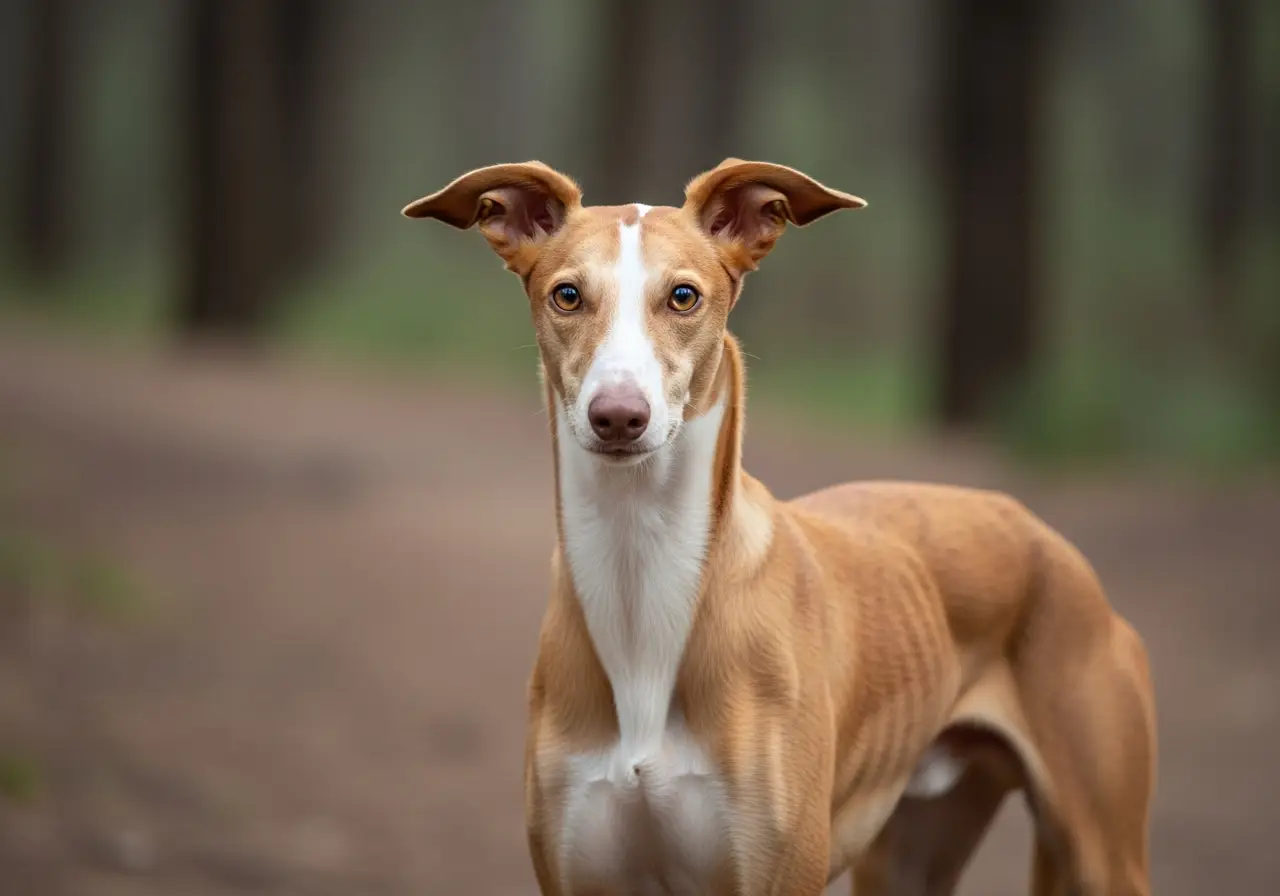
The Canarian Podengo (Podenco Canario) is a Spanish primitive hunting dog from the Canaries, FCI Group 5, heat-tolerant and athletic, withers height 53–64 cm.
03Profile
Key facts and suitability
- Origin
- Spanien (Kanaren)
- Original purpose
- Rabbit hunting on the Canary Islands
- FCI
- No. 329 · Group 5 · Sektion 7: Primitiver Typ – Jagdhunde
- height at the withers
- 53–64 cm
- Weight
- 20–30 kg
- Life expectancy
- 11–13 Years
- Coat type
- Short-haired
- Minimum exercise
- 90 min/day
- Puppy price
- 1'000–2'000 CHF
- Waiting period
- 12 months
- Sports
- Lure Coursing · Hunting · Agility
04Temperament
How the Canarian Podengo shows up in everyday life
The morning walk reveals what makes the Canarian Podengo unique: the nose immediately goes into scent tracking, the ears perk up at every sound, and the body is ready for movement in fractions of a second. This is not exuberance; it is the result of centuries of selection for independent hunting.
Internally, this dog requires daily intensive stimulation on both levels: physically through running, sprinting and terrain work, and mentally through nose work, search games or controlled prey-drive substitute activities. A moderate need for social contact means that it values the proximity of its primary caregiver without becoming clingy or separation-anxious, provided that everyday life is structured and predictable.
Externally, the Canarian Podengo reacts to strangers more reservedly than openly. It does not greet unknown people enthusiastically but shows no aggression if well socialised. Anyone who expects a high need for social contact within the family to automatically mean openness towards strangers is mistaken. These two axes diverge significantly in the Podenco Canario.
In households with other dogs, it is generally tolerant, especially if accustomed to working in groups. Small animals such as rabbits, hamsters or cats are a different matter: the prey drive necessitates clear boundaries here, and integration requires very careful introduction with no guarantee of lasting success.
It can be left alone for a maximum of four hours if everyday life otherwise provides sufficient stimulation. Anyone who regularly leaves it alone for longer risks frustration and stress-related behaviour.
05Needs
What this breed needs daily
The Canarian Podengo requires at least 120 minutes of active exercise daily, and this does not mean leisurely walks, but forms of movement that engage its body and instincts. Terrain runs, bikejoring on secure paths or structured search work in the forest suit its profile much better than city walks.
Its need for mental work is high. Mantrailing, nose work, tracking or hunting-related activities such as dummy training cover part of this need. Pure physical exhaustion without mental stimulation leads to frustration and undesirable behaviour in the medium term.
Off-lead exercise is a central issue: uncontrolled off-lead exercise with this dog is not realistic without a secure environment. A fenced property with a fence at least 1.80 m high (which can also be dug under if the dog is motivated) is not a luxury but a safety requirement. Anyone who does not have their own garden needs access to secure dog meadows or off-lead areas.
The Canarian Podengo requires a calm, clear primary caregiver with experience in handling high-drive dogs. Consistency here does not mean harshness but reliability: the dog needs predictable structures and an owner who knows and communicates its boundaries.
Being left alone should be built up gradually. A maximum of four hours is realistic if the rest of the day provides sufficient stimulation. Anyone planning regular longer absences needs a reliable care solution.
Exercise
Very high
mental work
A lot
Social needs
Medium
training
Demanding
06Sport & Mental and Physical Stimulation
What sports the Canarian Podengo is suited for
Realistic in terms of physiology and genetics – not every breed suits every sport.
Structurally and physiologically suitable: Suitable for mantrailing, dummy work and tracking · CaniCross / bikejoring possible.
07Quick Check
08Suitability
Who this breed is suitable for – and who it isn't
✓Matches
The Canarian Podengo suits owners with proven experience in handling high-drive, independently working dogs. Anyone who has already kept a hunting dog, a sighthound or another primitive type and knows the characteristics of this group brings an important prerequisite.
An active lifestyle is not an option but a requirement: at least two hours of daily exercise in varying terrain, supplemented by nose work or hunting-related activities, must be available permanently and reliably, even in winter and on holiday.
A rural or suburban environment with access to secure off-lead areas or a private fenced property is significantly more suitable for this dog than urban city life. Anyone living in an apartment without a garden needs a very concrete plan for daily stimulation.
Owners who enjoy working with their dog (whether mantrailing, tracking or dog sports) will find a willing partner in this dog that approaches tasks seriously. The willingness to further one's own expertise and collaborate with an experienced dog training school is a clear quality indicator.
Households without small animals or with the willingness for consistent separation management are also better equipped. Families with children from around ten years old who bring their own experience with dogs and actively share in the exercise requirements can also form a suitable constellation.
×Doesn't match
The Canarian Podengo is not suitable for first-time dog owners. The combination of high prey drive, pronounced independence and an exercise requirement of at least two hours daily structurally overwhelms novice owners without prior experience, not because the dog is vicious, but because misjudgements in keeping lead to serious problems.
Anyone who is away from home for eight or more hours daily and cannot organise reliable dog care should not choose this breed. Four hours of being left alone is the realistic maximum, and only if the rest of the day provides sufficient stimulation.
City dwellers without access to secure off-leash areas or green spaces face a permanent management problem. The dog needs space and terrain it can explore; concrete paving and dog toilets do not replace that.
Anyone who expects the Podenco Canario to become a reliably recallable dog without off-leash management through training underestimates the genetic depth of its prey drive. This expectation leads to frustration on both sides.
Households with small animals such as rabbits, guinea pigs or cats, lacking experience in integrating high-drive dogs, are also not a suitable environment. Families with very young children and little dog experience should consider another breed, not because the dog is dangerous, but because the requirements of both sides clash.
10Line reality
Show line, working line, breeder market
The Canarian Podengo is bred so rarely in the DACH region that a pronounced line differentiation between working and show dogs, as exists for example with Labradors or Golden Retrievers, is hardly relevant here. In Spain and on the Canary Islands, however, there are indeed differences between dogs actively used for hunting and those primarily bred for shows.
Working-oriented lines on the Canaries are selected for endurance, scenting ability and willingness to cooperate in a group. These dogs are often slimmer, quicker to react and show an even more pronounced prey drive than show lines.
Show lines focus more on the FCI standard regarding exterior (proportions, coat quality and colour) and may appear somewhat more balanced in temperament, without the prey drive being fundamentally reduced.
Anyone looking for a Canarian Podengo in the DACH region will find very little choice between different lines in practice. Availability is so limited that the individual dog's origin and the breeder's transparency regarding parent dogs and their working suitability are more important than categorisation by line. Mediterranean rescue dogs offered as Podencos are often crossbreeds or dogs of other Podenco types; having a professional determine the breed before taking the dog on is advisable.
11Health · Reality
What you need to plan for medically with your Canarian Podengo
The Canary Podengo is considered one of the less overbred breeds, a circumstance that reflects in its comparatively robust constitution. According to available data, life expectancy is 12 to 14 years, which is in the upper range for a medium to large dog.
Breed-typical diseases with frequent documentation hardly exist for the Podenco Canario to the extent seen in more popular breeds, partly due to the small population size and thus limited study base. Hip dysplasia (HD) is generally rarer in primitive hunting dogs than in heavy breeds; reliable breed statistics for the Podenco Canario are not available for the DACH region.
Due to its short, close-lying coat, sensitivity to cold is a relevant everyday factor: At temperatures below five degrees Celsius, the dog needs a well-fitting dog jacket for longer stays outdoors. This is not a medical problem, but an aspect of keeping that is often underestimated.
Preventive examinations recommended for this breed: annual general check-up with the vet, dental check (primitive types tend to develop tartar), eye examination if abnormalities are noticed, and parasite prevention, particularly for dogs imported from the Mediterranean region or that have holidayed there. Leishmaniosis is a serious risk in endemic areas of Southern Europe; prophylaxis before travelling to affected regions should be discussed with the vet. Overweight is rarely a problem with this active dog, provided its exercise needs are met.
12Structured data
Health by the numbers
Prone to diseases
No known breed-specific hereditary diseases, very robust
Recommended health tests
No specific mandatory examinations
13Myths ↔ Reality
What is often said incorrectly about this breed
Five myths, five realities, five sources.
„The Podenco Canario is like a sighthound, it only needs short sprints and then calms down.
The Canarian Podengo is not a pure sight hound like a Greyhound, but combines sight and scent drive. It requires at least 120 minutes of active exercise daily plus mental stimulation through nose work or hunting-related enrichment. Short sprints in the dog park do not come close to meeting its needs.
„Podencos are shy and traumatised, a Canarian Podengo from animal welfare is hardly integrable.
This image arises from confusion with animal welfare dogs of unknown origin, which are often referred to as Podencos. A well-socialised Canarian Podengo shows itself quite accessible towards people, albeit not effusively. Previous history and socialisation are decisive, not the breed name alone.
„The strong prey drive can be completely suppressed through consistent training.
The prey drive of the Canarian Podengo is genetically ingrained and cannot be eliminated by training, only managed. Impulse control and recall can be trained, but upon sighting wildlife or smelling game, the drive prevails in most situations. Off-lead walking without a secure environment remains a permanent risk.
„As a Mediterranean breed, the Canarian Podengo cannot tolerate the cold Central European climate.
The Canarian Podengo has a short, close-lying coat and is indeed more sensitive to cold than many Northern European breeds. This does not mean, however, that it cannot be kept in the DACH region. At low temperatures, it needs a jacket for longer stays outdoors and a warm sleeping place; this is feasible but requires awareness.
„The Canarian Podengo is a family dog that gets along well with children.
The Canarian Podengo is not a classic family dog in the sense of an uncomplicated everyday companion. It does not show fundamental rejection towards children, but requires clear structures, sufficient retreat options and a daily routine that meets its exercise and hunting needs. Families with very young children and little dog experience are rarely the right fit.
14animal welfare
The animal welfare perspective
Breeder market, designer versions, animal shelter reality — what no one writes in the puppy ad.
The Canary Podengo is so rare in the DACH region that an organised backyard breeder market, as exists for fashion breeds, hardly plays a role here. The risk of encountering a dubious mass breeder is lower than with popular breeds. Nevertheless: anyone who comes across offers online without pedigree, without access to the parent dogs or at prices far below market rate should consistently avoid them, regardless of how rare the breed is.
A specific animal welfare issue exists regarding Mediterranean Podencos: In Spain and on the Canary Islands, hunting dogs, including many Podencos of various types, are sometimes abandoned or handed over to kill shelters after the hunting season. Animal welfare organisations regularly rehome these dogs to Central Europe. This is fundamentally a legitimate and sensible option, but with important limitations.
Firstly, many of these dogs are not purebred Canary Podengos, but mixed breeds or other Podenco types. A breed determination by an expert is advisable before taking one on, if the breed designation is relevant for the decision on keeping conditions. Secondly, these dogs often have traumatic prior experiences, little socialisation with city life and require specialised care from experienced owners. Anyone taking on an animal welfare dog from the Mediterranean region should do so with eyes wide open, not as a romantic rescue story, but as a conscious decision with realistic expectations.
Designer versions or trend breeds do not exist for the Canarian Podengo to any significant extent. The breed is too little-known to become a target of fashion trends (which protects it in this regard, but also means that serious breeding structures in the DACH region are hardly developed. Anyone who chooses this breed takes responsibility for ensuring that the living conditions correspond to the dog's actual profile) and not to a romanticised image of the "wild island hunter".
15Costs · Transparency
What this breed realistically costs
A puppy from a reputable breeder with FCI papers costs between 1,200 and 2,000 EUR in the DACH region, depending on the breeding line and availability. Offers significantly below this without papers and without access to the parent animals are a warning sign. A rescue dog from the Mediterranean region usually costs between 300 and 600 EUR as a protection fee plus transport costs.
The annual living costs for a Canarian Podengo are estimated to be between 1,800 and 3,000 EUR per year for an adult dog (approx. 25–35 kg). This includes: high-quality food (approx. 600–900 EUR/year), veterinary costs for preventive care and vaccinations (approx. 300–500 EUR/year), parasite prevention including leishmaniosis prophylaxis when travelling to endemic areas (approx. 150–300 EUR/year), dog training school or training (approx. 300–600 EUR/year) as well as accessories such as a coat, lead, harness and toys.
Pet insurance is recommended for this breed: monthly premiums range between 40 and 90 EUR depending on the provider and scope of cover. In the event of illness, surgery costs can quickly reach 2,000 to 5,000 EUR. Anyone who does not take out insurance should plan for a reserve fund of at least 3,000 EUR.
16Puppy search
What you need to consider when choosing a breeder
- The Canary Podengo is one of the rarest breeds in the DACH region.
- Anyone looking for a puppy should expect long waiting times and carefully check offers from abroad, particularly from the Canary Islands or Spain.
- Reputable breeders provide proof of health tests on the parent dogs, allow several visits before handover and release puppies no earlier than eight weeks of age.
- They ask questions about the planned keeping conditions and refuse to hand over a puppy if the prerequisites are not met.
- Puppies without pedigree, without access to the parent dogs and at suspiciously low prices are a clear warning sign.
- The Swiss Club of Mediterranean Sighthounds (SKMW) is a first point of contact for reputable contacts in the German-speaking area.
- The VDH lists recognised breeders in its breeding register.
- Adoption as an equally valid option: Mediterranean Podencos occasionally enter rehoming via animal welfare imports.
- These dogs often have unknown backgrounds and require experienced owners with plenty of patience and knowledge in dealing with traumatised or poorly socialised dogs.
- A breed determination by an expert is advisable before taking one on; many dogs referred to as Podencos in animal welfare are mixed breeds.
- Anyone deciding on a rehomed dog should work closely with the rehoming organisation and bring realistic expectations.
FAQ
Frequently asked questions about the Canarian Podengo
Is Canarian Podengo a family dog?
Canarian Podengo is considered suitable for families with good socialisation and species-appropriate care.
How much exercise does Canarian Podengo need?
At least around 90 minutes of exercise per day. As an active breed, more so — plus mental stimulation.
What is the size and weight of Canarian Podengo?
Fully grown, Canarian Podengo reaches about 53–64 cm at the withers and weighs around 20–30 kg.
What is the life expectancy of Canarian Podengo?
The life expectancy of Canarian Podengo is approximately 11–13 years.
Which diseases are common in Canarian Podengo?
No known breed-specific hereditary diseases, very robust
17Breed clubs
Official breed clubs in DACH
19Related
Similar breeds – and their differences
You might also be interested in



Participate
Do you have a good photo of your Canarian Podengo?
We are looking for expressive images for our breed profiles. Submit yours; the editorial team reviews every submission before publication.
Does this breed suit you?
Elegant Canarian hunting dog. Needs warmth. Rare in Central Europe. Fast and athletic.