
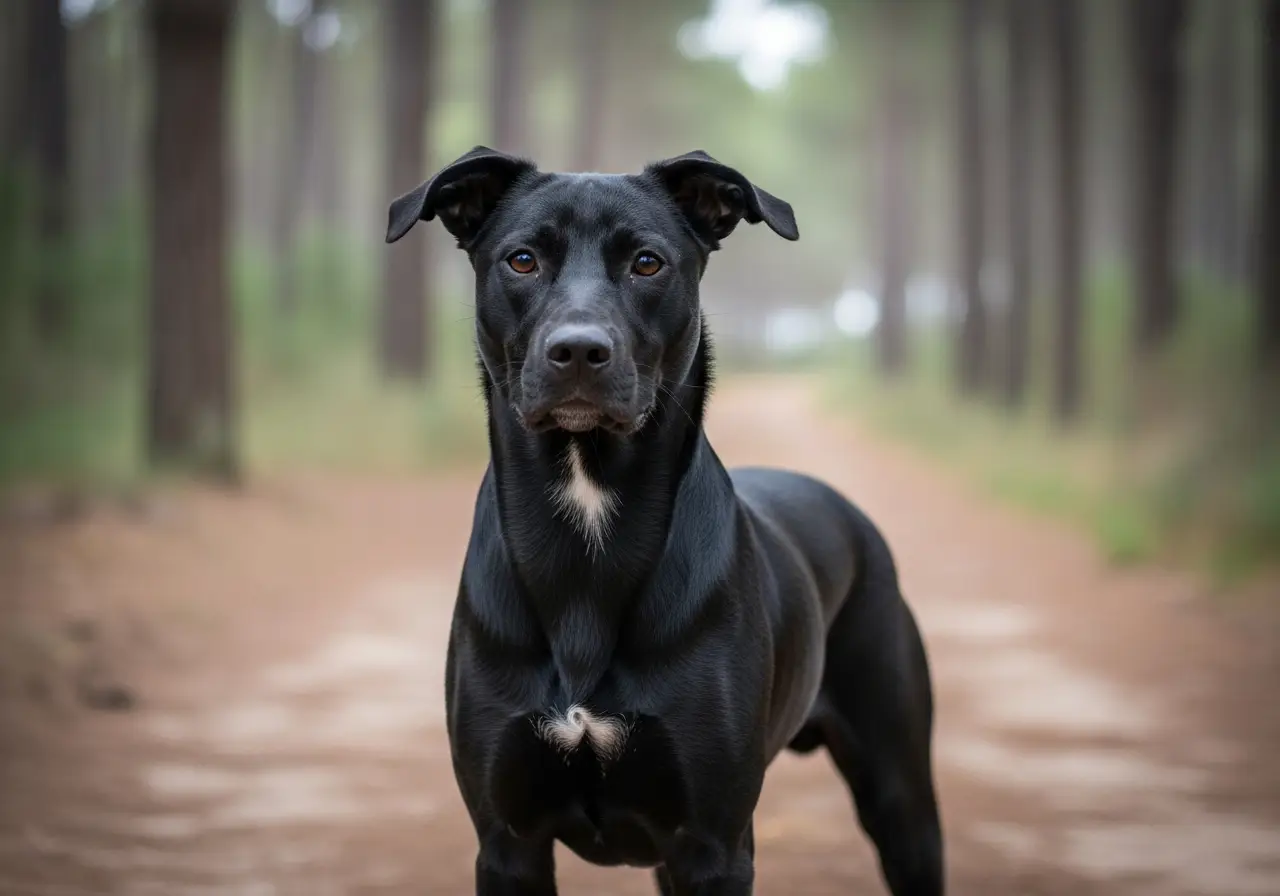
01Summary
In a paragraph
If you only have 30 seconds.
The Ca de Bestiar is a Mallorcan herding and guard dog with a deep bond to a primary caregiver and distinctly reserved behaviour towards strangers. It works independently, makes its own decisions, and demands confident leadership. Anyone who underestimates this breed or views its protective behaviour as a bonus risks ending up with a dog that manages the territory according to its own rules.
02Introduction
What makes the Ca de Bestiar (Mallorca Shepherd Dog) special
The Ca de Bestiar is a Mallorcan herding and guard dog, FCI Group 1, heat-tolerant and territorial, withers height 62–73 cm.
03Profile
Key facts and suitability
- Origin
- Spanien (Mallorca)
- Original purpose
- Herding livestock and guarding on Mallorca
- FCI
- No. 321 · Group 1 · Section 1
- height at the withers
- 62–73 cm
- Weight
- 30–40 kg
- Life expectancy
- 11–13 Years
- Coat type
- Short-haired
- Minimum exercise
- 90 min/day
- Puppy price
- 1'000–1'800 CHF
- Waiting period
- 12 months
- Sports
- Schutzhund · Agility · Obedience
04Temperament
How the Ca de Bestiar (Mallorca Shepherd Dog) shows up in everyday life
When a stranger enters the property, the Ca de Bestiar does not react by barking and retreating; it positions itself. Calm, attentive, controlled. This behaviour is no coincidence but the result of centuries of selection for independent guarding.
Internally, what the dog needs: The Ca de Bestiar has a high need for mental work. It requires tasks close to its original function: territory work, structured obedience exercises, nose work, or controlled protection work under expert guidance. Exercise alone is not enough. A dog that runs for two hours but receives no meaningful task will be physically tired but mentally unsatisfied in the evening. This manifests as increasing control behaviour towards the territory.
Externally, how the dog reacts: Towards its primary caregiver, the Ca de Bestiar is deeply loyal and attentive. It registers moods, body language, and uncertainty. Anyone who hesitates or acts inconsistently loses leadership clarity, and the dog fills this gap. It remains reserved to rejecting towards strangers, even after repeated contact. This reserve is not a training gap but breed character according to the FCI standard.
These two axes diverge: A high need for social contact with the primary caregiver does not mean openness towards visitors. Anyone who does not understand this difference and leaves the dog in social situations without management creates conflicts.
In everyday life, this means: visitor situations are actively prepared. The dog is given a defined place, and visitors behave calmly and predictably. Spontaneous situations (loud children, unknown tradesmen, crowds) require consistent intervention by the owner.
05Needs
What this breed needs daily
The Ca de Bestiar needs at least 90 minutes of structured exercise daily, not free roaming but guided activity with a clear task. Walks without structure do not sufficiently satisfy its working drive.
Mental stimulation takes precedence over pure distance here. Nose work, search tasks, controlled territory work, or advanced obedience training provide the stimulation this dog expects genetically. A Ca de Bestiar that runs ten kilometres daily but receives no mental tasks remains mentally under-stimulated.
Being left alone is possible for up to five hours, provided the dog has been sufficiently stimulated beforehand and has a clearly defined territory. A secured property is not a matter of comfort but a safety prerequisite. The dog needs boundaries it knows and accepts. Open or unsecured areas activate its control behaviour uncontrollably.
The guarding instinct requires active management: it must not be encouraged uncontrollably. Anyone aiming for protection work needs an experienced trainer with proven competence in this area, no YouTube training, no self-experimentation.
The need for social contact with the primary caregiver is high. The dog seeks closeness, orientation, and clear communication. At the same time, it is not a dog that expresses affection through submission; it remains independent. This combination requires an owner who does not confuse leadership with dominance but builds trust through consistency and reliability.
Exercise
High
mental work
A lot
Social needs
Medium
training
Demanding
06Sport & Mental and Physical Stimulation
What sports the Ca de Bestiar (Mallorca Shepherd Dog) is suited for
Realistic in terms of physiology and genetics – not every breed suits every sport.
Structurally and physiologically suitable: Suitable for herding work, treibball and coursing · CaniCross / bikejoring possible.
07Quick Check
08Suitability
Who this breed is suitable for – and who it isn't
✓Matches
The Ca de Bestiar suits owners with proven experience in leading independently working protection or herding dogs. Anyone who has already led a dog with a pronounced guarding instinct and knows the differences between working lines and show dogs brings the right starting basis.
Suitable owners have a rural or at least spacious environment with a secured property. A garden with a stable fence is not an option but a basic requirement. The daily activity time should be at least two hours, with a significant portion involving structured tasks.
Households with a stable daily structure and manageable visitor traffic are more suitable than those with frequently changing people. Anyone who manages visitors consistently and teaches the dog clear behavioural rules in social situations can keep this breed responsibly.
Experienced owners who have access to a specialised dog training school with knowledge of protection and herding dog work are clearly at an advantage. The breed demands expert guidance, particularly in the puppy phase, when guarding instinct and independence develop simultaneously.
×Doesn't match
The Ca de Bestiar is unsuitable for first-time owners and for owners who have previously kept exclusively social, people-friendly breeds. Experience with a Golden Retriever or Labrador does not prepare you for an independent guard dog.
Urban keeping in apartments or without a secure outdoor area is out of the question. High-arousal situations (busy streets, dog parks, public transport) are permanently stressful for this breed and require a level of management competence that goes beyond the everyday standard of most owners.
Anyone who views the guarding instinct as an attractive feature without knowing the consequences for daily management should not choose this breed. A dog with pronounced territorial and protective behaviour is not a status symbol; it is a daily responsibility.
Households with small children under eight years of age and without dog experience are also unsuitable. Anyone who expects the dog to automatically become child-friendly through early socialisation underestimates that reserve towards strangers, including unknown children, is a breed characteristic, not a training problem. Owners with little time budget or frequent absence for more than five hours daily should also not consider this breed.
10Line reality
Show line, working line, breeder market
The Ca de Bestiar does not have clearly differentiated breeding lines in the sense of working line versus show line, as documented for example with the German Shepherd or Belgian Malinois. The breed was bred functionally over centuries, with working ability taking precedence over exhibition success.
Two coat varieties exist: the short-haired variety, which represents the common form today, and the long-haired variant, known on Mallorca as Ca-cabrer. The FCI standard describes a slightly narrower muzzle for the long-haired variant; otherwise, both varieties share the same temperament and working profile.
Due to the very small breeding population outside the Balearic Islands, line differentiation in the DACH region is practically impossible. Prospective owners should be aware that genetic diversity in this breed is limited, making health screenings of parent animals particularly important. Asking the breeder about the inbreeding coefficient of the litter is not excessive caution but sensible diligence for rare breeds.
11Health · Reality
What you need to plan for medically with your Ca de Bestiar (Mallorca Shepherd Dog)
There are no extensive breed health studies for the Ca de Bestiar, unlike those available for popular breeds. The life expectancy is stated in specialist literature as 10 to 12 years, a typical value for large dogs.
As a functionally bred breed with a long history, the Ca de Bestiar is considered robust. This does not mean that hereditary diseases are excluded. In large dogs, hip dysplasia (HD) and elbow dysplasia (ED) are the most common orthopaedic problems. No published HD/ED prevalence studies exist for the Ca de Bestiar, but reputable breeders still have parent animals examined radiologically and provide proof of the results.
Overweight is a relevant risk for this breed, particularly if exercise needs and food quantity are not aligned. An adult Ca de Bestiar weighing 38 to 55 kg requires nutrition adapted to its caloric needs; estimates based on body size alone are insufficient.
Preventive examinations recommended include: annual vet check-up from the fifth year of life, joint screening in case of lameness or changed gait, dental check (the FCI standard describes well-developed teeth as a breed criterion). Eye examinations are not routinely prescribed for this breed but are sensible if behaviour is concerning.
Due to the small breeding population in the DACH region, the data situation is thin. Owners should choose a vet who has experience with large herding dogs.
12Structured data
Health by the numbers
Prone to diseases
Hip dysplasia, generally robust
Recommended health tests
Hip X-ray
13Myths ↔ Reality
What is often said incorrectly about this breed
Five myths, five realities, five sources.
The Ca de Bestiar is an aggressive dog that is fundamentally dangerous.
The FCI standard describes it as a dog of great nobility, reserved towards strangers, not aggressive. Its protective behaviour is genetically anchored and designed for control, not uncontrolled aggression. A well-led Ca de Bestiar reacts appropriately to the situation. However, lack of training and incorrect living conditions can lead to this potential becoming uncontrolled.
Because it worked in the heat on Mallorca, it is a low-maintenance outdoor dog without special requirements.
The breed's heat tolerance is a physiological trait, not a statement about keeping requirements. The Ca de Bestiar requires daily structured stimulation, clear leadership and a secure territory. Kept alone in the garden, without mental and physical enrichment, it develops independent behaviours that are difficult to control in everyday life.
The Ca de Bestiar is suitable as a family dog if it grows up with children from puppyhood.
Early socialisation reduces risks, but does not replace the basic prerequisites: experienced leadership, clear structure and consistent management in visitor situations. The FCI standard states that the dog recognises only one master and reacts rejectingly towards strangers. Children who appear insecure or unpredictable towards the dog can trigger this behaviour. The breed is not a dog for households without dog experience.
As a rare breed, the Ca de Bestiar is free from hereditary diseases.
Rarity does not automatically protect against genetic diseases. In large dogs with a small breeding population, there is a risk of inbreeding depression and limited genetic diversity. Hip and elbow dysplasia are documented problems in large herding dogs. Without systematic health screenings in breeding, statements about the breed's health cannot be made reliably.
The Ca de Bestiar is easy to train due to its herding dog background.
Herding dogs are not inherently easy to train; they are intelligent and independent, both of which require the owner to lead more clearly and consistently than the dog decides independently. The Ca de Bestiar was selected to work without instruction. Inconsistency or uncertainty in leadership leads it to make its own decisions, even in situations where this is undesirable.
14animal welfare
The animal welfare perspective
Breeder market, designer versions, animal shelter reality — what no one writes in the puppy ad.
The Ca de Bestiar is so rare in the DACH region that an organised backyard breeder market hardly exists. This is protective, but not complete. Occasionally, dogs appear on sales platforms described as Mallorca Shepherd Dog without proof of descent and without a discernible breeding structure. Anyone who buys a dog of this breed without checking papers and health documentation finances ignorance at best, and indifference towards animal welfare at worst.
Designer versions or crosses under the label Ca de Bestiar are not yet a widespread phenomenon; the breed is too unknown to function as a trend object. This could change if the breed gains popularity through social media presence. A dog that looks imposing in photos attracts interested parties who do not know its working profile.
The actual animal welfare problem of this breed lies not in the breeder market, but in misplacement: A Ca de Bestiar that ends up in an unsuitable household (without experience, without territory, without structure) develops behaviours that are difficult to correct. Returns to breeders or surrender to animal welfare organisations are the consequence. Since the breed rarely appears in adoption, knowledge on how to handle these dogs is often lacking.
Adoption through animal welfare organisations is an equally valid option for experienced owners. Dogs resembling the Ca de Bestiar or mixed-breed dogs with a comparable working profile are regularly rehomed from Spain. Those open to this option and meeting the keeping requirements may find a suitable dog there, avoiding the ethical questions raised by purchasing from an unknown provider. Crucial is an honest assessment by the rehoming organisation regarding the dog's character and background.
15Costs · Transparency
What this breed realistically costs
A puppy from a reputable breeder costs between 1,200 and 2,000 EUR in the DACH region, if available at all. Similar price ranges are common with breeders on Mallorca or mainland Spain, plus transport costs of 200 to 500 EUR depending on distance and mode of transport.
The annual living costs for a Ca de Bestiar weighing between 38 and 55 kg are significant. Food alone amounts to 800 to 1,400 EUR per year, depending on food quality and daily ration. Care is relatively low-maintenance for the short-haired variety, involving occasional brushing and nail trimming; effort increases with the long-haired variant.
Veterinary costs vary considerably. Basic care (vaccinations, parasite prevention, annual check-up) amounts to 300 to 600 EUR per year. For orthopaedic issues such as HD or ED, diagnosis and treatment can quickly reach 1,500 to 4,000 EUR. Pet insurance for large dogs costs between 60 and 150 EUR monthly depending on provider and coverage, representing sensible protection for a breed with limited health data.
Additional costs arise for dog training school and training: For a breed with a pronounced guarding instinct, professional guidance is not an option but a necessity. Group training alone is rarely sufficient; individual sessions with an experienced trainer cost 80 to 150 EUR per session.
16Puppy search
What you need to consider when choosing a breeder
- The Ca de Bestiar is an absolute rarity in the DACH region.
- Reputable breeders are hardly to be found domestically; the path usually leads to breeders on Mallorca or the Spanish mainland.
- This rarity makes finding a puppy challenging and increases the risk of ending up with unscrupulous providers.
- A reputable breeder provides proof of health examinations for the parent animals, at least HD and ED screening, and allows you to visit the litter on site.
- Anyone who sells puppies without inspection, without documentation, and without asking about the buyer’s living conditions is not acting in the interest of the breed.
- Occasionally, dogs appear on sales platforms described as Ca de Bestiar or Mallorca Shepherd Dog without any pedigree documentation.
- Without FCI papers and a studbook entry, the breed identity cannot be proven.
- Adoption through animal welfare organisations is an equally valid option.
- Due to the rarity of the breed, pure Ca de Bestiar are rarely available for adoption; more commonly, mixed-breed dogs or dogs of unknown origin from Spain can be found.
- These dogs can also suit experienced owners if character and living conditions match.
- An honest assessment by the adoption organisation is crucial here.
FAQ
Frequently asked questions about the Ca de Bestiar (Mallorca Shepherd Dog)
Is Ca de Bestiar (Mallorca Shepherd Dog) a family dog?
Ca de Bestiar (Mallorca Shepherd Dog) is considered suitable for families with good socialisation and species-appropriate care.
How much exercise does Ca de Bestiar (Mallorca Shepherd Dog) need?
At least around 90 minutes of exercise per day. As an active breed, more so — plus mental stimulation.
What is the size and weight of Ca de Bestiar (Mallorca Shepherd Dog)?
Fully grown, Ca de Bestiar (Mallorca Shepherd Dog) reaches about 62–73 cm at the withers and weighs around 30–40 kg.
What is the life expectancy of Ca de Bestiar (Mallorca Shepherd Dog)?
The life expectancy of Ca de Bestiar (Mallorca Shepherd Dog) is approximately 11–13 years.
Which diseases are common in Ca de Bestiar (Mallorca Shepherd Dog)?
Hip dysplasia, generally robust
17Breed clubs
Official breed clubs in DACH
19Related
Similar breeds – and their differences
You might also be interested in


Participate
Do you have a good photo of your Ca de Bestiar (Mallorca Shepherd Dog)?
We are looking for expressive images for our breed profiles. Submit yours; the editorial team reviews every submission before publication.
Does this breed suit you?
Rare Mallorcan shepherd dog. Independent and territorial. Experienced owners with space required.