
01Summary
In a paragraph
If you only have 30 seconds.
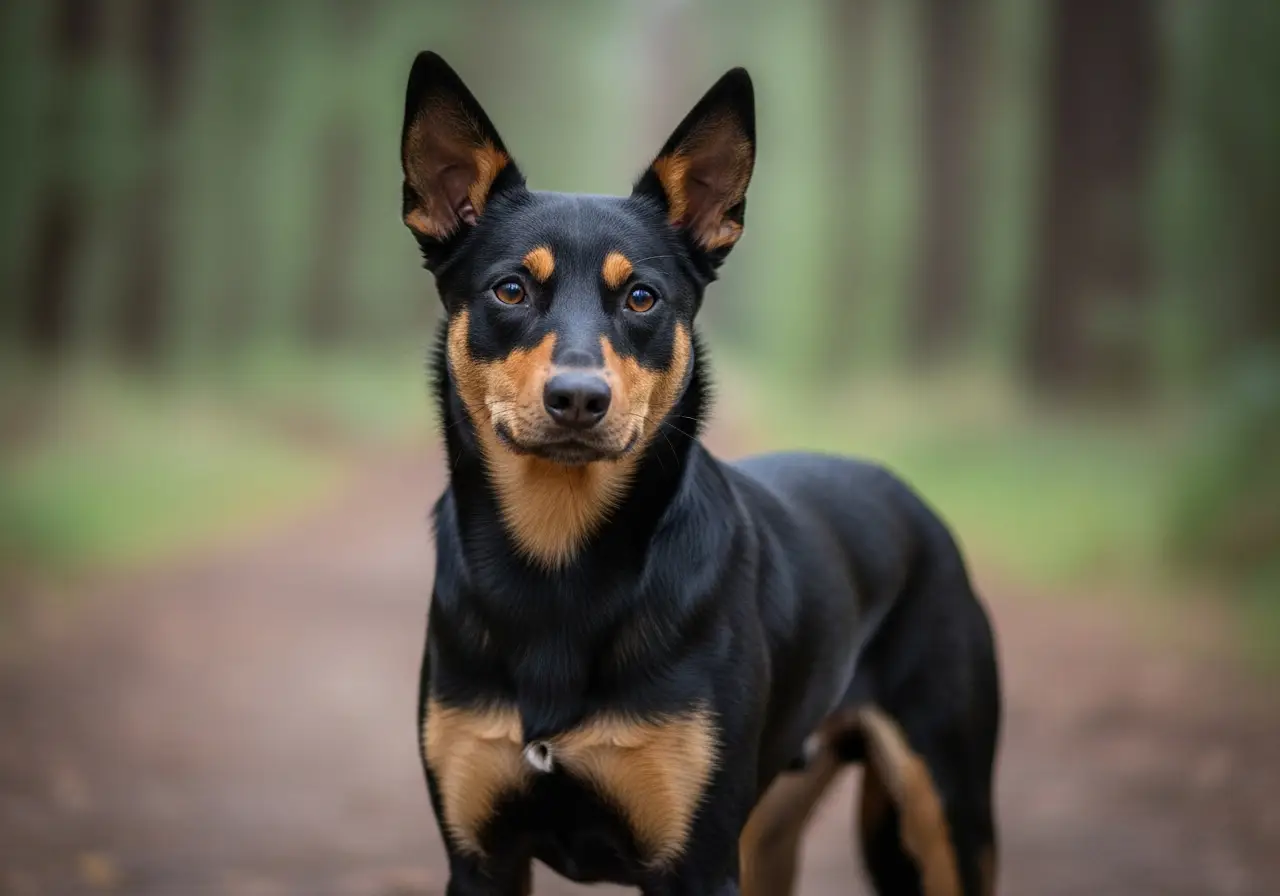
The Australian Kelpie is a herding dog from Australia that has been consistently bred for performance, not a leisure dog content with long walks. Anyone keeping one takes responsibility for a dog requiring mental work at level 5 out of 5 and an exercise need that must be met daily. Experience with working dogs is not just recommended; it is a prerequisite.
02Introduction
What makes the Australian Kelpie special
The Australian Kelpie is an Australian herding dog for sheep and cattle, FCI Group 1, extremely enduring, shoulder height 43–51 cm.
03Profile
Key facts and suitability
- Origin
- Australien
- Original purpose
- Driving sheep and cattle, herding work
- FCI
- No. 293 · Group 1 · Sektion 1: Schäferhunde
- height at the withers
- 43–51 cm
- Weight
- 11–20 kg
- Life expectancy
- 10–14 Years
- Coat type
- Short-haired
- Minimum exercise
- 120 min/day
- Puppy price
- 1'000–2'000 CHF
- Waiting period
- 9 months
- Sports
- Agility · Flyball · Frisbee · Herding work · Obedience
04Temperament
How the Australian Kelpie shows up in everyday life
The morning run shows what distinguishes the Australian Kelpie from a companion dog: It does not simply walk alongside you, it scans the environment, registers every movement stimulus and waits for a task. If there is none, it finds one.
Internally, the Kelpie needs intensive mental work and physical stimulation daily (need for mental work and need for movement both at maximum level). This means concretely: Two hours of active enrichment are not a buffer but a minimum. Anyone who comes home in the evening and finds a relaxed dog has structured the day well. Anyone who does not will find rearranged furniture, chewed door frames or a dog that has been herding the cat for hours.
Externally, the Kelpie behaves neutrally to reservedly towards strangers; friendliness towards unknown people is at level 3 out of 5. This means: no aggressive behaviour, but also no open greeting. Visitors expecting a tail-wagging greeting dog will be disappointed. The Kelpie observes first before allowing contact.
These two axes must not be confused: A high need for social contact with the primary caregiver does not mean that the dog is open to everyone. The Kelpie bonds closely with its main caregiver, yet remains at a distance towards strangers. Anyone who interprets this as shyness and pushes the dog into social situations creates stress.
In everyday life with other dogs, it shows itself to be compatible with good socialisation, but not intrusive. Many Kelpie owners know the herding instinct towards conspecifics (circling, nudging, fixing) from the dog park.
05Needs
What this breed needs daily
The Australian Kelpie requires at least two hours of active exercise daily, and this is the lower limit, not the benchmark for particularly committed owners. Pure walks do not meet this need. The dog requires forms of movement that simultaneously challenge the mind: herding work, agility, obedience, treibball or canicross with training elements.
Mental work is equal in importance to physical stimulation. A Kelpie that is physically exhausted but mentally under-stimulated recovers quickly and seeks out enrichment, rarely something that pleases the owner. Nose work, search games and structured training sessions belong in the daily plan.
The Kelpie tolerates being left alone for up to about four hours, provided that sufficient stimulation is ensured before being left alone. An under-stimulated Kelpie left alone develops destructive behaviour or excessive barking. This is not a character flaw; it is the logical consequence of a working dog without work.
The herding instinct requires active management. Movement stimuli (running children, bicycles, other animals) reliably activate the instinct. Impulse control training is therefore not an optional component, but a basic prerequisite for a safe everyday life.
Socially, the Kelpie needs a clear primary caregiver with consistent leadership. It reacts sensitively to moods and body language; inconsistent behaviour by the owner unsettles it and makes training more difficult. A dog training school with experience in working dogs is recommended for the first few months.
Exercise
Very high
mental work
A lot
Social needs
Medium
training
Demanding
06Sport & Mental and Physical Stimulation
What sports the Australian Kelpie is suited for
Realistic in terms of physiology and genetics – not every breed suits every sport.
Structurally and physiologically suitable: Suitable for herding work, treibball and coursing · CaniCross / bikejoring possible.
07Quick Check
08Suitability
Who this breed is suitable for – and who it isn't
✓Matches
The Australian Kelpie suits owners who can realistically implement at least two hours of structured stimulation, exercise and mental work combined daily. This includes people in employment who integrate the dog into their everyday life, not vice versa.
Specific profiles for whom the Kelpie represents a realistic choice:
Owners with an active dog sport background (agility, obedience, treibball, herding) and experience with high-drive dogs. Agricultural businesses or owners with access to herding work that offers the dog a real task. Sportively active individuals or couples without young children who integrate the dog into running or cycling sports and complete structured training in parallel. Families with children from about ten years of age, in which at least one person brings experience with working dogs, implements clear rules consistently and actively manages the herding instinct.
Internally, the owner must take the need for mental work seriously, not as occasional variety, but as a daily duty. Externally, they must accept that the Kelpie remains reserved towards strangers and does not function as an open social dog. Anyone who wants to impress visitors with a friendly greeting dog should choose a different breed.
×Doesn't match
The Australian Kelpie does not suit owners who are away from home for eight or more hours daily and do not have a reliable dog care plan. Four hours of being left alone is the realistic maximum, and only if sufficient stimulation is ensured beforehand.
First-time owners without prior experience with high-drive working dogs regularly underestimate what this dog demands daily. The Kelpie's quick learning ability seems impressive at first; however, it also means that unwanted behaviours become entrenched just as quickly as desired ones.
Households with young children under six years of age carry an increased risk: The herding instinct is directed at movement stimuli, and running young children reliably trigger this instinct. Nudging, nipping at the heels and circling are not aggression, but breed traits; they can be trained, but not bred out.
Anyone who plans to keep the Kelpie as a calm companion dog for occasional hikes or as a living room dog with a daily walk is choosing the wrong breed. Anyone who also expects the dog to react openly and warmly towards strangers will be disappointed by the Kelpie's reserved basic attitude. A high need for social contact with the primary caregiver does not automatically mean openness towards every person; anyone who confuses these two axes will experience surprises.
10Line reality
Show line, working line, breeder market
The Australian Kelpie exists in two clearly separated breeding lines that differ considerably in drive intensity, temperament and suitability for everyday life.
The Working Kelpie (working line) is bred exclusively according to performance criteria. Colour, body structure and FCI conformity play no role; endurance, herding instinct and independence are decisive. Working Kelpies from active farm lines generally show the highest drive intensity and the lowest frustration tolerance when under-stimulated. They are rarely available purebred with papers in Europe and are often imported directly from Australia or Great Britain. For owners without herding work or comparable dog sports at a high level, they are generally too demanding.
The Show Kelpie (show line) is bred according to FCI Standard No. 293 and is the more common variant in Europe. It shows the same breed character (high need for movement and mental work, pronounced herding instinct) but with somewhat lower drive intensity than the purest working lines. In everyday life, it is easier to handle for committed owners with dog sports ambitions but by no means needs less stimulation than an average companion dog.
Before buying or taking on a Kelpie, the line question is decisive: A puppy from an active working line in an urban household without herding work is a misplacement, regardless of how committed the owner is. The responsible breed club (VATH or Australian Kelpie Club Deutschland) advises on line assignment.
11Health · Reality
What you need to plan for medically with your Australian Kelpie
The Australian Kelpie is considered a functionally bred, robust breed with a life expectancy of 12 to 15 years, a high value compared to many other breeds, which is attributed to the consistently performance-oriented breeding.
Hip dysplasia (HD) occurs in the breed but is less common than in many large dog breeds. Reliable breed-specific HD rates for the Australian Kelpie are not yet widely available in scientific literature; the OFA (Orthopedic Foundation for Animals, USA) reports an HD rate of under 5% for the breed (status: OFA database 2023). Breeders should nevertheless provide proof of HD examination for both parent animals.
Hereditary eye diseases are the more relevant health issue: Progressive Retinal Atrophy (PRA) and Collie Eye Anomaly (CEA) occur in the breed. Both are genetically determined and detectable through DNA tests. Reputable breeders test breeding animals and present the results. In cases of visual abnormalities (night blindness, altered pupil reaction), an ophthalmological examination by a vet is required.
During growth (up to about 18 months), intensive strain (long runs on hard surfaces, jumping) should be reduced to spare joints and growth plates. The short coat requires minimal care; regular brushing is advisable during the main shedding periods (spring/autumn).
Overweight is rarely a problem in sufficiently exercised Kelpies, but possible in dogs with too little exercise and places long-term strain on joints. Regular weight checks at the vet (at least once a year) are recommended.
12Structured data
Health by the numbers
Prone to diseases
Collagenopathy (Hereditary Canine Spinal Muscular Atrophy), progressive retinal atrophy, hip dysplasia
Recommended health tests
DNA test CNSMD, eye examination, hip X-ray
13Myths ↔ Reality
What is often said incorrectly about this breed
Five myths, five realities, five sources.
"The Kelpie is like a Border Collie, just a bit calmer.
The Australian Kelpie is not a toned-down Border Collie. It shows greater independence in work and a different herding style, with less eye contact with the flock, more body pressure and endurance over long distances. Drive intensity and need for mental work are at a comparable level. Anyone looking for a 'calmer' herding dog will not find it here.
"A large garden replaces daily stimulation.
A garden offers freedom of movement but does not replace structured mental and physical stimulation. The Australian Kelpie needs tasks with a training character, herding work, dog sports or structured exercise sessions. A dog that occupies itself in the garden often develops undesirable behaviours such as digging, barking or herding children and other animals.
"Kelpies are family dogs that get along well with children.
The herding instinct of the Australian Kelpie is directed at movement stimuli; running children reliably trigger this instinct. Herding children by nudging, jumping up or nipping at the heels is not misbehaviour but a breed trait. In families with children, consistent training and permanent supervision are required; automatic compatibility does not exist.
"Working dogs like the Kelpie train themselves through work.
Work motivation is no substitute for training. The Australian Kelpie learns extremely quickly, which includes undesirable behaviours that solidify just as quickly without clear guidance. Independence in herding work does not mean the dog manages without structure in everyday life. Impulse control, recall and socialisation must be actively trained.
"Show Kelpies have the same character as Working Kelpies.
Show line and working line differ measurably in drive intensity and temperament. Working Kelpies from active farm lines generally show higher drive intensity and lower frustration tolerance when under-stimulated. Show Kelpies are often somewhat easier to handle in everyday life but still need significantly more stimulation than an average companion dog. The question of which line must be clarified before purchase.
14animal welfare
The animal welfare perspective
Breeder market, designer versions, animal shelter reality — what no one writes in the puppy ad.
In Switzerland, the Australian Kelpie ends up in animal shelters and breed rescue organisations disproportionately often. The most common reasons for surrender are destructive behaviour due to under-stimulation and uncontrolled herding instinct towards children or other animals. These are not character flaws; they are the predictable consequences of incorrect placement.
The market for Australian Kelpies has changed in recent years. The breed has become more visible through social media; videos of Kelpies performing spectacular herding work or excelling in dog sports create demand among owners who do not realistically assess daily life with this dog. Proliferation businesses and dubious suppliers respond to this demand with puppies lacking lineage clarity, without health tests and without advice on suitability.
A Kelpie puppy from such a source often costs between 500 and 900 euros on classifieds portals, significantly below the price of reputable breeders (1,200 to 1,800 euros). The price difference reflects missing health examinations, missing pedigrees and missing breeding advice. The follow-up costs (behavioural therapy, animal shelter, rehoming) regularly exceed the savings.
Designer versions of the Kelpie (crossbreeds with other herding dogs or companion dogs) are occasionally marketed as a "calmer Kelpie". Reliable statements about drive strength and temperament are not possible for crossbreeds without knowledge of lineage.
Rehoming an adult Kelpie from an animal shelter or breed rescue organisation is an equally valid and often more sensible option than buying a puppy: character, drive strength and everyday behaviour can already be assessed. Organisations such as the VATH or the Australian Kelpie Club Deutschland rehome dogs and advise on suitability without purchase pressure.
15Costs · Transparency
What this breed realistically costs
A puppy from a reputable breeder with FCI papers, health tests and breeding advice costs between 1,200 and 1,800 euros in the DACH region. Offers significantly below this, particularly on classifieds portals without proof of breeding, signal missing health examinations or unclear lineage affiliation.
The annual living costs for an Australian Kelpie are approximately 1,500 to 2,500 euros depending on the form of keeping. Food for an active dog of this size (14–20 kg) costs between 600 and 1,200 euros per year depending on quality and feeding method. Care is inexpensive for the short-haired Kelpie: occasional brushing and annual nail care are sufficient.
Vet costs vary greatly: basic care (vaccinations, deworming, annual examination) amounts to 200 to 400 euros per year. Potential costs for eye examinations (PRA/CEA screening: 80–150 euros) and orthopaedic checks during growth are added. Pet insurance costs between 40 and 90 euros monthly for this breed and size class depending on provider and scope of benefits, and is a sensible consideration given possible surgery costs (HD operation: 2,000–5,000 euros).
Dog sports and training are not optional expenses for the Kelpie: A supporting dog training school with experience in working dogs costs 150 to 400 euros for a basic course. Ongoing sports groups (Agility, Herding) add 20 to 60 euros monthly.
16Puppy search
What you need to consider when choosing a breeder
- A reputable breeder of Australian Kelpies lets puppies leave no earlier than at eight weeks, provides pedigrees (FCI/VDH/SKG) and enables a visit to the litter, including seeing the mother in everyday life.
- Both parent animals should be tested for hereditary eye diseases (PRA, Collie Eye Anomaly) as well as hip dysplasia; the results are presented in writing.
- The question of lines, working line or show line, must be clarified before purchase.
- A reputable breeder raises this question actively and advises honestly on which puppy suits the owner profile.
- Anyone who does not ask this question breeds for sale, not for placement.
- Warning signs: Puppies without papers at significantly reduced prices, sale via classifieds portals without proof of breeding, no right to visit before purchase, puppies under eight weeks.
- Placement via animal shelters or breed rescue organisations is an equally valid option.
- Australian Kelpies end up in rehoming services disproportionately often, usually due to under-stimulation rather than character problems.
- An adult Kelpie from a rehoming service has the advantage that its character and drive strength can already be assessed.
- The Australian Kelpie Club Deutschland e.V.
- and the VATH (Association for Australian Driving and Herding Dogs) maintain breeder lists and provide advice when looking for a puppy.
FAQ
Frequently asked questions about the Australian Kelpie
Is Australian Kelpie a family dog?
Australian Kelpie is considered suitable for families with good socialisation and species-appropriate care.
How much exercise does Australian Kelpie need?
At least around 120 minutes of exercise per day. As an active breed, more so — plus mental stimulation.
What is the size and weight of Australian Kelpie?
Fully grown, Australian Kelpie reaches about 43–51 cm at the withers and weighs around 11–20 kg.
What is the life expectancy of Australian Kelpie?
The life expectancy of Australian Kelpie is approximately 10–14 years.
Which diseases are common in Australian Kelpie?
Collagenopathy (Hereditary Canine Spinal Muscular Atrophy), progressive retinal atrophy, hip dysplasia
17Breed clubs
Official breed clubs in DACH
19Related
Similar breeds – and their differences
You might also be interested in

Participate
Do you have a good photo of your Australian Kelpie?
We are looking for expressive images for our breed profiles. Submit yours; the editorial team reviews every submission before publication.
Does this breed suit you?
Enduring working dog with enormous exercise needs. Not a city dog – requires daily intensive enrichment. One of the most capable herding dogs.