
01Summary
In a paragraph
If you only have 30 seconds.
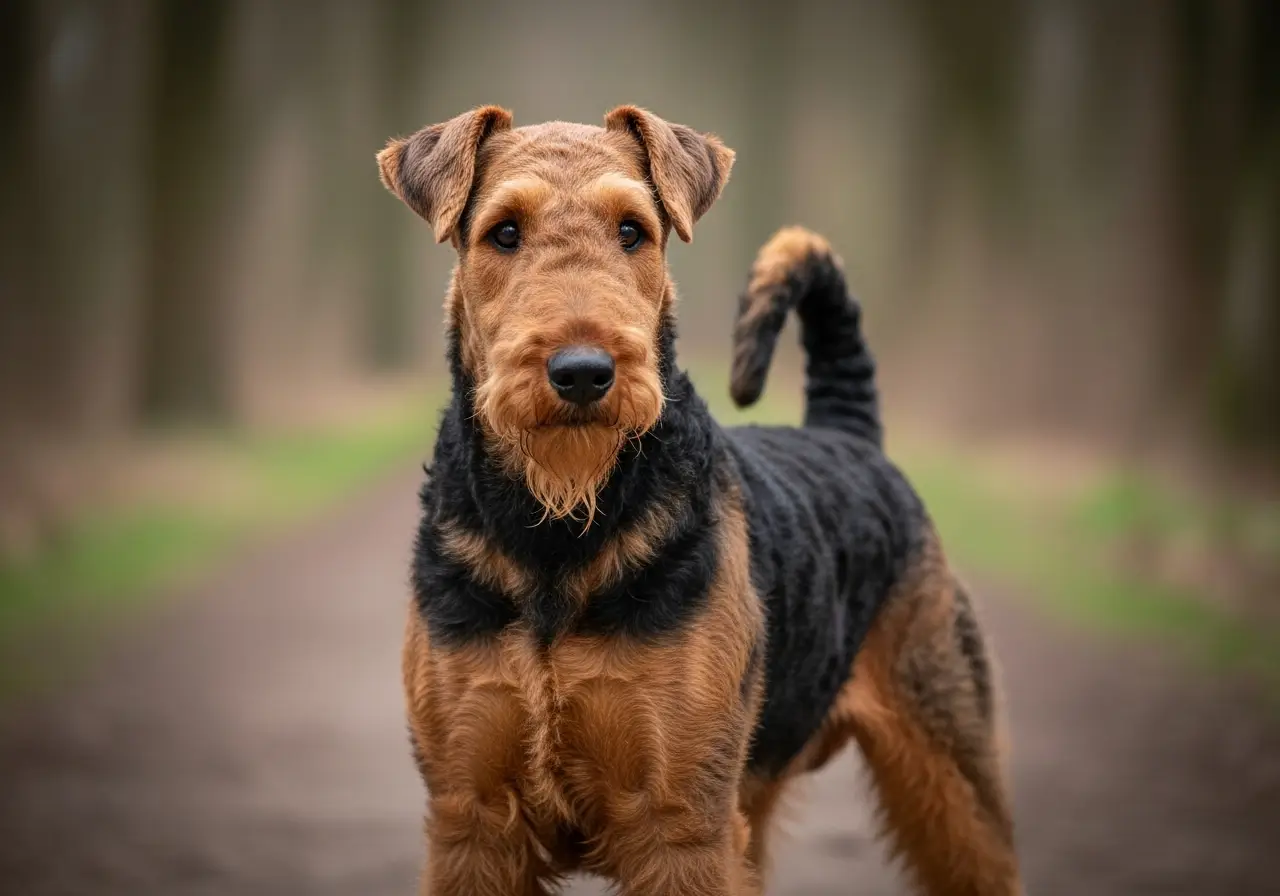
The Airedale Terrier is the largest representative of the terrier group and one of the most demanding. Its prey drive is strongly typical of the breed, its independence pronounced, and its need for mental work high. Whoever underestimates it will get a dog that shapes its own daily routine. Whoever leads with structure and invests time every day will get a versatile, resilient partner with genuine character.
02Introduction
What makes the Airedale Terrier special
The Airedale Terrier is the largest of all terriers, originally from Yorkshire, FCI Group 3, withers height 56–61 cm, known for versatility and courage.
03Profile
Key facts and suitability
- Origin
- Grossbritannien
- Original purpose
- Hunting otters and rats, police dog, war dog
- FCI
- No. 7 · Group 3 · Section 1
- height at the withers
- 56–61 cm
- Weight
- 18–29 kg
- Life expectancy
- 10–13 Years
- Coat type
- Wire-haired
- Minimum exercise
- 90 min/day
- Puppy price
- 1'200–2'000 CHF
- Waiting period
- 9 months
- Sports
- Agility · Schutzhund · Scent work · Obedience · Mantrailing
04Temperament
How the Airedale Terrier shows up in everyday life
The morning walk reveals what makes the Airedale Terrier unique: it does not simply follow along; it scans its surroundings, registers every wild scent, and independently decides which trail is interesting. The owner is both companion and leader, but not an autopilot.
Internally, in terms of what the dog needs, this breed has a high need for social contact. It seeks active contact with its primary caregiver, wants to be included, not just present. Hours of being left alone without gradual training leads to restlessness and destructive behaviour. Four hours are a realistic upper limit if being left alone has been trained properly.
Externally, in terms of how the dog reacts to stimuli, a different picture emerges. Towards strangers, the Airedale Terrier behaves reservedly and vigilantly. It does not greet unknown people enthusiastically; it observes first and then decides. This is not a lack of socialisation, but typical terrier watchfulness. These two poles (high need for social contact with the primary caregiver, reserve towards strangers) must not be confused.
Towards other dogs, it appears confident. Towards dogs of the same sex, it can react dominantly, especially if it feels provoked. In everyday life with children, it works in structured households; however, its temperament is impulsive enough that interactions with very young children must be actively supervised.
Its prey drive reliably activates in response to movement stimuli: hares, deer, cats. A reliable recall is not automatic but the result of consistent training over months.
05Needs
What this breed needs daily
The Airedale Terrier requires at least 90 minutes of active exercise daily; this is a minimum, not a recommendation. Simple walks without structure are insufficient. The dog needs activities that challenge its mind: nose work, search games, fetch training, or dog sports such as mantrailing, agility, or obedience.
Mental stimulation is just as important as physical exercise. An Airedale Terrier that is physically tired but mentally under-stimulated will find its own entertainment, rarely to the owner’s delight. Daily training sessions of 15–20 minutes that require genuine mental effort have a noticeable effect on calm behaviour.
The need for social contact is high. The dog wants to be included in daily life, not wait in the garden. Being left alone can be trained gradually but requires consistent training from the start. The maximum time alone is approximately four hours, provided the dog is well-trained and properly prepared.
Its prey drive demands secure exercise opportunities. Off-leash walking in areas rich in wildlife without a reliable recall is irresponsible. Recall must be trained under distraction, which requires time, patience, and regular repetition.
The coat requires professional stripping two to three times a year. Clipping is not an equivalent alternative as it permanently alters the coat structure. Ears and paws require regular checks. Overall, grooming effort is moderate but not negligible.
Exercise
High
mental work
A lot
Social needs
Medium
training
Demanding
06Sport & Mental and Physical Stimulation
What sports the Airedale Terrier is suited for
Realistic in terms of physiology and genetics – not every breed suits every sport.
Structurally and physiologically suitable: Suitable for mantrailing, dummy work and tracking · CaniCross / bikejoring possible.
07Quick Check
08Suitability
Who this breed is suitable for – and who it isn't
✓Matches
The Airedale Terrier suits owners who can provide at least 90 minutes of active enrichment daily, part of which should include structured training. Experience with independent or high-drive breeds is a clear advantage. Those who enjoy dog sports, nose work, or structured daily training will find a reliable partner in this breed.
Families with children from about eight years old, where clear rules are consistently enforced, get along well with the Airedale Terrier, provided that the need for exercise and mental work is met daily.
Active individuals or couples who include the dog in sports or leisure activities benefit from its endurance and eagerness to learn. A household with a garden makes daily life easier but does not replace structured enrichment.
Those willing to properly train being left alone and manage the prey drive through consistent recall training will gain a dog with true character and a wide range of applications, from companion dog to performance sports.
×Doesn't match
The Airedale Terrier does not suit owners looking for a calm companion dog without pronounced drive. Those who can offer less than 90 minutes of active enrichment daily or lack access to secure exercise opportunities will be permanently overwhelmed by this breed.
Households getting their first dog and not planning guidance from an experienced dog training school tend to underestimate the Airedale Terrier’s stubbornness. Those who view consistency in training as optional will end up with a dog that sets its own rules.
Those who confuse the high need for social contact with friendliness towards strangers will experience disappointment: the Airedale Terrier is intensely bonded to its primary caregiver but reserved and vigilant towards strangers; this is not a training error but a breed trait.
Households with very young children under five years old, where consistent supervision is not possible, as well as owners who are regularly absent for more than four hours daily, should not choose this breed.
10Line reality
Show line, working line, breeder market
The Airedale Terrier is today predominantly bred in show lines. These lines focus on exterior and type stability according to the FCI standard. The need for mental work and the prey drive are also present in show lines, but vary individually.
Working lines in the classical sense, as clearly defined for retriever or herding breeds, do not exist for the Airedale Terrier with comparable clarity. However, individual breeders deliberately value working instincts, nose performance and resilience. These dogs differ noticeably from pure show lines in everyday life: higher drive intensity, more pronounced reaction to movement stimuli, stronger focus on tasks.
Anyone looking for an Airedale Terrier for dog sports, mantrailing or scent work should specifically ask the breeder about working disposition and performance tests in the pedigree. A puppy from a pure show line may be suitable for these purposes, but does not have to be.
In Switzerland, Austria and Germany, breeding is organised through the respective breed clubs (SATC, Airedale Terrier Spezialklub, Klub für Terrier e.V.). Lineage differences are not always explicitly indicated in breeding documentation; therefore, a personal conversation with the breeder about the intended use and working traits of the parent dogs is recommended.
11Health · Reality
What you need to plan for medically with your Airedale Terrier
The Airedale Terrier is considered a robust breed with a life expectancy of 11 to 14 years. Brachycephaly or other structural traits associated with unethical breeding are not typical for the breed.
Hip dysplasia (HD) occurs in the breed but is less common than in large retriever or herding breeds. Reputable breeders have parent dogs radiologically examined for HD and provide proof of results; when buying a puppy, an HD assessment of the parents should be presented. Elbow dysplasia (ED) is documented less frequently but should also be queried.
Skin diseases, including allergic reactions and seborrhoeic dermatitis, are known in the breed. They manifest as itching, dandruff, or recurring inflammation. Early veterinary investigation prevents chronic conditions.
Hypothyroidism occurs more frequently in Airedale Terriers than in the breed average of many other breeds. Symptoms such as weight gain, lethargy, and coat changes should be investigated by a vet. Diagnosis is made via blood tests; treatment is medicinal and long-term.
Gastric dilatation and volvulus (Bloat/GDV) is a known risk in medium to large dogs with deep chests, including the Airedale Terrier. Preventive measures (several small meals, no intense exercise immediately after eating) reduce the risk.
Preventive examinations: HD X-rays of parent dogs before breeding, annual thyroid levels from the fifth year of life, skin checks if irregularities are noted. The coat must be regularly checked for parasites and skin changes.
12Structured data
Health by the numbers
Prone to diseases
Hip dysplasia, thyroid problems, skin problems
Recommended health tests
Hip X-ray, thyroid screening
13Myths ↔ Reality
What is often said incorrectly about this breed
Five myths, five realities, five sources.
"The Airedale Terrier is an uncomplicated family dog that is easy to train.
The Airedale Terrier has a pronounced stubbornness that is typical of the breed and genetically anchored. It learns quickly, but actively questions the consistency and sense of rules. Inconsistent guidance does not lead to indifference, but to independent problem-solving strategies, at the owner's expense. Experience in dealing with independent breeds is not optional, but a prerequisite.
"As a large dog, the Airedale Terrier mainly needs lots of space, no intensive training.
The need for space is secondary. The Airedale Terrier requires daily mental stimulation through training, nose work or structured tasks, regardless of living space. A house with a garden without an enrichment structure does not meet the need for mental work. Understimulation manifests itself in destructive behaviour, loud protest or uncontrolled hunting behaviour.
"The prey drive can be completely suppressed by early socialisation.
The Airedale Terrier's prey drive is typical of the breed and genetically anchored; it was selected over generations for hunting otters, rats and small game. Socialisation reduces overreactions, but does not eliminate the drive. A reliable recall in areas with wild scent requires consistent, long-term training and remains situation-dependent. Off-leash walking without security measures carries real risks.
"Airedale Terriers are aggressive towards people.
The FCI standard explicitly describes the Airedale Terrier as open, trusting and not aggressive, but fearless. It behaves reservedly and vigilantly towards strangers; this is terrier vigilance, not aggression. Problematic behaviour arises predominantly from lack of socialisation or overstimulation, not from breed disposition.
"The wiry coat of the Airedale Terrier is easy to care for and requires little effort.
The wiry coat of the Airedale Terrier requires regular hand-stripping, not clipping. Clipping permanently alters the coat structure: the regrowing coat loses its typical wiry texture and thus part of its protective function. Professional stripping is necessary two to three times a year and incurs ongoing costs of 80–150 EUR per session.
14animal welfare
The animal welfare perspective
Breeder market, designer versions, animal shelter reality — what no one writes in the puppy ad.
The Airedale Terrier regularly ends up in animal welfare shelters, and the reasons are predictable. Underestimated exercise needs, lack of engagement structure, and a prey drive that has not been managed in everyday life: these are the most common reasons for surrender documented by animal welfare organisations in the DACH region. The breed is not difficult; it is demanding. The difference lies in expectation management before purchase.
Backyard breeder market: Airedale Terriers from unethical breeding are regularly offered on classifieds platforms without pedigrees, without health certificates for the parent dogs, and at prices under 800 EUR. These puppies often come from operations that do not perform HD examinations or thyroid screenings on the parent dogs. The risk of follow-up costs due to hereditary diseases is correspondingly increased.
No designer versions: The Airedale Terrier has so far not become a target for systematic designer crosses. Occasionally, crosses with other terrier breeds appear; these are neither FCI-recognised nor accompanied by professional breeding practices.
Breeding and keeping-related problems: The greatest challenge lies not in breeding but in keeping. Airedale Terriers that are under-stimulated daily develop behavioural issues, described in animal welfare contexts as 'aggression' or 'uncontrollability', which are generally attributable to insufficient mental and physical stimulation. Overweight is an increasing problem in dogs of this breed with little exercise, as their energy requirement is high and a calorie surplus quickly leads to joint stress.
Adoption as an equivalent option: Adult Airedale Terriers from animal welfare or breed-specific rescue are a serious alternative to buying a puppy. Their character is already discernible, and their health status can be documented. Breed clubs such as the Klub für Terrier e.V. or the SATC maintain contacts for rehoming. Anyone looking for an adult dog with a known background will find competent contacts there.
15Costs · Transparency
What this breed realistically costs
An Airedale Terrier puppy from reputable breeding with FCI papers, HD certificates for the parent dogs, and initial veterinary care costs between 1,200 and 2,000 EUR in the DACH region. Offers significantly below this, especially without pedigrees or health certificates, often come from backyard breeding with increased health risks.
Running costs per year (guideline values):
- Food (quality dry food or BARF): 600–1,000 EUR
- Professional trimming (2–3 times a year at 80–150 EUR each): 160–450 EUR
- Vet routine (vaccinations, parasite prophylaxis, annual check-up): 200–400 EUR
- Dog liability insurance: 60–120 EUR/year
- Pet insurance (optional, recommended): 300–600 EUR/year
Vet special cases: Treatment of hypothyroidism (long-term medication): 200–500 EUR/year. HD treatment in clinical manifestation: 1,500–4,000 EUR depending on severity. Gastric dilatation (emergency surgery): 2,000–5,000 EUR.
The total costs in the first year (including getting a dog, basic equipment and initial vaccinations) realistically amount to 3,000–5,000 EUR. From the second year onwards, 1,500–2,500 EUR/year should be used as a guideline, excluding extraordinary vet costs.
16Puppy search
What you need to consider when choosing a breeder
- Reputable Airedale Terrier breeders can be found through the Klub für Terrier e.V.
- (Germany), the Schweizerischen Airedale Terrier Club (SATC), or the Airedale Terrier Spezialklub (Austria).
- Club membership alone is not a quality indicator, but it serves as an initial filter.
- On first contact, the breeder should be able to provide HD certificates for both parent dogs.
- Asking about the parents' thyroid levels and any irregularities in the pedigree is legitimate and will be answered by reputable breeders.
- A breeder who hands over puppies without allowing you to see the mother or without asking questions about your living conditions is a warning sign.
- Warning signs: No FCI papers, no litter inspection report, puppies under eight weeks old, handover at car parks, price under 800 EUR, multiple litters available simultaneously.
- Adoption as an equivalent option: Adult Airedale Terriers from animal welfare organisations or breed-specific rescue groups have a discernible character and documented health status.
- The breed clubs maintain contacts for rehoming.
- Anyone looking for a dog with a known background should actively consider this option; in many situations, it is on par with buying a puppy.
FAQ
Frequently asked questions about the Airedale Terrier
Is Airedale Terrier a family dog?
Airedale Terrier is considered suitable for families with good socialisation and species-appropriate care.
How much exercise does Airedale Terrier need?
At least around 90 minutes of exercise per day. As an active breed, more so — plus mental stimulation.
What is the size and weight of Airedale Terrier?
Fully grown, Airedale Terrier reaches about 56–61 cm at the withers and weighs around 18–29 kg.
What is the life expectancy of Airedale Terrier?
The life expectancy of Airedale Terrier is approximately 10–13 years.
Is Airedale Terrier suitable for allergy sufferers?
Airedale Terrier is considered relatively hypoallergenic. There’s never a guarantee — test direct contact beforehand.
Which diseases are common in Airedale Terrier?
Hip dysplasia, thyroid problems, skin problems
17Breed clubs
Official breed clubs in DACH
19Related
Similar breeds – and their differences
You might also be interested in

Participate
Do you have a good photo of your Airedale Terrier?
We are looking for expressive images for our breed profiles. Submit yours; the editorial team reviews every submission before publication.
Does this breed suit you?
The "King of Terriers" is intelligent, brave and versatile. It needs consistent guidance and plenty of enrichment. Good for active families with experience.