
Keeping an eye on siblings and parents? Can dogs recognise their relatives?
Dogs can recognise their siblings even after years – mainly through their sense of smell. Studies show clear behavioural differences during family reunions.
Content
Imagine this: your dog runs towards its brother after three years – and within seconds, the two behave like old mates. No stiff sniffing around, no tense circling. Simply: familiar. Is that really possible? In fact, yes. Research suggests that dogs can recognise their siblings – even after a long separation.
How do dogs recognise their relatives?
The sense of smell makes the difference. Every dog carries a genetically determined scent marking with it – something like an invisible fingerprint that lasts a lifetime. You cannot wash it off, nor can you replace it.
A study by Range and colleagues (2015) proved exactly that: dogs clearly recognised mother and siblings by smell – even after months of separation. The researchers presented the animals with various scent samples. With relatives, the reaction was significantly more intense, longer, and more attentive. No coincidence.
Then there are pheromones. These chemical messengers are released via saliva, urine, and skin glands – and basically function like an additional identity proof between family members. Nose plus pheromones: a pretty strong system.
What role does the early puppy period play?
The first eight weeks are more formative than many think. Puppies play with each other – but that is not harmless frolicking. Every bite, every growl, every brief submission leaves a trace. The brain stores it.
Especially the mother leaves a deep impression. She corrects, protects, sets boundaries. All of this together shapes a kind of “family recognition pattern” that can last surprisingly long – sometimes years.
Udell and colleagues (2010) observed puppies before and after a six-month separation. The result was clear: upon reunion, the siblings immediately showed familiar play behaviour – completely without the usual caution phase that dogs show with unknown conspecifics.
How can you tell that dogs recognise each other?
Body language does not lie. Instead of tense inspection, you see something almost exuberant: the tail wags more loosely than usual, the ears point forward, the whole body appears soft. Relaxed. Open.
Intensive sniffing is always part of it – but with siblings, it lasts longer and focuses on specific areas. Head, ears, and genital area are thoroughly “examined”. This is no longer a normal getting-to-know-you ritual. This is active recognition.
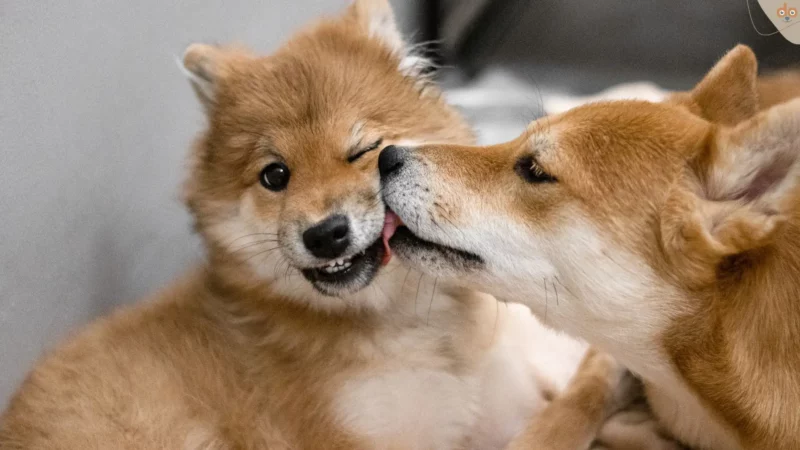
Mutual licking often starts spontaneously and without buildup. Siblings prefer to groom each other’s heads and ears – exactly the spots one cannot reach oneself. Adult dogs actually only do this with animals they truly trust.
And then there is the noticeably reduced aggression. Even dogs that otherwise quickly keep their distance show more tolerance with siblings. Food, toys, favourite spot – all of this is suddenly shared playfully or does not become a source of conflict at all.
Are there dogs that do not recognise their family?
Yes, there are. Especially when the separation happened very early. Puppies separated from mother and siblings before the sixth week of life show significantly weaker recognition reactions. The “family programme” simply did not have time to imprint properly.
Severe life experiences can also overshadow recognition. A dog with traumatic encounters with other dogs may react generally distrustfully – even with siblings. The pattern runs deeper than kinship.
In my observation, individual character also plays a role. Particularly self-confident or territorially inclined dogs take longer to somehow “allow” the familial connection. Recognition takes place – it is just covered up by other behavioural patterns. Sometimes for a while, sometimes permanently.
Can dogs recognise their siblings throughout their entire lives?
All appearances suggest yes. The olfactory memory persists – studies show recognition even after years of separation.
Do dogs also recognise half-siblings?
To some extent. With a shared mother, recognition is more likely than with the same father but different mothers. The maternal influence weighs heavier.
Do siblings automatically behave peacefully?
Not necessarily. Recognition does not automatically mean harmony – dominance struggles are possible even among siblings. Familiarity does not protect against conflicts.
Should I deliberately organise sibling meetings?
Only if both dogs are socially well-compatible. Do not force anything. Some dogs have become independent personalities after the separation – and that is perfectly fine.
Can mixed-breed dogs recognise their relatives just as well?
Yes. The ability does not depend on purebred status, but on early imprinting and the individual scent profile. This applies equally to all dogs.