
Food Mites
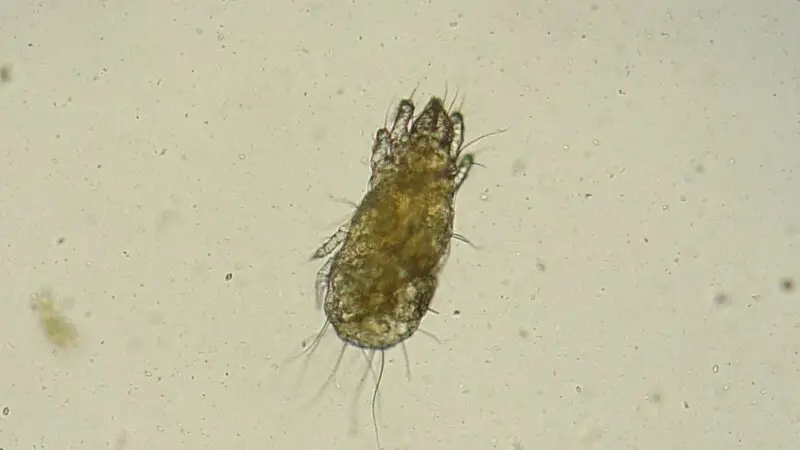 Image: Wikimedia Commons – Wikimedia Commons · CC BY-SA 3.0
 Food mites are relatives of house dust mites that settle in dry food and cereal products and can trigger allergic reactions in sensitive dogs through their allergens – excretions and decaying body parts.
Content
Food mites – barely visible to the naked eye, but a real problem for sensitive dogs. These tiny arachnids thrive particularly in dry food and grain products. They are among the most frequently overlooked triggers of allergies in dogs, especially if a food allergy or intolerance is already known. The mites themselves cause no direct damage. But their allergens – excretions and decaying body parts – can trigger allergic reactions in sensitive animals, burdening both dogs and owners alike.
What are food mites?
Food mites are relatives of dust mites and feel particularly at home in dry food – especially if it is not stored in an airtight container or kept for extended periods. Their diet consists of grain, flour, and other carbohydrate-rich foods. Warm, humid conditions significantly accelerate their reproduction.
You hardly see them yourself. What they leave behind is the actual problem: faeces and body remnants of dead mites, which contain concentrated allergens and can cause complaints in sensitive dogs.
How do food mites get into the food?
In most cases, improper storage is the entry point. Dry food that has been stored for too long, is not tightly sealed, or is kept in damp conditions offers mites virtually ideal conditions for settlement and reproduction.
The State Health Office of Baden-Württemberg has quantified what «ideal conditions» means specifically: Most storage and food mites require a relative humidity of 70 to 90 percent for their optimal living conditions, with the temperature optimum for their development lying between 20 and 25 °C. Individual species also thrive in significantly drier air. Storing food cool, dark, and tightly sealed removes precisely these conditions. State Health Office Baden-Württemberg, «Storage or Food Mites – Information», March 2009
- High humidity during storage: Food mites need moisture – the more humid the environment, the faster the populations grow.
- Open or poorly sealed containers: Dry food in non-airtight packaging or open food bins practically invite mites.
- Long storage times: The longer dry food sits in stock, the greater the risk. Those who buy in bulk should regularly check the food for abnormalities.
Symptoms of a food mite allergy
The symptoms often resemble those of other food or environmental allergies – which does not exactly make diagnosis easier. Typical signs are:
- Itching and skin problems: Persistent, intense itching is usually the first thing noticed. Dogs scratch or bite themselves – especially on paws, belly, and ears. This leads to skin irritation, redness, and in the worst case bacterial secondary infections.
- Recurring ear inflammation: Scratching at the ears, frequent head shaking, unpleasant odour – ear inflammation that keeps coming back is a classic warning signal.
- Digestive problems: Some dogs react via the gastrointestinal tract: diarrhoea, vomiting, or bloating can occur when mite allergens are ingested through food.
- Hair loss: Constant scratching and biting leaves traces – bald spots and coat loss are common accompanying symptoms.
- Secondary skin infections: Open scratch wounds are entry points for bacteria and yeast. These secondary infections often require separate treatment – a cycle from which many dogs find it difficult to escape without targeted therapy.
How is a food mite allergy diagnosed?
The diagnosis is tricky because the symptoms are hardly distinguishable from other allergies. However, vets have several tools at their disposal:
- Allergy tests: A blood test or skin test can check whether the dog reacts to food mite allergens.
- Elimination diet: The dog receives a special mite-free food for a set period. If the symptoms improve, this clearly points to a food mite allergy as the cause.
- Environmental analysis: The vet also examines how and where the food is stored – because sometimes the solution lies literally in the food bin.
Preventing food mites – concrete measures
By changing a few simple habits, you can significantly reduce the risk of mites:
- Airtight storage: Dry food should be kept in sealed containers made of plastic or metal with a tightly fitting lid – keeping moisture out and mites out.
- Buy small quantities: It is better to buy smaller amounts more frequently than to stock up on huge supplies. Shorter storage times mean less risk.
- Store cool and dry: In particularly humid living conditions, the refrigerator or a cool cellar room may be the better choice.
- Freeze if in doubt: If you suspect an infestation: A few days in the freezer will reliably kill mites and their eggs.
- Keep the feeding area clean: Clean the bowl and storage location regularly – this makes contamination significantly less likely.
- Mite-free food: Specifically vacuum-packed food brands for allergic dogs reduce the risk considerably from the outset.
- Wet food or home-cooked food: In cases of severe food mite allergy, switching to wet food or home-prepared meals may make sense – these variants simply do not offer a suitable habitat for mites.
Treatment for existing food mite allergy
Once the diagnosis is confirmed, there are several approaches to provide relief for the dog:
- Antihistamines and corticosteroids: Both groups of active ingredients can be used by the vet to dampen allergic reactions, relieve itching, and bring skin inflammation under control.
- Changing food: Switching to mite-free food or an elimination diet is often the most important step. It may take some time for the symptoms to subside completely – patience is required here.
- Skin care: Regular baths with hypoallergenic shampoos can soothe irritated skin and noticeably reduce itching.
- Treat secondary infections: If bacterial or fungal infections have already developed due to scratching, targeted antibiotic or antimycotic therapy is necessary – preferably in consultation with the vet.
More from the Wiki
All wiki entries →Plum
The plum is a stone fruit of the genus Prunus. Its stone contains cyanogenic glycosides; the …
Rhubarb
Rhubarb is a knotweed whose leaves are rich in soluble oxalic acid. For dogs, the leaves …
Why is dog faeces white?
White dog faeces occurs when normal digestion is disrupted or certain substances change the colour of …
Dog licks its anus, what to do?
Anal licking in dogs is a normal grooming behaviour that serves for cleaning and emptying the …