
01Summary
In a paragraph
If you only have 30 seconds.
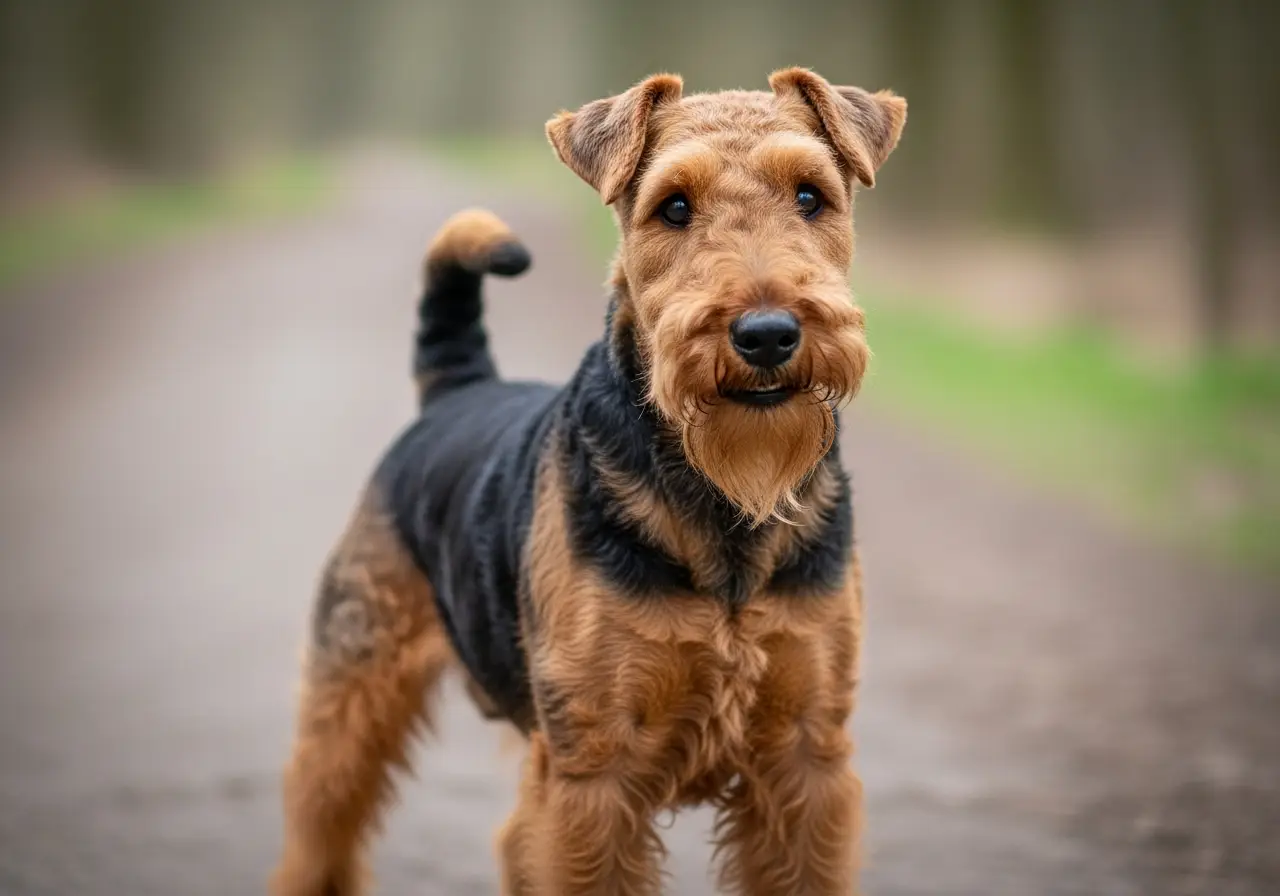
The Welsh Terrier is a compact, wiry-coated working terrier from Wales, bred for fox hunting, badger dens, and otter hunting. Its prey drive is genetically ingrained, and its head is independent. Anyone who gets this dog receives an enduring, trainable companion, but not one that occupies itself or tolerates inconsistency. Clear leadership and daily stimulation are not a recommendation, but a prerequisite.
02Introduction
What makes the Welsh Terrier special
Welsh Terrier: wiry-coated Welsh terrier, confident, friendly and good for active families
03Profile
Key facts and suitability
- Origin
- Wales
- Original purpose
- Fox hunting Badger hunting
- FCI
- No. 78 · Group 3 · Section 1
- height at the withers
- 36–39 cm
- Weight
- 9–10 kg
- Life expectancy
- 12–15 Years
- Coat type
- Wire-haired
- Minimum exercise
- 60 min/day
- Puppy price
- 1'500–2'500 CHF
- Waiting period
- 4 months
- Sports
- Agility Earthdog trials
04Temperament
How the Welsh Terrier shows up in everyday life
The morning walk shows what makes the Welsh Terrier unique: the nose immediately goes down to ground level, every mouse trail is followed, every bush inspected. The prey drive cannot be switched off; it is a permanent state. This means concretely: free running only on secure terrain or after solid recall training, which requires months of consistent work.
Internally, what the dog needs: The Welsh Terrier has a high need for mental stimulation. It wants to solve tasks, not just burn off kilometres. Search games, nose work, structured obedience training or agility challenge it in the way that corresponds to its genetics. Four hours alone is the upper limit; after that, the probability of displacement behaviour increases significantly.
Externally, how the dog reacts: Towards strangers, the Welsh Terrier behaves alertly and initially reservedly. It is not a dog that greets every visitor joyfully. Over time and with good socialisation, it opens up but remains selective. Towards other dogs, it can appear temperamental, especially if the encounter is unstructured or the other dog acts dominantly.
It is important to keep these two axes separate: A high need for social contact with one’s own family does not mean that the Welsh Terrier is open to everyone. It bonds closely with its primary caregiver but remains independent in its thinking. Whoever combines consistency with humour obtains a loyal, lively companion. Whoever understands leniency as friendliness obtains a dog that sets the rules itself.
05Needs
What this breed needs daily
The Welsh Terrier needs at least 90 minutes of active exercise daily, divided into several sessions, not as a single round. Pure walks are not sufficient. Running sessions with changing stimuli, changes in terrain and opportunities for nose work correspond better to its working profile than uniform routes.
Mental stimulation is equal in importance to physical exercise. Search games, tracking exercises, fetching drills or structured obedience training engage its mind in the way it was bred for. Dog sports such as agility, mantrailing or obedience offer meaningful channels for its willingness to work.
The prey drive requires special attention in training. Impulse control training and a reliable recall are not optional additions but basic prerequisites for a safe everyday life. Building these skills takes time and consistency; an accompanying dog training school with terrier experience is recommended.
Being left alone is possible but must be built up gradually. Four hours are a realistic upper limit for a well-stimulated adult. Being alone longer means an increased risk of boredom-related behaviour.
The coat requires professional stripping by an experienced dog groomer or the owner themselves two to three times a year. Weekly combing keeps the coat in shape between stripping appointments.
Exercise
High
mental work
A lot
Social needs
Medium
training
Demanding
06Sport & Mental and Physical Stimulation
What sports the Welsh Terrier is suited for
Realistic in terms of physiology and genetics – not every breed suits every sport.
Structurally and physiologically suitable: Suitable for mantrailing, dummy work and tracking · CaniCross / bikejoring possible.
07Quick Check
08Suitability
Who this breed is suitable for – and who it isn't
✓Matches
The Welsh Terrier suits active owners who can plan at least 90 minutes of structured exercise daily and enjoy working with an independently thinking dog. Experience with terriers or other high-drive breeds is a clear advantage.
Households with children from about eight years old are suitable if the children are experienced in handling dogs and respect boundaries. The Welsh Terrier does not tolerate disrespectful treatment and reacts to pressure by withdrawing or resisting.
Owners who want to practise dog sports or offer nose work will find a motivated partner in the Welsh Terrier. People in rural areas with access to secure open spaces also benefit from its possibilities.
Whoever already has experience with consistent, clear positive training and understands that terriers question rules will have long-term joy with this dog. A household in which at least one person is present during the day or a reliable care solution exists corresponds to the breed’s need for social contact.
×Doesn't match
The Welsh Terrier does not suit owners looking for a calm, uncomplicated companion dog that is satisfied with short walks. Whoever is away from home for eight hours daily and has no care solution structurally overloads this dog.
Households with small animals such as rabbits, guinea pigs or cats without many years of dog experience should be viewed critically; the pronounced prey drive cannot be trained away, only managed. Whoever underestimates this effort exposes both animal and dog to unnecessary risk.
Whoever equates “friendliness towards strangers” with “openness to everyone” will be disappointed by the Welsh Terrier. Its alertness and reserve towards unknown people is not a flaw but a breed type; however, it requires active socialisation from the start.
First-time owners without guidance from an experienced dog training school should carefully consider the breed. The Welsh Terrier questions inconsistency immediately and exploits leeway consistently. Whoever understands leniency as harmony quickly loses leadership.
10Line reality
Show line, working line, breeder market
The Welsh Terrier is kept primarily as a companion dog today and shown at exhibitions. A pronounced line differentiation between working and show lines, such as exists for example with the Labrador Retriever or the German Shepherd Dog, is less pronounced in this breed.
Nevertheless, differences exist between breeds focused on show success and those that value working type and temperament. Breeders focusing on exterior conformation can produce dogs that meet the standard in body structure but are less intense in drive. Breeds focusing on true-to-type character and working type often provide dogs with stronger prey drive and higher enrichment needs.
As the total population in Central Europe is manageable, it makes sense to have a direct conversation with the breeder about the orientation of the parent dogs. Asking about temperament tests, working trials or the behaviour of the parent dogs in everyday life provides insight into what kind of dog can be expected from the litter. A working trial is not required by the FCI standard for the Welsh Terrier, which makes line differentiation less formalised than with other terrier breeds.
11Health · Reality
What you need to plan for medically with your Welsh Terrier
The Welsh Terrier is considered a robust breed with a life expectancy of 12 to 15 years. This places it in the upper range for medium-sized dog breeds. Brachycephaly or extreme changes in body structure, which lead to structural health problems in other breeds, are not an issue with the Welsh Terrier.
Known breed-specific health risks primarily include eye diseases, particularly primary glaucoma (green star), which is documented in terrier breeds. According to data from the British Veterinary Association (BVA) and the Kennel Club UK, glaucoma cases were recorded in Group 3 terriers, justifying ophthalmological preventive examinations of breeding animals. Owners should have any changes in visual behaviour or red eyes checked by a vet immediately.
Skin diseases, particularly allergy-induced dermatitis, occur occasionally. The wiry coat can predispose the dog to skin problems if care is not carried out properly.
Hip and elbow dysplasia (HD/ED) is less common in this breed than in larger dog breeds, but should nevertheless be ruled out radiologically in breeding animals.
Overweight is an underestimated risk: Welsh Terriers are food-motivated. Already 10–15% overweight puts strain on joints and demonstrably shortens life expectancy (Source: German Veterinary Association, nutritional recommendations 2022). Regular weight checks at the vet, at least once a year, are advisable.
12Structured data
Health by the numbers
Prone to diseases
Eye problems kneecap problems
Recommended health tests
Eye examination kneecap check
13Myths ↔ Reality
What is often said incorrectly about this breed
Five myths, five realities, five sources.
“The Welsh Terrier is a small, low-maintenance family dog with no great demands.
The Welsh Terrier needs around 90 minutes of active exercise daily as well as additional mental stimulation. Its prey drive is genetically anchored and requires consistent recall and impulse control training. Without sufficient enrichment, it develops displacement behaviours such as digging, barking or destructive chewing.
“Welsh Terriers are aggressive towards people.
The FCI standard explicitly describes the Welsh Terrier as fearless but not aggressive. It behaves watchfully to reservedly towards strangers, which corresponds to the terrier type, not an aggression disorder. Misbehaviour usually arises from lack of socialisation or missing handling, not from breed-typical aggression.
“A garden is enough for stimulation; the dog occupies itself.
A garden offers space to move but does not replace structured enrichment. Welsh Terriers left to their own devices dig up flower beds, chase small animals or bark excessively. Mental stimulation through training, nose work or dog sports is necessary regardless of the available space.
“Welsh Terriers and Lakeland Terriers are practically the same breed.
Both breeds may share a common Celtic ancestor and show external similarities. However, they have been separate breeds since the 19th century with their own FCI standard, breeding history and slightly different temperament profiles. The Welsh Terrier is considered somewhat less exuberant in comparison.
“The wiry coat of the Welsh Terrier cares for itself.
The hard, dense wiry coat of the Welsh Terrier needs regular trimming, usually two to three times a year. Clipping permanently alters the coat structure and is not permitted for show dogs. Without proper care, the coat mats and loses its protective function.
14animal welfare
The animal welfare perspective
Breeder market, designer versions, animal shelter reality — what no one writes in the puppy ad.
The Welsh Terrier is a niche breed in Central Europe with a manageable breeding population. This reduces the risk of industrial puppy mills but does not rule it out. Anyone offering a Welsh Terrier on classifieds portals without club membership often operates outside studbook control, with corresponding consequences for the health and socialisation of the puppies.
Designer versions or hybrid trends currently play no significant role for the Welsh Terrier. The breed is not fashionable enough to justify mass production. This is a structural advantage over breeds such as the French Bulldog or the Labradoodle, where demand peaks regularly create quality problems.
Breeding and keeping-related problems with the Welsh Terrier arise less from physical extreme features than from keeping errors: underestimated prey drive, insufficient stimulation, and lack of leadership competence lead to dogs being given up. Animal welfare organisations and breed protection associations report that Welsh Terriers entering animal welfare often come from households where the need for occupation was underestimated.
Adopting an adult Welsh Terrier through animal welfare or a breed protection association is a fully valid alternative to buying a puppy. An adult dog brings the advantage that temperament, drive intensity, and social behaviour can already be assessed, which facilitates the fit with the household. Specialised terrier rescue stations in Germany, Austria, and Switzerland occasionally place Welsh Terriers and accompany the handover professionally.
15Costs · Transparency
What this breed realistically costs
A Welsh Terrier puppy from a reputable breeder registered with the Klub für Terrier e.V. or SCFT usually costs between 1,200 and 1,800 euros. Prices below this are a warning signal for lack of studbook control or insufficient health examinations of the parent animals.
The annual living costs consist of food (approx. 400–700 euros/year depending on quality), trimming two to three times a year (approx. 60–120 euros per session, i.e., 120–360 euros/year), basic equipment, dog training school, and accessories. In addition, there are vet costs: routine examinations, vaccinations, and parasite prevention amount to approx. 200–400 euros annually.
Pet insurance for a Welsh Terrier costs between 30 and 80 euros per month (360–960 euros/year) depending on the provider and scope of benefits. Given possible eye diseases or skin problems, surgery cost insurance can be sensible.
Realistically calculated, total costs of 3,000 to 5,000 euros arise in the first year including getting a dog, basic equipment, and increased vet effort. From the second year onwards, running costs of 1,500 to 2,500 euros annually are realistic.
16Puppy search
What you need to consider when choosing a breeder
- Reputable Welsh Terrier breeders are members of a recognised breed club, in Germany the Klub für Terrier e.V.
- (KfT), in Switzerland the Schweizer Club für Terrier (SCFT).
- Membership alone is not a quality indicator but a first filter.
- Reputable breeders provide health certificates for the parent dogs, show the puppies with the mother dog and ask questions about the planned everyday life.
- Waiting times of several months are normal for this rare breed.
- Anyone who receives a puppy immediately should question this critically.
- On-site inspections are mandatory; no reputable breeder sells puppies without personal contact.
- Prices significantly below 1,000 euros or offers on classifieds portals without club membership are warning signs of puppy mills.
- Adoption through animal welfare organisations is an equally valid option.
- Welsh Terriers rarely end up in animal shelters, but specialised terrier rescue stations and breed protection associations occasionally place adult dogs.
- An adult dog has the advantage that temperament and drive intensity can already be assessed.
FAQ
Frequently asked questions about the Welsh Terrier
Is Welsh Terrier suitable for beginners?
Welsh Terrier is considered suitable for first-time dog owners.
Is Welsh Terrier a family dog?
Welsh Terrier is considered suitable for families with good socialisation and species-appropriate care.
How much exercise does Welsh Terrier need?
At least around 60 minutes of exercise per day.
Does Welsh Terrier suit an apartment?
With enough exercise and enrichment, Welsh Terrier can also be kept in an apartment.
What is the size and weight of Welsh Terrier?
Fully grown, Welsh Terrier reaches about 36–39 cm at the withers and weighs around 9–10 kg.
What is the life expectancy of Welsh Terrier?
The life expectancy of Welsh Terrier is approximately 12–15 years.
Which diseases are common in Welsh Terrier?
Eye problems kneecap problems
17Breed clubs
Official breed clubs in DACH
19Related
Similar breeds – and their differences
You might also be interested in

Participate
Do you have a good photo of your Welsh Terrier?
We are looking for expressive images for our breed profiles. Submit yours; the editorial team reviews every submission before publication.
Does this breed suit you?
Independent terrier – needs consistency and enough stimulation