

01Summary
In a paragraph
If you only have 30 seconds.
The Tosa is a Japanese Molosser whose breeding history was geared towards courage, endurance and controlled seriousness, not sociability. Anyone who keeps this breed takes on responsibility at a level that goes far beyond everyday life with other large dogs. Legal requirements in Germany, Austria and Switzerland are not bureaucratic hurdles but a reflection of the actual requirement profile of this breed.
02Introduction
What makes the Tosa special
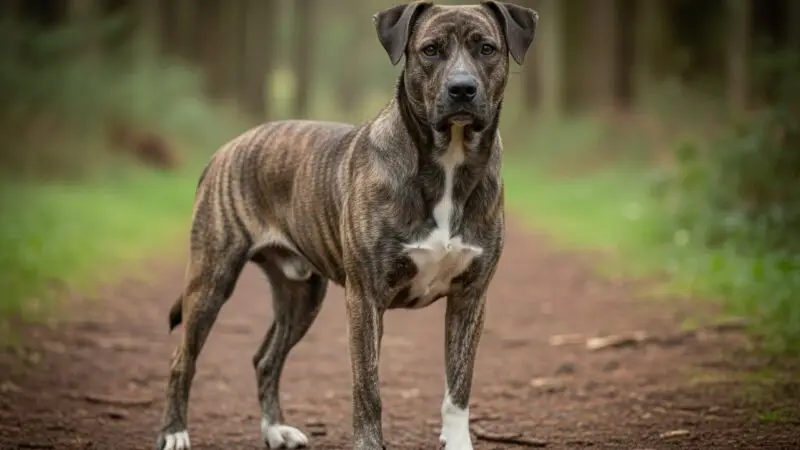
Tosa: Japanese fighting dog with European crossbreeding, calm and composed but subject to regulations in Switzerland
03Profile
Key facts and suitability
- Origin
- Japan
- Original purpose
- Fighting dog (historical)
- FCI
- No. 260 · Group 2 · Section 2.1
- height at the withers
- 55–60 cm
- Weight
- 36–90 kg
- Life expectancy
- 10–12 Years
- Coat type
- Short-haired
- Minimum exercise
- 90 min/day
- Puppy price
- 2'000–3'000 CHF
- Waiting period
- 8 months
- Sports
- Schutzhund Weight pulling
04Temperament
How the Tosa shows up in everyday life
On the morning walk, the Tosa shows what makes up its character: It walks calmly beside its primary caregiver, registers the surroundings attentively, and does not react to every stimulus. A passing bicycle, a barking dog behind the fence—the Tosa takes note without reacting immediately. This threshold for stimuli is high but not limitless.
Here come into play the two axes that must never be confused with the Tosa: The internal need for social contact is pronounced; the dog requires a close bond with its primary caregiver, seeks closeness, and reacts to uncertainty or inconsistency in leadership with increasing stress. The external reaction to strangers, on the other hand, is reserved to rejecting. A Tosa that is closely bonded to its primary caregiver does not mean that it reacts openly or neutrally towards visitors. Keeping these two poles apart is crucial.
When visitors arrive, the Tosa does not withdraw; it observes. Unknown persons in the territory activate its protective instinct. Without clear signals from the primary caregiver, the situation remains tense. An owner who does not confidently moderate these moments quickly loses control over the dynamics.
In daily life with the family, the Tosa is calm and attentive. It does not require constant enrichment, but it requires structure. Long phases without clear leadership, unclear rules, or changing primary caregivers destabilise it. Mental stimulation through controlled tasks (nose work, obedience exercises, structured walks) is more important than physical peak performance.
05Needs
What this breed needs daily
The Tosa requires 60 to 90 minutes of controlled exercise daily. More important than endurance sport is the quality of leadership: calm, structured walks on a leash where the primary caregiver clearly sets the direction. Off-leash exercise in open, uncontrolled environments is unsuitable due to territorial behaviour and possible dog incompatibility.
The mental need is at a medium level; the Tosa is not a dog that must be constantly challenged, but it requires regular tasks that bind its concentration. Nose work, controlled search exercises, and structured obedience training are suitable formats. Monotony and under-stimulation lead to restlessness and can intensify territorial behaviour.
The need for social contact is pronounced: The Tosa bonds closely with its primary caregiver and requires their presence as an anchor. Being left alone in a secured territory is possible for up to five hours, but only for a dog that has been gradually accustomed to this situation. Abrupt separations or frequent changes of primary caregiver destabilise it.
A securely fenced garden or a secured property is not an option but a basic requirement. The fence height should be at least 180 cm, and the fence must be dig-proof. Pure apartment keeping without outdoor space is not species-appropriate for this breed. Urban environments with high stimulus density (narrow pavements, encounters with many strangers, dog encounters with no way to avoid them) permanently increase stress levels.
Exercise
Medium
mental work
Medium
Social needs
Medium
training
Experts
07Quick Check
08Suitability
Who this breed is suitable for – and who it isn't
✓Matches
The Tosa suits owners with proven experience in handling large dogs with a strong guarding instinct, not just theoretical knowledge but lived daily life with comparable breeds. A calm, structured daily routine with fixed key persons is a basic requirement.
The breed is suitable for owners who live on a secured property with a fence that is at least 180 cm high and dig-proof. Rural or quiet suburban locations with few encounters with strangers in everyday life are significantly better suited than urban environments.
Those who are willing to fully comply with the legal requirements of their respective state (temperament test, proof of expertise, liability insurance, leash requirement) and do not see these as a burden but as part of responsible ownership are realistic candidates.
Families with children aged 14 and over, in which all family members are trained in dealing with the dog and consistently adhere to clear rules, can keep a Tosa, provided the other conditions are met. Owners who can devote at least 90 minutes daily to structured exercise and training and do not have to leave the dog alone regularly for more than five hours meet the basic time requirements.
×Doesn't match
The Tosa is not suitable for owners who are keeping a dog for the first time or whose previous experience is limited to small or medium breeds without a guarding instinct. The combination of body mass, territorial behaviour and readiness for dominance towards other dogs demands more than good will.
Those who equate the Tosa's calmness with sociability (and expect that a calm dog is automatically friendly towards strangers or compatible with other dogs) fundamentally underestimate the breed. This confusion of internal bond intensity with external openness is one of the most common mistakes in assessing this breed.
The breed is not suitable for households in states where keeping it is prohibited, nor for owners who are not willing or able to permanently meet all legal requirements. Rental flats without secured outdoor areas, densely populated urban locations and households with frequently changing visitors or small children under 12 years of age are unsuitable living conditions.
Those who are regularly away from home for more than five hours a day and do not have a reliable care solution should not consider this breed. The same applies to owners who rely on free running in dog groups or dog parks; this is generally incompatible with a Tosa.
10Line reality
Show line, working line, breeder market
The Tosa is currently bred in two different contexts: in Japan, where dog fighting is legal under certain conditions and breeding continues to focus on suitability for fighting, and outside Japan, where breeding primarily focuses on guarding and companion dog characteristics.
This geographical separation creates a factual difference in lines, even though the FCI standard does not formally distinguish between working and show lines. Japanese breeding lines are generally heavier, more massive, and selected for fighting endurance. Non-Japanese breeding lines, particularly European ones, tend to show a somewhat more balanced temperament, without the typical basic characteristics of the breed disappearing.
For owners in Germany, Austria, and Switzerland, this distinction is relevant: A dog from a Japanese fighting breeding line carries a different risk profile than a dog from European breeding focused on character clarity. Reputable breeders outside Japan place value on temperament tests and hip dysplasia examinations. The number of active breeders in the German-speaking region is very low, which makes finding puppies difficult and increases the risk of encountering disreputable providers.
A formal show line in the sense of an independent breeding direction hardly exists in Europe. The Tosa is not a breed bred for exhibition success; its standard assesses substance, dignity, and character, not spectacular appearance.
11Health · Reality
What you need to plan for medically with your Tosa
The Tosa has a life expectancy of an average of 10 to 12 years. As a large Molosser with considerable body mass, it carries an increased risk for several breed-typical diseases.
Hip dysplasia (HD) is the most common orthopaedic disease in large molossoid breeds. Reliable breed-specific HD prevalence studies for the Tosa are limited due to the small population size in Europe. Comparative data from the OFA database (Orthopedic Foundation for Animals, as of 2023) show HD rates of 20–25 % in related molossoids such as the Mastiff. Reputable breeders X-ray both parent animals and provide reports; this is a minimum standard, not a bonus.
Gastric torsion (gastric dilatation-volvulus, GDV) is a life-threatening emergency situation in deep-chested large dogs. Studies by Purdue University (Glickman et al., 2000) identify deep chest, high body weight and single large meals as the main risk factors. Owners of a Tosa should know the symptoms: distended abdomen, restlessness, unsuccessful retching. Any delay in visiting the vet can be fatal.
Elbow dysplasia (ED) as well as heart diseases (cardiomyopathy) occur in the breed, but are less systematically recorded than HD. Regular heart auscultation from the 5th year of life is advisable.
Overweight is a serious risk for this breed: The combination of calm temperament, high body mass, and a tendency towards low drive for movement in old age favours adiposity, which additionally burdens joints and the cardiovascular system. Weight control at the vet every 6 months makes sense.
12Structured data
Health by the numbers
Prone to diseases
Hip dysplasia Eye problems Heart problems
Recommended health tests
Hip X-rays Heart examination
13Myths ↔ Reality
What is often said incorrectly about this breed
Five myths, five realities, five sources.
"The Tosa is an uncomplicated dog for experienced owners due to its calm nature.
The composure of the Tosa is the result of targeted selection for impulse control, not social compatibility. A calm demeanour does not mean that the dog is easy to handle. Territorial behaviour, readiness for dominance towards other dogs and a pronounced bond with the primary caregiver demand constant, confident leadership. Even experienced owners regularly underestimate this difference.
"As a restricted breed, the Tosa is automatically dangerous and aggressive.
The restricted breed status is based on breed-specific legislation, not on a scientifically proven assessment of danger for the individual animal. The Tosa exhibits a high threshold for stimulation and generally does not react impulsively. The legal classification reflects the risk potential in case of improper keeping, not the nature of a well-socialised, competently handled dog. Nevertheless: The potential for harm due to improper keeping is real because of size, strength and guarding instinct.
"The Tosa gets along easily with other dogs if it has been well socialised.
Early socialisation reduces the risk but does not eliminate it. Same-sex intolerance, particularly in males, is typical of the breed and genetically ingrained. Even well-socialised Tosas may seek conflicts with other dogs in adulthood. Off-leash exercise in dog groups is generally unsuitable for this breed. Consistent leash handling and spatial separation from other dogs are part of the owner's daily routine.
„The Tosa is a pure family dog that loves children.
The Tosa can live in a structured family environment with children, but only under clearly defined conditions: experienced adults providing consistent leadership, no unsupervised interactions, and clear rules for all family members. Due to its body mass and protective instinct, it is not suitable for families without prior experience with large guardian dogs. The combination of size and territorial behaviour requires constant supervision when interacting with children.
„Importing a Tosa from abroad circumvents the German breed lists.
The restricted breed status applies in Germany on a state-specific basis and is linked to the breed, not the country of origin of the animal. A Tosa imported from Japan or an EU country is subject to the same or stricter regulations in Bavaria, North Rhine-Westphalia, Hamburg, and other states as a dog born in Germany. In some states, keeping the breed is completely prohibited. The responsible municipal or regulatory authority must be consulted before purchase.
14animal welfare
The animal welfare perspective
Breeder market, designer versions, animal shelter reality — what no one writes in the puppy ad.
The Tosa is classified as a restricted breed in Germany, Austria and Switzerland. The specific requirements vary by state: in Bavaria and Hamburg, keeping it is completely prohibited. In North Rhine-Westphalia, Baden-Württemberg and other states, it requires permission and is subject to a temperament test, proof of expertise, liability insurance and a leash requirement. In Switzerland, cantonal regulations apply, which must be checked before purchase. Status of this information: 2025; legal situations change, the competent authority is the only reliable source of information.
The backyard breeder market for Tosas is a real problem. The low demand and legal hurdles deter serious breeders (at the same time, offers arise via Eastern European intermediaries or classifieds portals where neither health checks nor temperament tests are documented. A puppy without HD findings for the parent dogs and without affiliation to a breeding association is not a bargain) it is a calculable risk for health costs and behavioural problems.
Designer versions or crosses of the Tosa with other molossoids are occasionally offered. These dogs often fall outside the scope of breed lists, which does not mean that they have a lower requirements profile. On the contrary: unclear genetics make it difficult to assess temperament.
Rehoming an adult Tosa via animal welfare organisations is a serious alternative. Dogs from animal welfare projects are usually assessed for their temperament before being rehomed. This gives owners a more realistic basis than a puppy with unknown development potential. Anyone who takes on a Tosa from animal welfare should still clarify all legal prerequisites in their own state in advance; the animal welfare status does not change the restricted breed status of the breed.
15Costs · Transparency
What this breed realistically costs
A Tosa puppy from a serious breeder affiliated with a breeding association costs between 1,500 and 2,500 EUR in the German-speaking area. Offers significantly below this are a warning signal for missing health checks or lack of affiliation with a breeding association.
The annual keeping costs are significantly above average due to the size. Food for an adult Tosa (60–90 kg) costs between 1,200 and 2,000 EUR per year depending on quality. Care (short coat, occasional bathing, nail care) is comparatively inexpensive, approx. 100–200 EUR annually.
Vet costs are structurally higher for large dogs: medication dosages, anaesthetic amounts and surgery costs scale with body weight. An average annual budget for routine care (vaccinations, parasite prophylaxis, check-ups) is 400–700 EUR. For orthopaedic diseases such as HD, treatment costs can quickly reach 3,000–8,000 EUR.
Dog liability insurance is legally required for restricted breeds in many states and costs between 200 and 500 EUR annually for the Tosa due to its restricted breed status. Pet health insurance is recommended given the breed-specific health risks; annual premiums start at approx. 600 EUR for large dogs with a molossoid profile. In addition, some states have increased dog tax rates for restricted breeds.
16Puppy search
What you need to consider when choosing a breeder
- Reputable Tosa breeders in the German-speaking region are rare.
- The Club für Molosser e.V.
- and the Molosser-Club der Schweiz MCS are points of contact for breeding recommendations and breeder directories.
- A reputable breeder provides X-ray reports for hip dysplasia (HD), conducts temperament tests and asks questions about the living situation, actively selecting buyers.
- Warning signs: puppies without a pedigree, sale without personal contact, prices significantly below 1,500 EUR, no opportunity to view the mother in the rearing environment, offers on classifieds portals without affiliation to a breeding association.
- The legal situation in your own state must be clarified before purchase.
- In Bavaria, Hamburg, Thuringia and other states, the Tosa is subject to strict regulations or is prohibited.
- The competent municipal or regulatory authority provides binding information, not the breeder.
- The rehoming of an adult Tosa via animal welfare organisations or breed protection projects is an equally valid option.
- Adult dogs come with a known temperament profile, which can be a real advantage for a breed with this requirement profile.
- Here too: living conditions and legal prerequisites must be fully clarified before taking the dog on.
FAQ
Frequently asked questions about the Tosa
Is Tosa a family dog?
Tosa is considered suitable for families with good socialisation and species-appropriate care.
How much exercise does Tosa need?
At least around 90 minutes of exercise per day.
What is the size and weight of Tosa?
Fully grown, Tosa reaches about 55–60 cm at the withers and weighs around 36–90 kg.
What is the life expectancy of Tosa?
The life expectancy of Tosa is approximately 10–12 years.
Which diseases are common in Tosa?
Hip dysplasia Eye problems Heart problems
17Breed clubs
Official breed clubs in DACH
19Related
Similar breeds – and their differences
You might also be interested in

Participate
Do you have a good photo of your Tosa?
We are looking for expressive images for our breed profiles. Submit yours; the editorial team reviews every submission before publication.
Does this breed suit you?
Mandatory registration in Switzerland – keeping is subject to cantonal regulations, please inform yourself before getting a dog