
01Summary
In a paragraph
If you only have 30 seconds.
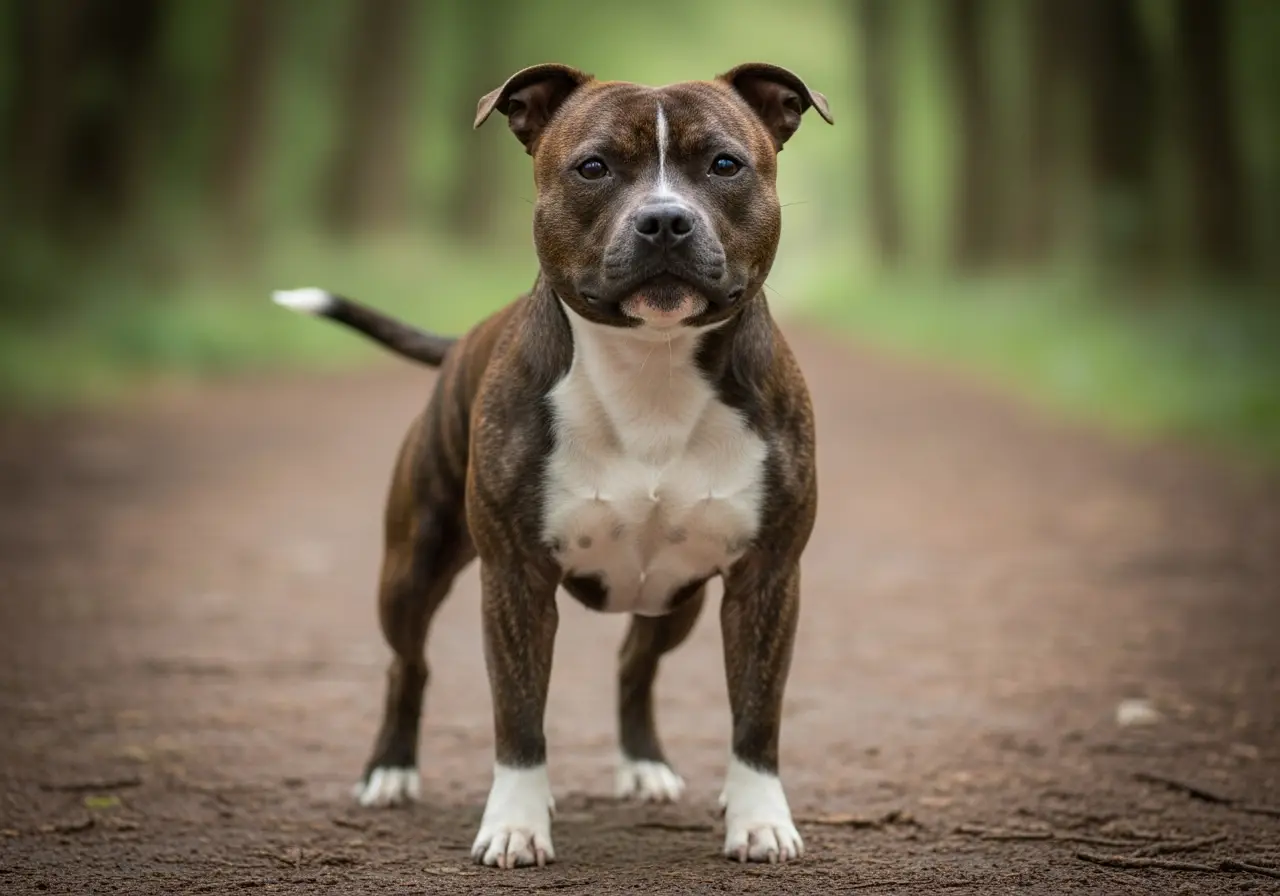
The Staffordshire Bullterrier is a compact, muscular terrier with a pronounced bond to humans. Historically selected for dog fighting, the breed was deliberately bred for human affinity and nerve strength. The result is a dog that demands closeness, requires consistency and falls under breed-specific legislation in several German states. For experienced owners with time and structure, an intense relationship; for everyone else, an underestimated risk.
02Introduction
What makes the Staffordshire Bull Terrier special
Staffordshire Bull Terrier: British muscular dog with a soft heart, child-friendly, brave and uncomplicated with good socialisation
03Profile
Key facts and suitability
- Origin
- Grossbritannien
- Original purpose
- Fighting dog (historically)
- FCI
- No. 76 · Group 3 · Sektion 3: Bullartige Terrier, ohne Arbeitsprüfung
- height at the withers
- 33–41 cm
- Weight
- 11–17 kg
- Life expectancy
- 12–14 Years
- Coat type
- Short-haired
- Minimum exercise
- 60 min/day
- Puppy price
- 1'500–2'500 CHF
- Waiting period
- 4 months
- Sports
- Agility Obedience
04Temperament
How the Staffordshire Bull Terrier shows up in everyday life
When you come home, you are not greeted calmly. The Stafford registers your arrival with its whole body, wagging, jumping, seeking physical contact. This intensity is not an isolated case, but everyday life. The need for social contact of this breed is at a high level: the dog does not just want to be near you, it needs active interaction, joint activities and clear communication.
Internally, what the dog brings with it: The Stafford is oriented towards close human bonding. It tolerates being alone only to a limited extent; four hours are considered a guideline, not a goal. Mental stimulation through nose work, fetching exercises or structured training is not a bonus, but part of species-appropriate keeping. Its exercise need is high: walks without an activity component are not sufficient.
Externally, how the dog reacts: Towards known people, the Stafford shows openness and affinity. Towards strangers it behaves neutrally to friendly in general, provided it has been well socialised, but this is not guaranteed. The guarding instinct is present, but not dominant. The conflict potential towards other dogs is significantly more pronounced, especially in encounters between dogs of the same sex. On the street this means: loose-leash walking and attentiveness are not optional, but mandatory.
In everyday life with children, the breed typically shows patience and playfulness, but the physical strength of the dog requires clear rules and supervision. Anyone who expects the Stafford to be a calm lapdog underestimates it. Anyone who leads it as a partner with clear demands receives a dog with exceptional depth of bonding.
05Needs
What this breed needs daily
The Staffordshire Bullterrier needs at least 60 to 90 minutes of active exercise daily, divided into several sessions. Pure walks without an activity component are not sufficient. Suitable forms of exercise include fetching training, controlled running training, swimming or structured play in the dog park with known conspecifics.
Mental stimulation is just as important as physical exercise. Nose work, search games, obedience training and impulse control exercises are part of the weekly programme. An under-stimulated Stafford develops frustration, which manifests itself in destructive behaviour, excessive barking or overexcitement.
The need for social contact is pronounced. The dog tolerates being alone only to a limited extent; four hours daily are considered the upper limit, not the normal state. Anyone who is regularly away from home for longer needs a reliable care solution: dog sitter, day care or an established network.
Training must be consistent, fair and sustained. The Stafford reacts sensitively to inconsistency and pressure. Positive reinforcement combined with clear communication yields the best results. A dog training school with experienced trainers is particularly recommended in the first few months.
Socialisation with other dogs must start early and be maintained continuously. Encounters in public spaces require attention and loose-leash walking, regardless of how well socialised the individual dog is.
Exercise
High
mental work
Medium
Social needs
High
training
Demanding
06Sport & Mental and Physical Stimulation
What sports the Staffordshire Bull Terrier is suited for
Realistic in terms of physiology and genetics – not every breed suits every sport.
Structurally and physiologically suitable: CaniCross / bikejoring possible.
07Quick Check
08Suitability
Who this breed is suitable for – and who it isn't
✓Matches
The Staffordshire Bullterrier suits owners with proven experience in handling assertive dog breeds. Specifically, this means: you have already handled a dog with a strong character, know the difference between consistency and pressure, and are prepared to invest long-term in training and socialisation.
Suitable for active individuals or couples who can dedicate 90 minutes daily to exercise and training. Families with children from about eight years old are an option if both parents have dog experience and enforce clear rules in everyday life.
Owners living in regions without restricted breed regulations or who are prepared to actively manage ownership permits, temperament tests and mandatory insurance are better positioned than those who regard the legal situation as a minor matter.
Those seeking a dog with a strong bond to humans, who are at home or within earshot daily and can actively manage dog contacts, will find an exceptionally loyal companion in the Stafford. Keeping it in an apartment is possible if exercise, structure and social contact are ensured.
×Doesn't match
The Staffordshire Bullterrier is unsuitable for first-time dog owners. The combination of physical strength, assertiveness and high need for social contact regularly overwhelms novice owners without prior experience; the above-average number of surrenders of this breed to animal welfare organisations confirms this.
Not suitable for households where the dog is left alone for more than four hours daily and no alternative care exists. Anyone who believes the Stafford is a calm apartment dog that occupies itself due to its bond with humans underestimates its need for activity and contact.
Unsuitable for owners who do not wish or are unable to actively manage dog encounters in everyday life. Anyone expecting a well-trained Stafford to interact problem-free with every conspecific confuses the dog’s internal depth of bond with external social compatibility; these are two different axes.
Also unsuitable for people living in cantons with strict restricted breed regulations who are not prepared to comply with ownership permits, temperament tests and mandatory insurance. The legal requirements are real and non-negotiable.
10Line reality
Show line, working line, breeder market
The Staffordshire Bullterrier does not have clearly defined working and show lines in the sense of Retriever or Shepherd dog breeding programmes. The FCI does not list it with a working trial. Nevertheless, there are relevant differences within the breed that owners should know about.
Show line (Kennel Club-oriented): Dogs from reputable breeding programmes bred to FCI or KC standards generally show a more stable temperament, clearer typification and better health screenings. Breeders of this line place value on temperament tests, HD screening and the exclusion of hereditary diseases.
Backyard and multiplier lines: A significant proportion of Staffords offered in the German-speaking region come from uncontrolled multiplication without breeding approval. These dogs more frequently exhibit an unstable temperament, unclear health history and lack of socialisation. They are disproportionately represented in animal welfare organisations.
Regional variants: In Great Britain there are breeding lines with a stronger focus on athleticism and endurance, which differ slightly in body structure from continental European show lines. For everyday life in the DACH region, this differentiation is less relevant than the question of reputable breeding versus multiplier keeping.
11Health · Reality
What you need to plan for medically with your Staffordshire Bull Terrier
The Staffordshire Bullterrier is considered relatively robust compared to other bull-type terrier breeds. The average life expectancy is 12 to 14 years according to the Kennel Club UK (Kennel Club UK Health Survey, 2014).
Two genetically determined diseases are typical for the breed and detectable via DNA tests: L-2-hydroxyglutaric aciduria (L-2-HGA) is a neurological metabolic disorder leading to movement disorders and seizures. Hereditary cataract (HC) causes early lens opacity and can lead to blindness. Reputable breeders test both parent dogs before mating; buyers should request written test results.
Hip dysplasia (HD) occurs in the breed but is less prevalent than in large breeds. Comprehensive HD rates for the Stafford are not available across the DACH region; nevertheless, the Kennel Club UK recommends X-ray examination of the parent dogs.
Skin problems, including allergies and demodicosis, are known in the breed and may require costly treatment. Overweight is a real risk: the compact build tempts owners to overfeed the dog. Even slight overweight demonstrably strains joints and shortens life expectancy.
Preventive examinations: check DNA tests for L-2-HGA and HC before purchase, annual eye examination recommended, weight control by the vet at least once a year.
12Structured data
Health by the numbers
Prone to diseases
Cataracts Patellar problems
Recommended health tests
Eye examination Patella check
13Myths ↔ Reality
What is often said incorrectly about this breed
Five myths, five realities, five sources.
"The Staffordshire Bull Terrier is naturally aggressive towards people.
The FCI standard explicitly describes the breed as highly intelligent, loving and reliable towards people. Aggression towards people was historically an exclusion criterion in breeding, as the dogs had to be handled by their owners in the fighting ring. Problematic behaviour towards people usually arises from inadequate socialisation, incorrect keeping or unstable temperament, not from breed-typical predisposition.
"Staffords are hostile towards children and therefore unsuitable for families.
The FCI standard explicitly highlights that the breed is particularly fond of children. This trait has developed historically and is embedded in breeding practices. Nevertheless, it applies to all dogs regardless of breed: no dog should be left unsupervised with young children. The physical strength of the Stafford and its play drive require clear rules in daily family life and consistent training.
"A well-trained Stafford gets along easily with all other dogs.
The breed typically shows high social compatibility towards people, but the situation is different regarding conspecifics. In particular, encounters between dogs of the same sex can be conflict-ridden. The pronounced terrier character and historical selection for fighting readiness against other dogs are genetically anchored. Dog socialisation must be trained early, consistently and permanently; a residual risk remains for many individuals.
"Restricted breed status means that the breed is generally banned.
In most German federal states, restricted breed status does not mean a general ban on keeping the dog, but rather increased requirements: permission to keep the dog, a temperament test, leash requirement and partly muzzle requirement in public spaces. The regulations vary greatly depending on the federal state and are regularly updated. Owners are obliged to independently check the currently applicable legal situation in their respective federal state.
"Staffords require little stimulation because they are small and compact.
The compact size is misleading regarding the actual energy requirement. The Staffordshire Bullterrier needs 60 to 90 minutes of active exercise daily as well as additional mental enrichment. Under-stimulated Staffords develop frustration and destructive behaviour. The combination of high exercise needs and pronounced need for social contact makes it a demanding companion in everyday life.
14animal welfare
The animal welfare perspective
Breeder market, designer versions, animal shelter reality — what no one writes in the puppy ad.
The Staffordshire Bull Terrier is one of the breeds that are disproportionately represented in animal welfare facilities in the German-speaking region. The reasons are documented and recurring: underestimated leadership requirements, legal restrictions due to restricted breed regulations, and overwhelmed owners without prior experience.
Backyard breeder market: Demand for Staffords has led to the emergence of an active backyard breeder market in recent years. Dogs without breeding approval, without health checks, and without socialisation are offered on classifieds platforms at low prices. These dogs more frequently exhibit unstable temperaments and end up in animal welfare after biting incidents or being overwhelmed, often within the first two years.
Restricted breed issue: Moving to a federal state with stricter requirements or a change in legislation can mean that owners can no longer legally keep their dog. Animal welfare organisations report that a significant proportion of Stafford surrenders are due to changes in the legal situation, not a failure of the dog, but a structural problem.
Keeping-related problems: Staffords kept under-stimulated or socially isolated on a permanent basis develop behavioural issues. These are generally not breed-related, but keeping-related, and therefore avoidable.
Adoption as an equally valid option: Many animal welfare organisations and breed-knowledge foster homes rehome Staffords with detailed prior information about the individual dog. An animal welfare dog is not a second-class dog; it is often a dog whose first owner was overwhelmed. Those who take the time to find the right dog will often find already basic-socialised, adult animals with an assessable character in animal welfare.
15Costs · Transparency
What this breed realistically costs
The purchase price for a Stafford from reputable breeding with breeding approval, health tests and papers is between 1,200 and 2,000 euros in the DACH region. Offers significantly below this often come from uncontrolled breeding without health checks.
Ongoing costs per year (guideline values for Germany/Austria/Switzerland): Food for an adult Stafford costs between 600 and 1,200 euros annually depending on quality. Basic care (claws, ears, occasional bathing) is inexpensive for the short-haired breed, around 100 to 200 euros per year. Vet costs for routine examinations, vaccinations and parasite prevention are between 300 and 500 euros annually.
Restricted breed-specific costs: In federal states with permission to keep such dogs, fees for a temperament test (50 to 200 euros, one-off) and increased dog tax apply. The dog tax for restricted breeds is between 300 and 1,000 euros annually depending on the municipality, significantly above the standard rate.
Pet health insurance: Given genetically determined diseases (L-2-HGA, HC) and possible skin problems, surgery cost insurance is recommended. Monthly premiums are between 40 and 80 euros depending on provider and scope of cover. Some insurers exclude restricted breeds or charge surcharges; check before signing the contract.
16Puppy search
What you need to consider when choosing a breeder
- A reputable breeder is a member of a recognised breed club, such as the Klub für Terrier e.V.
- (Germany) or the Staffordshire Bull Terrier Club Schweiz in the German-speaking area.
- Membership alone is not a quality indicator, but it serves as an initial filter.
- Concrete criteria for reputable breeding: both parent dogs have been tested for breed-typical hereditary diseases (L-2-HGA, HC, hereditary cataract).
- The results are available in writing.
- The breeder shows you the mother with the puppies on site.
- Puppies leave the litter no earlier than eight weeks of age.
- You receive a vaccination record, deworming certificate and written purchase documents.
- Warning signs: no viewing appointment possible, puppies handed over in car parks, multiple litters available simultaneously, no proof of health examinations, price significantly below 1,000 euros without explanation.
- Adoption through animal welfare organisations is an equally valid option.
- Staffords end up in animal welfare care above average often; frequently these are young dogs with basic socialisation that were surrendered due to a change of owner.
- Organisations such as the Deutsche Tierschutzbund or breed-knowledge foster homes facilitate adoption with prior information about the individual dog.
FAQ
Frequently asked questions about the Staffordshire Bull Terrier
Is Staffordshire Bull Terrier a family dog?
Staffordshire Bull Terrier is considered suitable for families with good socialisation and species-appropriate care.
How much exercise does Staffordshire Bull Terrier need?
At least around 60 minutes of exercise per day.
Does Staffordshire Bull Terrier suit an apartment?
With enough exercise and enrichment, Staffordshire Bull Terrier can also be kept in an apartment.
What is the size and weight of Staffordshire Bull Terrier?
Fully grown, Staffordshire Bull Terrier reaches about 33–41 cm at the withers and weighs around 11–17 kg.
What is the life expectancy of Staffordshire Bull Terrier?
The life expectancy of Staffordshire Bull Terrier is approximately 12–14 years.
Which diseases are common in Staffordshire Bull Terrier?
Cataracts Patellar problems
17Breed clubs
Official breed clubs in DACH
19Related
Similar breeds – and their differences
You might also be interested in
Participate
Do you have a good photo of your Staffordshire Bull Terrier?
We are looking for expressive images for our breed profiles. Submit yours; the editorial team reviews every submission before publication.
Does this breed suit you?
Despite history as a fighting dog, now family-friendly – requires clear leadership and socialisation