
01Summary
In a paragraph
If you only have 30 seconds.
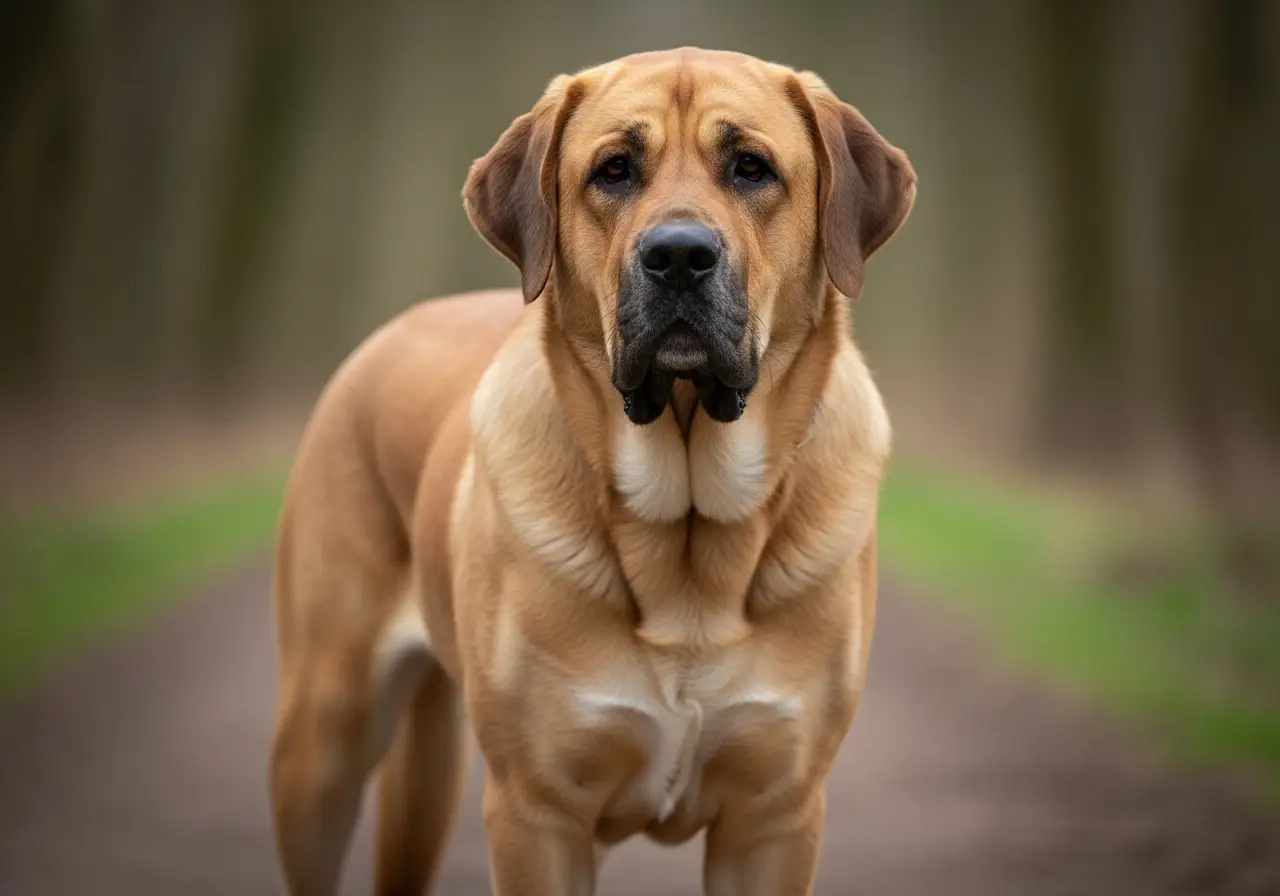
The Spanish Mastiff is not a companion dog in oversized form; it is a molosser genetically shaped for livestock guarding, which judges independently and acts consistently in serious situations. Anyone keeping it without prior experience with livestock guardian dogs underestimates its territorial behaviour and body mass. This breed demands secured land, confident leadership, and a life close to its original working profile.
02Introduction
What makes the Spanish Mastiff special
Spanish Mastiff: massive Iberian flock guardian, calm, loyal and resolute when threatened
03Profile
Key facts and suitability
- Origin
- Spanien
- Original purpose
- Livestock guarding
- FCI
- No. 91 · Group 2 · Sektion 2.2: Molossoide, Berghunde
- height at the withers
- 72–82 cm
- Weight
- 60–100 kg
- Life expectancy
- 10–12 Years
- Coat type
- Short-haired
- Minimum exercise
- 90 min/day
- Puppy price
- 1'500–2'500 CHF
- Waiting period
- 5 months
- Sports
- Hiking
04Temperament
How the Spanish Mastiff shows up in everyday life
On the morning walk, the Spanish Mastiff behaves differently from most dogs: it systematically scans its surroundings before moving. It registers strangers approaching early and positions itself between them and the owner without a command being necessary. This is not obedience, this is instinct.
Internally, what the dog needs: The need for social contact of this breed is moderate. The Spanish Mastiff bonds closely with its key people but does not demand constant interaction. It needs presence, not enrichment on a minute-by-minute basis. Mental work in the classical sense (fetching, search games, agility) does not correspond to its working profile. What it needs is a clearly defined task: a territory it knows and boundaries it understands.
Externally (how the dog reacts): Towards family members it shows itself loyal and calm, occasionally demonstratively affectionate. Towards strangers it is reserved to rejecting) not out of fear, but out of livestock guardian dog logic: unknown people do not belong in the territory. Visitors who come regularly and are introduced by the owner are accepted over time. Spontaneous visits remain a challenge.
In everyday life on the farm or property, it patrols independently, marks boundaries and barks deeply and audibly from afar; the FCI standard explicitly describes its barking as rough, heavy and audible from afar due to its strength. In an apartment, it seems out of place: not solely because of its size, but because it cannot define a territory. This divergence between internal need (territorial task) and external behaviour (protective reaction without clear territory) is the most common trigger for keeping problems.
05Needs
What this breed needs daily
The Spanish Mastiff requires 60 to 90 minutes of active movement daily, calm, endurance walks on varying terrain. Running-intensive sports such as canicross or agility do not correspond to its movement profile and unnecessarily strain the joints of such a massive dog.
In addition to active movement, it requires access to a large, securely fenced property. The fence must be stable and high enough (at least 1.80 m, preferably 2 m) as a determined Spanish Mastiff will overcome or break through weaker fencing. The property is not a luxury, but a functional prerequisite for species-appropriate keeping.
Mentally, the dog needs a defined task. In traditional keeping, this is monitoring a farmyard or herd. In modern leisure-time keeping, this means: a clearly demarcated territory that it knows and recognises as its own. Without this structure, it develops independent strategies for territorial defence, which leads to serious problems in densely populated areas.
The need for social contact is moderate. The dog needs daily contact with its key people but also copes well with phases of being alone on its own territory for up to six hours. Outside its own territory, for example at the vet or in unfamiliar surroundings, it needs a confident, calm owner who anticipates and de-escalates situations before the dog reacts itself.
The puppy and young dog stages demand special attention: early, broad socialisation with people, vehicles, other animals, and urban stimuli is indispensable. It reduces later overreactions but does not alter the genetic protective disposition.
Exercise
Medium
mental work
Something
Social needs
Low
training
Experts
07Quick Check
08Suitability
Who this breed is suitable for – and who it isn't
✓Matches
The Spanish Mastiff suits owners with proven experience in handling livestock guardian dogs or other independently working molossoids. Anyone who has already kept a Kangal, Pyrenean Mountain Dog, or Maremmano-Abruzzese brings the necessary foundation.
Suitable are owners with their own property of at least 1,000 m² that can be securely fenced. Rural or semi-rural locations are clearly preferable to urban environments. Anyone who keeps sheep, goats, or other livestock and wishes to use a livestock guardian dog in its original function will find a functionally suitable partner in this breed.
Families with older children from 12 years upwards, who are experienced in dealing with large dogs, may be considered, provided all family members know and consistently apply the basic rules for handling the dog. Small children and the body mass of an adult Spanish Mastiff are a combination that requires constant supervision.
Owners who spend much time on their own property due to work or lifestyle benefit from the dog's independence. It does not require constant occupation, but it does need presence and a primary caregiver who can read its signals.
×Doesn't match
The Spanish Mastiff is not suitable for owners keeping a dog for the first time. Even those with dog experience but exclusively with companion or sport dogs regularly underestimate the independence of a livestock guardian dog.
Keeping in an apartment, even a large one, is not suitable. Anyone who cannot offer secured outdoor space does not meet the basic requirement for this breed. The same applies to owners in densely populated urban areas, where the dog's territorial behaviour inevitably leads to conflicts with neighbours, passers-by, and other dogs.
Anyone who equates the external calmness of the Spanish Mastiff with friendliness towards strangers makes a consequential mistake. Internal composure and external openness are two different axes in this breed; the dog is calm but not open. Anyone expecting visitors who arrive spontaneously and frequently, and anyone looking for a dog that easily fits into changing social situations, chooses the wrong breed.
Owners who are away from home for 8 hours daily and cannot offer secured exercise on their own land are structurally overwhelmed by this breed, regardless of their dog experience.
10Line reality
Show line, working line, breeder market
The Spanish Mastiff does not have clearly defined working and show lines in the sense of other breeds. Breeding outside Spain is numerically small, so that a pronounced line differentiation such as that found in the German Shepherd Dog does not exist.
Within Spain, however, a functional distinction can be observed: dogs actively used in livestock guarding work, particularly in the regions of Castile and León and Extremadura, differ in temperament and reactivity from dogs bred exclusively for shows. Working-oriented dogs show more pronounced territorial behaviour, higher alertness and greater independence. Show-oriented dogs are tendentially calmer when dealing with unfamiliar situations, as show conditions presuppose a certain tolerance towards strangers and noise.
For interested parties in Central Europe, this distinction is practically relevant: a dog from active livestock guarding breeding in Spain comes with a significantly more intense protection profile than a dog from breeding aimed at show success. Anyone who does not plan functional livestock guarding use should explicitly address this question of origin with the breeder and ask to see the working certificates of the parent animals, or consciously factor in their absence.
11Health · Reality
What you need to plan for medically with your Spanish Mastiff
The Spanish Mastiff belongs to the large molossoids with an increased risk of orthopaedic and internal diseases. The life expectancy is 10 to 12 years according to reputable breeding associations, a realistic range for a dog of this body mass.
Hip dysplasia (HD) and elbow dysplasia (ED) are common in large molossoids. Reputable breeders have parent animals radiologically examined before breeding and provide corresponding findings. Anyone who does not receive HD/ED proof for the parent animals should regard this as a warning sign. The OFA (Orthopedic Foundation for Animals) lists HD prevalence rates of 20–40 % in non-selected populations for related molossoids (OFA database, status 2023).
Gastric dilatation-volvulus (bloat) is a serious risk in deep-chested large dogs. Symptoms (distended abdomen, restlessness, unproductive retching) require immediate veterinary intervention, as the condition becomes life-threatening within hours. Prophylactic measures: several small meals instead of one large one, no intensive exercise directly after eating.
Preventive examinations that the owner should plan for: annual orthopaedic check-up from the 5th year of life, heart examination (molossoids are prone to cardiomyopathy), eye examination for ectropion (the lower lid allows part of the conjunctiva to be seen according to the FCI standard; treatment required if excessively pronounced). Overweight is a significant health risk in this breed: already 5 kg above ideal weight measurably burdens joints and the cardiovascular system.
12Structured data
Health by the numbers
Prone to diseases
Hip dysplasia Elbow problems Gastric dilatation-volvulus
Recommended health tests
Hip X-ray Elbow X-ray
13Myths ↔ Reality
What is often said incorrectly about this breed
Five myths, five realities, five sources.
„The Spanish Mastiff is an aggressive dog because of its size.
The FCI standard explicitly describes the temperament as self-confident, calm and measured in its behaviour. The dog uses its strength consciously because it is aware of it. Aggressiveness in the sense of uncontrolled irritability contradicts the breed standard. Territorial behaviour and readiness to protect are not the same as aggressiveness; they are genetically anchored work reactions to specific triggers.
„A large plot of land replaces sufficient exercise.
Free access to secured terrain is a basic requirement, not a substitute for exercise. The Spanish Mastiff needs 60 to 90 minutes of active exercise with the owner daily. Simply standing around on the plot leads to muscle loss and promotes behavioural problems in young dogs. Terrain and exercise complement each other; neither replaces the other.
„The Spanish Mastiff is a beginner's dog because it is so calm.
The outward calmness conceals the complexity of keeping the dog. The dog decides independently when a situation requires intervention and then acts without further ado. Those who have no experience with livestock guardian dogs often recognise escalation signals too late. Several animal welfare organisations report that Spanish Mastiffs are surrendered at above-average rates due to being overwhelmed.
“Early socialisation turns the Spanish Mastiff into an amiable family dog.
Socialisation is necessary and reduces unnecessary reactivity, but it does not alter the genetic basic structure of the livestock guardian dog. Territorial behaviour, reserve towards strangers and independent judgement remain even in optimally socialised dogs. Socialisation creates tolerance, not a change in character.
“The Spanish Mastiff requires little mental stimulation because it is not a sports dog.
Although the dog does not require sporting high performance, mental under-stimulation combined with a lack of task leads to intensified territorial behaviour and uncontrolled protective reactions. Livestock guardian dogs are designed to monitor and assess a territory; if this task is missing, they seek one out independently. This is problematic in urban or confined conditions.
14animal welfare
The animal welfare perspective
Breeder market, designer versions, animal shelter reality — what no one writes in the puppy ad.
The Spanish Mastiff is one of the breeds that end up in animal welfare organisations and rescue centres at above-average rates, not due to behavioural issues, but because owners are structurally overwhelmed. The most common reasons for surrender: keeping the dog in conditions that are too small, underestimating its territorial behaviour, and lacking experience with dogs that work independently.
Backyard breeder market: The breed’s limited presence outside Spain does not protect it from unethical breeding. On the contrary: anyone who buys a Spanish Mastiff via classifieds or without pedigree registration often receives dogs without health certificates for the parent animals and without socialisation during the sensitive imprinting phase. For a breed with such a pronounced protective profile, early imprinting is crucial; a poorly socialised Spanish Mastiff is difficult to correct.
Breeding- and keeping-related problems: The breed does not show traits of breeding for harmful traits (Qualzucht) in the sense of brachycephaly or chondrodystrophy. The main problem lies in how the dog is kept: a dog selected for monitoring large pasture areas suffers in cramped urban conditions, not dramatically visible, but persistently. Chronic stress due to lack of territory structure manifests as increased barking, overreactions towards strangers, and digestive issues.
Adoption as an equally valid option: Spanish Mastiffs in animal welfare organisations are not problem dogs per se. They were often surrendered by well-meaning but overwhelmed owners. Anyone who meets the prerequisites (experience, property, time) will find adoption a serious alternative to buying a puppy. Specialised Molosser rescue centres and the Molosser Club of Switzerland can assist with placement.
15Costs · Transparency
What this breed realistically costs
The purchase price for a Spanish Mastiff from reputable, VDH- or FCI-recognised breeding in Central Europe ranges between 1,500 and 2,500 EUR. Significantly cheaper offers without pedigree registration and health certificates are not bargains; they shift costs onto the vet bill.
The annual living costs for an adult Spanish Mastiff are considerable: alone for food (species-appropriate, high quality, corresponding to body mass), 1,200 to 2,000 EUR per year is realistic. Add grooming costs (coat care, nail trimming) of approx. 200–400 EUR/year and basic equipment (collar, leash, transport crate for vehicle) of one-off 300–600 EUR.
Basic veterinary costs (vaccinations, annual check-up, parasite treatment) amount to approx. 400–700 EUR/year. Orthopaedic treatments for HD or ED can quickly reach 2,000–5,000 EUR. Pet insurance for a dog of this size costs in the DACH region between 80 and 180 CHF/EUR per month depending on provider and coverage, making it a serious option for a dog with an elevated orthopaedic risk profile.
16Puppy search
What you need to consider when choosing a breeder
- A reputable breeder of Spanish Mastiffs provides HD and ED examination results for both parent animals, releases puppies no earlier than 8 weeks of age, and allows a visit to the litter, including seeing the mother in her own environment.
- Anyone who cannot provide a breeding book entry with the VDH, ÖKV, SKG, or an FCI-recognised association should be questioned critically.
- Warning signs: puppies without vaccination records, sale via third parties without breeder contact, prices significantly below 1,500 EUR without a comprehensible justification, lack of socialisation of the puppies with people and everyday stimuli.
- Adopting an adult Spanish Mastiff via animal welfare organisations or specialised molosser rescue stations is an equally valid option.
- Adult dogs already show their character, which reduces surprises.
- The Molosser Club of Switzerland (molosser-club.ch) and the Club for Molossers e.V.
- can facilitate contacts with reputable breeders and adoption centres.
- No individual breeder recommendations are made on this platform.
FAQ
Frequently asked questions about the Spanish Mastiff
Is Spanish Mastiff a family dog?
Spanish Mastiff is considered suitable for families with good socialisation and species-appropriate care.
How much exercise does Spanish Mastiff need?
At least around 90 minutes of exercise per day.
What is the size and weight of Spanish Mastiff?
Fully grown, Spanish Mastiff reaches about 72–82 cm at the withers and weighs around 60–100 kg.
What is the life expectancy of Spanish Mastiff?
The life expectancy of Spanish Mastiff is approximately 10–12 years.
Which diseases are common in Spanish Mastiff?
Hip dysplasia Elbow problems Gastric dilatation-volvulus
17Breed clubs
Official breed clubs in DACH
19Related
Similar breeds – and their differences
You might also be interested in

Participate
Do you have a good photo of your Spanish Mastiff?
We are looking for expressive images for our breed profiles. Submit yours; the editorial team reviews every submission before publication.
Does this breed suit you?
One of the heaviest livestock guardian dogs – requires a lot of space and not suitable for inexperienced owners