
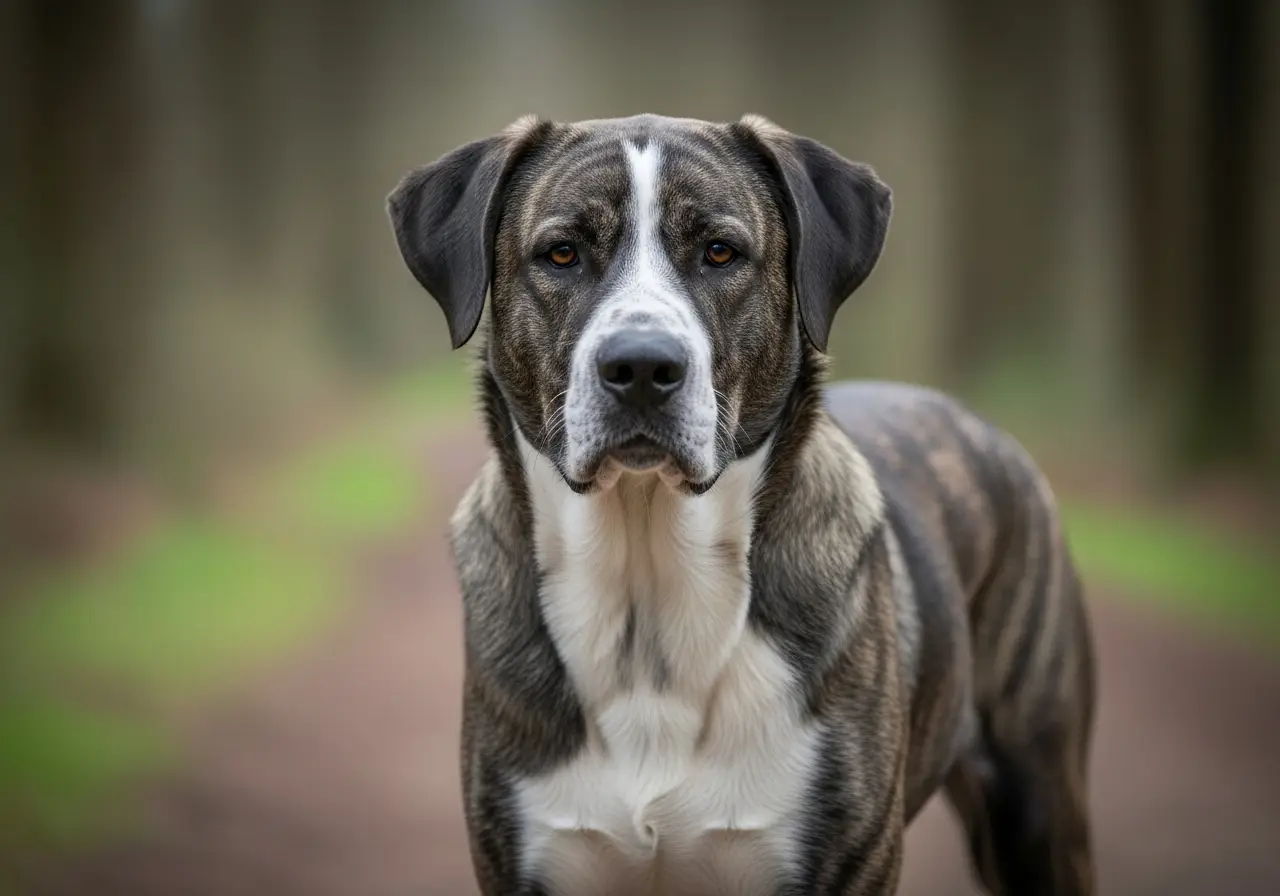
01Summary
In a paragraph
If you only have 30 seconds.
The Rafeiro do Alentejo is a large, independent Molosser from southern Portugal. It guards territories with a pronounced instinct and makes decisions independently, without asking for permission. Anyone keeping this dog takes responsibility for an animal that was bred not for obedience, but for autonomous protection. This demands experience, space and a clear inner attitude, every day.
02Introduction
What makes the Rafeiro do Alentejo special
Rafeiro do Alentejo: Portuguese molossoid with a strongly pronounced protective instinct, independently calm and reserved
03Profile
Key facts and suitability
- Origin
- Portugal
- Original purpose
- Livestock guarding
- FCI
- No. 96 · Group 2 · Sektion 2.2: Molossoide, Berghunde, ohne Arbeitsprüfung
- height at the withers
- 64–74 cm
- Weight
- 35–50 kg
- Life expectancy
- 12–14 Years
- Coat type
- Short-haired
- Minimum exercise
- 90 min/day
- Puppy price
- 1'200–2'000 CHF
- Waiting period
- 5 months
- Sports
- Hiking
04Temperament
How the Rafeiro do Alentejo shows up in everyday life
When a visitor enters the property, the Rafeiro does not react with excitement, but with quiet presence. It positions itself, observes, and decides. This appears calm, but is highly concentrated vigilance. Anyone who misinterprets this as indifference fundamentally underestimates the dog.
In everyday family life, it shows loyalty and calmness towards its primary caregivers. It does not seek intense interaction, no play on demand, no permanent enrichment. Its internal need for social contact is moderate; it requires closeness and orientation, not constant stimulation. Long phases of quiet togetherness correspond more to its nature than active training sessions.
The external axis looks different: It shows clear reserve towards strangers, up to outright rejection. These two poles (moderate bonding internally, strong demarcation externally) must not be confused. A Rafeiro that appears relaxed with its family is not automatically open to guests.
On walks outside the property, it behaves more calmly than on its territory. It moves leisurely, registers its surroundings attentively, and reacts to provocations from other dogs with self-assurance, not nervousness. Same-sex encounters require attention; assertive behaviour towards other males is breed-typical.
At night, it is more alert than during the day. Anyone living in a residential area must expect nocturnal barking; this is not a mistake, but a function.
05Needs
What this breed needs daily
The Rafeiro requires 60 to 90 minutes of exercise daily at a calm pace. Endurance sports, agility, or intensive training sessions correspond neither to its physique nor to its temperament. Walks with clear structure and sufficient sniffing time cover its need for exercise better than running units.
More important than physical workload is a clearly defined, securely fenced territory. The Rafeiro requires a domain that it recognises as its own and can oversee. A fence with a minimum height of 1.80 metres and secured protection against digging under is not an option, but a basic prerequisite.
The need for mental work is low compared to herding dogs or retrievers. The Rafeiro does not require daily brain teasers. What it requires is clarity: clear boundaries, clear hierarchy, clear signals. Inconsistency in leadership creates insecurity, and an insecure livestock guardian dog is a safety risk.
Socialisation begins early and does not end with puppyhood. The Rafeiro requires continuous, controlled encounters with people and situations outside its territory, not to “reprogramme” it, but so that it learns to differentiate. An accompanying dog training school with experience in guardian and livestock dogs is recommended.
It tolerates being left alone for up to six hours in a stable environment. The prerequisite is that its territory is secure and it has no uncontrolled encounters with strangers.
Exercise
Medium
mental work
Something
Social needs
Low
training
Experts
07Quick Check
08Suitability
Who this breed is suitable for – and who it isn't
✓Matches
The Rafeiro do Alentejo suits owners with proven experience in handling livestock guardian or Molosser breeds. Anyone who has already handled an independently working guard dog and understands its decision-making logic brings the necessary foundation.
The breed is suitable for owners with a large, securely fenced property, using at least 1,000 m² as a guideline value, with stable fencing. Rural or semi-rural locations are clearly preferable to urban environments.
Households in which children grow up are conceivable if all adults have experience with the breed, the dog's socialisation is accompanied consistently from the start, and permanent supervision during contact with children is ensured.
Owners who are prepared to adapt visitor regulations, i.e. generally announce strangers and introduce them in a controlled manner, are better positioned than those with frequently changing visitor traffic.
Those who communicate calmly, consistently and clearly through body language will find a loyal dog in the Rafeiro. The breed suits people who do not need confirmation from the dog, but value respect and reliability.
×Doesn't match
The Rafeiro do Alentejo is unsuitable for owners without prior experience with guard or livestock dogs. Anyone keeping a dog for the first time or who has previously only known companion dogs will most likely underestimate the independence of this breed.
Keeping in an apartment is out of the question, regardless of city size or willingness to take long walks. The Rafeiro needs a territory that it can define as its own. An apartment does not fulfil this function.
Owners looking for a social, friendly dog that greets guests and lies next to the table in a café are choosing the wrong breed. Reserve towards strangers is not a training issue; it is a breed trait.
Anyone who mistakes the Rafeiro's external reserve for a lack of attachment and tries to "correct" it through social pressure techniques creates stress for the dog and safety risks in its environment.
Households with frequently changing visitor traffic, children's playgroups in the garden or unannounced visitors are structurally unsuitable. This also applies to owners who are absent for more than six hours a day due to work and cannot organise reliable care.
10Line reality
Show line, working line, breeder market
The Rafeiro do Alentejo is not bred into clearly differentiated working and show lines, as is the case with some other breeds. The total population outside Portugal is too small to establish pronounced line differentiations.
In Portugal itself, there are breeders focused on traditional livestock guarding use; these dogs are selected for nerve calmness, endurance, and territorial behaviour. Breeders who primarily breed for shows focus on exterior according to the FCI standard. Since the breed is rare in Central Europe, available puppies often come from Portuguese or Spanish kennels with different orientations.
For interested parties, this means: The puppy’s origin kennel is more relevant than for breeds with established line designations. A breeder who selects for livestock guarding use produces dogs with a stronger work drive and more pronounced territorial behaviour than a pure show breeder. These differences are noticeable in everyday life and should be explicitly enquired about before purchase.
11Health · Reality
What you need to plan for medically with your Rafeiro do Alentejo
As a large-framed Molosser breed, the Rafeiro do Alentejo carries an increased risk of hip dysplasia (HD) and elbow dysplasia (ED). For Molossoids in general, the Orthopedic Foundation for Animals (OFA) reports HD prevalence rates of 20–40% depending on breed and breeding line (OFA database, status 2023). Breed-specific figures for the Rafeiro are not available in sufficient sample size due to the small population size, which underscores the importance of breeder-provided X-ray documentation for both parent animals.
The life expectancy is typically 10 to 12 years. Large breeds statistically reach lower age limits than small dogs; the body weight of 35–60 kg places a permanent strain on joints and the cardiovascular system.
Gastric dilatation-volvulus (bloat) is a serious risk in deep-chested large breeds. As a preventive measure, vets recommend several small meals instead of one large daily ration, as well as rest periods after eating.
Overweight poses a particular risk for this breed: The Rafeiro is naturally frugal and low-activity, a combination that quickly leads to obesity with incorrectly dosed food. Regular weight checks at the vet (at least twice a year) are recommended.
Preventive examinations should include HD/ED screening in puppyhood, annual heart auscultation from the fifth year of life, and eye checks. Given possible orthopaedic interventions, pet insurance with surgical coverage is financially sensible.
12Structured data
Health by the numbers
Prone to diseases
Hip dysplasia Gastric torsion
Recommended health tests
Hip X-ray
13Myths ↔ Reality
What is often said incorrectly about this breed
Five myths, five realities, five sources.
"The Rafeiro is an uncomplicated dog for beginners due to its calmness.
The Rafeiro’s outward calmness conceals its complexity. It independently decides who may enter its territory and acts accordingly. This independence is genetically ingrained and requires experienced leadership, not less of it. Livestock guardian dogs are regarded in specialist literature as one of the most demanding groups for keeping in a private environment.
“A large plot of land is sufficient as a prerequisite for keeping the dog.
Space is necessary but not sufficient. The Rafeiro additionally requires a clearly structured social hierarchy, early and consistent socialisation, and a primary caregiver with experience in handling independently working guardian breeds. An enclosed plot without these factors produces an uncontrollable guard dog, not a safe one.
“Livestock guardian dogs are naturally child-friendly because they protect the weak.
The Rafeiro’s protective instinct is directed towards its defined territory and familiar group, not automatically towards children. Unknown children or unpredictable movements can be interpreted as a threat. Keeping the dog with children presupposes many years of experience with the breed, consistent socialisation, and permanent supervision.
“The Rafeiro is quiet at night and sleeps through.
The FCI standard explicitly describes the Rafeiro as more watchful at night than during the day. This is no coincidence, but the result of centuries of selection: The greatest threats to herds came in the darkness. A Rafeiro that barks and patrols at night behaves in a breed-typical manner, not abnormally.
“With good training, the Rafeiro becomes approachable with strangers.
Reserve towards strangers is not a training deficit, but a breed characteristic. Socialisation can help the dog assess situations more differentiatedly, but it does not eliminate the protective and territorial instinct. Anyone looking for an open, stranger-friendly dog should choose a different breed.
14animal welfare
The animal welfare perspective
Breeder market, designer versions, animal shelter reality — what no one writes in the puppy ad.
Livestock guardian dogs are among the breeds that end up in shelters and rescue centres with above-average frequency. The reason is rarely aggression in the clinical sense; more often, it is an underestimation of the keeping requirements. A Rafeiro kept on a plot that is too small, whose protective behaviour cannot be channelled, and whose owner interprets the breed’s independence as disobedience, becomes a problem for both the dog and its surroundings.
The backyard breeder market reacts to trends. The Rafeiro is not yet a mass trend in Central Europe, but imports from Portugal and Eastern Europe without health documentation do exist. Anyone who receives an offer for puppies without HD/ED certificates for the parent dogs, without insight into the rearing conditions, and without the breeder asking questions about the living environment should not accept this offer, not out of moral pressure, but because the risk of health problems and behavioural instability is measurably higher.
Breeding-related problems in the Rafeiro concern extreme morphology less than in brachycephalic breeds, but selection for body size and weight carries orthopaedic risks. Breeders who breed exclusively for appearance and neglect health screenings reinforce this tendency.
Adopting an adult Rafeiro from a rescue organisation is an equally valid alternative to buying a puppy. Adult dogs already show their character; protective instinct, social behaviour, and territorial behaviour are observable, not just predictable. Organisations such as the KSOH or specialised livestock guardian dog rescues provide expert support during the rehoming process. This protects the dog from being returned and the owner from making poor decisions.
15Costs · Transparency
What this breed realistically costs
A puppy from a reputable breeder with health certificates and VDH/FCI papers costs between 1,500 and 2,500 EUR in Germany and Switzerland. Offers significantly below this without documentation are a warning sign.
The annual living costs for a Rafeiro do Alentejo range from 2,500 to 4,000 EUR. Of this, high-quality food for a dog of this size class (35–60 kg) accounts for around 1,200 to 1,800 EUR per year. Care is relatively low-maintenance for the short-haired type; basic equipment, accessories, and occasional trimming amount to 300 to 500 EUR per year.
Average veterinary costs: routine examinations, vaccinations, and parasite prevention cost 400 to 700 EUR per year for a large dog. Orthopaedic interventions for HD or ED can reach 2,000 to 6,000 EUR. Pet insurance with surgery cover costs 60 to 120 EUR per month for this size class, which is a sensible calculation for a breed with an increased joint risk.
In addition comes the fencing of the property, if not already present: a stable, 1.80 m high fence for a medium-sized plot costs 3,000 to 8,000 EUR as a one-off investment.
16Puppy search
What you need to consider when choosing a breeder
- The Rafeiro do Alentejo is a rare breed in Germany and Switzerland.
- This rarity increases the risk of encountering puppy mill breeding or imports from uncontrolled conditions.
- A reputable breeder provides proof of health examinations for both parent animals, at minimum HD and ED X-rays, and allows a visit to the litter before handover.
- Puppy markets, classifieds portals without breeding documentation and offers with immediate availability without waiting time are warning signs.
- Reputable breeders ask questions about the living conditions and refuse to hand over dogs to unsuitable households.
- The Club for South and East European Shepherd Dogs (KSOH) is a contact point for breeding information in the German-speaking area.
- Getting in touch there provides orientation regarding current litters and tested breeders.
- Rescuing an adult Rafeiro through protection organisations or breed rescues is an equally valid option.
- Adult dogs already show their character clearly, which can be an advantage for a breed with a pronounced guarding instinct.
- The prerequisite is a careful settling-in period with expert guidance.
FAQ
Frequently asked questions about the Rafeiro do Alentejo
Is Rafeiro do Alentejo a family dog?
Rafeiro do Alentejo is considered suitable for families with good socialisation and species-appropriate care.
How much exercise does Rafeiro do Alentejo need?
At least around 90 minutes of exercise per day.
What is the size and weight of Rafeiro do Alentejo?
Fully grown, Rafeiro do Alentejo reaches about 64–74 cm at the withers and weighs around 35–50 kg.
What is the life expectancy of Rafeiro do Alentejo?
The life expectancy of Rafeiro do Alentejo is approximately 12–14 years.
Which diseases are common in Rafeiro do Alentejo?
Hip dysplasia Gastric torsion
17Breed clubs
Official breed clubs in DACH
19Related
Similar breeds – and their differences
You might also be interested in

Participate
Do you have a good photo of your Rafeiro do Alentejo?
We are looking for expressive images for our breed profiles. Submit yours; the editorial team reviews every submission before publication.
Does this breed suit you?
Independent livestock guardian dog – very territorial and not suitable for inexperienced owners