
01Summary
In a paragraph
If you only have 30 seconds.
The Galgo Español is not an everyday dog for the undecided. The breed combines a pronounced sight-hunting instinct with surprisingly calm household behaviour, two poles that must be managed consistently in daily life. Many Galgos reach Central Europe via animal welfare organisations, often with a background history. Those who bring time, patience and a secure off-leash area will find an enduring and sensitive companion in this breed.
02Introduction
What makes the Spanish Greyhound special
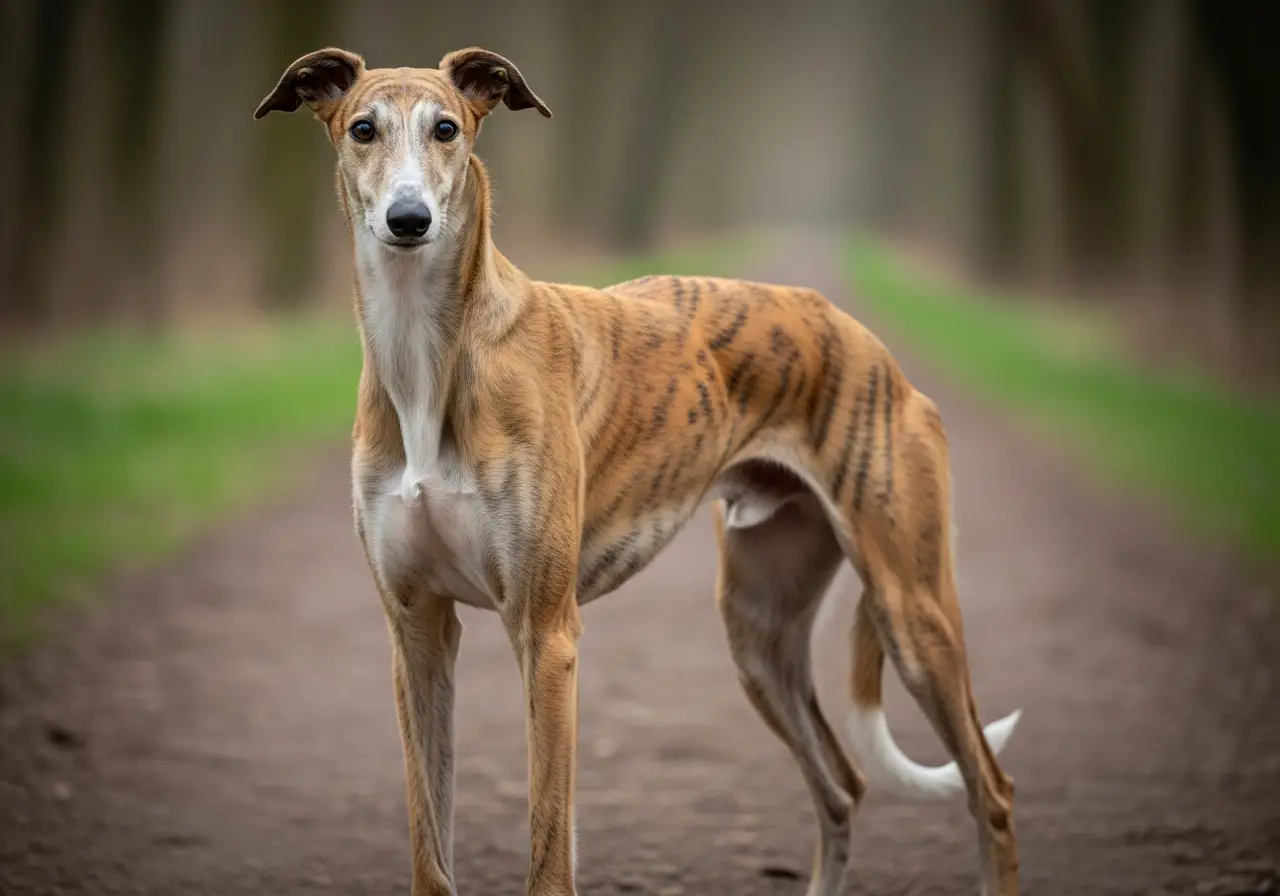
Spanish Greyhound (Galgo Español): elegant Iberian sighthound, slender and enduring, often rehomed as an animal welfare dog
03Profile
Key facts and suitability
- Origin
- Spanien
- Original purpose
- Sighthound hunting Hares and deer
- FCI
- No. 285 · Group 10 · Sektion 3: Kurzhaarige Windhunde. Ohne Arbeitsprüfung.
- height at the withers
- 62–70 cm
- Weight
- 20–30 kg
- Life expectancy
- 10–12 Years
- Coat type
- Short-haired
- Minimum exercise
- 90 min/day
- Puppy price
- 1'200–2'000 CHF
- Waiting period
- 5 months
- Sports
- Lure Coursing
04Temperament
How the Spanish Greyhound shows up in everyday life
The Galgo Español shows two clearly separable behavioural patterns in everyday life, which must not be confused with each other.
Internally, what the dog needs: The Galgo has a high need for exercise and a pronounced prey drive. On the morning walk, this means that as soon as it perceives an animal in motion, it switches into hunting mode. The reaction is lightning-fast, without warning. Secure off-leash areas are therefore not a matter of comfort, but a safety requirement. The need for social contact is at a moderate level; the Galgo appreciates company but does not demand constant attention. At home, it seeks a quiet spot, sleeps a lot and appears relaxed.
Externally, how the dog reacts to stimuli: The Galgo behaves reservedly to cautiously towards strangers. It rarely greets unknown people enthusiastically. This is not a sign of aggression, but breed-typical reserve. Anyone expecting an outgoing greeting dog will be disappointed. Towards known people, it shows affection, often quietly and close to the body.
In everyday life, this means concretely: When you come home, you can expect no outburst of joy, but a calm tail wag from its sleeping spot. On walks with other dogs, it generally behaves compatibly, provided there are no chasing stimuli. Small animals (cats, rabbits, small dogs) can trigger the prey drive. Careful introduction is mandatory in multi-pet households.
These two poles (high need for exercise and prey drive outside, calm and reserved nature inside) define the Galgo. Anyone who sees only one side underestimates the breed.
05Needs
What this breed needs daily
The Galgo needs at least two to three exercise sessions daily. At least one of these should allow free running on secure terrain, such as fenced dog meadows, coursing facilities or private properties with sufficient space. The fence must be sturdy and high enough: A Galgo can easily clear 1.50 metres if motivated.
Mental stimulation remains limited compared to herding or retrieving dogs. The Galgo does not need daily mental challenges in the form of nose work or obedience training, but benefits from calm activity sessions that promote its concentration. Loose-leash walking and a reliable recall on secure terrain are the most important training components.
The Galgo tolerates being left alone for up to four hours well, provided it has received sufficient exercise. Longer periods require gradual habituation, especially for animals from animal welfare organisations that may develop separation anxiety.
The Galgo needs a soft, raised resting place; its bony body structure makes hard surfaces problematic in the long term. Blankets and dog sofas are not indulgence, but a health necessity.
It requires social warmth in moderation: physical contact is appreciated, but forced interaction is rejected. The owner should be able to read the dog’s body language and actively offer retreat options, especially during the first weeks of settling in.
Exercise
High
mental work
Something
Social needs
High
training
Medium
06Sport & Mental and Physical Stimulation
What sports the Spanish Greyhound is suited for
Realistic in terms of physiology and genetics – not every breed suits every sport.
Structurally and physiologically suitable: Suitable for mantrailing, dummy work and tracking · CaniCross / bikejoring possible.
07Quick Check
08Suitability
Who this breed is suitable for – and who it isn't
✓Matches
The Galgo suits owners who can plan at least two hours of active exercise daily and have access to secure off-leash areas, i.e. fenced areas with a fence height of at least 1.50 metres.
Experienced dog owners who can read the body language of a reserved dog are clearly at an advantage. Anyone who has already worked with a sighthound or a sensitive animal welfare dog brings the right expectations.
Calm households without a constant stream of visitors suit the Galgo’s reserved nature. Singles, couples or families with older children from about ten years old who respect the dog and do not pressure it provide a suitable environment.
Owners who wish to practice coursing, lure coursing or similar dog sports will find a motivated partner in the Galgo. The breed demonstrates its genetic strength in these disciplines in a controlled and species-appropriate manner.
Anyone willing to give an animal welfare dog time and patience for settling in, at least three to six months, while foregoing quick results, can provide a rehomed Galgo with a permanent home. The prerequisite is a stable, calm environment during the initial phase.
×Doesn't match
The Galgo does not suit owners looking for an open, friendly dog that greets visitors enthusiastically. The reserved reaction towards strangers is not a training problem; it is breed character.
Anyone who assesses the Galgo as a calm sofa dog without significant exercise needs because it appears relaxed at home fundamentally underestimates the breed. The calm household character presupposes sufficient exercise; without it, restlessness and frustration develop.
Households with small animals (cats, rabbits, guinea pigs) are not suitable without careful, lengthy introduction. The sighthound prey drive cannot be trained away, only managed.
First-time owners without experience with sensitive or high-prey-drive dogs should not choose the Galgo as a starter dog. The combination of prey drive, sensitivity to body language and possible animal welfare background requires experience and calmness.
Anyone who does not have access to secure off-leash areas and relies on public, unsecured areas cannot meet the Galgo’s exercise needs. Owners who are regularly away from home for more than four hours daily and cannot organise care solutions also do not provide a suitable environment.
10Line reality
Show line, working line, breeder market
The Galgo Español exists in two coat variants recognised by the FCI standard: short-haired (pelo corto) and semi-long rough hair (pelo semilargo). These variants are not separate lines in the sense of a working/show line differentiation, but purely phenotypic differences with no proven behavioural relevance.
A classic working line/show line split, as documented for example in Labradors or Golden Retrievers, does not exist for the Galgo Español in comparable form. The breed is traditionally bred as a hunting dog in Spain, with performance criteria (speed, stamina, visual acuity) taking precedence. Coursing breeding and companion dog breeding outside Spain are increasingly diverging, without this separation having been institutionalised in clearly defined lines so far.
In the German-speaking region, a large proportion of kept Galgos come from animal welfare rehoming of Spanish hunting dog breeds. These animals genetically carry the characteristics of the working line: pronounced hunting motivation, high reaction speed to movement stimuli. Anyone who acquires a Galgo through a DACH breeding club generally receives an animal that has been selected for suitability as a companion dog, without the prey drive having been completely bred out.
11Health · Reality
What you need to plan for medically with your Spanish Greyhound
Compared to many other breeds, the Galgo Español is considered robust in terms of health. The life expectancy is 12 to 15 years, a value that is above average for a dog of this size.
A known and clinically relevant characteristic of all sighthound breeds is increased sensitivity to barbiturates and certain anaesthetics. The low body fat content significantly alters the distribution and breakdown of fat-soluble substances. Veterinarians without experience with sighthounds must be explicitly informed about this point before every procedure. Sighthound-appropriate anaesthesia protocols are documented and should be requested.
Heat collapse is a real risk during intense exertion in warm temperatures. The slender build offers little thermal buffering. Exercise in the morning or evening hours, as well as sufficient water, are mandatory in summer, not optional.
Joint problems such as HD (hip dysplasia) occur less frequently in Galgos than in heavier breeds, but are not excluded. Reliable breed-specific HD statistics for the Galgo Español are currently only limitedly available in the scientific literature.
Animal welfare dogs from Spain often arrive with pre-existing conditions: malnutrition, parasitic infestation (leishmaniasis is endemic in Spain) and injuries from hunting use are documented initial diagnoses. A complete health check including a leishmaniasis test before taking on an imported dog is mandatory.
12Structured data
Health by the numbers
Prone to diseases
Heart problems Eye problems
Recommended health tests
Heart examination Eye examination
13Myths ↔ Reality
What is often said incorrectly about this breed
Five myths, five realities, five sources.
"The Galgo is a high-performance athlete and requires hours of exercise daily.
The Galgo is a sprinter, not an endurance athlete in the sense of a Husky. It requires daily exercise with the opportunity to run freely, but recovers quickly afterwards and shows particularly calm behaviour at home. Two to three targeted sessions per day with secure off-leash access are usually sufficient.
"Animal welfare Galgos are traumatised and therefore not suitable as a family dog.
Many Galgos rehomed from Spain do indeed show insecurities and require patient settling-in. However, this does not rule out suitability as a family dog. With structured introduction, a calm environment and experienced owners, many animals develop into stable companions. A blanket disqualification is not factually justified.
"The Galgo cannot be walked off-leash due to its prey drive.
The pronounced sighthound instinct of the Galgo requires consistent management; free exercise is only advisable on secure terrain. This does not mean, however, that the dog is fundamentally uncontrollable. With established recall and suitable off-leash areas, the drive can be safely channelled. The leash requirement in unsecured areas remains mandatory nonetheless.
"Galgos are sick due to their slimness and have a short life expectancy.
The slim body structure of the Galgo is typical for the breed and not a sign of malnutrition or illness. Healthy Galgos reach a life expectancy of 12 to 15 years. The breed is considered relatively robust, but has increased sensitivity to anaesthetics, a point that vets must know before procedures.
"A Galgo from animal welfare always has an unknown past, which is too risky.
Reputable rehoming organisations create a behaviour and health profile for each dog. Origin and background are often documented. The risk of an unknown past exists with every dog, including puppies from private breeding. Decisive is the quality of the assessment by the rehoming organisation.
14animal welfare
The animal welfare perspective
Breeder market, designer versions, animal shelter reality — what no one writes in the puppy ad.
The Galgo Español is one of the breeds where animal welfare and breed history are inextricably linked. Understanding this connection is part of the basic information for anyone dealing with the breed.
Backyard breeder market and hunting use in Spain
In Spain, Galgos are traditionally bred and used as hunting dogs. The hunting season lasts from October to February. After the end of the season, thousands of dogs are abandoned annually, surrendered to kill shelters or, in documented cases, killed in cruel ways. Spanish animal welfare organisations and international partners have been working since the 1990s to rescue and rehome these animals. This practice is legally prohibited in Spain but is enforced differently depending on the region.
Designer versions and trend breeding
The Galgo has not yet become a victim of trends in the sense of hybrid breeding or miniaturisation. However, there is a risk due to increasing demand through animal welfare rehoming: when demand exceeds supply, incentives arise for unscrupulous intermediaries who pass on dogs without adequate health checks or behaviour profiles.
Breeding and husbandry-related problems
The breed itself does not show extreme breeding-related traits. The central husbandry-related problem is the misjudgement of character: anyone who equates the calm household character with low needs neglects exercise and off-leash running, with consequences for the animal's well-being.
Rehoming as an equivalent option
A Galgo from animal welfare is not a compromise. Specialised organisations know their dogs, create behaviour profiles and support the settling-in period. Anyone who brings patience for a sensitive dog with a background history makes an informed decision, not a sentimental one.
15Costs · Transparency
What this breed realistically costs
The acquisition costs for a Galgo from reputable breeding in the DACH region are between 800 and 1,500 EUR. Animal welfare rehoming organisations from Spain generally charge a care fee of 200 to 400 EUR, which covers neutering, basic vaccinations, microchipping and transport.
The annual living costs consist of food (approx. 600–900 EUR/year for an adult Galgo with high-quality nutrition), care (low for short-haired, slightly higher for rough-haired, approx. 100–200 EUR/year) and basic equipment such as a bed and lead.
Veterinary costs for Galgos regularly arise for preventive examinations, vaccinations and parasite prevention, calculable at 200–400 EUR/year. For animal welfare dogs from Spain, initial costs for the leishmaniasis test (approx. 40–80 EUR) and possibly treatment are added.
Pet health insurance is recommended for this breed, especially due to the anaesthesia particularity. Monthly premiums range between 30 and 70 EUR depending on the provider and scope of benefits.
Unscrupulous offers with puppy prices under 500 EUR or animal welfare rehoming without health records and behaviour assessment are a clear warning sign; the follow-up costs for treatments and behaviour therapy regularly exceed the apparent savings.
16Puppy search
What you need to consider when choosing a breeder
- In Switzerland, anyone looking for a Galgo through a breeding association should buy exclusively from breeders who are members of a recognised association, such as the GMGS (Greyhound Magyar Agár Galgo Club Schweiz).
- Reputable breeders provide health certificates for the parent animals, allow multiple visits before handover and ask questions about the living situation.
- Puppy mills and online adverts that do not allow visits are a clear warning sign.
- A puppy price significantly below the market average indicates missing health checks or insufficient socialisation.
- Rehoming through specialised animal welfare organisations is an equivalent and often sensible option for Galgos.
- Organisations that rehome Galgos from Spain generally create behaviour profiles and support the settling-in period.
- The advantage: the dog is already fully grown, making its character assessable.
- Before taking on an animal welfare dog, a personal meeting should take place, ideally several times.
- Questions about the background, behaviour towards other animals and previous living conditions are legitimate and will be answered by reputable organisations.
- A trial period or foster agreement before final adoption is a sign of reliability on both sides.
FAQ
Frequently asked questions about the Spanish Greyhound
Is Spanish Greyhound a family dog?
Spanish Greyhound is considered suitable for families with good socialisation and species-appropriate care.
How much exercise does Spanish Greyhound need?
At least around 90 minutes of exercise per day. As an active breed, more so — plus mental stimulation.
Does Spanish Greyhound suit an apartment?
With enough exercise and enrichment, Spanish Greyhound can also be kept in an apartment.
What is the size and weight of Spanish Greyhound?
Fully grown, Spanish Greyhound reaches about 62–70 cm at the withers and weighs around 20–30 kg.
What is the life expectancy of Spanish Greyhound?
The life expectancy of Spanish Greyhound is approximately 10–12 years.
Which diseases are common in Spanish Greyhound?
Heart problems Eye problems
17Breed clubs
Official breed clubs in DACH
19Related
Similar breeds – and their differences
You might also be interested in



Participate
Do you have a good photo of your Spanish Greyhound?
We are looking for expressive images for our breed profiles. Submit yours; the editorial team reviews every submission before publication.
Does this breed suit you?
Noble Spanish Greyhound – off-leash only in secured areas due to extreme speed