
01Summary
In a paragraph
If you only have 30 seconds.
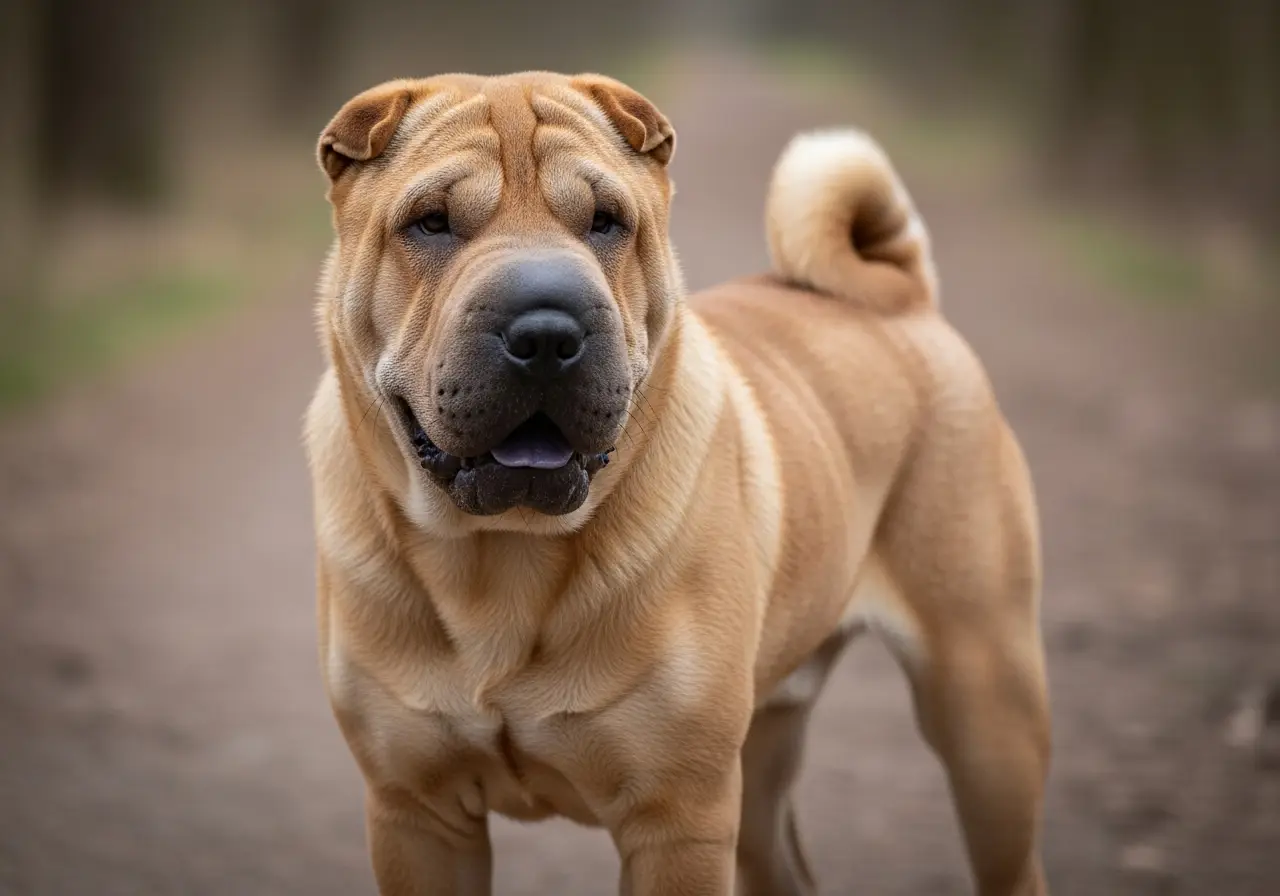
The Shar Pei is a calm, independent dog from southern China, with an appearance that immediately stands out and a character that demands clear leadership. Its wrinkles, its reserve towards strangers, and its breed-specific health risks make it a breed for experienced owners who do not shy away from responsibility. Those who bring this to the table receive a loyal, dignified companion.
02Introduction
What makes the Shar Pei special
Shar Pei: Chinese fold dog with typical blue-tongued expression, calm and loyal but demanding in terms of health
03Profile
Key facts and suitability
- Origin
- China
- Original purpose
- Watchdog and fighting dog
- FCI
- No. 309 · Group 2 · Section 2.1
- height at the withers
- 44–51 cm
- Weight
- 18–30 kg
- Life expectancy
- 8–12 Years
- Coat type
- Short-haired
- Minimum exercise
- 45 min/day
- Puppy price
- 1'500–2'500 CHF
- Waiting period
- 5 months
- Sports
- Therapy dog
04Temperament
How the Shar Pei shows up in everyday life
When you come home, the Shar Pei greets its primary caregiver calmly; no exuberant jumping, no barking. It observes, registers, and then decides whether the situation deserves its attention. This reserve is not a lack of interest but an expression of its genetically anchored independence.
Internal axis, what the dog needs: The Shar Pei is focused on its primary caregiver and requires reliable social closeness. It is not a dog that waits for hours alone in the garden. At the same time, it demands mental structure: clear rules, predictable routines, a primary caregiver with calm body language. Without this structure, it develops its own solutions, which rarely correspond to the owner's expectations.
External axis, how the dog reacts: Towards strangers, the Shar Pei shows pronounced reserve. A visitor who immediately seeks contact encounters a dog that withdraws or actively controls the situation. This reaction is not a training error; it is breed character. Towards other dogs, it appears self-confident; encounters with unknown conspecifics require attention and guidance.
In everyday life, this means: A walk with the Shar Pei is not relaxed strolling through busy pedestrian zones. The dog scans its environment, registers strangers, and expects clear signals from its owner. Whoever does not give these signals leaves the decision to the dog, and the Shar Pei makes it independently.
At home, it is calm and pleasant to handle, as long as its boundaries are respected. It seeks closeness to its primary caregiver without being intrusive. This character makes it a dignified companion for experienced owners, and a daily challenge for inexperienced ones.
05Needs
What this breed needs daily
The Shar Pei needs 60 to 90 minutes of moderate exercise daily. Long endurance runs or intensive dog sports do not correspond to its profile; it is not a high-performance athlete, but an enduring, structured companion dog. Walks with nose work, sniffing courses, or quiet exploration tours better meet its need for enrichment than ball-throwing marathons.
Mental stimulation is just as important as physical exercise. The Shar Pei needs tasks that challenge its mind: search games, obedience exercises with clear structure, or nose work. It rejects monotonous repetitions without purpose; it learns attentively but reacts sensitively to pressure and impatience.
Social closeness to the primary caregiver is not a luxury for this breed, but a basic need. The Shar Pei tolerates being left alone for up to about five hours if it has been built up carefully and gradually. Whoever leaves it alone for many hours daily risks stress reactions that manifest in destructive behaviour or excessive vigilance.
A securely fenced outdoor area considerably facilitates everyday life, not because the dog must be outside constantly, but because it needs a clearly defined territorial area. Keeping it in an apartment is possible if exercise and social structure are consistently ensured.
Skin care belongs to the daily or weekly maintenance effort: check folds, keep them dry, look for redness. This effort is non-negotiable; it is part of the responsibility of ownership for this breed.
Exercise
Medium
mental work
Medium
Social needs
Medium
training
Demanding
06Sport & Mental and Physical Stimulation
What sports the Shar Pei is suited for
Realistic in terms of physiology and genetics – not every breed suits every sport.
Structurally and physiologically suitable: not an endurance sport (brachycephaly / BOAS).
07Quick Check
08Suitability
Who this breed is suitable for – and who it isn't
✓Matches
The Shar Pei suits owners with proven dog experience who have already worked with independent or protection-oriented breeds. Whoever can read a dog's body language and masters calm, consistent guidance without pressure will find a loyal companion in this breed.
Suitable are households that offer the dog a structured daily routine with 60 to 90 minutes of moderate exercise and regular mental work. A fenced property facilitates everyday life. Whoever is away from home for a maximum of five hours daily or organises reliable care meets the basic condition for being left alone.
Families with children from about ten years old are possible, provided the children know boundaries in dealing with dogs and the parents take over consistent guidance. Visitors and a lively household with frequently changing people do not correspond to the profile of this breed.
Owners who are prepared to plan regular vet checks (eyes, skin, joints) and set aside a corresponding budget are well positioned for this breed. Whoever finds joy in a calm, dignified dog personality and does not expect confirmation through exuberant behaviour will be satisfied with the Shar Pei.
×Doesn't match
The Shar Pei does not suit owners who are keeping a dog for the first time. Its independence, guarding instinct, and reserve towards strangers require experience; whoever does not bring this risks training errors with long-term consequences.
The breed is not suitable for households where the dog is alone daily for more than five hours and no alternative care exists. Whoever hopes for a sociable, stranger-friendly dog that greets visitors joyfully will be disappointed by this dog, and the dog will be overwhelmed by the expectations.
Families with toddlers under six years old should not choose this breed. The territorial behaviour and sensitivity to unpredictable movements considerably increase the conflict potential in a household with small children.
Whoever equates the calm aura of the Shar Pei with approachability towards strangers or other dogs fundamentally misunderstands the breed character profile. Whoever cannot or will not plan a budget for regular skin care, eye checks, and possible veterinary interventions bears the risk of underestimating the health costs of this breed, which often leads to rehoming.
10Line reality
Show line, working line, breeder market
The Shar Pei exists in two recognised coat variants that play a role in breeding: the "Horse Coat" (extremely short, prickly coat) and the "Brush Coat" (somewhat longer, softer coat). A third variant, the "Bear Coat" with distinctly longer hair, does not correspond to the FCI standard and is considered a breeding fault.
Furthermore, during the course of rescue breeding from the 1970s onwards, a differentiation developed between more heavily folded lines — often referred to as "Meat Mouth" — and less folded lines — "Bone Mouth". The "Meat Mouth" type, with its strongly padded muzzle and pronounced folds, dominates today in Western breeding lines and corresponds to the common appearance. The "Bone Mouth" type is considered more original and shows less pronounced folds as well as a slimmer muzzle.
From a health perspective, this distinction is relevant: heavily folded lines carry a higher risk of entropion, fold dermatitis, and respiratory restrictions. Less folded lines generally show a more favourable health profile but are rarer to find in Europe.
A classic working line in the sense of Schutzhund or utility dog tests does not exist for the Shar Pei. The FCI standard provides for no working test. Anyone looking for a Shar Pei should ask the breeding organisation about health screenings and coat type, not about line designations that are not used uniformly in the German-speaking region.
11Health · Reality
What you need to plan for medically with your Shar Pei
According to data from British pet insurers and breeding associations, the life expectancy of the Shar Pei is on average 9 to 11 years, with a range of 7 to 13 years depending on the health profile and living conditions.
Familial Shar-Pei Fever (FSF) is the best-known breed-specific disease. A study in the Journal of Veterinary Internal Medicine (Olsson et al., 2011) shows that FSF is genetically linked to an overexpression of hyaluronic acid, the same mechanism that creates the characteristic wrinkles. Affected dogs show fever spikes of 39.5 to 41 °C, swollen hocks, and lethargy. In the long term, amyloidosis poses a threat, a deposition of proteins in the kidneys and liver that is life-threatening.
Entropion, the inward rolling of the eyelids, occurs above average frequency in Shar Peis. Without treatment, it leads to chronic corneal damage. Surgical corrections are possible, but do not rule out recurrences. Regular eye checks by the vet are mandatory, not optional.
Fold dermatitis (intertrigo) affects a significant proportion of the breed. Without weekly cleaning and keeping the folds dry, bacterial and fungal inflammations develop. Treatment costs for chronic skin problems can reach several hundred euros annually.
Preventive examinations recommended for this breed: annual eye examination, joint screening (HD/ED), kidney value control from the fifth year of life onwards, and temperature recording during fever spikes. Overweight exacerbates all the problems mentioned; the Shar Pei tends to gain weight with insufficient exercise.
12Structured data
Health by the numbers
Prone to diseases
Entropion Skin fold infections Kidney problems
Recommended health tests
Eye examination Kidney check Skin care
13Myths ↔ Reality
What is often said incorrectly about this breed
Five myths, five realities, five sources.
"The Shar Pei is a low-maintenance dog because of its wrinkles; the coat is short, so there is little to deal with."
The folds of the Shar Pei require regular and consistent care. Moisture, dirt, and germs accumulate between the skin folds; without weekly checks and cleaning, intertrigo inflammations develop, which are painful and require treatment. Veterinary treatments for fold dermatitis are part of everyday life for this breed, not the exception.
"The Shar Pei is a calm dog; it gets along well with strangers and other dogs."
Calm does not mean amenable in this breed. The FCI standard describes the Shar Pei as independent and watchful. It shows pronounced reserve towards strangers, up to mistrust. Towards other dogs, it can appear dominant, especially without early and consistent socialisation. Anyone who confuses these two axes significantly underestimates the care effort involved.
"Shar-Pei fever is rare and only occurs in poorly bred dogs."
Familial Shar-Pei Fever (FSF) is a genetically determined autoinflammatory disease that is widespread throughout the entire breed, regardless of breeding quality. Affected dogs show recurring fever spikes and swollen hocks. In the long term, FSF can lead to amyloidosis, a life-threatening deposition of proteins in the organs. A genetic predisposition cannot be eliminated by breeding selection alone.
"Entropion in the Shar Pei can be easily operated on; afterwards, the problem is solved."
Entropion, the inward rolling of the eyelids, occurs frequently in a breed-typical manner in the Shar Pei and causes chronic corneal irritation up to ulcerations. An operation corrects the problem but does not rule out recurrences or further interventions. The FCI standard explicitly requires that eye function must not be impaired by skin folds or hair; in practice, this is difficult to ensure in heavily folded lines.
"The Shar Pei is well suited for families with children because it appears so patient and calm."
The calm demeanour of the Shar Pei is often equated with child-friendliness; this is a fallacy. The dog is territorial, independent, and reacts sensitively to unpredictable movements and loud noises. In families with young children, it requires intensive socialisation, clear rules, and consistent supervision. Without these prerequisites, the potential for conflict increases considerably.
14animal welfare
The animal welfare perspective
Breeder market, designer versions, animal shelter reality — what no one writes in the puppy ad.
The Shar Pei belongs to the breeds that end up in animal shelters and rehoming centres above average frequency. The reasons are well documented: underestimated health costs, a character that requires experience, and an appearance that is trendy but does not fit into the everyday life of many owners.
Backyard breeder market and designer trends: The boom of the 1980s left a structure that still has repercussions today. Heavily wrinkled Shar Peis with exaggerated facial folds and massive "meat mouth" muzzles are deliberately marketed as trend animals. These animals do not conform to the FCI standard and carry an increased risk of entropion, breathing problems, and fold dermatitis. Anyone who buys a puppy without asking about health screenings is financing this market, not out of malice, but out of ignorance. Education is more effective here than condemnation.
Breeding and husbandry-related problems: The narrow gene pool of the rescue breeding in the 1970s is still noticeable today. FSF and amyloidosis are inherent breed risks that cannot be eliminated by breeding selection alone. Reputable breeding associations are working on health databases and screening programmes; this is the right way, but a long one.
Rehoming as an equally valid option: An adult Shar Pei from rehoming already shows its character. This makes assessment considerably easier and gives a dog a second chance that was given up due to underestimated requirements. Breed club rehoming services and animal welfare organisations with a breed focus are good points of contact. The decision for a puppy or an adult dog is personal; both paths are legitimate if they are made informed.
Anyone who decides on a Shar Pei takes responsibility for an animal with specific needs and specific risks. This responsibility begins before the purchase, with honest self-assessment and solid information.
15Costs · Transparency
What this breed realistically costs
A Shar-Pei puppy from a reputable, club-affiliated breeder costs between 1,500 and 2,500 euros in the German-speaking region. Offers significantly below that, under 800 euros, often come from backyard breeding without health screenings. The cheaper getting of a dog is usually compensated by higher subsequent costs.
The annual living costs for a Shar Pei are significantly above the average for medium-sized dog breeds. Food costs alone for a high-quality dry or wet food mix amount to 600 to 1,000 euros per year. In addition, there are care costs for the skin folds: special cleaning products and regular vet check-ups add up to 200 to 500 euros annually.
Veterinary costs: An entropion operation costs between 500 and 1,500 euros per eye, depending on the severity and clinic. Treatments for fold dermatitis (antibiotics, antifungals, follow-up checks) can reach 300 to 800 euros annually. For FSF episodes with inpatient treatment, costs of 500 to 2,000 euros per event are realistic.
Dog health insurance is recommended for this breed. Monthly premiums range from 60 to 120 euros, depending on the provider and scope of cover. Anyone who does not take out insurance should keep a reserve of at least 3,000 euros for veterinary emergencies.
16Puppy search
What you need to consider when choosing a breeder
- Reputable Shar Pei breeders are members of a recognised breed club, in the German-speaking area for example the 1.
- Deutschen Shar-Pei-Club 1985 e.V.
- or an SKG-affiliated association in Switzerland.
- They carry out health screenings: eye examinations for entropion, documentation of Shar Pei fever episodes in the line, and X-ray checks of the joints.
- Ask for this evidence; a reputable breeder provides it unsolicited.
- Puppy mills and intermediaries without club affiliation often offer Shar-Pei puppies at suspiciously low prices.
- Heavily wrinkled puppies with exaggerated facial folds are a warning sign: they do not conform to the FCI standard and carry an increased health risk.
- Adopting an adult Shar Pei through animal welfare organisations or breed club rehoming services is an equally valid option.
- Adult dogs already show their character, which makes it easier to assess whether the dog and household are a good match.
- Many Shar Peis end up in rehoming because health costs or temperament traits were underestimated.
- Prior experience with the breed is not a disadvantage here, but an advantage.
- No reputable platform recommends individual breeders by name.
- Use the club directories of recognised breed associations as a starting point.
FAQ
Frequently asked questions about the Shar Pei
Is Shar Pei a family dog?
Shar Pei is considered suitable for families with good socialisation and species-appropriate care.
How much exercise does Shar Pei need?
At least around 45 minutes of exercise per day.
Does Shar Pei suit an apartment?
With enough exercise and enrichment, Shar Pei can also be kept in an apartment.
What is the size and weight of Shar Pei?
Fully grown, Shar Pei reaches about 44–51 cm at the withers and weighs around 18–30 kg.
What is the life expectancy of Shar Pei?
The life expectancy of Shar Pei is approximately 8–12 years.
Which diseases are common in Shar Pei?
Entropion Skin fold infections Kidney problems
17Breed clubs
Official breed clubs in DACH
19Related
Similar breeds – and their differences
You might also be interested in
Participate
Do you have a good photo of your Shar Pei?
We are looking for expressive images for our breed profiles. Submit yours; the editorial team reviews every submission before publication.
Does this breed suit you?
Breed demanding in terms of health – clean skin folds regularly, check eyes for entropion