
01Summary
In a paragraph
If you only have 30 seconds.
The Ratonero Bodeguero Andaluz is not a lapdog in terrier clothing. It originates from Andalusian wine cellars, where speed, initiative and prey drive were vital for survival. These characteristics are still fully present today. Anyone who underestimates it because it is small will experience a dog that organises its own enrichment, rarely to the owner's delight. With structure and daily stimulation, it is an exceptionally trainable companion.
02Introduction
What makes the Ratonero Bodeguero Andaluz special
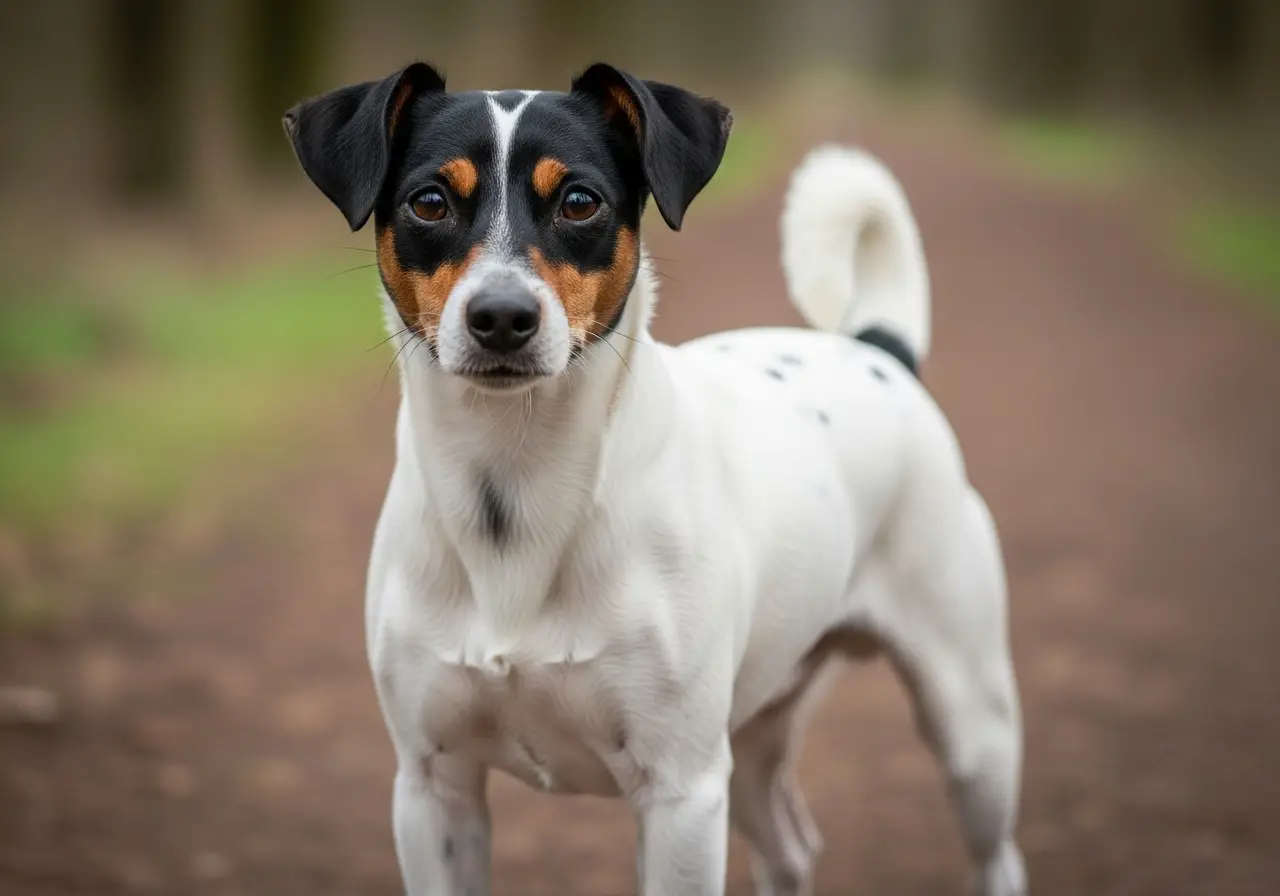
Ratonero Bodeguero Andaluz: small southern Spanish rat hunter with typical white and brown coat, agile and self-confident
03Profile
Key facts and suitability
- Origin
- Spanien
- Original purpose
- Rat hunting in wine cellars
- FCI
- No. 371 · Group 3 · Section 1
- height at the withers
- 35–45 cm
- Weight
- 4–8 kg
- Life expectancy
- 14–16 Years
- Coat type
- Short-haired
- Minimum exercise
- 60 min/day
- Puppy price
- 800–1'500 CHF
- Waiting period
- 3 months
- Sports
- Agility Scent work
04Temperament
How the Ratonero Bodeguero Andaluz shows up in everyday life
The morning walk reveals what makes the Ratonero Bodeguero Andaluz unique: He does not simply walk alongside you. He scans the environment, reacts to every rustle in the bushes, switches from relaxed to focused in fractions of a second. This is not nervousness; this is working dog genetics in real time.
Internally, the Bodeguero requires daily mental and physical stimulation at a high level. The need for social contact and the need for mental work are both four out of five points. This means concretely: A walk without a task is not enough. The dog needs search games, nose work, training sessions or structured interaction, daily, not occasionally.
Externally, he behaves cautiously to reservedly towards strangers. A Bodeguero does not greet unknown people enthusiastically. He observes first, then decides. This reserve is not a lack of socialisation, but breed-typical behaviour of a farm dog that brings territorial thinking with it. Anyone who expects the dog to welcome every visitor warmly immediately will be disappointed.
With known key persons, he shows close bonding and high attention. He follows movements in the household, positions himself within sight, alerts at changes. When left alone, he tolerates up to four hours, with gradual conditioning. Longer absences without preparation lead to restlessness and vocalisation.
Towards other dogs, he is tolerant with early socialisation, but shows terrier-typical directness: He does not automatically avoid conflicts and communicates clearly. Small animals (rabbits, hamsters, birds) are problematic in a shared household. The prey drive for small game cannot be reliably suppressed.
05Needs
What this breed needs daily
The Ratonero Bodeguero Andaluz requires 60 to 90 minutes of active exercise daily, not as free running in a meadow, but as structured activity with a task. Free running around without a mental component releases energy but does not fully satisfy the working dog drive.
Specific forms of exercise that suit the dog: nose work and mantrailing, where the prey drive is channelled; agility or treibball as combined physical and mental work; structured search games in the terrain. Short, intensive training sessions of ten to fifteen minutes several times a day are also more effective than one long, monotonous session.
The need for mental work is at the same level as the need for exercise. A Bodeguero who is physically stimulated but mentally under-challenged develops strategies for self-occupation, digging, barking, destroying objects. This is not a character flaw, but the logical consequence of unused capacity.
Being left alone must be built up gradually. Four hours are the realistic maximum for a well-conditioned dog. Anyone who is regularly absent for longer needs a reliable care solution, such as a dog sitter, neighbourhood network or dog day care.
A securely fenced run is sensible, but no substitute for shared activity. The Bodeguero requires interaction with its owner as part of the workload; a garden in which it runs around alone does not meet this need. The bond with the primary caregiver is strong; this makes it an attentive training partner, but also increases the need for social contact in everyday life.
Exercise
High
mental work
A lot
Social needs
High
training
Medium
06Sport & Mental and Physical Stimulation
What sports the Ratonero Bodeguero Andaluz is suited for
Realistic in terms of physiology and genetics – not every breed suits every sport.
Structurally and physiologically suitable: Suitable for mantrailing, dummy work and tracking · CaniCross / bikejoring possible.
07Quick Check
08Suitability
Who this breed is suitable for – and who it isn't
✓Matches
The Ratonero Bodeguero Andaluz suits owners who can plan at least 90 minutes of active time with the dog daily, not as a walk, but as structured enrichment with training or scent work components. Active individuals or couples with flexible routines who enjoy dog sports or nose work will find an enduring partner in it.
Families with children from about eight years of age are suitable if the children are accustomed to handling an attentive, quick-reacting dog and respect boundaries. The Bodeguero tolerates lively children's play but requires retreat options and clear rules in the household.
Owners with experience in terrier training or with independent dogs have an advantage: they know the principle of actively building impulse control rather than waiting for natural obedience. First-time owners can also be successful with the Bodeguero, provided they accompany the training from the start with a qualified dog training school.
Those living in the countryside or in an area with access to forest and terrain offer the dog optimal conditions. Keeping it in an apartment works if daily stimulation is consistently ensured. A securely fenced property is a plus, not a must.
×Doesn't match
The Ratonero Bodeguero Andaluz does not suit owners who expect a calm, independently balanced companion dog. Anyone who is away from home for eight hours daily and cannot organise reliable care structurally overloads the dog, regardless of the willingness for good keeping.
Households with small animals (rabbits, guinea pigs, birds, hamsters) are problematic. The prey drive towards small game is genetically anchored and cannot be completely neutralised by training. The risk remains permanently real.
Anyone who interprets the Bodeguero's reserve towards strangers as a socialisation deficit and expects the dog to become an open, friendly-to-all dog through consistent training misunderstands the external behavioural axis. Reserve towards strangers is typical of the breed, not a mistake that can be trained away.
Owners who perceive clear leadership and consistency as a burden or do not hold boundaries out of pity will experience a power struggle with this dog, which the dog wins. Also, people who can only occasionally plan physical activity are better served by a calmer breed. The Bodeguero does not forgive exception days without consequence.
10Line reality
Show line, working line, breeder market
The Ratonero Bodeguero Andaluz is bred in such small numbers outside Spain that pronounced line differentiation, as exists for example with Labradors between working lines and show lines, has not yet emerged. Breeding is concentrated in Spain, where the RSCE (Real Sociedad Canina de España) maintains the stud books.
Within Spain, regional differences exist in breeding philosophy: Some breeders focus on working traits (prey drive, endurance, agility) and test their dogs in functional trials. Others breed more for exterior and FCI conformity for the show circuit. These differences are real, but not as pronounced as in breeds with decades of separate selection in working and show lines.
For interested parties in the German-speaking region, this means: Contact with the breeder and directly asking about the breeding focus are decisive. A breeder who values working traits will generally provide information on the drive strength and temperament of the parent dogs. This is more relevant than asking about show successes when looking for a companion dog.
11Health · Reality
What you need to plan for medically with your Ratonero Bodeguero Andaluz
The Ratonero Bodeguero Andaluz is considered a robust breed with comparatively few typical hereditary diseases. The life expectancy is 13 to 15 years, a value typical for small terrier breeds, favoured by the low body mass and the hitherto manageable breeding population.
Known health risks include patellar luxation (kneecap displacement), which generally occurs at an increased rate in small dog breeds. According to an evaluation by the OFA (Orthopedic Foundation for Animals), the prevalence in small terrier breeds is between 5 and 15 %, depending on the breeding line and body structure. No breed-specific large-scale studies exist for the Bodeguero; breeders should have parent animals examined for patellar findings.
Dental problems (tartar, malocclusions, early tooth loss) occur more frequently in small breeds than in large ones. Regular dental care from puppyhood and annual veterinary dental check-ups demonstrably reduce the risk. According to a study by the University of Edinburgh (2019), dental diseases are among the most common diagnoses in small dog breeds under ten kilograms.
Eye diseases and heart problems have not yet been documented as breed-specific issues in this breed. Nevertheless, an annual preventive check-up at the vet is recommended, including cardiac auscultation, joint assessment, and dental status. Overweight significantly increases the risk of joint problems in this active breed; the dog tends to gain weight if it lacks sufficient exercise.
12Structured data
Health by the numbers
Prone to diseases
Kneecap problems Dental problems
Recommended health tests
Kneecap check Dental check
13Myths ↔ Reality
What is often said incorrectly about this breed
Five myths, five realities, five sources.
“Small means little effort; the Bodeguero also fits into a calm household.
Body size says nothing about energy requirements. The Ratonero Bodeguero Andaluz was bred for endurance, speed and initiative. A quiet household without structured stimulation produces a frustrated dog with destructive behaviour, regardless of the size of the apartment.
"The strong prey drive can be completely eliminated through good training.
The Bodeguero's prey drive is genetically anchored and has been reinforced by selection over generations. Consistent training can build impulse control and make the dog reliably manageable in many situations. However, the basic pattern of immediate reaction to movement stimuli from small animals remains and requires permanent management, especially off-leash.
"As a terrier, he is difficult to train and stubborn.
The Ratonero Bodeguero Andaluz shows high willingness to learn and responds well to varied, clear training. Terrier-typical independence does not mean untrainability, but rather that the dog needs consistency and structure, and loses motivation with monotonous repetitions. Whoever varies the training and challenges the dog works with an attentive partner.
"Because he is so rare, he must come from a breeder in Spain; animal welfare is not an option.
The breed is indeed very rarely represented in animal shelters in the German-speaking region. Nevertheless, there are placement organisations that place Spanish dogs in Germany and Switzerland, occasionally including Bodegueros or related terrier types from Andalusia. Researching reputable overseas placement agencies is worthwhile before buying.
14animal welfare
The animal welfare perspective
Breeder market, designer versions, animal shelter reality — what no one writes in the puppy ad.
The Ratonero Bodeguero Andaluz is a rare breed in the German-speaking region. This has a direct effect on the market: because demand exceeds supply, incentives for irresponsible breeding arise, even for breeds that are not currently trendy.
Those searching online for Bodeguero puppies occasionally come across offers from Eastern Europe or via classifieds portals where neither pedigree registration nor health checks of the parent dogs can be verified. A puppy without documented origin, without access to the parent dogs, and without affiliation to a breeding association is not a bargain; it is a calculable risk for health problems and behavioural issues.
Designer versions or hybrid trends hardly exist for the Bodeguero so far. The breed is too unknown to function as a status symbol. This is relative protection, but not absolute.
Breeding-related problems in this breed are defined less by extreme morphology than by temperament selection: those who breed exclusively for sharpness and drive intensity without regard for social behaviour and suitability for everyday life produce dogs that are difficult to handle in family life.
Adoption as an equivalent option: Bodegueros are rare in animal shelters in the German-speaking region. Reputable international adoption organisations that bring Spanish dogs to Germany or Switzerland occasionally place terrier-type dogs from Andalusia, including isolated Bodegueros or closely related breeds. It is worth contacting specialised adoption organisations before purchasing. Adopted dogs are not a second choice; however, they often require an experienced primary caregiver who can handle the terrier temperament.
15Costs · Transparency
What this breed realistically costs
A puppy from a reputable breeder costs between 1,200 and 1,800 EUR in the DACH region; with Spanish breeders, import costs (transport, entry documents, vet fees for entry) add another 300 to 600 EUR. Offers significantly below 800 EUR without proof of affiliation to a breeding association are a warning sign.
Annual living costs for a small breed of this size typically range between 1,500 and 2,500 EUR, depending on food quality, care requirements, and health status. Food for a dog weighing four to eight kilograms costs between 400 and 800 EUR annually when fed high-quality dry food or fresh food.
Average vet costs: Annual preventive check-up with booster vaccination 80 to 150 EUR. Dental cleaning under anaesthesia, more frequently necessary in small breeds, 200 to 500 EUR per procedure. Pet insurance for this breed and size class costs between 30 and 70 EUR monthly, depending on the provider and scope of coverage. Given potential patella surgery costs of 1,500 to 3,000 EUR per joint, surgical cost insurance is a sensible calculation.
16Puppy search
What you need to consider when choosing a breeder
- Reputable breeders of the Ratonero Bodeguero Andaluz are rarely represented in Germany and Switzerland.
- Most active breeding operations are located in Spain, affiliated with the RSCE (Real Sociedad Canina de España) or the VDH partner breeding association.
- A reputable breeder allows a visit to the litter, shows both parent animals or at least the mother, and provides health documents, particularly patellar findings of the parent animals.
- Waiting times of six to twelve months are normal for this rare breed.
- Anyone who can buy a puppy immediately should regard this as a warning signal.
- Concrete criteria for reputable breeding: entry in the stud book with the RSCE or an FCI member association, proof of health examinations of the parent animals, litter inspection by the breeding association, puppy handover no earlier than eight weeks, vaccination passport and microchip.
- Rehoming as an equivalent option: Reputable international rehoming organisations that bring dogs from Spain to Germany or Switzerland occasionally rehome Bodegueros or closely related terriers.
- An inquiry with established rehoming organisations with transparent origin documentation is a legitimate alternative to buying from a breeder.
FAQ
Frequently asked questions about the Ratonero Bodeguero Andaluz
Is Ratonero Bodeguero Andaluz suitable for beginners?
Ratonero Bodeguero Andaluz is considered suitable for first-time dog owners.
Is Ratonero Bodeguero Andaluz a family dog?
Ratonero Bodeguero Andaluz is considered suitable for families with good socialisation and species-appropriate care.
How much exercise does Ratonero Bodeguero Andaluz need?
At least around 60 minutes of exercise per day. As an active breed, more so — plus mental stimulation.
Does Ratonero Bodeguero Andaluz suit an apartment?
With enough exercise and enrichment, Ratonero Bodeguero Andaluz can also be kept in an apartment.
What is the size and weight of Ratonero Bodeguero Andaluz?
Fully grown, Ratonero Bodeguero Andaluz reaches about 35–45 cm at the withers and weighs around 4–8 kg.
What is the life expectancy of Ratonero Bodeguero Andaluz?
The life expectancy of Ratonero Bodeguero Andaluz is approximately 14–16 years.
Is Ratonero Bodeguero Andaluz suitable for allergy sufferers?
Ratonero Bodeguero Andaluz is considered relatively hypoallergenic. There’s never a guarantee — test direct contact beforehand.
Which diseases are common in Ratonero Bodeguero Andaluz?
Kneecap problems Dental problems
17Breed clubs
Official breed clubs in DACH
19Related
Similar breeds – and their differences
You might also be interested in


Participate
Do you have a good photo of your Ratonero Bodeguero Andaluz?
We are looking for expressive images for our breed profiles. Submit yours; the editorial team reviews every submission before publication.
Does this breed suit you?
Little-known Spanish breed – lively and easy to care for