
01Summary
In a paragraph
If you only have 30 seconds.
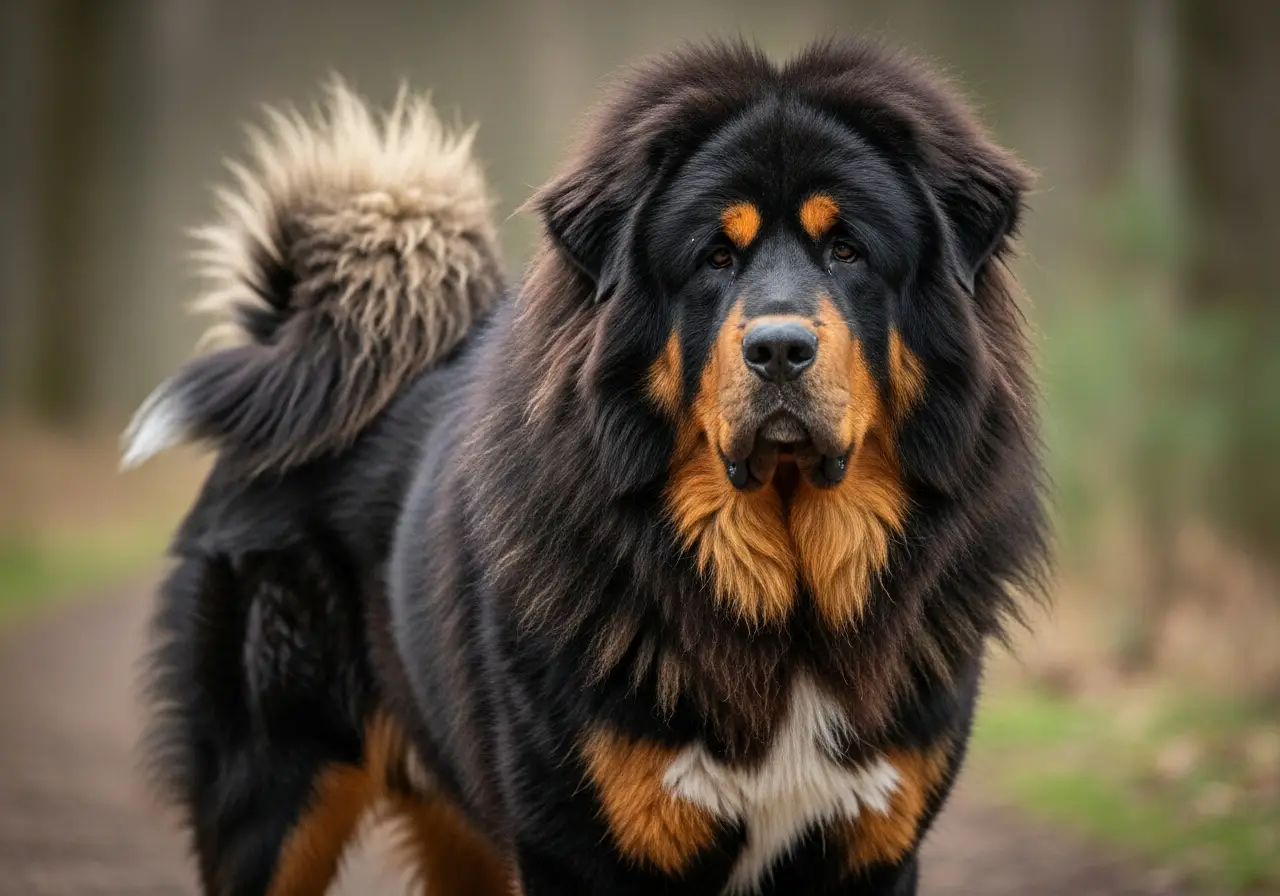
The Do Khyi is a livestock guardian dog from the Himalayas whose genetics are geared towards independent action rather than cooperation. It guards its territory with high consistency, remains permanently reserved towards strangers and decides for itself when to obey. Anyone who owns this breed takes responsibility for a dog that can become dangerous without experienced guidance.
02Introduction
What makes the Do Khyi (Tibetan Mastiff) special
The Do Khyi (Tibetan Mastiff) is a powerful livestock guardian dog from the Himalayas, FCI Group 2, extremely cold-resistant and nocturnal, with a withers height of 61–71 cm.
03Profile
Key facts and suitability
- Origin
- Tibet (China)
- Original purpose
- Livestock guarding in the Himalayas
- FCI
- No. 230 · Group 2 · Sektion 2.2: Molossoide, Berghunde (ohne Arbeitsprüfung)
- height at the withers
- 61–71 cm
- Weight
- 45–90 kg
- Life expectancy
- 10–14 Years
- Coat type
- Doppel
- Minimum exercise
- 60 min/day
- Puppy price
- 2'000–8'000 CHF
- Waiting period
- 12 months
- Sports
- Schutzhund
04Temperament
How the Do Khyi (Tibetan Mastiff) shows up in everyday life
When a visitor enters the property, the Do Khyi does not react with curiosity but with positioning. It places itself between the intruder and its territory, calmly but unambiguously. This is not a sign of aggression but its basic mode.
In everyday family life, it shows itself calm and dignified. It does not seek constant closeness but accepts its key people as part of its territory. Petting on command is not its profile. It decides for itself when contact takes place.
Internal axis (what the dog needs): The need for social contact is low to moderate; the Do Khyi does not require intensive enrichment with humans, but clear structures and a stable territory. Mental work in the sense of obedience training only works to a limited extent; it assesses situations independently. Exercise needs are moderate, around 60 to 90 minutes daily, but without sporting intensity.
External axis (how the dog reacts): It remains permanently reserved towards strangers, which hardly changes even after repeated contact. With other dogs, it can appear dominant, especially towards animals of the same sex. It generally tolerates children it has grown up with; unknown children behaving unpredictably can trigger its protective reflex.
It is active at night. Night barking is not a fault but a function. Anyone keeping a Do Khyi in a residential area must expect conflicts. A rural environment with sufficient distance from neighbours is not a recommendation, it is a prerequisite.
05Needs
What this breed needs daily
The Do Khyi requires 60 to 90 minutes of controlled exercise daily. Intensive endurance sport does not fit its profile and is also orthopaedically inadvisable due to its body size and slow development. Walks at a calm pace, combined with free movement on secured terrain, cover its exercise needs.
More decisive than the quantity of exercise is a stable, clearly defined territory. The Do Khyi requires a securely fenced property; the fence must be high and sturdy enough to hold a dog of this size and strength. Keeping it in an apartment is not compatible with this breed.
Mental stimulation for the Do Khyi does not occur through classic obedience exercises or toys, but through the opportunity to monitor its territory. It needs control over its area. Anyone who takes away this function creates frustration.
Social structure is indispensable: The Do Khyi accepts leadership only from people it experiences as sovereign and consistent. Inconsistency or uncertainty in body language leads to it making its own decisions, which can be safety-relevant.
Being left alone within its territory is generally unproblematic, provided the territory is secured. Up to six hours are possible. Outside the territory, for example in unfamiliar surroundings or during transport, it reacts noticeably more tense.
An accompanying dog training school with experience in livestock guardian dogs is particularly indispensable during the puppy phase. The breed matures slowly; males are temperamentally mature at the earliest at four years of age.
Exercise
Medium
mental work
Medium
Social needs
Low
training
Experts
07Quick Check
08Suitability
Who this breed is suitable for – and who it isn't
✓Matches
The Do Khyi suits owners with proven experience in handling independent, strongly protective dogs, ideally livestock guardian dogs or similar breeds. A rural environment with sufficient property area and a secure fence is a basic requirement, not an option.
Suitable are owners who are prepared to offer 60 to 90 minutes of controlled exercise daily but refrain from intensive sporting activities. Anyone who combines clear, calm leadership with consistent body language and does not expect constant interaction from the dog can build a stable relationship with the Do Khyi.
Families with older children (from about 12 years) who have grown up in the household and know the dog are conceivable, provided all family members understand handling of the breed and implement it consistently. Visitor contact must be actively managed; spontaneously leaving the door open for strangers is not compatible with this breed.
Owners living in regions without restrictions on restricted breeds and willing to inform themselves about local regulations are better prepared. In several German federal states, the Do Khyi is subject to special requirements.
×Doesn't match
The Do Khyi is not suitable for owners keeping a dog for the first time. Even those with experience of cooperative breeds such as retrievers or spaniels generally underestimate the independence of a livestock guardian dog. This experience is not transferable.
The breed is not suitable for urban or densely populated living environments. Anyone who cannot provide a secured property with sufficient distance from neighbours should not consider this breed, as the barking at night alone regularly leads to official regulations.
Anyone expecting a Do Khyi to be a social, accessible companion dog that greets strangers in a friendly manner will be permanently disappointed. The external reaction to strangers is structurally reserved to repulsive; this is not a training deficit but breed character. Anyone who does not understand this difference endangers third parties.
Households with small children or frequent, changing visitors are also unsuitable. The Do Khyi does not tolerate unpredictable movements in its territory without clear classification by its primary caregiver. Owners who travel a lot for work or have to take the dog regularly into unfamiliar environments should choose another breed.
10Line reality
Show line, working line, breeder market
The Do Khyi is bred in two phenotypically and temperamentally distinct types, often referred to in specialist literature as the "Do Khyi type" (original working type) and the "Lion Head" type (breeding more focused on exterior).
The original working type is based on the FCI standard and its historical function as a livestock guardian dog. These dogs have a slimmer head, are more keen to move and are temperamentally closer to the original profile: independent, territorial, watchful. Breeders aiming for this type place value on health tests and working traits.
The "Lion Head" type emerged mainly from the Chinese breeding boom of the 2000s. These dogs have a heavier head, are heavier and show partly overdeveloped skin folds. Health-wise, eye problems (entropion, ectropion) and orthopaedic strain due to overweight are more frequently documented in this type. The FCI standard explicitly describes a functional, not exaggerated, type.
In Europe, FCI-compliant breeding dominates, relying on health tests (HD, ED, thyroid). The International Club for Tibetan Dog Breeds e.V. (KTR) coordinates breeding in the German-speaking region. Anyone looking for a Do Khyi should explicitly ask for the studbook type and demand health certificates for the parent animals; the differences between the types are significant and directly affect health and longevity.
11Health · Reality
What you need to plan for medically with your Do Khyi (Tibetan Mastiff)
The Do Khyi is considered a robust breed but has several breed-specific health risks that must be known before getting a dog.
Hip dysplasia (HD) and elbow dysplasia (ED) occur regularly in large molossoids. Reputable breeders X-ray parent animals and disclose the results; a purchase without HD/ED certification of the parents is a clear warning sign. Exact breed rates for the Do Khyi are statistically limited in reliability due to the small population size in Europe, but lie in the range of other large molossoids at 20–40% for HD findings (source: OFA database, status 2023, ofa.org).
Thyroid diseases (hypothyroidism) are documented more frequently in the Do Khyi than in many other breeds. Symptoms such as weight gain, lethargy and coat changes should be investigated by a vet. A basic thyroid test (T4) is part of preventive care.
Gastric dilatation-volvulus (gastric torsion) is a life-threatening risk in large, deep-chested dogs. Owners must know the warning symptoms (distended abdomen, unsuccessful retching, restlessness) and seek immediate veterinary emergency care if they occur. Prophylactic measures (several small meals, no exercise immediately after eating) reduce the risk.
Eye problems such as entropion and ectropion occur particularly in dogs with exaggerated skin folds. The life expectancy is 10 to 12 years. Regular preventive examinations (annually from the 5th year of life) are recommended, particularly for joints, thyroid and eyes.
12Structured data
Health by the numbers
Prone to diseases
Hip dysplasia, hypothyroidism, autoimmune diseases, hyperuricosuria
Recommended health tests
Hip X-ray, thyroid screening
13Myths ↔ Reality
What is often said incorrectly about this breed
Five myths, five realities, five sources.
“The Do Khyi is like a large, calm family dog, just more imposing.
The Do Khyi is not an enlarged family dog. Its guarding instinct is genetically geared towards independent action, not social compliance. It tolerates its family but does not seek a close bond in the sense of a cooperative companion dog. Strangers, including known visitors, are treated with distrust on an ongoing basis.
“With consistent training, the guarding instinct can be switched off.
The Do Khyi’s guarding instinct is not a behavioural disorder but the breeding goal over centuries. It can be guided and channelled through training, but not eliminated. Anyone who keeps a Do Khyi with the aim of training out this instinct will fail and produce a frustrated dog.
“Do Khyis hardly bark; they are quiet giants.
The opposite is documented: The barking of the Do Khyi was already described as particularly distinctive in historical sources. Nocturnal, enduring barking is a breed-typical characteristic and one of the most common reasons for rehoming in Central Europe. In densely populated areas, this regularly leads to neighbour disputes.
“Due to its size, the Do Khyi is a good protection and companion dog for active sportspeople.
The Do Khyi is not a sport dog. It develops slowly, males mature at the earliest at 4 years of age, and it is not geared towards intensive physical cooperation with humans. Endurance sports, agility or similar activities do not correspond to its profile. Its exercise requirement is moderate; what is decisive is a stable, clearly structured territory.
“A Do Khyi from reputable breeding is health-wise unproblematic.
Even in reputable breeding, Do Khyis typically develop breed-typical hip dysplasia (HD), elbow dysplasia (ED) and thyroid diseases. Due to their body size, there is an increased risk of gastric dilatation-volvulus (bloat). Reputable breeding reduces the risk but does not eliminate it.
14animal welfare
The animal welfare perspective
Breeder market, designer versions, animal shelter reality — what no one writes in the puppy ad.
The Do Khyi is a breed with a clearly documented animal welfare problem that stems from several sources.
Backyard breeder market and status symbol effect: The Chinese breeding boom of the 2000s has left traces worldwide. Individual dogs were traded for several million euros converted. When the market collapsed from 2013, tens of thousands of animals were abandoned or given to rescue stations. In Europe, this extreme hype did not occur to the same extent, but the Do Khyi is also occasionally kept here as a prestige object, with predictable consequences if owners underestimate the requirements.
Surrenders due to housing conditions: Do Khyis are regularly surrendered in Germany and Switzerland because the barking at night leads to neighbour disputes, because territorial behaviour escalates or because owners are overwhelmed by the dog's independent decision-making structure. These surrenders are not isolated cases; they are a structural pattern that begins with false expectations when buying.
Breeding-related problems: The "Lion Head" type, promoted by the Chinese boom, shows eye problems and orthopaedic stresses more frequently. Anyone buying a Do Khyi should explicitly ask for the FCI-compliant type and demand health certificates.
Adoption as an equally valid option: Do Khyis regularly appear in animal shelters and with breed rescue organisations, having been surrendered due to their owners being overwhelmed. An adult dog from adoption has the advantage that its character is already assessable, which is a considerable benefit over a puppy for a breed with this profile. The International Club for Tibetan Dog Breeds e.V. occasionally places dogs from emergency situations.
15Costs · Transparency
What this breed realistically costs
The acquisition costs for a Do Khyi from reputable, VDH-affiliated breeding in Germany and Switzerland range between 1,500 and 3,000 EUR. Offers significantly below this, particularly from Eastern Europe or Asia without pedigree documentation, are a warning sign for missing health tests and unclear origins.
The annual living costs are considerable due to the body size. Feed costs alone for an adult Do Khyi (40–70 kg) amount to 800 to 1,500 EUR per year, depending on feed quality and weight. Grooming (the double coat requires intensive care, especially during moulting) can cost 200 to 400 EUR annually with professional support.
Basic veterinary costs (vaccinations, annual preventive care) amount to 300 to 600 EUR per year. Orthopaedic assessments (HD/ED X-rays) cost a one-off 200 to 400 EUR. In case of illness, such as gastric torsion or joint surgery, costs of 3,000 to 8,000 EUR per procedure are realistic. Pet insurance is strongly recommended for this breed; annual premiums range from 600 to 1,200 EUR depending on the provider and coverage.
16Puppy search
What you need to consider when choosing a breeder
- Reputable Do Khyi breeders are members of the International Club for Tibetan Dog Breeds e.V.
- (KTR), which is subordinate to the VDH and thus to the FCI.
- Breeders with a VDH studbook number disclose health certificates of the parent animals (HD, ED, thyroid) and allow inspections before purchase.
- Warning signs for dubious offers: no studbook entry, no health certificates of the parents, puppies under eight weeks old, handover without personal contact, prices below 800 EUR or significantly above 3,000 EUR without comprehensible justification, multiple litters available simultaneously.
- Adopting an adult Do Khyi from an animal shelter or breed rescue is an equally valid option.
- Adult dogs have the advantage that their character can already be assessed; for a breed with pronounced protective and territorial behaviour, this is a relevant factor.
- The KTR occasionally places dogs from emergency situations.
- Specialised animal welfare organisations for molossoids also regularly have Do Khyis in their care.
- Before purchasing or taking on a Do Khyi, a conversation with an experienced owner or breeder of this breed is indispensable, not as a formality but as a reality check.
FAQ
Frequently asked questions about the Do Khyi (Tibetan Mastiff)
How much exercise does Do Khyi (Tibetan Mastiff) need?
At least around 60 minutes of exercise per day.
What is the size and weight of Do Khyi (Tibetan Mastiff)?
Fully grown, Do Khyi (Tibetan Mastiff) reaches about 61–71 cm at the withers and weighs around 45–90 kg.
What is the life expectancy of Do Khyi (Tibetan Mastiff)?
The life expectancy of Do Khyi (Tibetan Mastiff) is approximately 10–14 years.
Which diseases are common in Do Khyi (Tibetan Mastiff)?
Hip dysplasia, hypothyroidism, autoimmune diseases, hyperuricosuria
17Breed clubs
Official breed clubs in DACH
19Related
Similar breeds – and their differences
You might also be interested in
Participate
Do you have a good photo of your Do Khyi (Tibetan Mastiff)?
We are looking for expressive images for our breed profiles. Submit yours; the editorial team reviews every submission before publication.
Does this breed suit you?
Nocturnal livestock guardian Molosser. Barks all night. Extremely cold-resistant, intolerant of heat. Only for experienced specialists.