
01Summary
In a paragraph
If you only have 30 seconds.
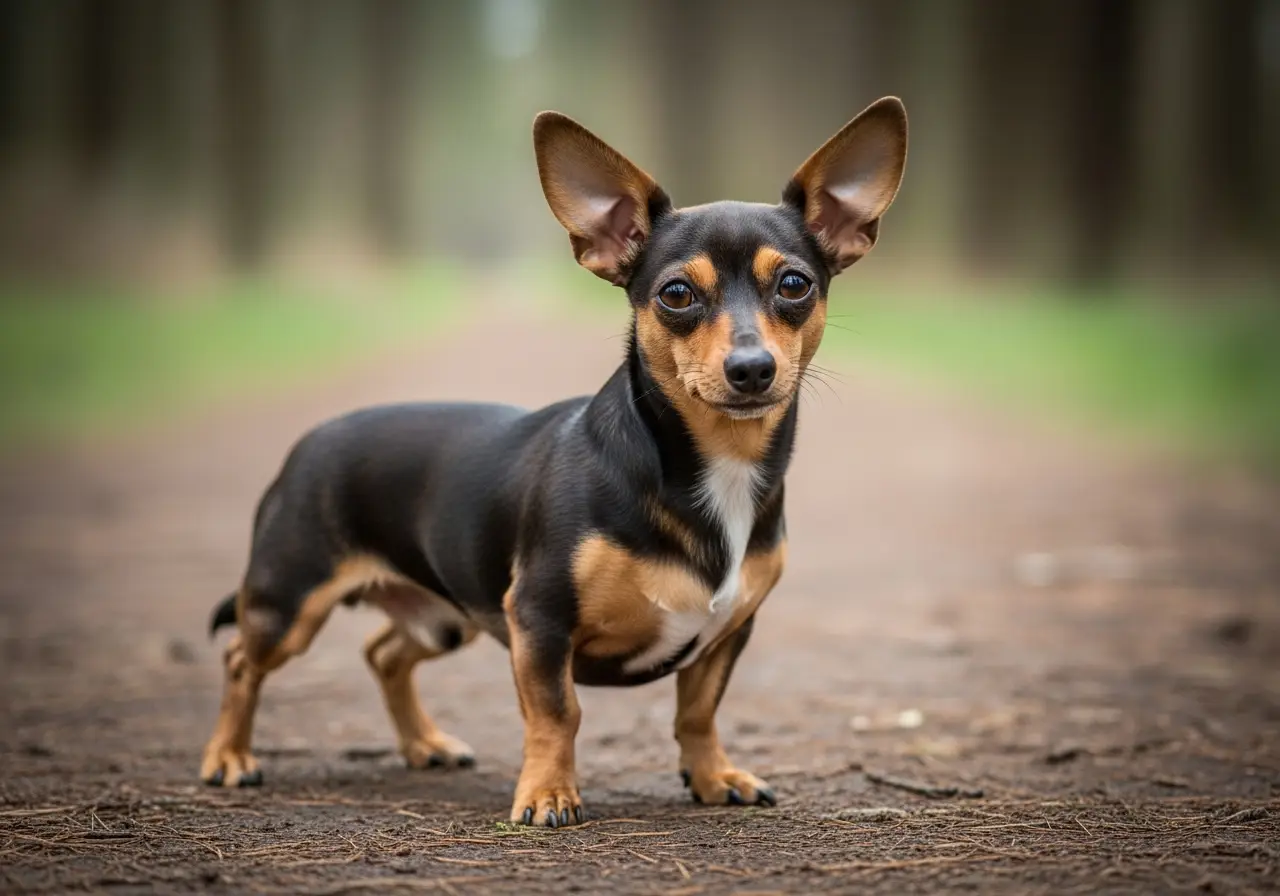
The Chiweenie is not an FCI-recognised breed but a designer hybrid of Chihuahua and Dachshund. What results is genetically less predictable than with purebreds: coat type, body structure, and temperament vary greatly depending on the parent animals. Anyone looking for a small, alert dog with an independent character and who can provide clear daily structure will find an lively companion here, without guarantees on paper.
02Introduction
What makes the Chiweenie special
The Chiweenie is a non-FCI-recognised cross between a Chihuahua and a Dachshund, compact and alert, with a withers height of 15–25 cm.
03Profile
Key facts and suitability
- Origin
- USA
- Original purpose
- Companion dog (cross Chihuahua × Dachshund)
- height at the withers
- 15–25 cm
- Weight
- 3–7 kg
- Life expectancy
- 12–16 Years
- Coat type
- Short-haired
- Minimum exercise
- 20 min/day
- Puppy price
- 500–1'200 CHF
- Waiting period
- 3 months
- Sports
- Obedience · Tricks
04Temperament
How the Chiweenie shows up in everyday life
When you come home, a Chiweenie greets its primary caregiver with clear intensity, barking, jumping, and physical contact. The need for social contact is high: the dog is strongly oriented towards its main caregiver and follows them around the apartment. This is not just a mood, but genetically anchored bonding readiness of both parent breeds.
At the same time, it often shows reserve or active barking readiness towards strangers. Here, internal and external axes diverge significantly: a high need for social contact with the family does not mean that the dog is open to every visitor. Anyone who confuses this underestimates its guarding instinct.
Outside, the prey drive of the dachshund side reliably activates. Small animals, rustling in the bushes, bird flight – the Chiweenie reacts with body tension and a pursuit impulse. On a lead, this manifests as pulling and fixing. Off-lead walking is only advisable in secure terrain.
In everyday life, it needs mental stimulation: search games, nose work, or short training sessions. Without this enrichment, it develops displacement behaviour, excessive barking, destruction of objects, or restlessness. Three short ten-minute training sessions daily are more effective than one long session.
Towards other dogs, it appears confident, sometimes beyond its size. The dachshund heritage provides independence and little willingness to submit. Encounters with unknown dogs should be introduced in a controlled and calm manner.
05Needs
What this breed needs daily
The Chiweenie needs 45 to 60 minutes of active exercise daily, divided into at least two sessions. Long marches are less purposeful than varied walks with sniffing opportunities; the nose of the dachshund side demands olfactory stimulation.
Mental stimulation is not a bonus, but a must. Search games, nose work, simple fetch exercises, or trick training cover the need for mental work. A dog that is mentally under-stimulated compensates through barking, restlessness, or destructive behaviour.
The need for social contact is high. The Chiweenie tolerates being left alone for up to about four hours, provided this state has been built up gradually and consistently. Anyone who is regularly away from home for more than four hours needs a reliable care solution, such as a dog sitter, neighbourly help, or day care.
Training requires consistency. The dog reacts sensitively to inconsistent signals and quickly develops controlling behaviour if structure is lacking. Short, clear training sessions with positive reinforcement are more effective than long correction phases. An accompanying dog training school in the first months is recommended.
The prey drive requires management: secure off-lead walking, reliable recall training, and loose-leash walking are not optional extras. Anyone living in an area with wildlife crossings must take this aspect particularly seriously.
Exercise
Low
mental work
Medium
Social needs
High
training
Medium
06Sport & Mental and Physical Stimulation
What sports the Chiweenie is suited for
Realistic in terms of physiology and genetics – not every breed suits every sport.
Structurally and physiologically suitable: no jumping sports (risk of slipped disc) · Suitable for mantrailing, dummy work and tracking.
07Quick Check
08Suitability
Who this breed is suitable for – and who it isn't
✓Matches
The Chiweenie suits individuals or couples who spend a lot of time at home or work remotely and can offer their dog 45 to 60 minutes of active exercise and mental enrichment daily. A calm household without frequent visitor traffic suits its guarding profile.
Owners who bring experience with independent dogs and can implement consistent, calm everyday handling get along well with its temperament. Anyone who enjoys nose work, search games, or trick training will find an attentive training partner in it.
Families with children from about eight years old, who are accustomed to respectful handling of small dogs and do not treat the dog as a toy, can successfully keep a Chiweenie, provided that clear rules apply equally to all family members.
City dwellers with access to secure off-lead areas or quiet green spaces are well positioned. The dog does not need a garden, but benefits from regular sniffing walks away from busy streets.
×Doesn't match
The Chiweenie does not suit households where the dog is regularly left alone for more than four hours and no care solution exists. Its high need for social contact and tendency towards separation anxiety make long absences without preparation and support problematic.
Anyone looking for an uncomplicated, friendly dog for a sociable home with frequent visitors will be disappointed by its reserve towards strangers and its readiness to bark. A high need for social contact within the family does not mean openness to everyone; those who confuse these aspects fundamentally underestimate the dog.
Households with very young children under six years of age, where rough and unpredictable handling is unavoidable, are not a suitable environment. The susceptibility to injury of the small body and the readiness to react of the Dachshund component when overstimulated increase the risk of conflict.
Owners without the willingness for consistent training and clear daily structure should not choose this crossbreed. Anyone who coddles the dog due to its size and refrains from setting boundaries actively promotes barking behaviour, leash reactivity, and controlling behaviour, regardless of how good their intentions are.
10Line reality
Show line, working line, breeder market
As the Chiweenie is not an FCI-recognised breed, there are no officially defined breeding lines in the sense of working, show, or field trial lines. The variance between individual animals is correspondingly high.
In practice, two informal types can nevertheless be observed: animals with a stronger Chihuahua influence tend to have a rounder head, larger eyes, and pronounced wariness towards strangers. Animals with a stronger dachshund influence more frequently show a longer back, pronounced sniffing readiness, and a more active prey drive.
Reputable breeders, who have both parent animals health-screened, generally work with long-haired dachshunds or short-haired Chihuahuas, which directly affects the coat type and grooming effort of the puppy. Puppies from backyard breeding often have unknown parent animals, making it difficult to assess their future character and health profile.
A differentiation by lines in the classical sense is not possible for the Chiweenie. Anyone seeking a specific temperament or body type must get to know both parent animals personally and review their health certificates.
11Health · Reality
What you need to plan for medically with your Chiweenie
The life expectancy of the Chiweenie is 12 to 16 years, a value based on the longevity data of both parent breeds (Chihuahua: 14–16 years, Dachshund: 12–15 years according to VDH breed profiles).
The health profile combines the known risks of both parent breeds. Disc problems (Intervertebral Disc Disease, IVDD) are genetically determined in the Dachshund component: According to a study by the University of Bern (2020), chondrodystrophic breeds have up to 19 times higher IVDD risk compared to non-chondrodystrophic breeds. Animals with pronounced Dachshund body structure carry this risk directly.
Patellar luxation occurs frequently in the Chihuahua component: The OFA (Orthopedic Foundation for Animals) records a patellar luxation rate of around 5–10% in tested Chihuahua populations. For the Chiweenie without parent animal testing, this rate is not estimable.
Dental problems are generally increased in small breeds: Narrow jaw conditions favour tartar, periodontitis, and retained deciduous teeth. Regular dental care from puppyhood and annual veterinary dental checks are recommended.
Heart diseases (mitral valve insufficiency) occur in both parent breeds in old age. Annual heart auscultations are sensible from the sixth year of life onwards.
Overweight poses a real risk: The low exercise requirement tempts overfeeding. Already 10–15% overweight measurably increases pressure on discs and joints.
12Structured data
Health by the numbers
Prone to diseases
Slipped disc (from Dachshund line), patellar luxation, dental problems
Recommended health tests
X-ray of the spine
13Myths ↔ Reality
What is often said incorrectly about this breed
Five myths, five realities, five sources.
'The Chiweenie is a low-maintenance apartment dog that requires little effort.
The pronounced prey drive of the Dachshund component and the alertness of the Chihuahua make the Chiweenie a dog that, without clear structure, quickly tends towards barking behaviour and uncontrolled hunting attempts. Apartment keeping is possible but does not replace daily exercise nor consistent training.
'Mixed breeds are automatically healthier than purebreds, so the Chiweenie is too.
Heterosis (hybrid vigour) does not occur reliably. The Chiweenie inherits the breed-typical risks of both parents: slipped disc problems (Dachshund chondrodystrophy), patellar luxation, and dental problems (Chihuahua). Without health tests of the parent animals, the risk profile of the puppy cannot be assessed.
'Small dogs require hardly any training, the Chiweenie manages that on its own.
Small dogs are often coddled and receive less consistent boundary setting than large breeds. In the Chiweenie, this demonstrably leads to control-seeking behaviour, excessive barking, and leash reactivity. Consistent, calm leadership is not an option but a basic prerequisite.
'The Chiweenie is particularly suitable for children due to its size.
Its small size makes the Chiweenie susceptible to injury from rough handling. Its dachshund heritage can lead to snapping when overstimulated. Respectful, calm interaction by children is a prerequisite, not a given.
“Because it is not an FCI-recognised breed, there are no health risks to consider.
Lack of FCI recognition means the opposite: there are no binding breeding health requirements. Both parent breeds carry known hereditary diseases. Without proof of health screening for the parent animals (X-rays, patella, heart), the risk for the puppy is increased, not decreased.
14animal welfare
The animal welfare perspective
Breeder market, designer versions, animal shelter reality — what no one writes in the puppy ad.
The Chiweenie belongs to the designer dogs that have been particularly affected by multiplier breeding in recent years. Because no FCI studbook requirements apply, institutional control is lacking, which at least sets a minimum framework for recognised breeds. The result: puppies from untested parent animals, without socialisation, without health documentation, marketed via classified ad platforms at prices between 300 and 800 euros.
The argument "mixed-breed dogs are healthier" is deliberately used in marketing to justify the omission of health tests. In fact, the Chiweenie inherits the risk profiles of both parent breeds. Without proof of X-rays, patella examination, and heart auscultation of the parent animals, the health profile of the puppy is simply unknown.
Another structural problem: The Chiweenie is often marketed as a "low-maintenance city dog". Its actual profile (prey drive, readiness to bark, high need for social contact, need for structure) is systematically hidden. This leads to animals whose behaviour was underestimated regularly ending up in animal shelters. Animal welfare organisations in the DACH region report a measurable increase in small designer dogs in rehoming since 2018.
Adopting a Chiweenie from an animal shelter or foster home is an equivalent option to buying. Many of these dogs are young, socialised, and come with an assessment of their character by experienced animal carers. Anyone taking on an adult dog already knows the size, coat type, and basic temperament, factors that are unpredictable in a puppy.
Anyone buying a puppy bears responsibility for the demand they create. A reputable breeder tests both parent animals, lets puppies grow up with the mother dog, and provides health documents, regardless of whether FCI recognition exists.
15Costs · Transparency
What this breed realistically costs
The purchase price for a Chiweenie puppy varies considerably: reputable breeders who health-test both parent dogs charge between 800 and 1,500 euros. Classifieds platforms feature offers starting from 200 to 400 euros, often without vaccination records, without health documentation, without socialisation.
Annual living costs for a Chiweenie are typically between 1,200 and 2,000 euros, depending on food quality, grooming effort, and region. Food for a dog of this size costs approximately 30 to 60 euros monthly with high-quality dry kibble or fresh meat-based diets.
Veterinary costs for basic care (vaccinations, annual check-ups, parasite prevention) amount to 200 to 400 euros annually. Potential treatment costs for breed-typical conditions are added: an IVDD operation costs between 2,000 and 5,000 euros depending on severity. A patellar luxation surgery ranges from 800 to 2,500 euros per joint.
Dog liability insurance is mandatory in several German states and costs approximately 40 to 80 euros annually for small dogs. A health insurance policy for a Chiweenie ranges from 30 to 80 euros monthly depending on the provider and coverage, making it a serious option given the risk of IVDD.
16Puppy search
What you need to consider when choosing a breeder
- As the Chiweenie is not an FCI-recognised breed, there is no studbook and no association control.
- This significantly increases the requirements for your own assessment.
- A reputable breeder has both parent animals tested for patellar luxation, disc health, and heart function before breeding and provides corresponding certificates.
- Puppies grow up with the mother dog and leave the litter no earlier than eight weeks of age.
- A personal visit before purchase is not optional but the minimum standard.
- Warning signs: puppies without a vaccination record, sale via intermediaries, photos without recognisable context, pressure to make a quick decision, no viewing appointment possible, prices under 500 euros without explanation.
- Adoption through an animal shelter or foster home is a fully valid alternative.
- Many Chiweenies end up in rehoming due to underestimated care requirements, often young, with known character and initial veterinary care.
- Animal welfare organisations in the DACH region as well as specialised small animal rehoming services regularly have suitable dogs.
- Anyone buying a puppy should take their time: compare several breeders, obtain references, and do not make a decision under time pressure.
FAQ
Frequently asked questions about the Chiweenie
Is Chiweenie suitable for beginners?
Chiweenie is considered suitable for first-time dog owners.
How much exercise does Chiweenie need?
At least around 20 minutes of exercise per day.
Does Chiweenie suit an apartment?
With enough exercise and enrichment, Chiweenie can also be kept in an apartment.
What is the size and weight of Chiweenie?
Fully grown, Chiweenie reaches about 15–25 cm at the withers and weighs around 3–7 kg.
What is the life expectancy of Chiweenie?
The life expectancy of Chiweenie is approximately 12–16 years.
Which diseases are common in Chiweenie?
Slipped disc (from Dachshund line), patellar luxation, dental problems
17Breed clubs
Official breed clubs in DACH
19Related
Similar breeds – and their differences
You might also be interested in



Participate
Do you have a good photo of your Chiweenie?
We are looking for expressive images for our breed profiles. Submit yours; the editorial team reviews every submission before publication.
Does this breed suit you?
Non-FCI-recognised cross. Affordable, city-suitable companion. Note the risk to the spine from the Dachshund line.