3 sourcesUpdated September 11, 2026Responsible editor: Roger KleinText: Miriam Schäfer
01Summary
In a paragraph
If you only have 30 seconds.
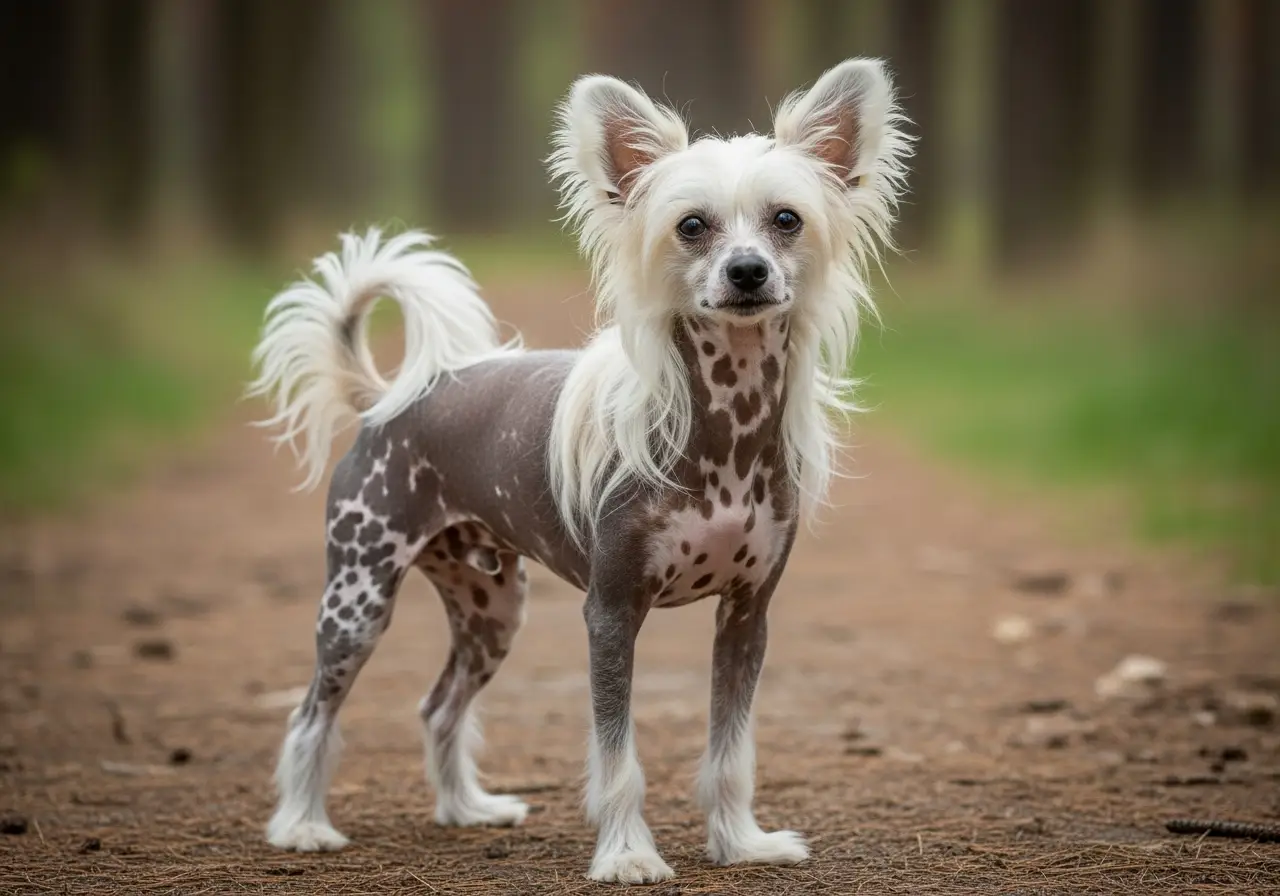
The Chinese Crested Dog exists in two variants: hairless with crest, socks, and tail plume, or fully haired as a Powder Puff. Both share a high need for social contact and a strong attachment orientation. Anyone who takes on this dog commits to daily skin care or intensive grooming, and to a dog that structurally cannot tolerate long periods of being left alone. Life expectancy: 13 to 15 years.
02Introduction
What makes the Chinese Crested Dog special
The Chinese Crested Dog is a naked Chinese companion dog, FCI Group 9, hypoallergenic and heat-loving, withers height 23–33 cm.
03Profile
Key facts and suitability
- Origin
- China
- Original purpose
- Companion dog, source of warmth
- FCI
- No. 288 · Group 9 · Section 4
- height at the withers
- 23–33 cm
- Weight
- 2–5 kg
- Life expectancy
- 13–15 Years
- Coat type
- hairless dog
- Minimum exercise
- 20 min/day
- Puppy price
- 1'200–2'500 CHF
- Waiting period
- 9 months
- Sports
- Agility · Obedience · Tricks
04Temperament
How the Chinese Crested Dog shows up in everyday life
When you return home, the Chinese Crested Dog immediately registers your arrival and seeks physical closeness, not just eye contact. This is not a greeting routine that ends after five minutes. The breed has a need for social contact that extends throughout the entire day: on the sofa, while working at the desk, or watching television.
The need for social contact is extremely high. This means concretely that this dog requires people in its immediate vicinity for most of the day. Being left alone for more than three hours causes stress, which can manifest as vocalisation, insecure behaviour, or digestive problems. The exercise requirement is moderate at around 45 to 60 minutes daily, divided into two to three sessions. Mental work in the form of nose work or trick training rounds off the day meaningfully.
The Crested Dog behaves reservedly or cautiously towards strangers. Friendliness towards unknown people is rated four out of five; it is therefore not shy or anxious but requires time and a calm approach. This reserve is not a flaw but typical of the breed. Anyone expecting the dog to greet every visitor immediately will be disappointed.
On a walk, it shows little prey drive. It explores its surroundings with its nose, reacts to sounds, and observes its environment attentively. Hairless specimens require a dog coat at temperatures below ten degrees; this is not a fashion choice but thermal protection for unprotected skin. In summer, avoid direct midday sun and apply sun protection.
05Needs
What this breed needs daily
The Chinese Crested Dog requires 45 to 60 minutes of exercise daily, divided into several sessions. Long endurance runs or intensive dog sports do not match its profile; moderate walks combined with short training sessions fully cover its exercise needs.
Mental stimulation: The need for mental work is in the medium range. Nose games, simple search tasks, and trick training with positive reinforcement are suitable formats. The breed learns cooperatively and shows enjoyment in structured interactions, provided the training approach is calm and consistent. Pressure or loud correction leads to withdrawal and insecurity.
Need for social contact: This is the decisive factor in everyday life. The Crested Dog requires the physical presence of its primary caregivers for most of the day. Being left alone for more than three hours is structurally not consistent with the breed's characteristics. Anyone who is regularly away from home for eight hours needs a reliable care solution, such as a dog sitter, a dog daycare, or a second person in the household.
Care as a daily task: Hairless variants require skin care in the morning (moisturising cream on dry areas), UV protection when exposed to sunlight, and a close-fitting coat in cold weather. Powder Puff variants require regular brushing to prevent matting, at least three times a week. Dental care is mandatory for both variants; for hairless dogs, it must be implemented particularly consistently due to genetically predisposed dental weakness.
Living in an apartment works well, provided the need for social contact is met. A garden is not essential, but outdoor areas without direct sunlight are advantageous in summer.
Exercise
Low
mental work
Medium
Social needs
Very high
training
Easy
06Quick Check
07Suitability
Who this breed suits and who it doesn't
✓Matches
The Chinese Crested Dog suits individuals or households that spend most of the day at home, whether working from home, retired, or with flexible working hours. The tolerance for being left alone is a maximum of three hours; this is not a recommendation but an upper limit.
Suitable for singles or couples looking for an intensely bond-oriented dog and willing to accept daily skin or coat care as a fixed part of everyday life. Calm households without frequent changes in visitors suit the breed's nature; reserve towards strangers requires time and calm settling-in.
Families with older children from around ten years old, who handle a sensitive, small dog respectfully, are also suitable. Toddlers and the Crested Dog do not fit together well structurally, not because of aggression but due to the breed's sensitivity to unpredictable movements and noise.
Anyone with experience of sensitive or strongly bond-oriented breeds will find a willing-to-learn, cooperative companion in the Crested Dog. First-time owners are also conceivable, provided that care effort, need for social contact, and limits for being left alone are assessed realistically before purchase and not glossed over.
×Doesn't match
The Chinese Crested Dog does not suit individuals who are regularly away from home for eight or more hours and cannot or will not organise a care solution. The need for social contact of this breed is not a character trait that can be reduced through habituation; it is genetically anchored.
Not suitable for households with very young children under six years old, where everyday life is characterised by unpredictable stimuli, loud noise, and abrupt movements. The sensitivity of the Crested Dog does not fit well with this environment.
Anyone choosing the hairless variant because they hope for less care effort is mistaken. Skin care, sun protection, and cold protection are daily duties; anyone who underestimates these risks skin problems and animal suffering. Anyone choosing the Powder Puff variant because they expect a "low-maintenance" coat underestimates the brushing effort.
Active owners looking for a running companion, an agility dog, or a dog with high drive for movement will not find the right profile in the Crested Dog. Also, individuals who prefer a dog that reacts openly and sociably to strangers should assess this breed realistically: reserve towards unknown people is typical of the breed, not a training issue.
08Related
Similar breeds and how they differ



09Line reality
Show line, working line, breeder market
The Chinese Crested Dog is bred exclusively as a companion dog today; a differentiation into working and show lines, as exists for retriever or herding breeds, is not relevant for this breed. The FCI standard does not provide for a working test.
However, two clearly distinguishable body types exist within the breed, which play a role in breeding and in the show ring: the "Deer Type" with a slender, tall-legged frame and fine bone structure, and the "Cobby Type" with a stockier, more robust build. Both types are standard-compliant and can occur within the same litter.
Additionally, the two varieties Hairless and Powder Puff coexist, also possible within the same litter, since the hairlessness gene is inherited heterozygously. Reputable breeders mate both varieties together, as homozygous hairlessness is lethal.
In the show area, the focus lies on type, movement and coat quality for the Powder Puff, and on skin condition and crest quality for the Hairless. Anyone acquiring a Crested Dog from show breeding should check the parent dogs for health traits, particularly dental status and skin health, not just for visual criteria.
10Health · Reality
What you need to plan for medically with your Chinese Crested Dog
The life expectancy of the Chinese Crested Dog is between 13 and 15 years, which is in the upper average range for a small dog breed. This figure assumes that breed-specific health risks are actively managed.
Dental health: Hairless carriers of the hairlessness gene often show dental misalignments, missing teeth, or incompletely developed tooth enamel. This is genetically linked to the hairlessness gene and is not an exception but a known risk profile. Powder Puff dogs are significantly less affected. Semi-annual dental check-ups at the vet are mandatory for hairless specimens.
Skin health: The unprotected skin of the hairless variant tends towards dryness, acne, sunburn, and contact irritation. Without consistent UV protection, long-term skin damage occurs. Dermatological check-ups should take place at least once a year.
Eyes: Progressive Retinal Atrophy (PRA) is documented in the breed. Reputable breeders have breeding dogs tested for PRA; proof of negative test results from the parent dogs should be provided when buying a puppy.
Luxating patella: Generally widespread in small dogs, also relevant for the Crested Dog. An examination of the parent dogs is advisable.
Overweight: The moderate exercise requirement combined with a high need for social contact (lots of time on the sofa) increases the risk of being overweight. Calorie-appropriate feeding and regular weight checks are important for prevention.
11Structured data
Health by the numbers
Prone to diseases
Sunburn, skin problems (acne, allergies), dental problems, patellar luxation
Recommended health tests
Patella screening, eye examination, dental check
12Myths ↔ Reality
What is often said incorrectly about this breed
Five myths, five realities, five sources.
"The Chinese Crested Dog is hypoallergenic and therefore unrestrictedly suitable for allergy sufferers.
The allergen Canis lupus familiaris allergen 1 (Can f 1) is found in saliva, urine and skin, not primarily in the coat. Hairless dogs produce this protein just like coated breeds. The Powder Puff variant also has a full coat. Suitability for allergy sufferers can only be assessed individually and after medical consultation, not generally derived from hairlessness.
"Hairless dogs require little care because there is no coat.
The hairless skin of the Crested Dog requires regular cleaning, moisturising and consistent sun protection. Without UV protection, sunburn and long-term skin damage occur. In winter, close-fitting protection against cold is required. The care effort is no less than that for long-haired breeds; it is simply different.
"The Chinese Crested Dog is an uncomplicated beginner's dog.
The breed reacts sensitively to pressure, conflicts and inconsistent handling. A high need for social contact of up to five hours of active closeness daily and a tolerance for being left alone of a maximum of three hours pose concrete demands on everyday life. Anyone who underestimates the care effort and intensity of bonding will overwhelm themselves and the dog.
"Chinese Crested Dogs have no teeth or very poor teeth; this is normal.
Hairless carriers of the hairlessness gene are genetically predisposed to dental misalignments and missing tooth enamel. This is a known breed-specific characteristic, not a normality that must be accepted. Regular dental checks by the vet and adapted nutrition are mandatory, not optional. Powder Puff dogs are significantly less affected by this problem.
"A small dog requires little mental stimulation.
Body size and the need for mental work do not correlate. The Chinese Crested Dog benefits from nose work, trick training and structured interaction sessions. Without mental enrichment, restlessness or excessive barking develops. The breed is cooperative and eager to learn; this drive requires a meaningful direction.
13animal welfare
The animal welfare perspective
Breeder market, designer versions, animal shelter reality: what no one writes in the puppy ad.
The Chinese Crested Dog regularly ends up in animal welfare organisations, and the most common reasons for surrender are predictable: underestimated care effort, overestimated ability to be left alone, and purchasing based on appearance without engaging with the temperament.
Backyard breeder market: The distinctive appearance of the breed makes it attractive to backyard breeders who rely on impulse purchases. Puppies without health certificates for the parent dogs, without proof of PRA tests or dental status of the parents, and at prices well below market level are a warning sign. Reputable breeding costs money because health tests, veterinary supervision, and species-appropriate rearing tie up resources.
Designer versions: Crossbreeds with the term "Crested" in their name circulate on sales platforms. These dogs are neither conform to the breed standard nor health-tested. The hairlessness gene is often uncontrolled in such crossbreeds, with unknown health consequences.
Breeding and husbandry-related problems: The genetic linkage between hairlessness and dental problems is known and addressable in reputable breeding through selection and health tests. Where this effort is not made, the dogs suffer from avoidable toothache and skin problems. Obesity is another risk that arises from incorrect feeding and too little exercise, especially in dogs that spend the whole day on the sofa.
Adoption as an equally valid option: Animal welfare organisations and breed rescue groups regularly rehome Chinese Crested Dogs. Many of these dogs are already socialised, health-checked, and looking for a stable home. Anyone who knows the breed and realistically assesses the requirements often finds a well-suited dog through adoption, without waiting for a puppy and with complete prior information about the individual character of the animal.
14Costs · Transparency
What this breed realistically costs
The acquisition costs for a puppy from reputable breeding are between €1,500 and €2,500 (Germany/Austria) or CHF 1,800 and CHF 2,800 (Switzerland). Offers under €800 on classifieds platforms are a clear warning sign of missing health tests.
Ongoing costs per year (estimate for an adult Crested Dog):
- Food: €300 to €500, depending on quality and variant
- Grooming (Powder Puff, professional): €400 to €700 annually
- Skin care (Hairless, products): €100 to €200 annually
- Vet routine (vaccinations, dental check-up, prevention): €300 to €600
- Dental treatments (more frequently necessary for hairless dogs): €200 to €800 depending on findings
- Dog liability insurance: €50 to €120 annually
- Health insurance (recommended): €300 to €600 annually
Total annual costs: realistically 1,500 to 3,000 euros, depending on health status and care requirements. Anyone who underestimates the dental issues of the hairless variant will face unexpected vet bills. Pet insurance with dental cover is particularly recommended for hairless specimens.
15Puppy search
What you need to consider when choosing a breeder
- A reputable breeder provides health certificates for the parent dogs, including PRA test results, details on the dental status of both parents, and a veterinary health certificate for the puppies.
- Anyone who does not provide these documents or evades questions is not a reliable contact.
- On-site visits are mandatory.
- Puppies handed over without their mother dog or under unclear circumstances often come from backyard breeding.
- A reputable breeder asks questions about daily life, living situation, and the ability to be left alone, as they want to ensure the puppy goes into a suitable environment.
- The purchase price for a puppy from reputable breeding in Germany and Switzerland is usually between €1,500 and €2,500.
- Significantly cheaper offers on classifieds platforms are a warning sign.
- Adoption through animal welfare organisations or breed rescue groups is an equally valid option.
- Adult dogs have the advantage that their character and health status are already known.
- The Chinese Crested Club e.V.
- (Germany) and the Kleinhunde Club Schweiz KCS can serve as points of contact for breeder and adoption enquiries, without making specific named recommendations.
FAQ
Frequently asked questions about the Chinese Crested Dog
Is Chinese Crested Dog suitable for beginners?
Chinese Crested Dog is considered suitable for first-time dog owners.
Is Chinese Crested Dog a family dog?
Chinese Crested Dog is considered suitable for families with good socialisation and species-appropriate care.
How much exercise does Chinese Crested Dog need?
At least around 20 minutes of exercise per day.
Does Chinese Crested Dog suit an apartment?
With enough exercise and enrichment, Chinese Crested Dog can also be kept in an apartment.
What is the size and weight of Chinese Crested Dog?
Fully grown, Chinese Crested Dog reaches about 23–33 cm at the withers and weighs around 2–5 kg.
What is the life expectancy of Chinese Crested Dog?
The life expectancy of Chinese Crested Dog is approximately 13–15 years.
Is Chinese Crested Dog suitable for allergy sufferers?
Chinese Crested Dog is considered relatively hypoallergenic. There’s never a guarantee — test direct contact beforehand.
Which diseases are common in Chinese Crested Dog?
Sunburn, skin problems (acne, allergies), dental problems, patellar luxation
Participate
Do you have a good photo of your Chinese Crested Dog?
We are looking for expressive images for our breed profiles. Submit yours; the editorial team reviews every submission before publication.
Does this breed suit you?
Hypoallergenic and ideal for allergy sufferers. Needs sun protection and winter clothing. Two variants: hairless (Hairless) and long-haired (Powderpuff).