
01Summary
In a paragraph
If you only have 30 seconds.
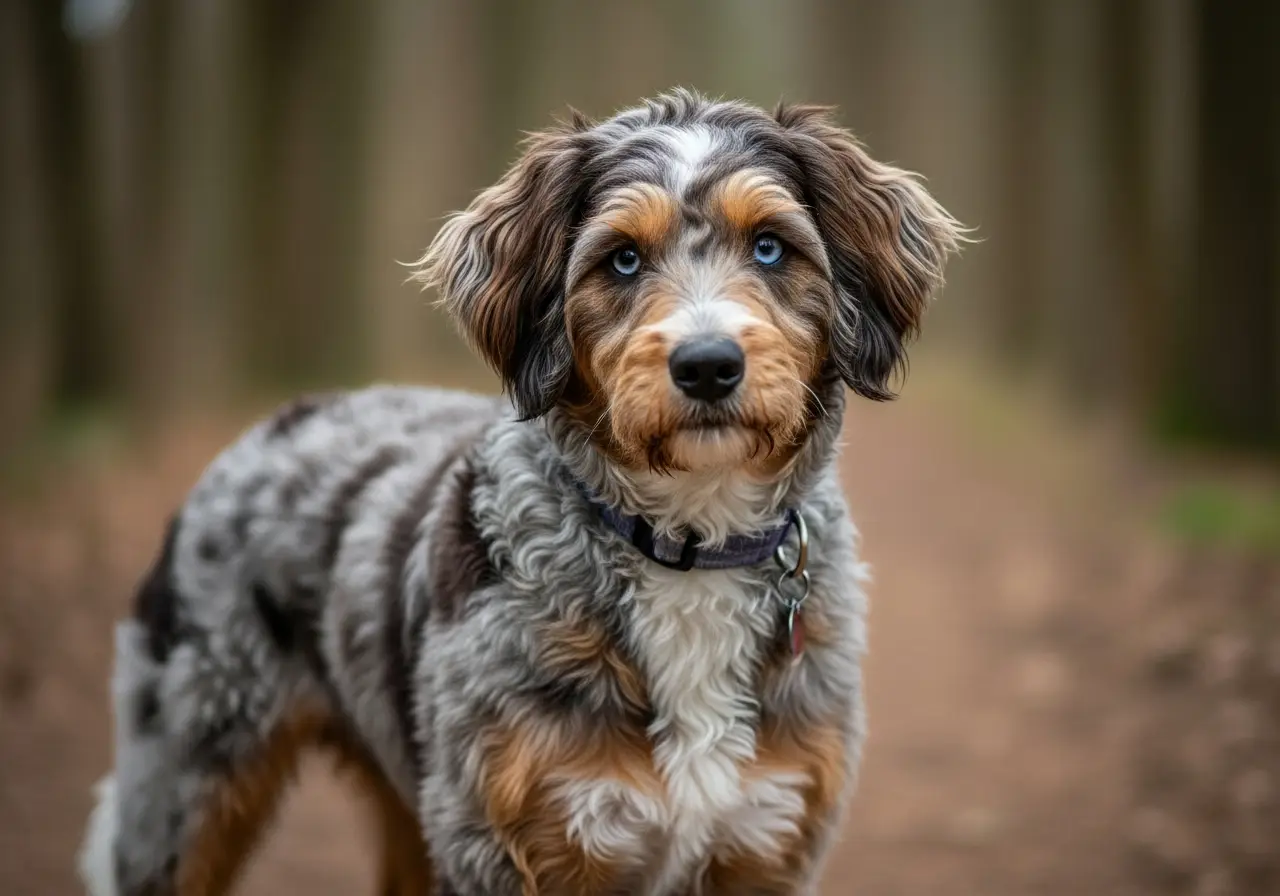
The Aussiedoodle is a crossbreed not recognised by the FCI, between an Australian Shepherd and a Poodle. Both parent breeds were bred for intensive work, which is reflected in everyday life. Anyone who underestimates this dog because it looks curly and photogenic will quickly experience what happens when a highly intelligent, movement-loving dog organises its own enrichment. Substance counts more than optics here.
02Introduction
What makes the Aussiedoodle special
The Aussiedoodle is a crossbreed between an Australian Shepherd and a Poodle that is not recognised by the FCI, considered hypoallergenic, with a withers height of 38–58 cm.
03Profile
Key facts and suitability
- Origin
- USA
- Original purpose
- Companion dog (crossbreed Australian Shepherd × Poodle)
- height at the withers
- 38–58 cm
- Weight
- 10–30 kg
- Life expectancy
- 10–13 Years
- Coat type
- Gelockt
- Minimum exercise
- 90 min/day
- Puppy price
- 1'500–3'500 CHF
- Waiting period
- 6 months
- Sports
- Agility · Obedience · Tricks · Frisbee
04Temperament
How the Aussiedoodle shows up in everyday life
During morning exercise, the Aussiedoodle does not simply run alongside you; it observes, anticipates changes in direction and reacts to the slightest body signals. This behaviour is no coincidence: The herding instinct of the Australian Shepherd is genetically anchored and shows itself even without sheep.
In everyday life, this means concretely: The dog registers when a family member leaves the group and may try to "correct" the situation. Children who are running or playing activate this instinct additionally. This is not misbehaviour; it is the profile of the breed.
Internally, the Aussiedoodle requires structured mental work daily. Pure walks without a mental task are insufficient. A dog that has walked for 60 minutes in the morning but has not received any thinking tasks will start looking for enrichment independently in the afternoon, by rearranging objects, barking at the patio door or intensely observing road traffic.
Externally, the Aussiedoodle generally shows curiosity rather than shyness towards strangers. The friendliness towards unknown people is comparatively high, which does not mean, however, that the dog knows no boundaries. Territorial behaviour is possible, especially when the herding instinct is transferred to the home.
It is crucial to keep these two axes separate: A high need for social contact (the dog wants to be with the family, wants to work, wants to be led) is not the same as unrestricted openness towards every visitor. Whoever confuses this will experience surprises during the first visit of strange children.
05Needs
What this breed needs daily
The Aussiedoodle requires at least 90 minutes of active exercise daily, not as a walk at a walking pace, but as structured activity with changes in direction, recall exercises or fetch work. Pure off-lead time on a meadow without interaction does not fully cover the need.
Mental work is equivalent to physical stimulation. Daily training sessions of 10–15 minutes focusing on nose work, trick training or obedience exercises significantly reduce the risk of boredom-related behavioural issues. Dog sports such as agility, obedience or rally-obedience correspond to the genetic potential of both parent breeds.
The need for social contact is pronounced. The Aussiedoodle is geared towards close integration into family life; isolation or prolonged being left alone for more than four hours leads to separation anxiety or stress behaviour in many individuals. Building up the ability to be left alone must happen early, gradually and consistently.
The herding instinct demands active management. Whoever has children in the household or receives visitors regularly must channel this drive through training, not suppress it but guide it. A supporting dog training school with experience in herding breeds is recommended, not optional.
The coat requires brushing several times a week depending on its characteristics and professional clipping every 6–10 weeks. The time required for grooming is underestimated by many owners and should be included in the overall planning.
Exercise
High
mental work
A lot
Social needs
High
training
Medium
06Sport & Mental and Physical Stimulation
What sports the Aussiedoodle is suited for
Realistic in terms of physiology and genetics – not every breed suits every sport.
Structurally and physiologically suitable: Suitable for herding work, treibball and coursing · CaniCross / bikejoring possible.
07Quick Check
08Suitability
Who this breed is suitable for – and who it isn't
✓Matches
The Aussiedoodle suits people who can plan at least 90 minutes of active exercise with the dog daily, not as an occasional exception, but as a fixed everyday structure. Whoever practises or plans to practise dog sports will find a willing-to-learn partner for agility, obedience or trick training in this cross.
Households with adults or children from about 8 years upwards are suitable, provided they know the dog's herding instinct and actively manage it. A clear daily structure with fixed training times is a prerequisite, not an option.
Whoever already brings experience with active or herding breeds will experience the Aussiedoodle as a pleasantly cooperative dog. First-time owners are also conceivable if they are willing to involve a supporting dog training school with herding dog experience from the start and engage intensively with the topic of drive management.
People who spend a lot of time at home, work remotely and can integrate the dog into their working day benefit from the close bonding readiness of this cross. A garden is helpful but does not replace structured stimulation.
×Doesn't match
The Aussiedoodle does not suit people who are out of the house for more than four hours daily and cannot organise reliable care solutions. The pronounced bonding intensity makes prolonged being left alone a serious stress factor for the dog.
Whoever is looking for a calm, independent dog that is content even without daily training will not be happy with this dog. The combination of herding instinct, need for mental work and urge to move demands active leadership, not laissez-faire.
Households with toddlers under 5 years should assess the herding instinct realistically: Circling, jumping up or herding running children is not an aggression problem but an everyday problem that requires consistent training. Whoever underestimates this effort because the dog "looks so friendly" will experience conflicts.
Whoever chooses the Aussiedoodle primarily because of the curly coat or the "designer" image and regards exercise and training needs as secondary makes a decision that often ends in being overwhelmed. Animal welfare organisations regularly report on surrendered Doodle dogs whose owners made exactly this mistake.
10Line reality
Show line, working line, breeder market
The Aussiedoodle has no FCI-recognised standard and therefore no officially defined breeding lines. In practice, however, factual types emerge that result from the choice of parent animals.
If an Australian Shepherd from working lines is crossed with a Poodle, a dog with a pronounced herding instinct, high sensitivity to stimuli and strong willingness to work often results. This type demands significantly more structured workload than a dog from parent animals with a companion dog focus.
If an Australian Shepherd from show or companion lines is used instead, the temperament can be considerably calmer, the herding instinct is less dominant, but the intensity of bonding remains high.
Miniature Aussiedoodles (from miniature poodle crosses) vary considerably in body size, not necessarily in energy level. A small dog with a high drive to work is not an easier variant; it requires the same mental stimulation as the standard type.
As no breeding associations with binding health protocols exist, the quality of parent testing varies greatly. Reputable breeders test for HD, ED, eye diseases and the MDR1 gene, while disreputable providers dispense with this entirely. This gap makes the dog's origin the decisive quality feature.
11Health · Reality
What you need to plan for medically with your Aussiedoodle
According to various breeder associations and veterinary sources, the life expectancy of the Aussiedoodle is between 12 and 15 years. Smaller variants (Mini Aussiedoodle) tend towards the upper limit of this range.
The MDR1 gene defect syndrome (also ABCB1 mutation) is one of the most important hereditary diseases in Australian Shepherd genetics. Affected dogs react to certain medications, including common deworming agents and anaesthetics, with life-threatening poisoning symptoms. According to OFA (Orthopedic Foundation for Animals), a relevant proportion of Australian Shepherds carry this mutation. A DNA test before purchase is strongly recommended.
According to OFA statistics, hip dysplasia (HD) occurs in approximately 6–7% of tested dogs among Australian Shepherds; the rate is lower for Poodles. Hybridisation does not automatically reduce the risk if no parent dog testing takes place.
Eye diseases — including cataracts, Collie Eye Anomaly (CEA) and progressive retinal atrophy (PRA) — are documented in both parent breeds. A CAER eye test (Canine Eye Registry Foundation) of the parent dogs is a minimum standard for reputable breeding.
Overweight is a real risk for the Aussiedoodle if the need for exercise is not met. Adiposity increases the risk of joint problems and demonstrably shortens life expectancy. Regular weight checks with the vet, at least once a year, are recommended.
12Structured data
Health by the numbers
Prone to diseases
Hip dysplasia, progressive retinal atrophy, epilepsy (possible from both parent breeds)
Recommended health tests
Hip X-ray, eye examination, DNA panel
13Myths ↔ Reality
What is often said incorrectly about this breed
Five myths, five realities, five sources.
"Aussiedoodles are hypoallergenic and suitable for allergy sufferers."
No dog is completely allergen-free. Allergic reactions are primarily caused by the protein Can f 1 in saliva and skin, not exclusively by coat hairs. The coat type of an Aussiedoodle varies greatly; even littermates can produce allergens to different degrees. Individual allergy testing before purchase is essential.
"As a mixed-breed dog, the Aussiedoodle is automatically healthier than purebred dogs."
The so-called heterosis effect (hybrid vigour) does not occur reliably when both parent breeds carry similar genetic diseases. Australian Shepherds and Poodles share risks for hip dysplasia, eye diseases and certain hereditary conditions such as the MDR1 gene defect syndrome. Without health tests of the parent animals, hybridisation offers no guarantee of better health.
"The Aussiedoodle is a low-maintenance family dog for beginners."
Both parent breeds were bred for intensive working tasks. The Aussiedoodle has a pronounced herding instinct, high mental workload requirements and a strong drive for movement. Anyone who can offer less than 90 minutes of active stimulation daily and does not plan structured training will be confronted with behavioural issues such as herding children, destructive behaviour or excessive barking.
"Curly coat means less grooming effort."
The opposite is often true. Curly or wavy coats tangle quickly, especially behind the ears, in the armpit area and on the paws. Without regular brushing (several times a week) and professional clipping every 6–10 weeks, painful and skin-damaging mats can form. The grooming effort exceeds that of many purebred dogs.
"Aussiedoodles are always child-friendly and socially compatible."
The herding instinct of the Australian Shepherd can manifest in everyday life as herding children, through jumping up, circling or nipping at heels. This behaviour is not an aggression problem, but a genetically anchored instinct. Without targeted socialisation and clear boundaries, it can lead to conflicts in family life, especially with toddlers.
14animal welfare
The animal welfare perspective
Breeder market, designer versions, animal shelter reality — what no one writes in the puppy ad.
The Aussiedoodle belongs to the breeds that are increasingly appearing in animal welfare organisations, not because the dog is a problem, but because the expectations of many owners collide with reality. The desire for an intelligent, curly, supposedly allergy-friendly family dog meets a dog with 90+ minutes of daily exercise needs, pronounced herding instinct and high mental stimulation requirements. This gap between expectation and reality is the most common reason for surrender.
The breeding market around Doodle crossbreeds is little regulated in the DACH region. As no breeding association with binding health protocols exists, structural control is lacking, which is at least partially present for FCI-recognised breeds through dog shows and breeding suitability tests. The result: puppies from untested parent dogs are marketed at high prices as "designer dogs", without buyers having the opportunity to demand health certificates because they do not know that they should.
Designer versions such as the "Micro Aussiedoodle" or the "Teddy Aussiedoodle" are created through targeted selection for body size and coat appearance. Temperament and health are treated as secondary. Particularly small variants can bring joint problems caused by miniaturisation.
Rehoming an adult Aussiedoodle from animal welfare is a fully valid alternative to buying a puppy. An adult dog shows its actual temperament; the herding instinct, bonding intensity and energy level are assessable. Animal welfare organisations usually accompany the rehoming with advice and aftercare. Anyone open to this option not only saves a dog from a difficult situation but often makes the better-informed decision.
15Costs · Transparency
What this breed realistically costs
The purchase price for an Aussiedoodle puppy from reputable breeding with health tests is between 1,800 and 3,500 EUR in the DACH region. Offers significantly below this often come from breeding operations without parent dog testing. Rehoming via animal welfare organisations usually costs between 200 and 500 EUR as a protection fee.
Annual living costs consist of food (high-quality dry food or BARF: approx. 600–1,200 EUR/year depending on size), grooming (professional clipping every 6–10 weeks: approx. 60–120 EUR per session, annual costs approx. 400–800 EUR) as well as basic equipment, toys and accessories.
Veterinary costs for routine care (vaccinations, parasite prevention, annual check-up) are approx. 300–500 EUR/year. In addition, possible costs for special examinations such as MDR1 gene test (approx. 50–80 EUR one-off) or HD X-ray apply. Pet insurance costs between 40 and 120 EUR/month depending on provider and scope of benefits and is a sensible consideration given the hereditary risks of both parent breeds.
Dog training school and training are not optional additional costs for the Aussiedoodle; they are a basic need. Group training costs approx. 150–300 EUR per course; individual training is 60–120 EUR per session.
16Puppy search
What you need to consider when choosing a breeder
- A reputable breeder of Aussiedoodles, even without an FCI framework, can be identified by specific criteria: both parent dogs are tested for hip dysplasia (HD), elbow dysplasia (ED), eye diseases and the MDR1 gene.
- The results are presented in writing, not just mentioned verbally.
- The breeder asks questions about your planned daily routine and refuses a sale if the keeping conditions do not suit.
- Puppy mills and breeding operations can be recognised by missing health certificates, immediate availability without a waiting period and sales via third-party platforms without personal contact.
- A price under 1,500 euros for an Aussiedoodle puppy is not a bargain; it is a warning signal.
- Placement via animal welfare organisations is an equally valid option.
- Aussiedoodles and Doodle mixes regularly end up in animal welfare because their needs were underestimated.
- An adult dog from rehoming has the advantage that temperament and energy level are already assessable.
- Platforms such as Tasso or the rehoming exchanges of regional animal welfare associations offer corresponding listings.
FAQ
Frequently asked questions about the Aussiedoodle
Is Aussiedoodle suitable for beginners?
Aussiedoodle is considered suitable for first-time dog owners.
Is Aussiedoodle a family dog?
Aussiedoodle is considered suitable for families with good socialisation and species-appropriate care.
How much exercise does Aussiedoodle need?
At least around 90 minutes of exercise per day. As an active breed, more so — plus mental stimulation.
Does Aussiedoodle suit an apartment?
With enough exercise and enrichment, Aussiedoodle can also be kept in an apartment.
What is the size and weight of Aussiedoodle?
Fully grown, Aussiedoodle reaches about 38–58 cm at the withers and weighs around 10–30 kg.
What is the life expectancy of Aussiedoodle?
The life expectancy of Aussiedoodle is approximately 10–13 years.
Is Aussiedoodle suitable for allergy sufferers?
Aussiedoodle is considered relatively hypoallergenic. There’s never a guarantee — test direct contact beforehand.
Which diseases are common in Aussiedoodle?
Hip dysplasia, progressive retinal atrophy, epilepsy (possible from both parent breeds)
17Breed clubs
Official breed clubs in DACH
19Related
Similar breeds – and their differences
You might also be interested in
Participate
Do you have a good photo of your Aussiedoodle?
We are looking for expressive images for our breed profiles. Submit yours; the editorial team reviews every submission before publication.
Does this breed suit you?
Intelligent and eager to learn, suitable for allergy sufferers. High variance in size and coat depending on the parents. Not FCI-recognised.