
Crusty nose in dogs: causes and treatment options
Crusty dog noses are caused by dry air, allergies or skin diseases. With the right home remedies and targeted care, the nose becomes healthy again.
Content
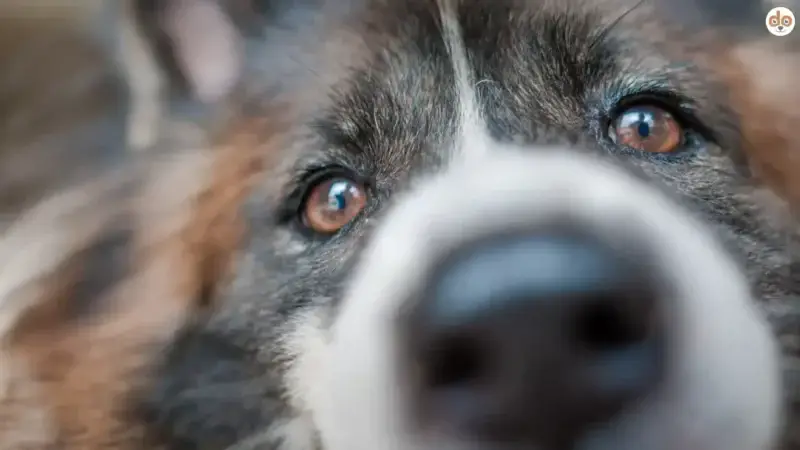
Your dog rubs its snout on the carpet. The usually smooth nose has become rough and scaly. Sometimes small crusts form that fall off when stroked.
Is a dry dog nose normal at all?
A healthy dog nose fluctuates between dry and moist. It is usually drier in the morning after waking up, and moister again after drinking. This is due to the mucous membranes, which produce more or less moisture as needed.
It only becomes problematic with crusts, cracks or persistent dryness over several days. Then there is usually a treatable cause behind it.
Your dog’s nose reacts to three main factors: ambient temperature (it becomes drier below 5°C), activity (often moister after a walk) and stress (a vet visit makes it warmer and drier).
Which causes lead to crusty dog noses?
Crusts form when the outermost layer of skin dries out too quickly and flakes off.
Winter air and heating: At humidity levels below 30%, the nasal skin dries out. Dogs that spend a lot of time indoors or whose sleeping area is close to the heater are particularly affected.
Sunburn: Dogs with pink noses or little pigmentation can suffer sun damage after just 30 minutes of direct sunlight. The skin then peels off in a crusty manner.
Contact allergies: Plastic bowls, certain cleaning agents, or new dog beds trigger skin reactions in sensitive dogs. The nose first becomes red, then scales form.
Hyperkeratosis: An overproduction of the stratum corneum, which is usually genetically determined. The nose becomes thick and cracked, affecting German Shepherds and Labrador Retrievers in particular.
Fungal infections: Malassezia yeast fungi like to settle in damp, warm places. The nose first becomes oily, then scaly.
Mite infestation: Demodex mites burrow tunnels into the skin and leave characteristic, circular bald patches with crusts. It usually does not itch, unlike other skin problems.
What helps with crusted dog noses?
Softening crusts: Put a drop of lukewarm coconut oil on a cotton pad. Hold it against the crusted area for 2-3 minutes. The scales then come off more easily.
Increase humidity: Place a bowl of water next to the heater or hang a damp towel over the radiator. Optimal humidity is 40-50%.
Apply nose balm: Use only dog-specific balms without menthol or essential oils. A blob the size of a grain of rice is enough for the whole nose.
Chamomile compresses have an anti-inflammatory effect: Let the tea cool completely and dab the nose gently, do not rub.
When should you take the dog to the vet?
A visit to the vet is necessary if the crusts do not improve after a week of care. Or if these warning signs appear:
Bleeding cracks in the nose, purulent discharge, severe itching (the dog scratches itself until it bleeds), loss of appetite for more than 24 hours, or swelling in the face.
If autoimmune diseases such as pemphigus are suspected, the vet takes a tissue sample. The diagnosis usually takes 1-2 weeks, after which targeted treatment can begin.
How do I recognise a bacterial infection?
Bacterial infections usually smell sweetly putrid. The crusts are yellowish and stick firmly to the skin. Without antibiotics, this will not heal.
Are crusted noses contagious?
Fungal and mite infections are transmitted between dogs. Allergies and sunburn are not. If in doubt, reduce contact with other dogs until the cause is clear.
How long does healing take?
Environmentally caused crusts disappear within 3-7 days with consistent care. Skin diseases require 2-8 weeks of treatment. Hyperkeratosis is not curable, but can be well controlled.
Which dog breeds are particularly affected?
German Shepherds, Siberian Huskies and Collies have a genetic predisposition to nasal keratosis. Dogs with little pigmentation (Dalmatians, Weimaraners) are more prone to sun damage.
Can I prevent it?
UV protection stick for the nose when exposed to sunlight, a humidifier during the heating season and hypoallergenic food bowls made of ceramic or stainless steel significantly reduce the risk.