
Elbow Surgery (CUE)
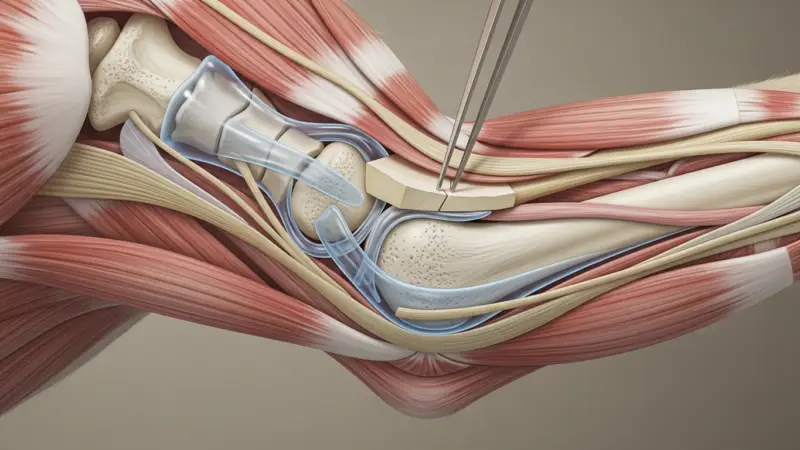 Source: KI_generated · erstellt mit fal.ai / Imagen 4
 The CUE procedure (Caudal Ulnar Osteotomy) is an orthopaedic intervention to treat elbow dysplasia in dogs, in which a wedge-shaped piece of bone is removed from the ulna to reduce joint load.
Content
The CUE procedure (Caudal Ulnar Osteotomy) is an orthopaedic intervention to treat elbow dysplasia in dogs, in which a wedge-shaped piece of bone is removed from the ulna to reduce joint load.
Elbow dysplasia occurs in about 20% of cases in large dog breeds. The CUE technique is considered one of the most promising surgical options, however, only for certain forms of the disease.
When is CUE surgery appropriate?
A CUE operation comes into question when imaging procedures show an incongruity in the elbow joint. This means: The joint surfaces of the humerus, ulna, and radius do not fit together perfectly.
However, the procedure does not work for all forms of elbow dysplasia. In advanced arthritis with pronounced cartilage damage, success is often lacking.
How does the CUE procedure work?
The surgeon removes a 2-4 mm wide bone wedge from the ulna, approximately 6-8 cm below the elbow joint. This incision permanently alters the biomechanics of the joint.
The operation lasts 60-90 minutes under general anaesthesia. A special titanium plate fixes the bone after the procedure. The dog usually stays in the clinic for 2-3 days.
What does a CUE procedure cost?
In Germany, costs range between €1,500 and €3,500 per elbow. Pre-examinations (CT: €400-800) and follow-up checks (€150-300 per appointment) are additional.
Some dog insurance policies cover the costs partially, but only if elbow dysplasia is not considered a pre-existing condition.
How successful is the CUE procedure?
In the largest evaluation to date with 103 procedures, 47.6% of joints achieved full function, and 43.7% acceptable function. For 8.7%, the result was unsatisfactory (Cook 2015). “Success” there means: significantly less lameness and better mobility.
Whether the dog’s age influences the outcome is open; the study did not evaluate this. There is no guarantee of complete pain relief.
How long does aftercare last?
The first 8 weeks: strict leash walking, maximum 15 minutes per walk. Controlled movement promotes bone healing without overloading.
Physiotherapy usually begins in week 3-4 with passive exercises. Swimming is allowed after 6-8 weeks, but only in still water, not in currents.
Full loading is possible earliest after 10-12 weeks, if X-rays confirm complete bone healing.
More from the Wiki
All wiki entries →Plum
The plum is a stone fruit of the genus Prunus. Its stone contains cyanogenic glycosides; the …
Rhubarb
Rhubarb is a knotweed whose leaves are rich in soluble oxalic acid. For dogs, the leaves …
Why is dog faeces white?
White dog faeces occurs when normal digestion is disrupted or certain substances change the colour of …
Dog licks its anus, what to do?
Anal licking in dogs is a normal grooming behaviour that serves for cleaning and emptying the …