
Cystoscopy
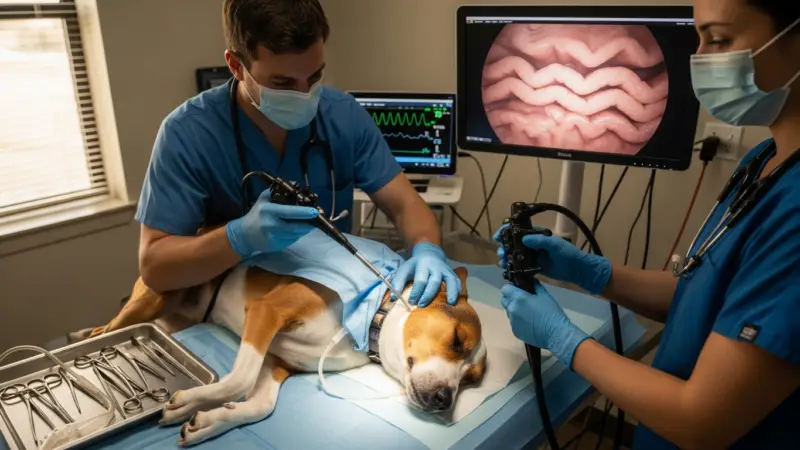 This image was created with AI
 A cystoscopy (bladder endoscopy) is an endoscopic examination of the urethra and urinary bladder.
Content
A cystoscopy (bladder endoscopy) is an endoscopic examination of the urethra and urinary bladder. A thin optical instrument, the cystoscope, is inserted through the urethra or, in certain procedures, directly into the bladder via a small access point. This allows the mucous membrane, urethra, bladder wall and the openings of the ureters to be assessed. Depending on the findings, the removal of tissue samples or certain minimally invasive interventions may also be possible.
What is a cystoscopy (bladder endoscopy) in animals?
A bladder endoscopy – known in technical terms as cystoscopy – is an endoscopic examination procedure in which the inside of the urinary bladder is examined directly. For this purpose, the vet advances a thin, flexible endoscope with an integrated camera through the urethra. This allows the urinary bladder, urethra and parts of the ureters to be assessed from the inside – inflammation, bleeding, tumours or congenital malformations are hardly concealed.
How does a cystoscopy (bladder endoscopy) proceed in animals?
- Preparation:
- The animal receives general anaesthesia or at least strong sedation – this procedure cannot be performed without it.
- Before the anaesthesia, a physical examination and blood analysis are scheduled so that the vet can be sure that the animal will tolerate the procedure well.
- Procedure:
- The endoscope is carefully inserted into the urethra.
- During the examination, the vet continuously flushes the urethra and bladder with saline solution – this ensures clear visibility and protects the tissue.
- Step by step, he advances into the bladder and examines the entire mucous membrane.
- Notable areas – bleeding, inflammatory foci, tumours or malformations – are documented in detail.
- If necessary, small tissue samples (biopsies) are taken there immediately.
When is a cystoscopy (bladder endoscopy) used in animals?
If an animal shows complaints that indicate problems in the urinary tract, cystoscopy is often an important next step. Typical signs that lead to the examination:
- Difficulty urinating
- Frequent, strained straining when urinating
- Blood in the urine (haematuria)
- Suspected urinary stones
- Pain when urinating
- Involuntary urine discharge or incontinence
- Visible changes in the urine stream
- Tumours or other tissue changes
- Certain congenital malformations
Specific areas of application include:
- Bladder stones, tumours and polyps: Cystoscopy allows a direct view of changes in the bladder – without major surgical intervention.
- Congenital malformations: Especially in young animals, the procedure can clarify whether, for example, an ectopic ureter or a persistent urachus is present.
- Tissue samples (biopsies): Suspicious areas can be sampled specifically and examined in the laboratory for inflammation or tumour tissue.
What are the risks of a cystoscopy (bladder endoscopy) in animals?
Cystoscopy is generally considered a low-risk procedure. Nevertheless, one should be aware of possible complications:
- Anaesthesia risks: Every general anaesthesia carries a certain residual risk. Therefore, a careful pre-examination of the cardiovascular system is standard – especially in older or previously ill animals.
- Injuries to the urinary tract: The urethra or bladder wall can be irritated by the endoscope or, in an unfortunate case, injured.
- Infections: Germs can enter the urinary tract when inserting the instrument and trigger inflammation there. In male animals, there is an additional risk of prostatitis.
In principle, the examination is possible in most pets, provided they are large enough. In small animals such as hamsters or rabbits, the procedure usually fails due to the tiny urethra.
In specialised veterinary clinics, cystoscopy in dogs, cats, horses and cattle is part of the routine examination repertoire.
More from the Wiki
All wiki entries →Plum
The plum is a stone fruit of the genus Prunus. Its stone contains cyanogenic glycosides; the …
Rhubarb
Rhubarb is a knotweed whose leaves are rich in soluble oxalic acid. For dogs, the leaves …
Why is dog faeces white?
White dog faeces occurs when normal digestion is disrupted or certain substances change the colour of …
Dog licks its anus, what to do?
Anal licking in dogs is a normal grooming behaviour that serves for cleaning and emptying the …