
Tail off and arm around? Docking in dogs
Although banned in Germany, Austria and Switzerland, docked dogs are still encountered. Fines can reach up to 25,000 euros, and the health consequences are more serious than often assumed.
Content
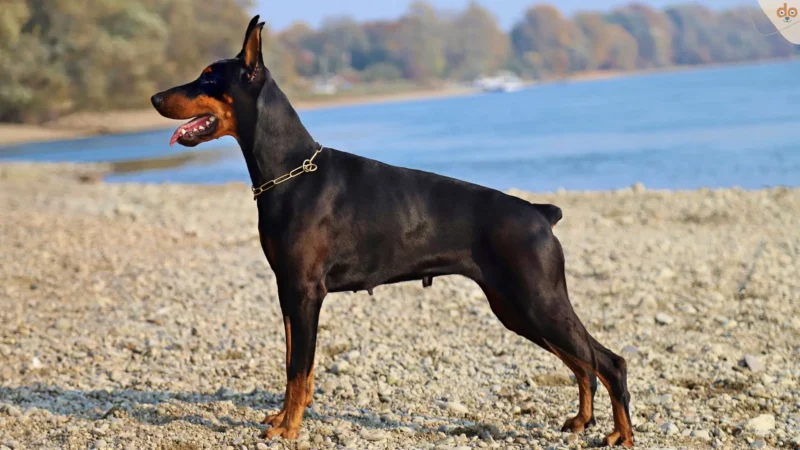
The Doberman at the dog show – pricked ears, stub tail, flawless appearance. Seeing it like this, one might think: typical Doberman. Yet its ears would naturally hang down, and its tail would be long and strong. Docking (usually called cropping in Germany) has been banned in the D-A-CH region for decades – and yet one still encounters dogs whose ears or tails have been surgically altered.
What happens during dog docking?
Simplified: ears or tail are operatively shortened or completely removed. The procedure is performed under general anaesthesia, using a special docking knife. Templates are often used for ears to dictate the desired upright shape – as if cutting a dog to pattern.
Puppies are usually docked between the 7th and 12th week of life, while the cartilage is still soft. Some breeders amputate the tail within the first days of life – and sometimes without any anaesthesia.
This is followed by stitching up the wound and weeks of aftercare. Pricked ears additionally require an elaborate taping construction to keep them upright. Not a minor procedure – especially not for a puppy.
Why were dogs docked in the past?
The explanations sound plausible at first. Hunting dogs, according to the traditional reasoning, should not have a long tail that gets caught in brambles and is injured. This story persists – yet newer studies show that undocked hunting dogs do not injure their tails more frequently than docked ones. The premise was simply wrong.
In fighting dogs, short ears were supposedly meant to offer less surface area for attacks. In reality, it was almost always about breed standards and a certain “hard” look – not about protecting the animal.
Today, docking is done because it looks as a breeding standard demands. And these standards are long outdated in many countries. Nevertheless, some breeders have their dogs docked abroad to then sell them as “standard-compliant” in Germany – a grey area that deliberately circumvents the ban.
What penalties threaten for docking in Germany, Austria and Switzerland?
In Germany, docking is prohibited under §6 of the Animal Welfare Act (TSchG). Anyone who violates the law risks fines of up to 25,000 euros or imprisonment for up to three years. There is one exception: veterinarians may dock hunting dogs if they are actually used in hunting.
Austria has punished violations since 2008 with fines of up to 7,500 euros – and goes even further: exhibitions, import and trade of docked dogs are completely prohibited there. Anyone who brings a docked dog from abroad commits an offence.
In Switzerland, fines of up to 20,000 Swiss francs or imprisonment for up to three years are imposed. Here too, docked dogs may neither be imported nor exhibited.
Veterinarians who still dock lose their licence additionally. In practice, however, many cases are not prosecuted – proof is difficult, especially if the procedure took place abroad.
What health consequences does docking have?
The perhaps most underestimated aspect: chronic nerve pain. In around 30% of cases with amputated tails, so-called neuromas develop – painful nerve growths at the stump that can burden the dog permanently.
Cropped ears often heal crooked, flop over again despite taping, or leave behind scar tissue and inflammation. There is also a loss that is often overlooked: ears and tail are central means of expression in dog body language. A dog without a functioning tail simply cannot send certain signals anymore.
This has measurable consequences: behavioural studies show that dogs with cropped tails are more frequently perceived as aggressive by other dogs and humans – because their appeasing signals are no longer readable. This leads to more conflicts in everyday life.
And one more thing: many procedures are carried out without adequate pain medication. What this means for a young animal can only be imagined – permanently traumatising experiences during the early imprinting phase are not uncommon.
How do I recognise cropped dogs?
Cropped tails are usually only a few centimetres long and end abruptly. If you are unsure: natural bobtails, as found in the Australian Shepherd, look different and can moreover be documented with papers. Scars on the stump can be another clue.
Cropped ears stand unnaturally upright and have straight, visibly cut edges. Natural prick ears – such as those of the German Shepherd – taper to a point and are free of scars.
Particular caution is required with puppies from abroad. Anyone who breeds responsibly can produce the papers of the parent animals and explain under which legal circumstances cropping took place in the country of origin – if it was permitted there at all.
What can dog owners do?
No compromises when buying: anyone who consciously buys a cropped puppy – even out of pity – is financing the practice. This sounds harsh, but it is reality. Instead of buying: inform the local veterinary office if cropped puppies are offered for sale.
Anyone who already has a cropped dog faces different tasks. The dog is not “defective” – but it may need more attention in contact with conspecifics, because its body language is restricted. Observe it closely for signs of chronic pain: protective posture, sensitivity at the stump or changed mood can be clues.
And finally: breeding associations that have revised their standards deserve support. The German Boxer Club is a concrete example of what modern breeding without cropping looks like – and how it works.