
Man sells Ferrari to open animal shelter – what is there to the story?
Content
“Man sells Ferrari to open an animal shelter in Japan” – this story is currently going viral on social media. Emotional texts, moving images and references to international media create the impression that this is an extraordinary but clearly documented animal welfare action. But with stories like this, the question arises: what is really true, and what remains unclear?
We have looked more closely at the background, checked sources and contextualised the circulating information. In this fact-check we show which parts of the story are substantiated and where caution is advised, summarised clearly and presented transparently.
Man sells Ferrari for animal shelter: what is true?
Several international media outlets report consistently on a Japanese man called Hirotaka Saito, who is said to have left his previous life behind to build an animal shelter for abused and traumatised dogs. According to these reports, he closed his business and sold his Ferrari to finance the Wansfree Canine Rescue Center. The location given is Yaizu in Shizuoka Prefecture.
The animal shelter is said to focus specifically on dogs that show behavioural problems due to abuse or neglect and are therefore considered difficult to rehome.
The story is picked up by the South China Morning Post and the Asahi Shimbun, among others, which suggests that the core of the narrative is real and not entirely made up.
Man sells Ferrari for animal shelter: what is not substantiated?
Despite the media coverage, several important points remain open.
There is no official website for the Wansfree Canine Rescue Center and also no social media presence, as one would expect from established animal shelters or in stories like this.
Specific details on organisational structure, funding or public operation cannot therefore be verified.
The inconsistent imagery on social media is also striking. While established media such as the South China Morning Post apparently use authentic photos, many viral posts show images that differ significantly from one another.
The man’s hair colour, his overall appearance and the style of the backgrounds vary considerably, suggesting that not all the photos used actually show the real person.
Many depictions also show only illustrations, stock images or AI-generated motifs instead of real scenes.
The frequently cited personal background, such as the story surrounding a previous life crisis and rescue by his own dog, also comes purely from retellings and cannot be independently verified.
Facts at a glance
| ✔️ What is true | ❌ What remains unclear |
|---|---|
| Several international media outlets report on a Japanese man named Hirotaka Saito. | There is no official website for the Wansfree Canine Rescue Center. |
| According to reports, he sold his Ferrari to finance an animal shelter. | No verified press photos of Saito or the animal shelter exist. |
| The animal shelter is said to focus on abused and traumatised dogs. | Many of the images circulating on social media are AI-generated or not clearly verifiable. |
| The location is stated to be Yaizu in Shizuoka Prefecture. | Precise details regarding address, opening hours or organisational structure are missing. |
| The story is picked up by the South China Morning Post and the Asahi Shimbun, among others. | A social media presence with verified attribution cannot be found. |
What we learn from this
Inspiring animal welfare stories may touch us, but should still be critically contextualised.
Not every gap means a complete false report, but missing evidence, inconsistent images and highly emotionalised depictions are good reasons to look more closely.
Anyone who takes animal welfare seriously should always also engage with the credibility and traceability of a story.
Sources, info & note on the image
- Article by the South China Morning Post (English-language daily newspaper from Hong Kong): https://www.scmp.com/news/people-culture/article/3317523/japan-man-sells-ferrari-fund-shelter-taxing-dogs-repay-pet-saved-his-life
- Article by the Asahi Shimbun (one of Japan’s largest and oldest daily newspapers): https://www.asahi.com/ajw/articles/15655170
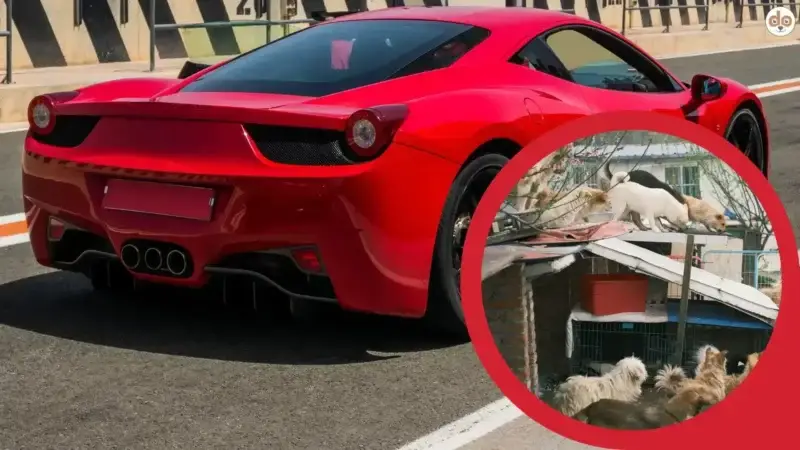
- Note on our title image: We also deliberately use a symbolic photo for this contribution. The images of the man circulating online cannot be clearly verified and differ significantly from one another in some cases, which is why we refrain from using supposedly real photos.