
01Summary
In a paragraph
If you only have 30 seconds.
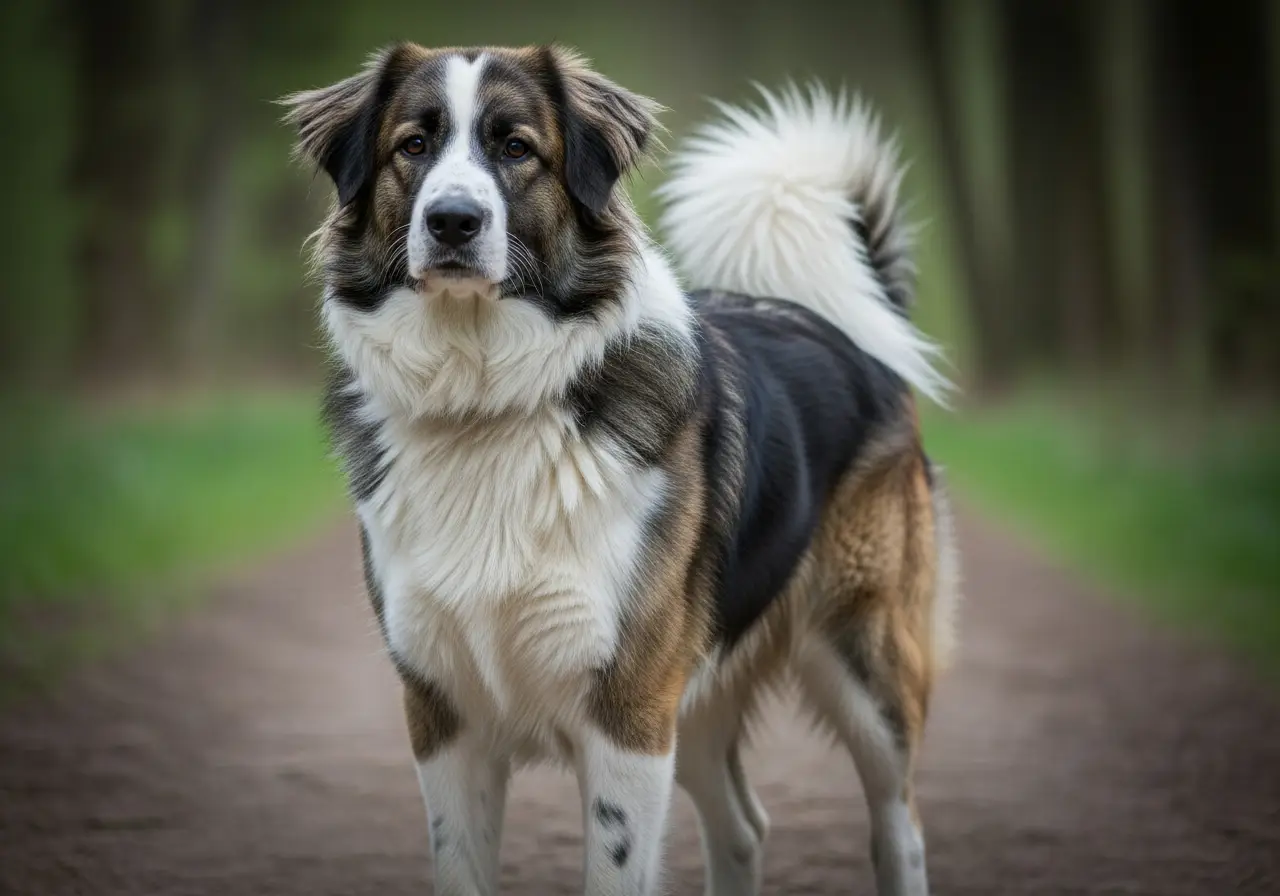
The Tornjak is a large, calm livestock guardian dog from Bosnia-Herzegovina and Croatia that has been bred over centuries for independent decision-making in the field, not for obedience. Its loyalty to the family is pronounced, its distrust of strangers is genetically ingrained. Anyone keeping this breed must provide space, experience and a stable territory. It is not suitable for urban living or first-time owners.
02Introduction
What makes the Tornjak special
Tornjak: large Bosnian-Croatian livestock guardian, loyal to the family, reserved towards strangers and very enduring
03Profile
Key facts and suitability
- Origin
- Bosnien/Kroatien
- Original purpose
- Livestock guarding
- FCI
- No. 355 · Group 2 · Section 2.2
- height at the withers
- 58–72 cm
- Weight
- 35–55 kg
- Life expectancy
- 12–14 Years
- Coat type
- Doppel
- Minimum exercise
- 90 min/day
- Puppy price
- 1'000–1'800 CHF
- Waiting period
- 5 months
- Sports
- Hiking
04Temperament
How the Tornjak shows up in everyday life
When returning home, the Tornjak greets its key people calmly and without excessive excitement. It observes, registers, and relaxes as soon as it has assessed the situation. If a stranger enters the property, the picture changes immediately: the Tornjak positions itself, observes intensively and clearly signals that it is controlling the territory.
Here, the crucial distinction between internal need and external behaviour becomes apparent. Internally, the Tornjak needs closeness to its family; it is not a loner and actively seeks contact with its key people. Externally, it reacts reservedly to strangers up to vigilant: friendliness towards unknown people does not correspond to its profile. Anyone who confuses these two poles and infers general openness from family bonding significantly underestimates the breed.
In everyday life on the property, the Tornjak regularly patrols its territory, even without external cause. This behaviour is not a sign of restlessness, but an expression of its genetic task. In the apartment or house, it behaves calmly and adaptively, provided that its need for movement and territorial activity is met.
Towards children of its own family, it shows patience and protectiveness. Towards unknown children or unfamiliar visitors, it initially reacts distantly. Clear introduction rituals and consistent guidance by the owner are essential in such situations. The Tornjak does not decide impulsively, but it decides independently if it does not receive clear orientation.
05Needs
What this breed needs daily
The Tornjak requires 60 to 90 minutes of active, controlled exercise daily. Free roaming on a securely fenced property supplements this need, but does not replace it. Guided walks with varying stimuli and clear guidance by the owner are just as important for the mental balance of the breed as physical workload.
The need for social contact is in the medium range: the Tornjak seeks closeness to its key people and requires regular contact with the family. Isolation or being left alone permanently without a task leads to behavioural problems such as excessive barking or increased territorial reaction. Up to six hours alone in its own territory is generally no problem for a well-socialised Tornjak, provided that the property is secured and familiar.
The Tornjak needs mental stimulation in the form of tasks that are close to its original function: field work, nose work or structured training sessions with clear consistency. Classic obedience exercises in the sense of dog sports hit genetic limits; the breed was selected for independent judgement, not for rapid command-reaction.
The property itself is a basic prerequisite: at least 500 square metres of secured terrain, fence with a height of at least 180 centimetres, without climbing opportunities. Pure apartment keeping or an urban environment without its own territory does not meet the husbandry requirements of this breed. A Tornjak without a clearly defined territory loses a central orientation point of its psyche.
Exercise
Medium
mental work
Medium
Social needs
Medium
training
Demanding
07Quick Check
08Suitability
Who this breed is suitable for – and who it isn't
✓Matches
The Tornjak suits owners with proven experience in dealing with livestock guardian dogs or comparable independent breeds. Anyone who has already kept a Kangal, Caucasian Ovcharka or Pyrenean Mountain Dog brings a sensible starting basis.
The breed is suitable for owners with a generous, securely fenced property in a rural or suburban environment, at least 500 square metres, fence with 180 centimetres height. Families with children from about ten years of age, who are socialised in dealing with large dogs, come into consideration if the parents clearly take on the leadership role.
Anyone who leads a calm, structured everyday life, has little visitor traffic and is willing to invest 60 to 90 minutes of active guidance daily will find a loyal, reliable companion in the Tornjak. The external axis, reserved behaviour towards strangers, requires that the owner actively manages visits and gives the dog clear orientation. Anyone who consistently takes on this guidance task receives a dog with exceptional bonding depth and reliability in its own territory.
×Doesn't match
The Tornjak is not suitable for first-time owners without prior experience with independent or protection-drive-oriented breeds. Anyone who has previously kept only social companion dogs regularly underestimates the independence of this breed.
Urban keeping in apartments or without secured terrain does not meet the minimum requirements, regardless of how much time the owner invests. Anyone who regularly receives many visitors, lives in a multi-family house or does not have a garden should choose another breed.
Anyone who infers general sociability from the Tornjak's family bonding (i.e. expects that an affectionate dog is automatically also open towards strangers) fundamentally misunderstands the dual-axis profile of this breed. Exactly this confusion leads to keeping problems. Families with small children under six years of age, who do not yet show clear body language in dealing with large dogs, are also not the suitable target group. Anyone who is away from home for 8 hours daily and does not have a reliable care solution overloads the breed permanently.
10Line reality
Show line, working line, breeder market
The Tornjak does not have pronounced show or working lines in the sense of other breeds. Breeding in the countries of origin, Bosnia-Herzegovina and Croatia, is primarily oriented towards the FCI standard, which considers function and type equally. A separation into working line and show line, as known for example with the German Shepherd Dog, does not exist for the Tornjak in comparable form.
In the regions of origin, dogs are still occasionally used in traditional livestock protection functions. These animals differ considerably in their socialisation and drive profile from dogs that were raised exclusively as family or companion dogs. Anyone acquiring a puppy from active livestock guardian keeping must expect significantly more pronounced territorial and protective behaviour.
In Germany, Austria and Switzerland, the breed is so rare that a differentiated assessment of lines is hardly possible. Reputable breeders in the DACH region work closely with countries of origin and place value on health tests and temperament stability. Anyone looking for a Tornjak in the DACH region should specifically enquire about the origin of the parent dogs and their working conditions.
11Health · Reality
What you need to plan for medically with your Tornjak
The Tornjak is considered a robust, long-lived breed. According to the FCI standard and breeder information, life expectancy is 12 to 14 years, with individual dogs reaching 15 years.
As a large molossoid, there is an increased risk of hip dysplasia (HD). Reliable breed-specific HD rates for the Tornjak are not available due to the small population size in the DACH region. Comparative data from the OFA database (Orthopedic Foundation for Animals, as of 2023) show HD prevalences of 15 to 25 percent in related livestock guardian dog breeds. Reputable breeders X-ray both parent dogs before breeding and make the results public.
Elbow dysplasia (ED) occurs less frequently in the breed than HD, but should also be checked for breeding use. Gastric dilatation-volvulus (bloat) is a relevant risk in large, deep-chested breeds; owners should know the symptoms and seek veterinary help immediately if suspected.
Overweight is an underestimated risk for this breed: The Tornjak tends to gain weight with insufficient exercise and incorrect feeding, which puts additional strain on joints and the cardiovascular system. Regular weight checks at the vet, at least once a year, are recommended.
Preventive examinations include: HD/ED X-rays of parent dogs before breeding, annual health checks, dental checks as well as eye and ear examinations. Vaccinations and parasite prevention depend on the area of use; for dogs kept outdoors, regular deworming is particularly relevant.
12Structured data
Health by the numbers
Prone to diseases
Hip dysplasia Elbow problems
Recommended health tests
Hip X-ray Elbow X-ray
13Myths ↔ Reality
What is often said incorrectly about this breed
Five myths, five realities, five sources.
„The Tornjak is a calm family dog that can be kept like a Golden Retriever.
The Tornjak is calm, but not approachable in the sense of a social companion dog. Its protective and territorial behaviour is deeply rooted genetically. Without a clear leadership structure, sufficient terrain and consistent socialisation, it can show considerable problems towards strangers and unknown dogs. The breed was bred for independent decision-making in the field, not for obedience.
„Livestock guardian dogs are aggressive and dangerous.
The Tornjak shows a high threshold of irritation and usually reacts initially in a waiting-observant manner. Aggressiveness in the sense of impulsive attack does not correspond to the breed standard. Its protective behaviour is situational and territorial, directed against perceived threats to the territory, not against people in general. Early, broad socialisation is decisive.
“A large property replaces sufficient exercise and enrichment.
A secured terrain is a necessary prerequisite, but does not replace active guidance. The Tornjak needs 60 to 90 minutes of controlled exercise daily as well as mental stimulation through clear tasks and structures. A dog that is merely left to its own devices on the property often develops excessive barking behaviour and intensified territorial reactions.
„The Tornjak is easy to train because it appears so calm.
The outward calmness of the Tornjak conceals its independence. As a livestock guardian dog, it was selected to assess situations itself and act without instruction. Classic obedience exercises, which are based on rapid reaction to commands, reach genetic limits with this breed. Training requires patience, consistency and an understanding of livestock guardian behaviour.
„Tornjaks can be kept in Germany without problems like other large breeds.
The Tornjak is extremely rare in Germany, Austria and Switzerland. Reputable breeders conduct extensive suitability assessments. The keeping requirements (large, securely fenced terrain, experience with livestock guardian dogs, clear leadership structure) go far beyond what applies to many other large breeds. Urban or suburban keeping without corresponding infrastructure is not appropriate for the breed.
14animal welfare
The animal welfare perspective
Breeder market, designer versions, animal shelter reality — what no one writes in the puppy ad.
The Tornjak is a rarity in the German-speaking region. It rarely appears in organised animal welfare, so anyone rehoming a Tornjak from abroad should check the origin and socialisation of the animal very carefully. Livestock guardian dogs from Eastern European rehoming schemes often have little bond with humans and have experienced little socialisation with urban stimuli. This makes integration into a normal household extraordinarily difficult without corresponding experience.
The backyard breeder market for the Tornjak in the DACH region is manageable due to low demand. Nevertheless, there are listings on classifieds platforms where neither health checks of the parent dogs nor litter inspections by the breeding club are documented. Anyone who acquires a Tornjak without HD X-rays of the parents, without breeding approval and without a litter inspection bears the health and behavioural risk alone.
A central husbandry problem arises from misconceptions about the breed's character: Owners looking for a calm large dog and viewing the Tornjak as a "relaxed alternative" systematically underestimate its territorial instinct. This leads to overburdening on both sides, and consequently to rehoming. Animal welfare organisations report that livestock guardian dogs are among the most difficult candidates for rehoming because the pool of suitable owners is very small.
Rehoming an adult Tornjak from a reputable source, such as through the Club for South and Eastern European Shepherd Dogs, is an equally valid option to taking on a puppy. An adult dog already clearly shows its character, which facilitates the assessment of suitability. Anyone who meets the keeping requirements will find a reliable partner in a rehomed Tornjak.
15Costs · Transparency
What this breed realistically costs
A Tornjak puppy from reputable breeding in the DACH region costs between 1,200 and 2,000 euros. Listings significantly below this usually involve missing health checks or inadequate socialisation.
The annual living costs for a Tornjak are significantly above average due to its size. Feed costs alone for an adult male (40 to 50 kg) amount to between 800 and 1,400 euros per year with high-quality nutrition. Grooming costs for the dense double coat (regular brushing, occasional professional trimming) add another 200 to 400 euros annually.
Veterinary costs for basic care (vaccinations, parasite prevention, annual check-up) are between 300 and 500 euros per year. With orthopaedic problems such as HD-related arthritis, treatment costs can quickly rise to 1,500 to 4,000 euros per procedure. Pet insurance for a Tornjak costs between 60 and 130 euros monthly depending on the provider and scope of cover, and is recommended for this breed due to the risk of HD.
Total costs in the first year (including getting a dog, basic equipment, vet and food) realistically lie between 3,500 and 5,500 euros. From the second year onwards, running costs of 2,000 to 3,500 euros per year should be planned for.
16Puppy search
What you need to consider when choosing a breeder
- Reputable Tornjak breeders in the DACH region can be found through the Club for South and Eastern European Shepherd Dogs (KSOH).
- A reputable breeder provides HD and ED X-ray results for both parent dogs, has a litter inspection carried out by the breeding club, and issues a pedigree certificate.
- Puppies leave the breeder no earlier than eight weeks of age and are vaccinated, dewormed and microchipped.
- An important identifying feature: The breeder asks you just as many questions as you ask them.
- Anyone who hands over a Tornjak without a suitability interview and without an inspection of the living conditions is not acting in the interest of the breed.
- Rehoming an adult Tornjak through the breeding club or specialised livestock guardian dog organisations is an equally valid alternative.
- An adult dog already shows its character, which makes assessing suitability easier.
- Listings on general classifieds platforms without club affiliation, without health certificates and with very low prices are a clear warning sign.
- The purchase price of a reputable Tornjak puppy in the DACH region is generally between 1,200 and 2,000 euros.
FAQ
Frequently asked questions about the Tornjak
Is Tornjak a family dog?
Tornjak is considered suitable for families with good socialisation and species-appropriate care.
How much exercise does Tornjak need?
At least around 90 minutes of exercise per day.
What is the size and weight of Tornjak?
Fully grown, Tornjak reaches about 58–72 cm at the withers and weighs around 35–55 kg.
What is the life expectancy of Tornjak?
The life expectancy of Tornjak is approximately 12–14 years.
Which diseases are common in Tornjak?
Hip dysplasia Elbow problems
17Breed clubs
Official breed clubs in DACH
19Related
Similar breeds – and their differences
You might also be interested in
Participate
Do you have a good photo of your Tornjak?
We are looking for expressive images for our breed profiles. Submit yours; the editorial team reviews every submission before publication.
Does this breed suit you?
Traditional Balkan herd dog – territorial and very independent