
01Summary
In a paragraph
If you only have 30 seconds.
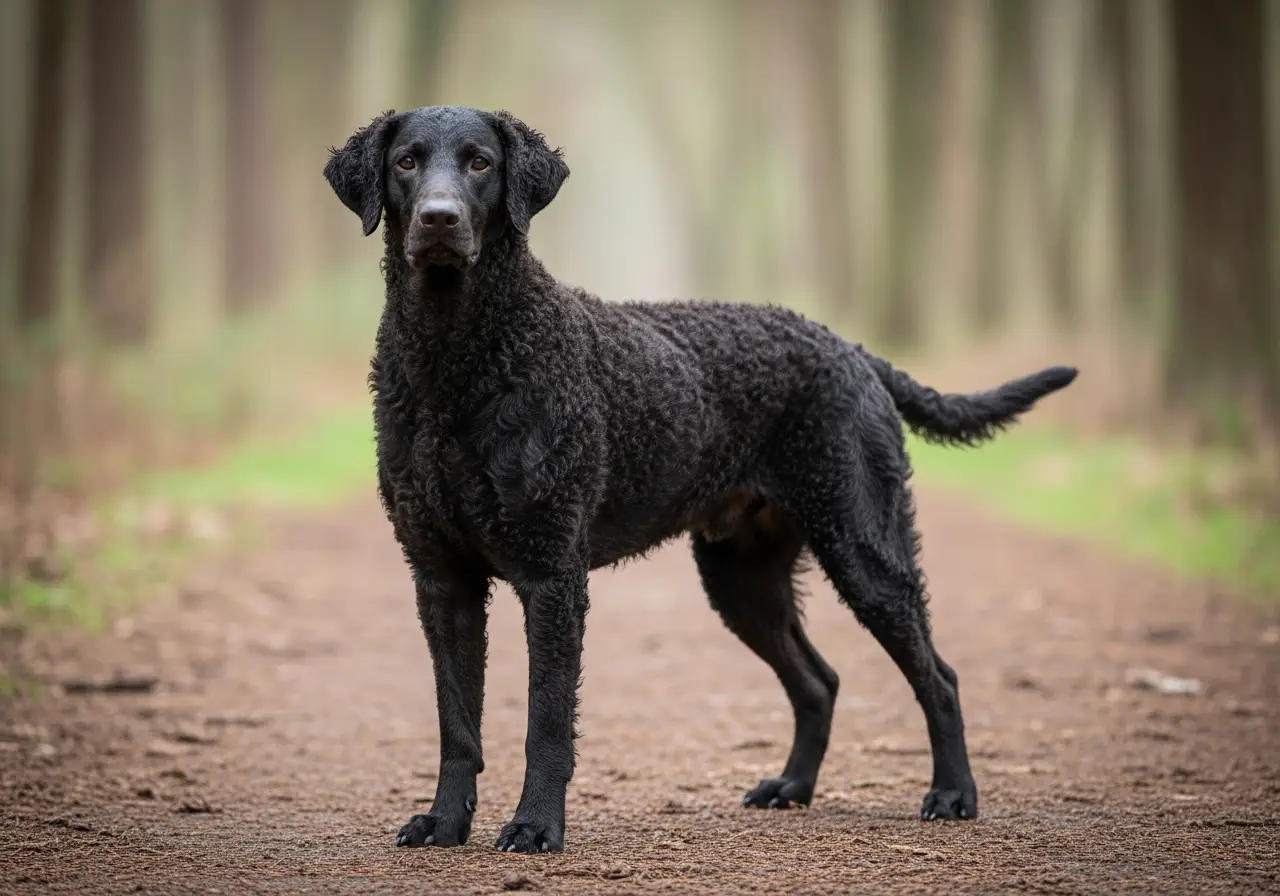
The Curly Coated Retriever is the oldest recognised Retriever type and the most independent of its group. Its dense curly coat protects it in water and undergrowth, and its character demands the same level of consistency as its body requires stimulation. Anyone who expects an uncomplicated family dog fundamentally underestimates it. Anyone who understands it as a working partner gains an exceptional dog.
02Introduction
What makes the Curly Coated Retriever special
The Curly Coated Retriever is the largest and most independent of all retrievers, FCI Group 8, with a characteristic curly coat, shoulder height 58–69 cm.
03Profile
Key facts and suitability
- Origin
- Grossbritannien
- Original purpose
- Water and land hunting, retrieving
- FCI
- No. 110 · Group 8 · Sektion 1: Apportierhunde. Mit Arbeitsprüfung. (Gruppe 8: Apportierhunde, Stöberhunde, Wasserhunde)
- height at the withers
- 64–69 cm
- Weight
- 29–41 kg
- Life expectancy
- 9–14 Years
- Coat type
- Gelockt
- Minimum exercise
- 90 min/day
- Puppy price
- 1'200–2'200 CHF
- Waiting period
- 9 months
- Sports
- Hunting · Swimming · Retrieving · Dummy · Agility
04Temperament
How the Curly Coated Retriever shows up in everyday life
When returning home, the Curly Coated Retriever greets its primary caregiver with genuine joy, but without the exuberant constant presence attributed to some Retrievers. It registers the return, shows it briefly, and then returns to its own enrichment. This independence is not disinterest, but character.
Here the two axes separate that are decisive for understanding this breed: The Curly’s need for social contact is high; it requires close integration into family life, regular joint activity, and a reliable primary caregiver. At the same time, its reaction to strangers is significantly more reserved than in other Retrievers. A visitor who wants to pet the dog immediately will often be ignored or observed from a distance. This is not an error in socialisation; it is breed-typical.
On the walk, the pronounced prey drive shows itself: The Curly registers game early, pulls towards the undergrowth, and requires clear leash handling as well as reliable recall before running free in secure terrain. Free running without prior work on recall is not an option with this breed.
In training, it questions repetitions. Whoever demands the same exercise ten times in a row will receive a dog that looks away by the seventh time. Variety, clear tasks, and meaningful sequences maintain its attention. Dummy training, nose work, or hunting-style handling correspond most strongly to its genetic profile.
It gets along well with children who are calm and respectful in their handling, provided the children understand that it is not a cuddly toy on demand.
05Needs
What this breed needs daily
The Curly Coated Retriever requires at least 90 minutes of active movement daily, not walking at a walking pace, but movement with a task. Dummy training, retrieving work in water, scent work, or hunting-style handling cover its need for mental work, which is rated very high at level 4 out of 5.
Pure endurance runs without a mental component are not sufficient. A Curly that is physically tired but mentally under-stimulated seeks its own enrichment, and this rarely turns out in the owner’s interest.
The need for exercise is also at level 4. This means in practice: two shorter units daily are not enough. One longer unit with a real task plus one moderate unit in the evening correspond to the minimum. On rainy days or during weeks without field work, it needs substitutes in the form of nose work or search games in the apartment.
It tolerates being left alone for up to four hours with a stable bond; beyond that, stress signals arise. Anyone who is regularly away from home for longer periods needs a reliable care solution.
The need for social contact is high: the Curly wants to be integrated into daily life, not kept in a kennel or permanently in the garden. It requires a fixed primary caregiver with clear body language and consistency. Changing handlers without a coordinated concept make it insecure.
A rural environment with access to natural areas and water bodies corresponds most strongly to its profile. Keeping in the city is possible if stimulation is implemented consistently and daily.
Exercise
High
mental work
A lot
Social needs
Medium
training
Medium
06Sport & Mental and Physical Stimulation
What sports the Curly Coated Retriever is suited for
Realistic in terms of physiology and genetics – not every breed suits every sport.
Structurally and physiologically suitable: Suitable for mantrailing, dummy work and tracking · CaniCross / bikejoring possible.
07Quick Check
08Suitability
Who this breed is suitable for – and who it isn't
✓Matches
The Curly Coated Retriever suits owners who can offer at least 90 minutes of active stimulation with a task daily, such as dummy training, water work, scent work, or hunting-style handling. Experience with independent, high-drive dogs is not a recommendation, but a prerequisite.
Suitable for individuals or couples with an active, nature-oriented lifestyle and a structured daily routine. Families with children from around eight years of age are suitable if the adults clearly take on the leadership role and the children show respectful behaviour towards the dog.
An owner who enjoys structured collaboration with the dog, not just movement for its own sake, hits the core of what this breed requires. Dog sports such as mantrailing, search and rescue work or retrieving competitions offer meaningful outlets.
Anyone who regularly receives visitors and expects a socially open dog must know: The Curly remains reserved towards strangers. This requires active socialisation from puppyhood and realistic expectations. A rural environment or regular access to natural areas and bodies of water makes keeping the dog significantly easier.
×Doesn't match
The Curly Coated Retriever is not suitable for owners who can devote less than 90 minutes a day to active, task-oriented exercise. Anyone who is away from home for eight hours and has no reliable care solution will structurally overwhelm this dog.
First-time owners without prior experience with independent, hunting-motivated dogs regularly underestimate the leadership skills this breed demands. A Curly that refuses monotonous exercises and seeks its own path is not a stubborn dog; it is a dog that demands more than an average basic training course offers.
Anyone looking for a socially open, stranger-friendly Retriever that greets every visitor is mistaken about the Curly. The reserve towards strangers is not a training error but a breed characteristic; anyone who sees this as a problem should choose a different breed.
Households with very young children, where no structured daily routine is possible, are also unsuitable. Owners looking for a calm companion dog for city life without intensive stimulation will not be happy with the Curly, regardless of how large the apartment or garden is.
10Line reality
Show line, working line, breeder market
The Curly Coated Retriever exists in two recognisable lines, even if the division is less sharp than, for example, in the Labrador Retriever.
The working line (still actively used in hunting in Australia, New Zealand, and parts of Great Britain) shows a dog with a more pronounced prey drive, higher endurance, and stronger independent initiative in the field. These dogs are bred for use as retrieving dogs and require a handler with a hunting or at least dog sport background.
The show line, which dominates in Central Europe, is somewhat more cooperative to handle but retains the breed-typical independence and reserve towards strangers. The difference from the working line is subtler than in other Retriever breeds; overall, the Curly has been less strongly selected for pure show dog characteristics.
In Germany, Austria, and Switzerland, the breed is very rare overall. Most litters come from breeders who keep both exhibition and working traits in mind. Field trial lines in the strict sense hardly exist in the DACH region; anyone looking for a Curly for active hunting work often looks towards British or Australian breeders.
Before purchase, it is worth asking the breeder which line the parent dogs represent and which working tests have been completed; this provides insight into the expected drive and activity level of the puppy.
11Health · Reality
What you need to plan for medically with your Curly Coated Retriever
The life expectancy of the Curly Coated Retriever is 10 to 12 years. This places it within the typical range for large Retriever breeds.
Hip dysplasia (HD) is documented: Evaluations by the German Retriever Club show that HD examinations are mandatory for breeding dogs. Exact prevalence rates for the Curly are not available in a statistically reliable form due to the small population size in the DACH region, but reputable breeders provide HD X-ray results for both parent dogs.
Eye diseases represent a relevant risk. Progressive retinal atrophy (PRA) is known in the breed; DNA tests are available and should be documented for breeding dogs. Regular eye examinations by a specialist vet are recommended.
Cancer: Retriever breeds in general show an increased susceptibility to certain types of tumours. This risk is mentioned in the specialist literature for the Curly, without breed-specific prevalence studies being available with a sufficient sample size.
The curly coat does not require intensive care, but should be checked for embedded foreign bodies such as burrs after every outing in rough terrain, as these can bore into the skin and cause inflammation.
Overweight is less common in sufficiently stimulated Curlys than in less active Retriever breeds, but remains a risk with lack of exercise. Weight should be checked regularly; the ribs must remain palpable.
Preventive examinations: HD X-rays, annual eye examination, dental treatment as needed, weight check at the vet at least once a year.
12Structured data
Health by the numbers
Prone to diseases
Hip dysplasia, progressive retinal atrophy, heart problems, epilepsy
Recommended health tests
Hip X-ray, eye examination, heart examination
13Myths ↔ Reality
What is often said incorrectly about this breed
Five myths, five realities, five sources.
„The Curly is like a Labrador, just with curls.
The Curly Coated Retriever differs considerably from the Labrador in temperament and working style. It is more independent, reserved towards strangers and requires significantly more mental stimulation. The FCI standard explicitly describes it as self-confident and independent, characteristics that are far less pronounced in a Labrador.
„The curly coat is high-maintenance and must be brushed regularly.
The opposite is the case: The close-lying curly coat of the Curly does not tangle like long hair and does not require regular brushing; brushing actually destroys the curl structure. Care is limited to occasional wetting to refresh curls and checking for foreign objects after field use.
„Retrievers are generally suitable for beginners, so is the Curly.
The Curly Coated Retriever is the most demanding breed within the Retriever group to handle. Its independence, pronounced prey drive, and tendency to refuse monotonous exercises require experience with work-oriented dogs. Without consistent, varied handling, it develops unwanted independent initiatives.
“A large garden replaces the daily exercise.
A garden offers no substitute for targeted stimulation for the Curly. The breed requires at least 90 minutes of active movement daily, plus structured mental work such as dummy training or scent work. Without this stimulation, behavioural problems arise, regardless of the property size.
“The Curly is particularly healthy due to its rarity.
Rarity does not automatically protect against hereditary diseases. In the Curly Coated Retriever, hip dysplasia, eye diseases (including progressive retinal atrophy), and an increased susceptibility to certain cancers are documented. Reputable breeders carry out mandatory health checks; this should be actively enquired about before purchase.
14animal welfare
The animal welfare perspective
Breeder market, designer versions, animal shelter reality — what no one writes in the puppy ad.
The Curly Coated Retriever is one of the rarest Retriever breeds in the DACH region. This rarity has a downside: The market is small, and unscrupulous providers deliberately exploit the demand for rare breeds.
Anyone who comes across online offers with immediate availability, unusually low prices or missing health certificates is in the area of puppy farming. These operations do not carry out health examinations, do not select for temperament and working characteristics and often give away puppies too early. The result is dogs with unclear health status and frequently exacerbated behavioural problems because the genetic basis and early imprinting are lacking.
Designer versions of the Curly are virtually non-existent, as the breed has not entered the trend segment. This protects it from the worst pressure from backyard breeders, but it also means: anyone looking for a Curly needs to be patient. Waiting times of one year are normal with a reputable breeder.
Keeping-related problems in the Curly arise almost exclusively from underestimating its needs. Dogs that receive too little exercise and mental work develop behavioural problems such as destruction, excessive barking or prey-driven escapes. These animals occasionally end up in rehoming programmes, not because the breed is difficult, but because expectations did not match reality.
Rehoming an adult Curly through animal welfare organisations or the German Retriever Club is an equally valid option to buying a puppy. An adult dog has the advantage that character, drive strength and health status are already assessable, and that the dog is given a second chance.
15Costs · Transparency
What this breed realistically costs
A puppy from a reputable breeder with pedigree, health certificates and VDH/FCI papers costs between 1,500 and 2,500 EUR in the DACH region. Offers significantly below this almost always come from backyard breeding without health checks.
Annual living costs consist of food (high-quality dry food or BARF for a large dog: approx. 600–1,000 EUR/year), basic equipment and care (approx. 200–400 EUR/year) as well as dog training school and training (approx. 300–600 EUR/year for courses and dummy training).
Average vet costs: routine examinations, vaccinations and parasite prevention cost approx. 300–500 EUR/year. If an illness occurs, such as HD treatment or eye surgery, individual costs can quickly reach 2,000–5,000 EUR.
Dog health insurance (surgery insurance) costs approx. 400–800 EUR/year for a large dog in the DACH region, depending on provider and scope of cover. Given the known health risks of the breed, such cover is recommended.
Total costs in the first year (incl. getting a dog): realistically 3,500–5,500 EUR. From the second year: approx. 1,500–2,500 EUR/year without major vet costs.
16Puppy search
What you need to consider when choosing a breeder
- The Curly Coated Retriever is very rare in the DACH region.
- Waiting times of a year or more are not exceptional with reputable breeders.
- Anyone who can buy a puppy immediately should regard this as a warning sign.
- A reputable breeder is a member of the German Retriever Club (DRC) or a recognised national breeding association and provides health certificates for both parent dogs, including at least hip dysplasia X-rays, eye examinations and, where available, DNA tests for progressive retinal atrophy.
- The puppies are raised in the home, have contact with everyday noises and are handed over to the buyer with a vaccination record, microchip and pedigree.
- Questions that should be asked before purchase: Which working trials have the parent dogs completed?
- Which bloodline do they come from?
- How many litters per year does the breeder produce?
- Placement through animal welfare organisations is rare for the Curly, but not excluded.
- Surrenders usually occur due to underestimated work and exercise needs.
- Anyone open to an adult dog will occasionally find dogs available for rehoming through the DRC or specialised Retriever rescue centres, with the advantage that character and drive strength are already assessable.
FAQ
Frequently asked questions about the Curly Coated Retriever
Is Curly Coated Retriever suitable for beginners?
Curly Coated Retriever is considered suitable for first-time dog owners.
Is Curly Coated Retriever a family dog?
Curly Coated Retriever is considered suitable for families with good socialisation and species-appropriate care.
How much exercise does Curly Coated Retriever need?
At least around 90 minutes of exercise per day. As an active breed, more so — plus mental stimulation.
What is the size and weight of Curly Coated Retriever?
Fully grown, Curly Coated Retriever reaches about 64–69 cm at the withers and weighs around 29–41 kg.
What is the life expectancy of Curly Coated Retriever?
The life expectancy of Curly Coated Retriever is approximately 9–14 years.
Which diseases are common in Curly Coated Retriever?
Hip dysplasia, progressive retinal atrophy, heart problems, epilepsy
17Breed clubs
Official breed clubs in DACH
19Related
Similar breeds – and their differences
You might also be interested in
Participate
Do you have a good photo of your Curly Coated Retriever?
We are looking for expressive images for our breed profiles. Submit yours; the editorial team reviews every submission before publication.
Does this breed suit you?
One of the oldest retrievers. More independent and less 'people-pleasing' than Labrador/Golden. For hunters and active families.