
01Summary
In a paragraph
If you only have 30 seconds.
The Chesapeake Bay Retriever is not a Retriever for everyone. It was bred for icy waters, long hunting days, and independent decision-making, and these traits remain inherent today. Those who bring clear leadership, structured work, and enjoyment of an independent dog will find an exceptionally loyal partner. Those seeking an amiable family dog are mistaken about this breed.
02Introduction
What makes the Chesapeake Bay Retriever special
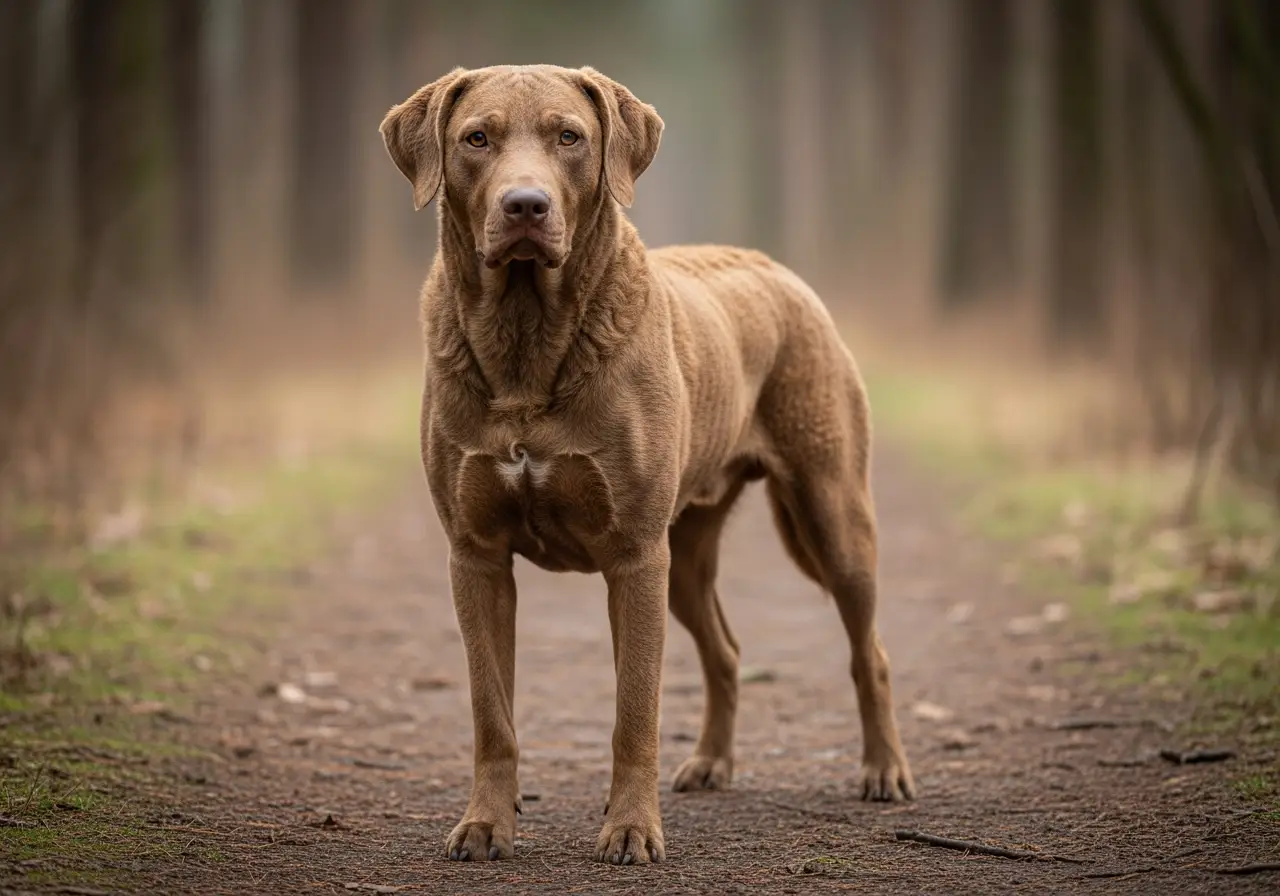
The Chesapeake Bay Retriever is a US retriever breed, FCI Group 8, known for its water-repellent coat and cold-water hunting conditions, withers height 53–66 cm.
03Profile
Key facts and suitability
- Origin
- USA
- Original purpose
- Waterfowl hunting and retrieving ducks in icy waters
- FCI
- No. 263 · Group 8 · Sektion 1: Retriever
- height at the withers
- 53–66 cm
- Weight
- 25–36 kg
- Life expectancy
- 10–13 Years
- Coat type
- Gelockt
- Minimum exercise
- 90 min/day
- Puppy price
- 1'200–2'200 CHF
- Waiting period
- 9 months
- Sports
- Hunting · Swimming · Retrieving · Dummy
04Temperament
How the Chesapeake Bay Retriever shows up in everyday life
When returning home, the Chesapeake Bay Retriever greets its primary caregiver intensively, but selectively. Visitors it does not know, it initially observes from a distance. It positions itself between strangers and its primary caregiver without becoming loud. This behaviour is not a mistake, but genetically anchored: The breed was bred for independent decision-making under hunting conditions, not for social openness towards everyone.
Internally, what the dog needs: The need for social contact is high, but concentrated on the core family. The Chesapeake Bay Retriever wants to be involved, to cooperate, to be led. Left alone for more than four hours, many dogs show restlessness or controlling behaviour. Mental work has the same importance as physical exercise; a dog that only runs but does not think is not sufficiently stimulated.
Externally, how the dog reacts: Towards strangers, it shows reserve (friendliness towards strangers: 3 out of 5). This does not mean aggression, but also no spontaneous warmth. With other dogs, it is compatible with early and consistent socialisation, but occasionally shows dominant behaviour towards conspecifics of the same sex.
In everyday life, this means: A walk without a task is idle time for this dog. Retrieving sequences, nose work or structured search tasks belong in the daily routine. Anyone who understands and implements this experiences a focused, loyal dog. Anyone expecting a relaxed companion dog underestimates the profile of this breed.
05Needs
What this breed needs daily
The Chesapeake Bay Retriever requires at least 90 minutes of active exercise daily, a significant portion of which should be structured. Free-running on a lawn does not fully meet this need. Water work, retrieving sequences, tracking exercises, or dummy training align with the breed's genetic profile and should be an integral part of the weekly routine.
The mental workload requirement is rated at 4 out of 5. This means that without sufficient mental stimulation, frustration can arise, potentially manifesting as controlling behaviour, excessive guarding behaviour, or destructiveness. Nose work, search games, and hunting-related exercises are not extras; they are essential care.
Being left alone should be introduced early and built up systematically. Four hours is the upper limit for many dogs of this breed; beyond that, the risk of stress-related behaviour increases. A dog sitter or day care is not a luxury option but a necessity during longer absences.
The Chesapeake Bay Retriever requires a clear leadership structure. This does not mean harshness, but rather consistency and predictability. Inconsistent rules or changing key persons without a clear hierarchy lead to problems more quickly in this breed than in socially open Retrievers. For first-time owners of this breed, attending a dog training school with experience in working dogs is not an option but a strongly recommended measure.
Exercise
High
mental work
A lot
Social needs
Medium
training
Demanding
06Sport & Mental and Physical Stimulation
What sports the Chesapeake Bay Retriever is suited for
Realistic in terms of physiology and genetics – not every breed suits every sport.
Structurally and physiologically suitable: Suitable for mantrailing, dummy work and tracking · CaniCross / bikejoring possible.
07Quick Check
08Suitability
Who this breed is suitable for – and who it isn't
✓Matches
The Chesapeake Bay Retriever suits owners with proven experience in handling confident working dogs. Anyone who has already handled a dog with high drive and independent thinking possesses the basic prerequisites.
Specific profiles: Hunters or dog sport enthusiasts who actively engage in water work, dummy training, or tracking exercises and can plan at least 90 minutes of structured stimulation daily. Owners in rural environments with regular access to bodies of water or large natural areas. Families with children from around 10 years old, where all family members consistently apply the same rules and the dog has clear key persons.
Those who are professionally flexible and rarely leave the dog alone for more than four hours, or who have organised reliable care solutions, meet another basic condition. A garden is not a substitute for active stimulation, but it is an advantage for the daily exercise routine.
Those who enjoy an intense, task-oriented human-dog relationship and are willing to further their professional knowledge will find an exceptionally loyal and capable partner in the Chesapeake Bay Retriever.
×Doesn't match
The Chesapeake Bay Retriever is not suitable for owners handling a dog for the first time, regardless of how motivated they are. The breed demands experience with independent, high-drive dogs; motivation alone does not replace this experience.
Those seeking an amiable, socially open dog that reacts warmly to visitors and behaves relaxed in changing social situations are mistaken about this breed. Reserve towards strangers is not a training issue but a breed characteristic.
Households where the dog regularly spends more than four hours alone and no alternative care exists are unsuitable for this breed. Anyone who believes a large garden replaces structured stimulation significantly underestimates the breed's mental workload requirements.
City dwellers without regular access to natural areas, bodies of water, or dog sport facilities should not choose this breed. Anyone seeking a Retriever because of the friendly Retriever image and equating the Chesapeake Bay Retriever with a Labrador is making a wrong decision, for themselves and for the dog. Families with toddlers under six years old, where a consistent leadership structure cannot be maintained, are also not a suitable environment.
10Line reality
Show line, working line, breeder market
The Chesapeake Bay Retriever is kept almost exclusively as a working dog or hunting companion in Europe. A pronounced show line, such as exists with the Labrador or Golden Retriever, has not established itself in the small European population. The breeding population in Germany and Switzerland is small; the German Retriever Club (DRC) and the Retriever Club Switzerland (RCS) handle the breed, but litter numbers remain low.
In the USA, there is a clearer differentiation: dogs from working breeds, so-called "hunting lines", are slimmer, more enduring and have stronger drives than dogs from show breeds. The latter often show a calmer temperament, but also less hunting motivation. Anyone looking for a Chesapeake Bay Retriever for hunting work or intensive dog sports should specifically ask for descendants of the working line and observe the parent animals in practice.
For the European market, the following applies: The origin of the litter, whether imported from US American working breeding or from European breeding, noticeably influences the temperament. A conversation with the breeder about the line and the tasks of the parent animals is more important for this breed than for more popular retrievers.
11Health · Reality
What you need to plan for medically with your Chesapeake Bay Retriever
The life expectancy of the Chesapeake Bay Retriever is between 10 and 13 years. This places it within the range for large Retriever breeds, without significant outliers either way.
Hip dysplasia (HD) is the most common orthopaedic condition in the breed. The Orthopedic Foundation for Animals (OFA) records an HD rate of around 20 % in its database (as of 2023) for Chesapeake Bay Retrievers tested, comparable to other large retrievers. Elbow dysplasia (ED) occurs less frequently but should also be X-rayed in both parent dogs.
Eye conditions are another focus: Progressive Retinal Atrophy (PRA) and cataracts occur in the breed. The CAER examination (Canine Eye Registry Foundation) is part of the minimum standard for serious breeding.
Degenerative Myelopathy (DM) is genetically testable; a DNA test of the parent dogs provides information on the risk to the offspring. Serious breeders provide this test.
Overweight is an underestimated risk in this breed: The Chesapeake Bay Retriever shows a high willingness to eat combined with a pronounced work drive. If it is not sufficiently exercised, the weight increases quickly, with consequences for joint and heart health.
Preventive examinations: HD/ED X-rays of the parent dogs before breeding, CAER eye examination, DM genetic test, annual veterinary check-up including weight control.
12Structured data
Health by the numbers
Prone to diseases
Hip dysplasia, progressive retinal atrophy, thyroid problems
Recommended health tests
Hip X-ray, eye examination, thyroid screening
13Myths ↔ Reality
What is often said incorrectly about this breed
Five myths, five realities, five sources.
"The Chesapeake Bay Retriever is like a Labrador, just a bit more robust."
This assessment significantly underestimates the differences. The Chesapeake Bay Retriever exhibits markedly stronger territorial behaviour, a stronger bond with a single primary caregiver, and less openness towards strangers. It was bred for independent hunting work, not for cooperative team work with changing people. Anyone accustomed to a Labrador will experience a fundamentally different dog.
"Its dense coat makes it easy to care for."
The oily double coat of the Chesapeake Bay Retriever is functional, but not low-maintenance. It tends to mat if brushed too frequently or with the wrong products. The natural oil protects against water and cold; frequent bathing destroys this protection. Regular checks for skin problems and targeted grooming are necessary; it is not a self-sustaining process.
"As a retriever, he is an uncomplicated family dog."
The term 'retriever' evokes associations with the Golden Retriever or Labrador, dogs bred for broad social compatibility. The Chesapeake Bay Retriever shares the enthusiasm for retrieving, but not the social openness. It shows reserve to mistrust towards strangers and requires consistent socialisation and clear leadership. Without these prerequisites, protective and controlling behaviour can develop.
"He only needs lots of exercise, then he is balanced."
Pure physical exercise is not enough for the Chesapeake Bay Retriever. The breed has a high need for mental work (score 4 out of 5). Without structured tasks (dummy training, tracking, nose work or hunting guidance), many dogs develop controlling behaviour or signs of frustration. Exercise and mental work are equally important pillars of keeping the dog.
"Hip dysplasia is not a big issue in retrievers."
HD and ED are relevant overall in retrievers, particularly in the Chesapeake Bay Retriever. The Orthopedic Foundation for Animals (OFA) records an HD rate of around 20% for the breed (OFA database, status 2023). Reputable breeders provide X-ray results for both parent animals. Anyone who does not receive proof should regard this as a warning signal.
14animal welfare
The animal welfare perspective
Breeder market, designer versions, animal shelter reality — what no one writes in the puppy ad.
The Chesapeake Bay Retriever is a rare breed in Germany and Switzerland. This protects it from the worst excesses of the backyard breeder market, but not completely. Those searching online for puppies occasionally find offers from Eastern European backyard breeding operations that provide neither health certificates nor stud book entries. The low price is not a bargain, but a signal: health examinations, socialisation and animal-appropriate rearing cost money.
Designer versions or hybrid breeds with the Chesapeake Bay Retriever exist on the fringes of the market, but are not widespread. The risk lies less in trend crosses than in the simple underestimation of the breed: anyone looking for a "robust retriever" and ignoring the working profile will overwhelm themselves and the dog.
Keeping-related problems with the Chesapeake Bay Retriever almost always arise from under-stimulation. A dog with a mental workload requirement of 4 out of 5 that only goes for walks daily develops control behaviour, excessive guarding behaviour or frustration signals. This leads to surrender in some cases, not because the dog is "difficult", but because the owner profile did not match the breed.
Animal welfare organisations and retriever rescue groups occasionally take in Chesapeake Bay Retrievers. An adult dog from rehoming has the advantage that temperament and health status are already assessable. Anyone who knows the breed and meets the requirements should consider rehoming as an option equivalent to puppy breeding. The DRC and RCS can help with the search for rehoming dogs or make appropriate contacts.
15Costs · Transparency
What this breed realistically costs
A puppy from serious, VDH/DRC-affiliated breeding costs between 1,500 and 2,200 euros in Germany. Offers significantly below this often come from backyard breeding operations without health certificates; follow-up costs due to hereditary diseases regularly exceed the savings.
Annual living costs are approximately 2,000 to 3,500 euros, depending on food quality, training effort and health status. High-quality dry food for a dog of this size costs between 600 and 1,000 euros per year. Grooming is manageable at home for this breed, but should be done regularly.
Veterinary costs: Annual basic care (vaccinations, parasite prophylaxis, check-up) is 300 to 500 euros. With orthopaedic problems, HD or ED, which are typical for the breed, diagnosis and treatment can quickly reach 1,500 to 4,000 euros.
Dog health insurance costs between 60 and 130 euros per month for this breed, depending on the provider and scope of benefits. Given the HD rate of around 20 % (OFA, 2023), surgery insurance is a sensible safeguard. Dog liability insurance is mandatory or strongly recommended in Germany and Switzerland; costs: 50 to 100 euros per year.
16Puppy search
What you need to consider when choosing a breeder
- Reputable breeders of Chesapeake Bay Retrievers are rare in Germany and Switzerland.
- The German Retriever Club (DRC) and the Retriever Club Switzerland (RCS) maintain breeding lists and facilitate contact with tested breeders.
- A breeder affiliated with the DRC or RCS is subject to breeding regulations and health requirements, which serves as an initial orientation point but does not replace personal assessment.
- Specific criteria for reputable breeding: Both parent dogs have been X-rayed for HD and ED, with results available in writing.
- Eye examinations (CAER) are documented.
- The breeder allows visits to the litter and shows the mother in everyday life.
- Puppies leave the litter no earlier than eight weeks of age, ideally at nine to ten weeks.
- Warning signs: No proof of health examinations for the parent dogs, immediate availability without waiting time, sale via animal markets or without a personal conversation.
- Placement through animal welfare organisations is rare but not excluded for Chesapeake Bay Retrievers in Europe.
- Retriever rescue organisations and the DRC can assist in finding surrendered dogs.
- An adult dog from placement is an equally valid option, precisely because its character is already assessable.
FAQ
Frequently asked questions about the Chesapeake Bay Retriever
Is Chesapeake Bay Retriever a family dog?
Chesapeake Bay Retriever is considered suitable for families with good socialisation and species-appropriate care.
How much exercise does Chesapeake Bay Retriever need?
At least around 90 minutes of exercise per day. As an active breed, more so — plus mental stimulation.
What is the size and weight of Chesapeake Bay Retriever?
Fully grown, Chesapeake Bay Retriever reaches about 53–66 cm at the withers and weighs around 25–36 kg.
What is the life expectancy of Chesapeake Bay Retriever?
The life expectancy of Chesapeake Bay Retriever is approximately 10–13 years.
Which diseases are common in Chesapeake Bay Retriever?
Hip dysplasia, progressive retinal atrophy, thyroid problems
17Breed clubs
Official breed clubs in DACH
19Related
Similar breeds – and their differences
You might also be interested in


Participate
Do you have a good photo of your Chesapeake Bay Retriever?
We are looking for expressive images for our breed profiles. Submit yours; the editorial team reviews every submission before publication.
Does this breed suit you?
Most robust of all retrievers. Cold- and water-resistant. More independent than Labrador/Golden – needs experienced leadership.