
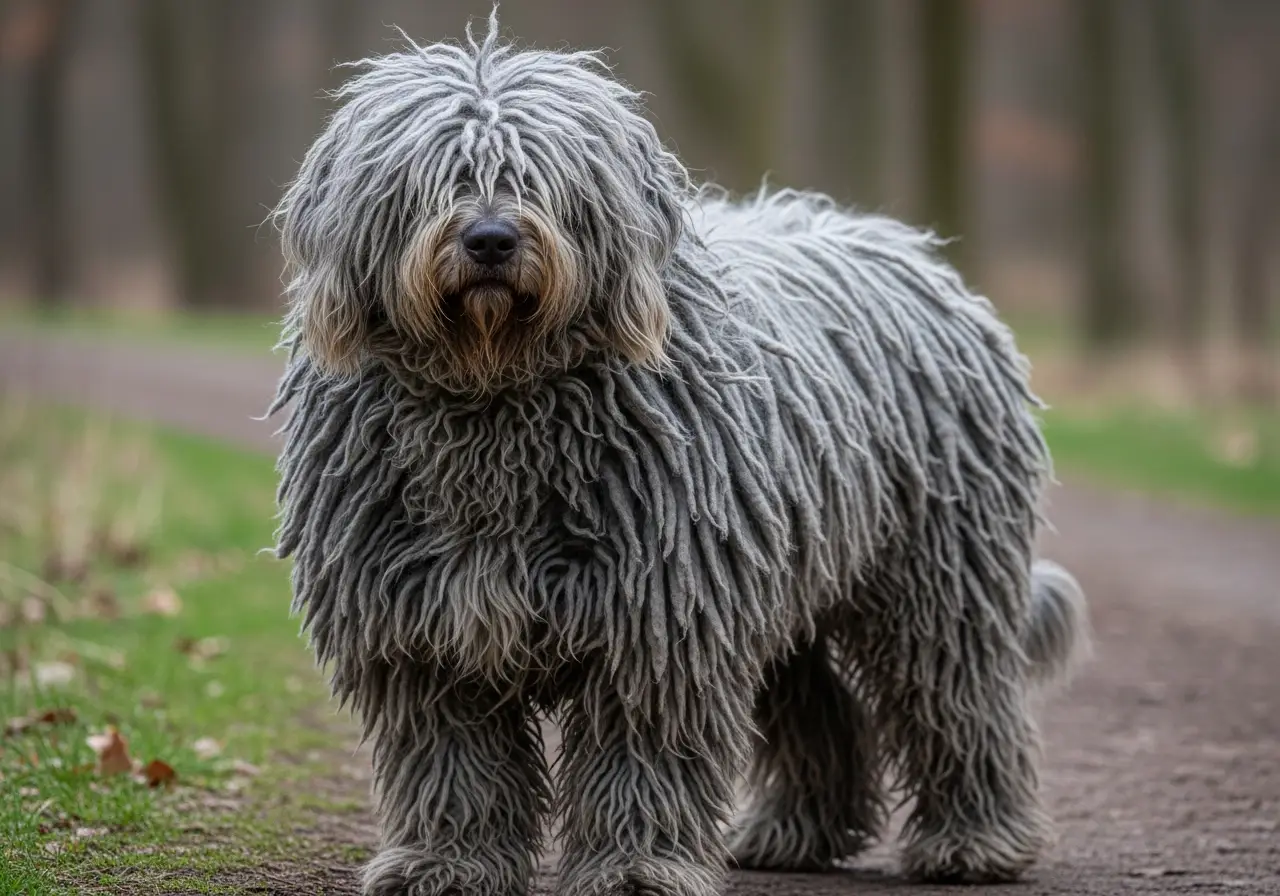
01Summary
In a paragraph
If you only have 30 seconds.
The Bergamasco Shepherd Dog is a robust Alpine herding dog that worked independently for centuries, bringing this heritage with it daily. Its felted coat is unmistakable, its character even more distinctive: calm, alert, deeply people-oriented and yet consistently independent in its thinking. Anyone who keeps this breed takes responsibility for a dog that does not expect leadership but tests it.
02Introduction
What makes the Bergamasco Shepherd Dog (Cane da Pastore) special
The Bergamasco Shepherd Dog is an Italian Alpine sheepdog, FCI Group 1, known for its characteristic matted coat, withers height 54–62 cm.
03Profile
Key facts and suitability
- Origin
- Italien
- Original purpose
- Sheep herding in the Alps
- FCI
- No. 194 · Group 1 · Section 1
- height at the withers
- 54–62 cm
- Weight
- 26–38 kg
- Life expectancy
- 13–15 Years
- Coat type
- Long-haired
- Minimum exercise
- 60 min/day
- Puppy price
- 1'200–2'000 CHF
- Waiting period
- 12 months
- Sports
- Herding work · Obedience · Hiking
04Temperament
How the Bergamasco Shepherd Dog (Cane da Pastore) shows up in everyday life
When going for a morning walk, what distinguishes the Bergamasco from many other dogs becomes apparent: it does not simply follow along, it observes. Passers-by, bicycles, other dogs – the Bergamasco registers everything, assesses it and then decides whether a reaction is necessary. This alertness is not nervousness, but a genetically anchored working attitude.
Internally (i.e., in what the dog itself needs), the breed shows a high need for social contact with the reference family. The Bergamasco wants to know where its people are. It does not follow intrusively, but it positions itself so that it keeps an overview. In the evening on the sofa, it often lies in such a way that it has the door and window in view. This is no coincidence.
Externally, i.e., in its reaction to strangers, the breed behaves significantly more reservedly. Visitors who come for the first time are observed, not greeted. The Bergamasco decides for itself when it allows contact. This process can take minutes or even several visits. Anyone who interprets this as rejection and pressures the dog creates stress. Anyone who understands it as breed-typical behaviour and gives the dog space will experience a calm, reliable interaction after some time.
Mental work is not an optional extra. A Bergamasco without mental stimulation begins to seek tasks for itself; it observes neighbours, checks fences, reacts to noises. These self-initiated activities can develop into undesirable behaviours if they are not channelled through structured tasks. Nose work, herding exercises or clearly structured training sessions give the dog what it expects genetically: a meaningful task with a comprehensible result.
05Needs
What this breed needs daily
The Bergamasco requires at least 90 minutes of active exercise daily, divided into several sessions, not as a single long walk. Pure running distance is not sufficient here. The exercise should be combined with perception tasks: varying terrain, new smells, unfamiliar situations that the dog can assess independently.
Mental stimulation is equal in importance to physical exercise. The need for mental work in this breed is high. Nose work, search tasks, structured obedience exercises or, where possible, herding work correspond to the genetic profile of the Bergamasco. Without this component, a dog arises that invests its energy in uncontrolled alertness or territorial behaviour.
The need for social contact with the reference group is pronounced. The Bergamasco does not tolerate being left alone permanently. Up to four hours alone are possible with good habituation; beyond that, stress arises, which manifests itself in restlessness or excessive barking. A dog that is regularly left alone for longer periods requires a reliable care solution.
Training requires consistency without pressure. The Bergamasco reacts to harshness with withdrawal or resistance, both of which are counterproductive. Calm, clear communication with comprehensible rules works. The dog learns quickly but tests boundaries when they become unclear. A supporting dog training school with experience in independent herding dogs is recommended for most owners, especially in the first phase of ownership.
A garden with a secure fence is advantageous but does not replace structured guidance. The Bergamasco uses a garden for observation and control, not for self-occupation in the sense of stimulation.
Exercise
High
mental work
A lot
Social needs
High
training
Demanding
06Sport & Mental and Physical Stimulation
What sports the Bergamasco Shepherd Dog (Cane da Pastore) is suited for
Realistic in terms of physiology and genetics – not every breed suits every sport.
Structurally and physiologically suitable: Suitable for herding work, treibball and coursing · CaniCross / bikejoring possible.
07Quick Check
08Suitability
Who this breed is suitable for – and who it isn't
✓Matches
The Bergamasco suits owners with proven experience in handling independently thinking dogs, ideally herding dogs or other breeds with a pronounced guarding instinct. Anyone who has successfully handled a dog of this category already brings the necessary foundation.
Households that can offer at least 90 minutes of active exercise plus structured mental work daily are suitable. A natural environment, rural or at least with regular access to forest and terrain, corresponds to the breed's activity profile.
Families with children from about eight years of age are suitable if the children are socialised in their interaction with dogs and the parents clearly take on the leadership role. The Bergamasco accepts children as part of its reference group but expects respectful treatment.
Owners who enjoy a close, calm human-dog bond and do not rely on a socially open dog will find a reliable companion in the Bergamasco. Those who rarely receive visitors or can cope with the dog remaining reserved towards strangers are at an advantage.
People interested in nose work, herding exercises or structured dog sports that correspond to the breed's working profile provide the Bergamasco with meaningful stimulation. Quiet individuals or couples with sufficient time and experience are also suitable owners.
×Doesn't match
The Bergamasco is not suitable for first-time owners without prior experience with independently thinking dogs. Those who have previously kept exclusively socially open, biddable breeds tend to underestimate the independence of this breed, with consequences that only become apparent after months.
Households in which the dog is regularly left alone for more than four hours without a care solution are unsuitable. The high need for social contact of the Bergamasco is incompatible with permanent isolation.
Those looking for a socially open, friendly dog will not be happy with the Bergamasco. The breed-typical reserve towards strangers is not a training problem; it is a character trait. Anyone who finds this behaviour disturbing or tries to train it out of the dog creates stress without lasting success.
Anyone who underestimates grooming or does not have time for the intensive build-up phase of the felted mats in the first years of life should not choose this breed. The coat is not a decorative feature; it requires regular checking and targeted care.
City dwellers without access to natural terrain and without the possibility for structured mental work are also poorly positioned. A Bergamasco that walks exclusively on asphalt and receives no tasks develops behaviours that burden everyday life.
10Line reality
Show line, working line, breeder market
The Bergamasco Shepherd Dog does not have a pronounced line differentiation between show and working lines, as is known, for example, with the Border Collie or German Shepherd. The breed is so rare worldwide that breeding is primarily focused on preserving the overall type; specialisation into distinct lines has not become established.
The FCI standard requires a working test, which means that working traits remain an official part of the breeding goal. In practice, Bergamascos are hardly ever used for active herding work in the DACH region anymore; however, most dogs from reputable breeding show the breed-typical characteristics (alertness, independence, guarding instinct) in full measure.
Regional differences exist between Italian breeds, which are closer to the working type, and individual Central European breeds, which select more strongly for suitability as companion dogs. These differences are gradual, not categorical. An owner who acquires a Bergamasco from an Italian working breed should expect a dog that expresses its guarding instinct and independence more clearly than a dog from a breeding focused on companionship.
The recommendation is: Before buying, specifically ask the breeder about their breeding programme, which working tests the parent dogs have completed and how the puppies were socialised; this provides more insight into the expected character than the country of origin alone.
11Health · Reality
What you need to plan for medically with your Bergamasco Shepherd Dog (Cane da Pastore)
The Bergamasco is considered a robust breed with a life expectancy of 13 to 15 years, an above-average value for medium-sized dogs, which is attributed to historically work-oriented breeding without extreme typification.
Hip dysplasia (HD) occurs in the breed but is not as widespread as in large herding dogs. Reliable breed-specific HD prevalence studies for the Bergamasco do not exist due to the small population size. As a guideline: reputable breeders provide HD X-ray reports for both parent animals; a breeder without these certificates is not a reliable partner. Eye problems, particularly progressive retinal atrophy (PRA), are known as a breed-typical risk and should be clarified through eye examinations of the parent animals.
The coat requires special attention: moisture, dirt and parasites can accumulate under the felted mats. Regular checking of the skin under the mats, at least monthly, prevents skin irritation and infections. Ears and paws should also be checked regularly, as the dense coat can hide problems there.
Overweight is rarely a primary problem in this active breed but can occur with insufficient exercise. Weight is difficult to assess under the coat; regular weight checks at the vet (at least annually) are advisable.
Preventive examinations: annual vet examination including dental check, HD screening for breeding animals, eye examination in youth. Vaccination protection and parasite prevention according to the current STIKO-Hund vaccination calendar (status 2024, VDH).
12Structured data
Health by the numbers
Prone to diseases
Hip dysplasia, eye problems, generally robust
Recommended health tests
Hip X-ray, eye examination
13Myths ↔ Reality
What is often said incorrectly about this breed
Five myths, five realities, five sources.
The shaggy coat of the Bergamasco requires little care because it forms by itself.
Although the felted plates form naturally, they must be actively separated and controlled in shape during the first two to three years of life. Matting in wrong places, dirt accumulation, and skin problems under the plates occur without regular checks. The time commitment is significant during the development phase and requires instruction by experienced breeders.
The Bergamasco is an uncomplicated dog for first-time owners due to its calmness.
The outward composure of the Bergamasco masks a pronounced independence. The breed actively questions inconsistent guidance and takes initiative itself in case of uncertainty. Without experience with independently thinking herding dogs, leadership problems arise that develop insidiously and are difficult to correct.
As a herding dog, the Bergamasco is naturally friendly towards all people.
The FCI standard explicitly describes a natural reserve towards strangers as typical for the breed. The Bergamasco forms a close bond with its reference family but meets unknown persons with reservation and vigilance. Its guarding instinct is pronounced. Lack of socialisation in the puppy phase can intensify this reserve into problematic mistrust.
The Bergamasco is a pure outdoor dog that lives best alone in the garden.
The breed has a high need for social contact with its reference group. Isolation or permanent living alone outdoors fundamentally contradicts the nature of the Bergamasco and leads to behavioural issues such as excessive barking, restlessness or destructive behaviour. The dog requires close contact with the family.
Because the Bergamasco is rare, all breeders are automatically reputable and committed.
Rarity does not protect against irresponsible breeding. Even with rare breeds, backyard breeders exist who respond to demand without carrying out health tests or adequately socialising puppies. Hip dysplasia screenings and eye examinations are also relevant preventive checks for the Bergamasco that reputable breeders demonstrably carry out.
14animal welfare
The animal welfare perspective
Breeder market, designer versions, animal shelter reality — what no one writes in the puppy ad.
The Bergamasco is so rare in the DACH region that an organised market for backyard breeders in the classical sense hardly exists. This does not, however, mean that all available puppies come from reputable breeding. Particularly with rare breeds, breeders without association membership occasionally respond to enquiries without health tests and without a socialisation concept, but with immediate availability. This constellation is a warning signal, not an advantage.
Designer versions of the Bergamasco do not currently exist in significant numbers. The breed is too rare and too unsuitable for mass appeal to serve as a crossbreeding partner for trend mixes. This could change if the unusual coat receives media attention, a pattern that has been repeatedly observed with other visually striking breeds.
Breeding and keeping-related problems with the Bergamasco arise less from physical extreme typification than from errors in socialisation and husbandry. A dog that was not sufficiently accustomed to people and environments during the sensitive phase develops a reticence towards strangers, which can intensify into serious mistrust. Husbandry errors — too little exercise, too much isolation, lack of guidance — generate behavioural abnormalities that are difficult to correct. These dogs rarely end up in animal welfare shelters because the breed is too rare — but when they do, it is often with a complex history.
Adoption as an equivalent option: Anyone who takes on an adult Bergamasco with a known character has a clear advantage over a puppy; the temperament is assessable, and socialisation is complete. Specialised herding dog rescue organisations and breed protection associations are the first point of contact. The search requires patience but can be worthwhile, especially for experienced owners who know what they are looking for.
15Costs · Transparency
What this breed realistically costs
A puppy from reputable breeding affiliated with the VDH costs between 1,500 and 2,500 EUR in the DACH region. Offers significantly below this range without verifiable health tests of the parent animals should be viewed critically. Long waiting lists at reputable breeders are normal; anyone who can deliver immediately should explain why.
The annual living costs for a Bergamasco are, based on experience, between 2,000 and 3,500 EUR, depending on food choice, insurance, and grooming. High-quality dry food or BARF for a dog of this size costs between 60 and 120 EUR monthly.
Grooming is a specific cost factor: During the build-up phase of the felt mats (first to third year of life), professional instruction by the breeder or a specialist is necessary. Thereafter, regular grooming costs are eliminated, although the time commitment for self-grooming remains considerable. Veterinary costs for routine examinations, vaccinations, and parasite prevention amount to 300 to 600 EUR annually. Unforeseen treatments can be significantly higher.
Dog liability insurance is strongly recommended in the DACH region (mandatory in some cantons and federal states) and costs between 60 and 150 EUR annually, depending on the provider. Health insurance for the dog is optional but can be sensible for a breed with potential HD or eye problems, with annual premiums from approx. 400 EUR.
16Puppy search
What you need to consider when choosing a breeder
- In Switzerland, the Bergamasco belongs to the very rare breeds in the DACH region.
- Reputable breeders work with long waiting lists; anyone who receives a puppy immediately should regard this as a warning signal.
- A reputable breeder provides health certificates for the parent animals: hip dysplasia screening (HD X-ray) and eye examinations are relevant preventive checks that should be documented.
- Ask specifically for these certificates and have original documents shown to you.
- Puppies should stay with the breeder for at least eight weeks and be accustomed to people, everyday noises and various environments during this time.
- Socialisation in the sensitive phase significantly shapes later behaviour towards strangers.
- The mother should be present and accessible.
- A breeder who refuses meetings or hands over puppies on neutral ground provides no insight into the housing conditions.
- Adoption as an equally valid option: Although the Bergamasco rarely appears in animal welfare contexts, specialised herding dog rescue stations and breed protection associations occasionally place dogs.
- This option is worth targeted research; an adult dog with a known character can be the more suitable choice for experienced owners than a puppy.
- The VDH and specialised breed club contacts can assist with the search.
FAQ
Frequently asked questions about the Bergamasco Shepherd Dog (Cane da Pastore)
Is Bergamasco Shepherd Dog (Cane da Pastore) a family dog?
Bergamasco Shepherd Dog (Cane da Pastore) is considered suitable for families with good socialisation and species-appropriate care.
How much exercise does Bergamasco Shepherd Dog (Cane da Pastore) need?
At least around 60 minutes of exercise per day.
What is the size and weight of Bergamasco Shepherd Dog (Cane da Pastore)?
Fully grown, Bergamasco Shepherd Dog (Cane da Pastore) reaches about 54–62 cm at the withers and weighs around 26–38 kg.
What is the life expectancy of Bergamasco Shepherd Dog (Cane da Pastore)?
The life expectancy of Bergamasco Shepherd Dog (Cane da Pastore) is approximately 13–15 years.
Is Bergamasco Shepherd Dog (Cane da Pastore) suitable for allergy sufferers?
Bergamasco Shepherd Dog (Cane da Pastore) is considered relatively hypoallergenic. There’s never a guarantee — test direct contact beforehand.
Which diseases are common in Bergamasco Shepherd Dog (Cane da Pastore)?
Hip dysplasia, eye problems, generally robust
17Breed clubs
Official breed clubs in DACH
19Related
Similar breeds – and their differences
You might also be interested in

Participate
Do you have a good photo of your Bergamasco Shepherd Dog (Cane da Pastore)?
We are looking for expressive images for our breed profiles. Submit yours; the editorial team reviews every submission before publication.
Does this breed suit you?
The Bergamasco's coat naturally mats into "locks" – a unique care picture. Calm, enduring Alpine herding dog.