
01Summary
In a paragraph
If you only have 30 seconds.
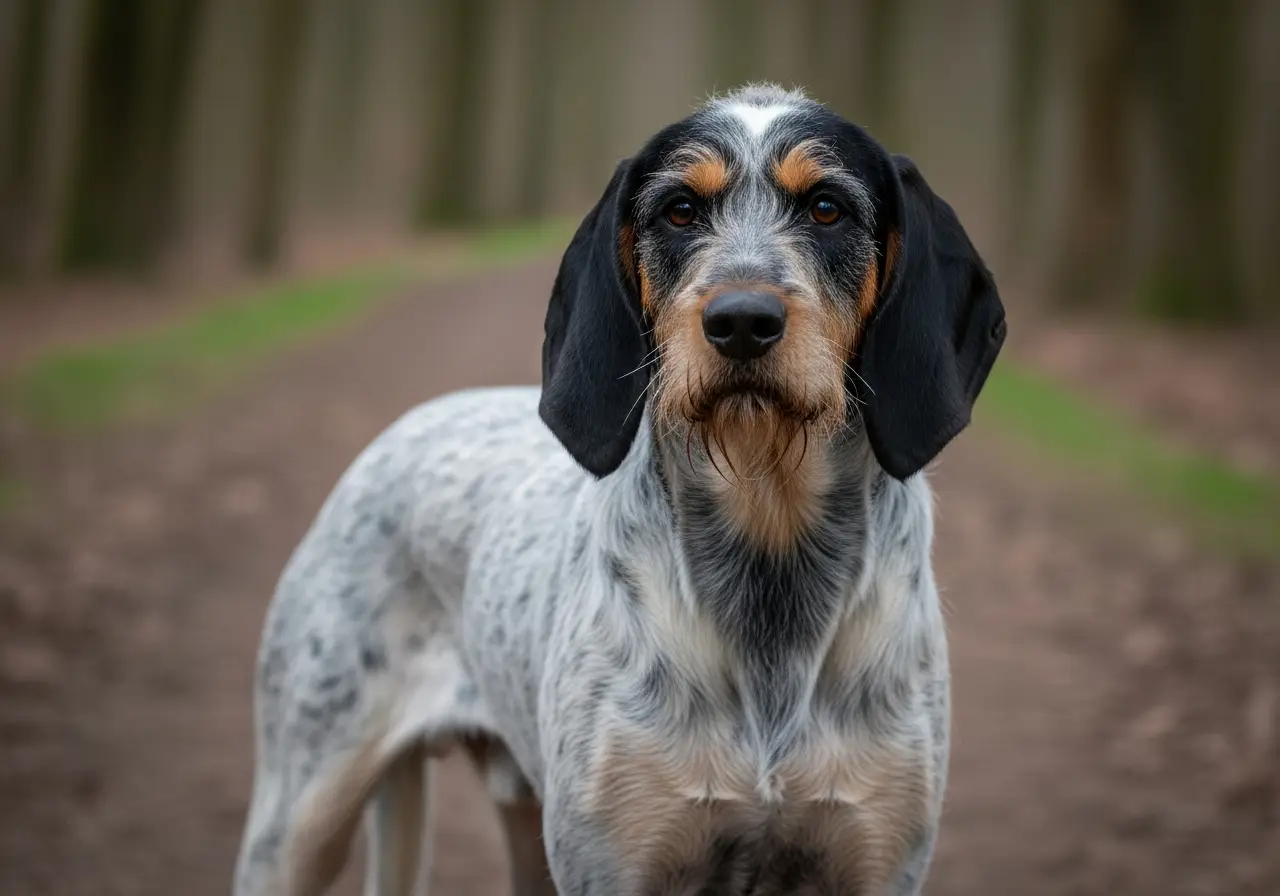
The Griffon Bleu de Gascogne is a rough-coated French scent hound from Gascony, bred for hunting hare and wild boar. His prey drive is genetically deeply anchored, his baying on the scent is breed-typically loud. Anyone who keeps this dog needs a rural environment, at least two hours of active exercise daily, and enjoyment of nose work. Outside France, he counts among the rarest scent hounds in Europe.
02Introduction
What makes the Blue Gascogne Griffon (Griffon Bleu) special
The Griffon Bleu de Gascogne is a rare French hound with a rough bluish coat, FCI Group 6, height at withers 50–57 cm.
03Profile
Key facts and suitability
- Origin
- Frankreich
- Original purpose
- Pack hunting of hare
- FCI
- No. 32 · Group 6 · Section 1.2
- height at the withers
- 50–57 cm
- Weight
- 18–23 kg
- Life expectancy
- 10–13 Years
- Coat type
- Wire-haired
- Minimum exercise
- 120 min/day
- Puppy price
- 700–1'200 CHF
- Waiting period
- 12 months
- Sports
- Hunting · Tracking
04Temperament
How the Blue Gascogne Griffon (Griffon Bleu) shows up in everyday life
During the morning run in the forest, what makes the Griffon Bleu special becomes apparent: As soon as he picks up a trail, his entire attention focuses on the scent. Calling, whistling, hand signals, all of that recedes into the background. This is not an obedience problem, but the result of centuries of selection for exactly this behaviour.
At home, a different picture presents itself. The Griffon Bleu is alert in everyday life, people-oriented and seeks closeness to his reference persons. He follows through the apartment, accompanies routines and shows genuine interest in daily events. This attachment, however, has one clear condition: He must be sufficiently stimulated. A dog that has not received his two hours of movement and his nose work is not a calm companion; he is a restless, noisy dog looking for enrichment.
Here lies the central divergence between internal needs axis and external behaviour: The need for social contact is high; the Griffon Bleu wants to be part of the group and tolerates isolation poorly. At the same time, his reaction to strangers is open and friendly, which distinguishes him from many other hunting dog breeds. This openness towards people does not mean, however, that he is reliably recallable when off-lead. Friendliness and prey drive exist in parallel, not in competition.
With other dogs, he generally shows himself to be tolerant; his pack background shapes a fundamental social compatibility with conspecifics. Keeping small animals in the same household must however be assessed critically: The pronounced prey drive makes secure separation mandatory, not optional.
05Needs
What this breed needs daily
The Griffon Bleu needs at least two hours of active movement every day, and this does not mean a leisurely walk through the city park. Running in open terrain, forest paths and areas where he can follow his nose are the basic prerequisites for a balanced dog.
Nose work is not on the programme as an addition, but as a central element of daily stimulation. Scent trail work, mantrailing or hunting-related enrichment such as following artificial scent trails cover his need for mental work at a level that pure movement alone does not achieve. A Griffon Bleu who runs every day but is never allowed to use his nose is not sufficiently stimulated; he is just tired.
He tolerates being left alone for up to about four hours, provided he has been sufficiently enriched beforehand. Longer absences without prior stimulation lead to vocalisation and restlessness. A dog that regularly spends many hours alone is structurally incompatible with this breed.
A rural environment with direct access to forest and fields is not a matter of comfort, but a prerequisite for keeping the dog. The deep, resonant voice of the Griffon Bleu on the trail is a real potential for conflict in multi-storey apartment buildings or densely populated residential areas.
Socially, he needs to be integrated into family life. Kennel keeping without regular human contact contradicts his need for social contact and leads to behavioural problems. Anyone who keeps him must bring time, terrain, and the willingness to take his working drive seriously.
Exercise
Very high
mental work
A lot
Social needs
Medium
training
Demanding
06Sport & Mental and Physical Stimulation
What sports the Blue Gascogne Griffon (Griffon Bleu) is suited for
Realistic in terms of physiology and genetics – not every breed suits every sport.
Structurally and physiologically suitable: Suitable for mantrailing, dummy work and tracking · CaniCross / bikejoring possible.
07Quick Check
08Suitability
Who this breed is suitable for – and who it isn't
✓Matches
The Griffon Bleu suits active people with direct access to forest and fields, who can plan at least two hours daily for targeted exercise and nose work. Hunters or dog handlers with hunting-related enrichment find a serious working partner in him.
He is suitable for owners with experience in handling scent hounds or hunting-motivated breeds, people who know and accept the difference between a recallable companion dog and a strong-drive hunting dog. Those who enjoy tracking work, mantrailing, or field runs will find an enduring and motivated partner.
Families with children from about ten years old, who are active themselves and provide a rural environment, can keep the Griffon Bleu, provided that the need for exercise and work is consistently met and the children are supported in dealing with a strong-drive dog.
A time budget of at least two hours daily for the dog alone is the minimum requirement. Those who additionally have an interest in dog sports with a focus on nose work create the basis for long-term stable keeping. Single-dog households are possible if the need for social contact is met through intensive integration into everyday life.
×Doesn't match
The Griffon Bleu does not suit owners who expect a companion dog that is recallable at all times. Anyone who wants to regularly walk their dog off-leash without security measures will be in permanent conflict with this breed; the prey drive overrides any recall when on a scent.
City dwellers without regular access to forest and terrain are structurally overwhelmed by the Griffon Bleu. His baying on the scent is a serious problem in multi-storey buildings, which cannot be trained away.
Anyone who is out of the house for more than four hours daily and has no care solution for the dog should not choose this breed. The Griffon Bleu does not tolerate isolation well; his high need for social contact and drive for movement make longer periods alone without prior stimulation a risk for both human and animal.
Households keeping a dog for the first time, without experience with hunting-motivated breeds, regularly underestimate what a pronounced scent instinct means in everyday life. Anyone who believes that the friendliness of the Griffon Bleu towards people also implies general controllability confuses the external behavioural axis with the internal drive structure, an error that leads to being overwhelmed on both sides in practice.
Households with small animals such as rabbits, guinea pigs, or cats without secure separation are also unsuitable. The prey drive makes no exceptions for familiar animals.
10Line reality
Show line, working line, breeder market
The Griffon Bleu de Gascogne is bred almost exclusively as a working dog. A differentiation between show lines and working lines, which exists in pronounced form for more popular breeds such as the Labrador or the Golden Retriever, is not relevant for this breed; the population is too small and too homogeneous for independent lines with different performance profiles to have been able to establish themselves.
The FCI standard requires a working test, which structurally anchors the hunting orientation of breeding. Breeders who breed the Griffon Bleu outside the hunting context are the absolute exception. This means for interested parties: The dog they acquire comes with high probability from a line that was selected for hunting performance, not for temperament stability in a city household or for show type.
Regional differences within France exist, but are hardly relevant for the German-speaking market, as imports are rare and the base of breeders in the DACH region is practically non-existent. Anyone looking for a Griffon Bleu will usually find them directly with French hunting dog breeders, with all consequences for advice, puppy assessment and aftercare that a linguistic and geographical distance entails.
11Health · Reality
What you need to plan for medically with your Blue Gascogne Griffon (Griffon Bleu)
The Griffon Bleu de Gascogne is considered a robust, functionally bred breed without the breed-typical extreme features that lead to structural health problems in other dogs. The life expectancy is approximately 10 to 13 years according to information from the Club for French and Swiss Scent Hounds, a typical range for medium-sized scent hounds.
Reliable breed-typical health statistics with large sample sizes do not exist due to the small population size. Known risk areas include hip dysplasia (HD), which can fundamentally occur in medium-sized scent hounds, as well as ear infections, caused by the long, hairy flaps that restrict air circulation and cause moisture accumulation. A weekly ear check and regular cleaning are therefore mandatory parts of the care routine.
Overweight poses a real risk in this breed if the need for exercise is not met. An inactive Griffon Bleu with too high a calorie intake develops overweight, which burdens joints and the cardiovascular system. The daily food quantity should be aligned with the actual activity level.
Before purchasing a puppy, it is advisable to request HD X-ray reports for both parent dogs. Eye examinations are less of a focus for this breed than for other dogs, but should not be ruled out entirely. In cases of lameness, recurring ear infections, or an abnormal gait, a veterinary examination should be initiated without delay.
12Structured data
Health by the numbers
Prone to diseases
Hip dysplasia, ear problems
Recommended health tests
Hip X-ray
13Myths ↔ Reality
What is often said incorrectly about this breed
Five myths, five realities, five sources.
The Griffon Bleu is an uncomplicated family dog due to its friendly nature.
In everyday life, the Griffon Bleu does indeed show an open, people-friendly nature. However, this does not change its genetically anchored prey drive, which can become a serious danger when off-leash without security. A friendly character and a controllable prey drive are two independent characteristics. Anyone who keeps the dog purely as a companion, without meeting its exercise and nose work needs, risks behavioural problems.
Hounds like the Griffon Bleu are calm and undemanding because they were previously kept in packs.
Keeping the dogs in a pack did not mean peace and quiet, but rather collective stimulation through daily hunting work. A Griffon Bleu kept individually without adequate enrichment does not develop a calm character, but instead shows restlessness, vocalisation and destructive behaviour. The FCI standard explicitly describes him as lively and full of enterprise; this is no contradiction, but the basic profile of the breed.
The baying on the trail of the Griffon Bleu can be stopped through consistent training.
Baying on the trail is a breed-typical characteristic that was deliberately selected for over centuries. It is not a learned behaviour, but a genetically anchored reflex when picking up a scent trail. Training can structure the dog in everyday life, but it cannot suppress the baying on the trail. In densely populated areas or multi-storey apartment buildings, this regularly leads to conflicts with neighbours.
Because the Griffon Bleu is so rare, puppies automatically come from reputable breeding.
Rarity does not protect against irresponsible breeding. Especially with rare breeds that have low public awareness, buyers often lack comparative values to recognise differences in quality. Reputable breeders provide evidence of working tests, present health examinations and are members of a recognised breeding association. The mere rarity of a litter is not a quality feature.
The Griffon Bleu manages with little exercise if he has a garden.
A garden does not replace active movement. The Griffon Bleu needs at least two hours of targeted stimulation every day, including nose work and running in open terrain. A garden does offer freedom for self-entertainment, but it covers neither the need for movement nor the drive to work of the breed. Dogs kept exclusively in a garden often show vocalisation, digging or fence-running as compensatory behaviour.
14animal welfare
The animal welfare perspective
Breeder market, designer versions, animal shelter reality — what no one writes in the puppy ad.
The Griffon Bleu de Gascogne is an exceptional breed in the German-speaking region. It hardly appears in organised animal welfare, as the population is too small for surrenders to occur in significant numbers. However, this does not mean that no problems exist.
The few dogs surrendered in the DACH region mostly come from hunting households. Common reasons for surrender include underestimated baying, insufficient mental and physical stimulation, or changed living situations of the owners. As the breed is hardly known, these dogs rarely find a new home quickly; waiting times in foster homes are the norm.
The Griffon Bleu plays no major role on the breeding market. Nevertheless, offers exist on classifieds platforms that advertise puppies without pedigree registration or proof of working tests for the parent dogs. Anyone purchasing such a puppy does not receive a Griffon Bleu with traceable origins and bears the full risk for health and temperament alone.
Designer versions or trend crosses with the Griffon Bleu are unknown in the DACH region. The risk here lies less in the trend than in exoticisation: rare breeds are occasionally marketed as particularly valuable, without buyers having the opportunity to assess breeder quality.
Anyone looking for a Griffon Bleu should actively inquire with hound rescue organisations and the Association for French and Swiss Hounds before buying a puppy. The chance of rehoming an adult dog with a known character is low, but it exists. An adult dog from secure origins offers the advantage that drive structure and temperament can already be assessed, which is a real benefit for such a specialised breed.
15Costs · Transparency
What this breed realistically costs
The purchase price for a Griffon Bleu puppy from reputable breeding ranges between 800 and 1,500 euros, depending on the country of origin and breeding quality. Offers significantly below this without pedigree registration or health certificates for the parents are associated with increased risk.
The annual living costs for a medium-sized hound of this size include: food (high-quality dry food or BARF) between 600 and 1,000 euros per year, depending on activity level and food quality. Basic care including ear cleaning, nail trimming and occasional trimming of the rough coat amounts to approximately 150 to 300 euros annually.
Average veterinary costs: routine examinations, vaccinations and parasite prevention cost between 200 and 400 euros annually. Unplanned treatments for ear infections or lameness can result in individual bills of 150 to 500 euros. Pet insurance for a medium-sized dog costs between 40 and 90 euros monthly in the DACH region, depending on coverage and provider.
Additional costs arise for dog training school, tracking courses or hunting-related enrichment, which for this breed are not optional leisure activities but a requirement of ownership: 300 to 600 euros annually is realistic.
16Puppy search
What you need to consider when choosing a breeder
- Reputable breeders of the Griffon Bleu are hardly to be found in the German-speaking region.
- The search usually leads to breeders in France who are affiliated with the national breeding association and can provide proof of working tests for the parent dogs.
- The Club for French and Swiss Scent Hounds (CCFS) at laufhunde.eu is a first point of contact for contacts and breeding information.
- The following criteria characterise reputable breeding: Both parent dogs are registered in the stud book.
- HD X-ray reports of the parents are available.
- The breeder asks questions about the planned keeping and refuses a handover if the prerequisites do not fit.
- Puppies are handed over no earlier than at eight weeks of age and are vaccinated, dewormed, and microchipped.
- Offers without stud book registration, without health certificates of the parents, or with immediate availability without a waiting list should be viewed critically.
- The price alone is not a quality feature.
- The placement of an adult Griffon Bleu via rescue organisations or the breed club is an equally valid option.
- Adult dogs bring the advantage of an already recognisable drive structure, which is a relevant factor for the suitability of keeping in such a specialised breed.
FAQ
Frequently asked questions about the Blue Gascogne Griffon (Griffon Bleu)
Is Blue Gascogne Griffon (Griffon Bleu) a family dog?
Blue Gascogne Griffon (Griffon Bleu) is considered suitable for families with good socialisation and species-appropriate care.
How much exercise does Blue Gascogne Griffon (Griffon Bleu) need?
At least around 120 minutes of exercise per day. As an active breed, more so — plus mental stimulation.
What is the size and weight of Blue Gascogne Griffon (Griffon Bleu)?
Fully grown, Blue Gascogne Griffon (Griffon Bleu) reaches about 50–57 cm at the withers and weighs around 18–23 kg.
What is the life expectancy of Blue Gascogne Griffon (Griffon Bleu)?
The life expectancy of Blue Gascogne Griffon (Griffon Bleu) is approximately 10–13 years.
Which diseases are common in Blue Gascogne Griffon (Griffon Bleu)?
Hip dysplasia, ear problems
17Breed clubs
Official breed clubs in DACH
19Related
Similar breeds – and their differences
You might also be interested in
Participate
Do you have a good photo of your Blue Gascogne Griffon (Griffon Bleu)?
We are looking for expressive images for our breed profiles. Submit yours; the editorial team reviews every submission before publication.
Does this breed suit you?
Very rare French hound, kept almost exclusively for hunting.