
01Summary
In a paragraph
If you only have 30 seconds.
The West Siberian Laika is not a companion dog with hunting aesthetics; it is a functional hunting dog whose genetics are geared towards independent work in wide, rugged terrain. Those who keep one take responsibility for a dog with pronounced tracking desire, high need for movement and an independence that consistently exploits inconsistent handling. Experience with Nordic hunting dogs is not a recommendation; it is a prerequisite.
02Introduction
What makes the West Siberian Laika special
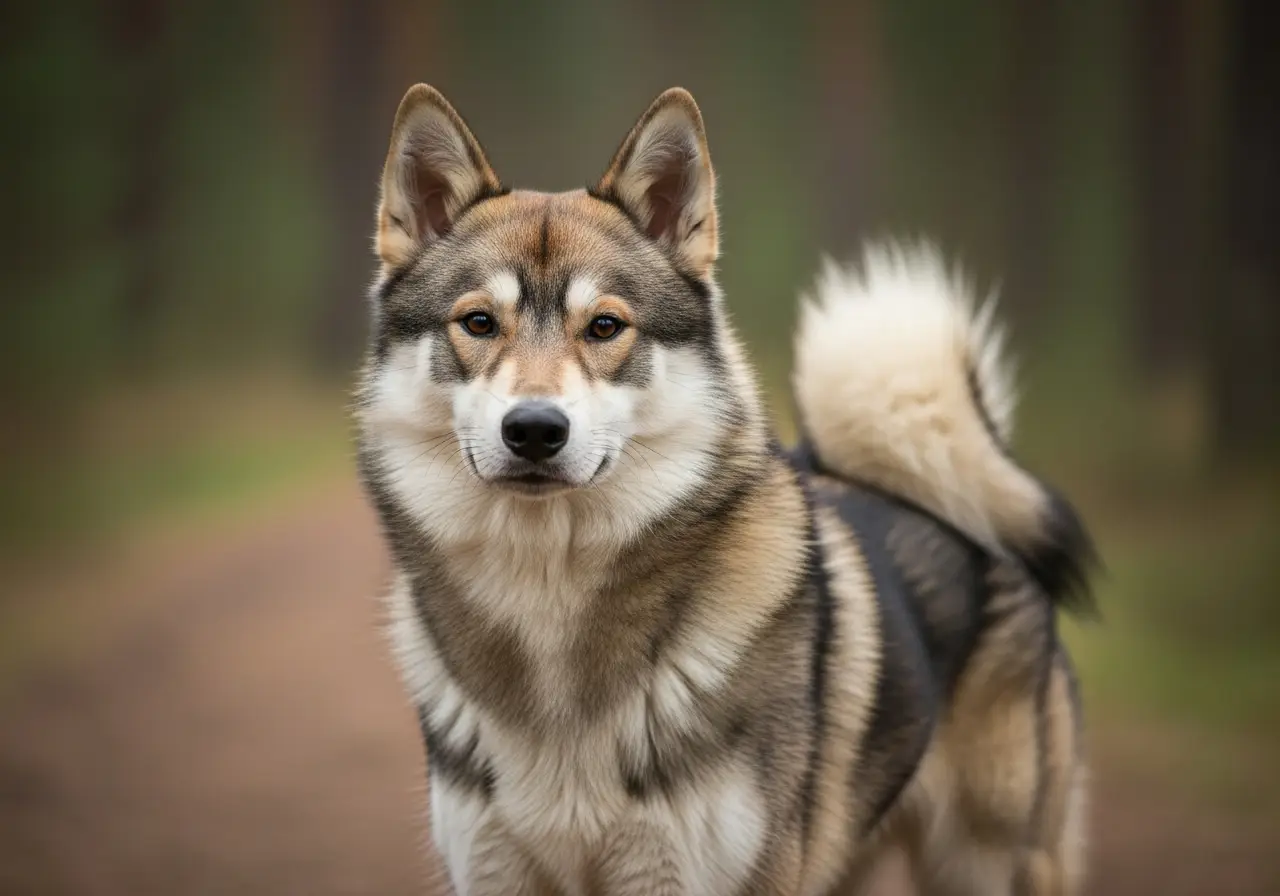
West Siberian Laika: North Asian hunting spitz from the Ural region, enduring, independent and closely tied to hunting work
03Profile
Key facts and suitability
- Origin
- Russland
- Original purpose
- Hunting large game
- FCI
- No. 306 · Group 5 · Section 2
- height at the withers
- 52–60 cm
- Weight
- 16–22 kg
- Life expectancy
- 12–14 Years
- Coat type
- Doppel
- Minimum exercise
- 120 min/day
- Puppy price
- 800–1'500 CHF
- Waiting period
- 4 months
- Sports
- Scent work Mantrailing
04Temperament
How the West Siberian Laika shows up in everyday life
The morning walk reveals what separates the West Siberian Laika from many other breeds: its gaze does not go to you, it goes into the landscape. It registers every change in wind, every scent trail, every rustling in the undergrowth before you notice it. This is not disobedience. This is the breed at work.
**Internal axis, what the dog needs:** The mental workload requirement is high (value 4 out of 5), the exercise requirement is at maximum (5 out of 5). The dog needs at least 120 minutes of intensive exercise daily, not a walk, but exercise with stimulus and task. Nose work, tracking or hunting-related enrichment are not extras, but basic care. It tolerates being left alone for up to about four hours, provided the stimulation requirement has been met beforehand. Anyone who chronically under-stimulates it will get a dog that organises its own entertainment, rarely to the household’s advantage.
**External axis, how the dog reacts:** The West Siberian Laika meets strangers with reserve (value 2 out of 5). It is not a dog that runs joyfully towards visitors. This reserve is not a sign of fear or poor socialisation; it is breed character. Anyone who interprets this as a guarding instinct and encourages it accordingly creates a behavioural problem. With known people and its primary group, it shows attachment but remains independent in its actions.
**Important:** Need for social contact (value 3) and reserve towards strangers (value 2) must not be equated. The dog needs closeness to its primary caregiver and suffers from social isolation, but it is not an openly sociable dog that seeks every contact. Anyone who confuses these two poles will be surprised by its reserve towards visitors.
It usually shows tolerance towards conspecifics but can appear self-confident. Small animals in the household are a permanent management issue due to the pronounced prey drive.
05Needs
What this breed needs daily
The West Siberian Laika needs at least 120 minutes of intensive exercise daily, in a form that involves its hunting instinct and nose work. A city walk on a lead does not cover this requirement. Suitable forms of exercise include: tracking, mantrailing, blood trailing, accompanying hunting or extended off-lead runs in secure, extensive terrain.
Mental stimulation is equal in importance to physical exercise. The mental workload requirement is 4 out of 5. Nose games, search tasks and structured training sessions with clear objectives are necessary daily. Pure physical exhaustion without cognitive challenge leads to frustration in the medium term.
Terrain and environment: A rural environment with access to forest and open spaces is almost a prerequisite. A secure property with sufficient space significantly reduces management risk. Pure apartment keeping without structured stimulation is not compatible with this breed.
Social structure: The dog needs a clear, consistent primary caregiver with experience in handling independently working dogs. It questions inconsistent leadership and actively tests boundaries. Training sessions must be short, clear and engaging; long repetition sequences lose its attention.
Being left alone: Up to four hours are possible if the dog has been sufficiently stimulated beforehand. Longer absences without preparation and gradual training lead to stress behaviour. Dog sitting or a second dog can bridge the time alone but does not replace the daily stimulation by the primary caregiver.
Exercise
Very high
mental work
A lot
Social needs
Medium
training
Demanding
06Sport & Mental and Physical Stimulation
What sports the West Siberian Laika is suited for
Realistic in terms of physiology and genetics – not every breed suits every sport.
Structurally and physiologically suitable: Suitable for mantrailing, dummy work and tracking · CaniCross / bikejoring possible.
07Quick Check
08Suitability
Who this breed is suitable for – and who it isn't
✓Matches
The West Siberian Laika suits owners who bring a hunting-oriented daily routine or are prepared to create a structured alternative for it. Specifically: hunters or foresters with regular access to terrain, active people in a rural environment with at least two hours of daily activity time, owners with experience in working with Nordic hunting dogs or independently working breeds.
A secure property with sufficient open space is advisable. Those who actively engage in nose work, tracking, or blood trailing provide this breed with a meaningful structure for activity.
Families with children from around ten years of age are possible if the need for movement and stimulation is fully met by the adult owners and the children are experienced in dealing with reserved, independent dogs. Multi-dog households with compatible, similarly active dogs work well, provided the social structure is stable.
Essential: experience with hunting-motivated dogs, willingness for consistent recall training and long-term prey drive management, as well as a living environment that enables daily stimulation in suitable terrain.
×Doesn't match
The West Siberian Laika is not suitable for first-time dog owners, regardless of how active their lifestyle is. The combination of pronounced prey drive, independence, and reserve towards strangers requires experience that cannot be replaced by motivation.
Those who are away from home for eight hours a day and cannot organise reliable dog care will structurally overwhelm this breed. Those living in an apartment without a garden and reducing stimulation to evening walks do not meet the need for movement and mental work.
A common misunderstanding: those who equate reserve towards strangers (external axis, value 2) with low need for social contact (internal axis, value 3) will find that the dog does not tolerate social isolation; it is simply not openly sociable. Those looking for a friendly, easy-going everyday companion are choosing the wrong breed.
Households with small animals such as cats, rabbits or birds are not suitable without long-term, professionally supported management. The prey drive is genetically anchored and cannot be reliably controlled by habituation alone. Those who underestimate these restrictions endanger the animal and overwhelm the dog.
10Line reality
Show line, working line, breeder market
The West Siberian Laika is bred primarily as a working dog in Russia and the Scandinavian countries. The working line takes precedence: hunting performance, scent fidelity, barking behaviour and endurance are the primary selection criteria. The FCI standard requires a working test, indicating that exterior without function does not represent a complete breeding goal.
In the DACH region, the breeding base is very narrow. Most dogs come from Russian or Scandinavian working lines with documented hunting performance. Show-oriented lines without working tests exist but play a marginal role in the German-speaking area.
Anyone acquiring a puppy from a working line receives a dog with pronounced prey drive, high endurance and strong environmental orientation. These traits are the breeding goal, not a random product. Anyone who cannot actively manage these traits should not choose this breed.
Relevant line differentiation in the sense of show vs field lines, as seen with some Western European hunting dog breeds, is hardly documented for the West Siberian Laika in the DACH region. Origin from Russian breeders with proof of working tests is considered a quality feature and should be actively enquired about when purchasing.
11Health · Reality
What you need to plan for medically with your West Siberian Laika
The West Siberian Laika is considered a robust breed with a life expectancy of approximately 12 to 14 years. This range is realistic for medium-sized dogs of this weight class and supported by observations from breeding clubs, even though large-scale epidemiological studies for this rare breed are lacking in the DACH region.
Common health risks: Hip dysplasia (HD) occurs in Nordic hunting breeds but is less documented in the West Siberian Laika than in large Retriever breeds. Reputable breeders X-ray parent animals and disclose HD findings. Eye diseases — particularly progressive retinal atrophy (PRA) — are known in the breed; a current eye certificate for the parent animals (not older than 12 months) should be requested when buying a puppy.
Preventive examinations: Annual veterinary check-up, dental status (the FCI standard describes a complete scissor bite with 42 teeth; deviations should be documented), eye examination if abnormalities are noted, hip X-ray at the age of 12–18 months in case of signs of lameness.
Overweight: The risk is low for this breed with sufficient stimulation. If the need for movement is not met, weight increases quickly, with negative consequences for joints and the cardiovascular system. Weight checks every three months are advisable.
Note: For the West Siberian Laika, there are no published HD/ED rates from DACH breeding clubs with a sufficient sample size (as of 2024). Owners should actively request health data from the breeding club.
12Structured data
Health by the numbers
Prone to diseases
Hip dysplasia Eye problems
Recommended health tests
Hip X-ray Eye examination
13Myths ↔ Reality
What is often said incorrectly about this breed
Five myths, five realities, five sources.
“The West Siberian Laika is like a Husky, robust, friendly and also manageable for active city dwellers.
The comparison with the Siberian Husky is misleading. The West Siberian Laika was not selected as a sled dog but as an independently working hunting dog. Its tracking drive, environmental orientation and reaction to foreign stimuli differ fundamentally. An active city dweller without hunting structure and extensive terrain cannot meet the needs of this breed.
“Laikas are natural dogs that cope with everything and do not require intensive training.
The robustness of the West Siberian Laika refers to physical resistance to cold and terrain, not tolerance for training. The breed works independently and actively questions inconsistent leadership. Without clear structure, consistent recall training and prey drive-aware management, behavioural patterns arise that are difficult to correct.
“The pronounced prey drive can be reliably reduced through early socialisation and lots of love.
The prey drive of the West Siberian Laika is genetically anchored and cannot be eliminated through socialisation. Early imprinting and training can improve management but do not replace structural stimulation. Off-leash running without a secure environment remains a permanent risk for this breed, regardless of training effort.
“As a rare breed, the West Siberian Laika is particularly healthy, inbreeding is not an issue.
Small populations outside the country of origin increase the risk of close relative pairings. In the DACH region, the breeding base is very narrow. Reputable breeders work with international partners and document inbreeding coefficients. Anyone buying a puppy should explicitly ask for the COI (Coefficient of Inbreeding).
“The West Siberian Laika is a good guard dog due to its reserve towards strangers.
The FCI standard describes the breed as self-confident and wary of strangers, not as a guard dog. The reserve is a hunting dog trait, not a guarding instinct in the sense of a protection dog breed. Anyone looking for a guard dog should choose a breed selected for that purpose.
14animal welfare
The animal welfare perspective
Breeder market, designer versions, animal shelter reality — what no one writes in the puppy ad.
The West Siberian Laika is an exceptional breed in the DACH region, and precisely this makes it susceptible to specific animal welfare problems that differ from those of popular fashion dogs.
Backyard breeder market: Low demand does not automatically protect the breed from irresponsible breeding. On the contrary: those looking for a West Siberian Laika and unable to find a breeder with club affiliation quickly end up with offers from Eastern Europe lacking health documentation or proof of working tests. These dogs often come from lines that have not been selected for either health or working ability.
Problems related to keeping: The most common animal welfare issue with this breed is under-stimulation. Owners who choose the dog for its looks or rarity regularly underestimate its need for exercise and mental work. A West Siberian Laika that is not sufficiently occupied daily develops stress behaviour: vocalisation (Laikas are known for their endurance in barking and howling), destructive behaviour, attempts to escape. These dogs then end up in animal welfare organisations, not because the breed is problematic, but because the living conditions did not suit the breed.
Animal welfare as an equal option: West Siberian Laikas from animal welfare or rehoming are rare, but available. Organisations specialising in Nordic dogs know the breed and can assess background and behaviour. A dog from a rehoming organisation is not a compromise; it is an informed decision that often saves a dog coming from a situation where it was overtaxed.
Designer versions: Crossbreeds with Laika ancestry are occasionally marketed as "primitive-type dogs" or "wolf dogs". These terms are not quality indicators. Anyone wanting a West Siberian Laika buys a dog with an FCI pedigree and documented origin; anything else is speculative.
15Costs · Transparency
What this breed realistically costs
Getting a dog: A puppy from reputable, club-affiliated breeding with a pedigree, health checks of the parent animals and a vaccination passport costs between 1,200 and 2,000 EUR/CHF in the DACH region. Offers significantly below this, particularly from Eastern Europe without club affiliation, often lack health documentation.
Running costs per year: Food (quality-oriented, adapted to activity level): 600–1,000 EUR/CHF. Grooming (West Siberian Laikas have a dense double coat with seasonal shedding): predominantly own effort, occasional professional care 100–200 EUR/CHF. Basic equipment, accessories, replacements: 200–400 EUR/CHF annually.
Vet: Routine care (vaccinations, parasite prophylaxis, annual check-up): 300–500 EUR/CHF annually. In case of illness or injury, particularly in an active hunting dog used in the field, individual treatments can quickly reach 500–2,000 EUR/CHF.
Insurance: Pet health insurance with surgical coverage costs for this weight class 50–120 EUR/CHF monthly depending on provider and scope of benefits. For an actively kept breed used in the field, such cover is recommended.
Total costs per year (excluding getting a dog): realistically 2,000–4,000 EUR/CHF, depending on health status and activity level.
16Puppy search
What you need to consider when choosing a breeder
- Reputable breeders of West Siberian Laikas in the DACH region are rare.
- The Swiss Club for Nordic Dogs (SKNH) as well as the VDH list affiliated breeders who are subject to the respective breeding regulations.
- A litter without proof of working tests for the parent animals is a warning sign for this breed, as the FCI standard requires a working test.
- Reputable features: litter inspection by the breeding club, health examinations of the parent animals (hips, eyes), documented coefficient of inbreeding (COI), opportunity to view the mother dog in the rearing environment, contract with right of return.
- Warning signs: puppies without pedigree, offers via commercial animal exchanges, breeders without club affiliation, multiple litters available simultaneously, no personal conversation before purchase.
- Adoption through animal welfare organisations is an equally valid option.
- West Siberian Laikas from animal welfare often come from homes that underestimated the breed's needs, which means that history and behaviour must be carefully assessed.
- Experienced support from a dog training school with knowledge of Nordic hunting breeds is particularly advisable in this case.
FAQ
Frequently asked questions about the West Siberian Laika
Is West Siberian Laika a family dog?
West Siberian Laika is considered suitable for families with good socialisation and species-appropriate care.
How much exercise does West Siberian Laika need?
At least around 120 minutes of exercise per day. As an active breed, more so — plus mental stimulation.
What is the size and weight of West Siberian Laika?
Fully grown, West Siberian Laika reaches about 52–60 cm at the withers and weighs around 16–22 kg.
What is the life expectancy of West Siberian Laika?
The life expectancy of West Siberian Laika is approximately 12–14 years.
Which diseases are common in West Siberian Laika?
Hip dysplasia Eye problems
17Breed clubs
Official breed clubs in DACH
19Related
Similar breeds – and their differences
You might also be interested in

Participate
Do you have a good photo of your West Siberian Laika?
We are looking for expressive images for our breed profiles. Submit yours; the editorial team reviews every submission before publication.
Does this breed suit you?
Independent North Russian hunting dog – not suitable for city life