
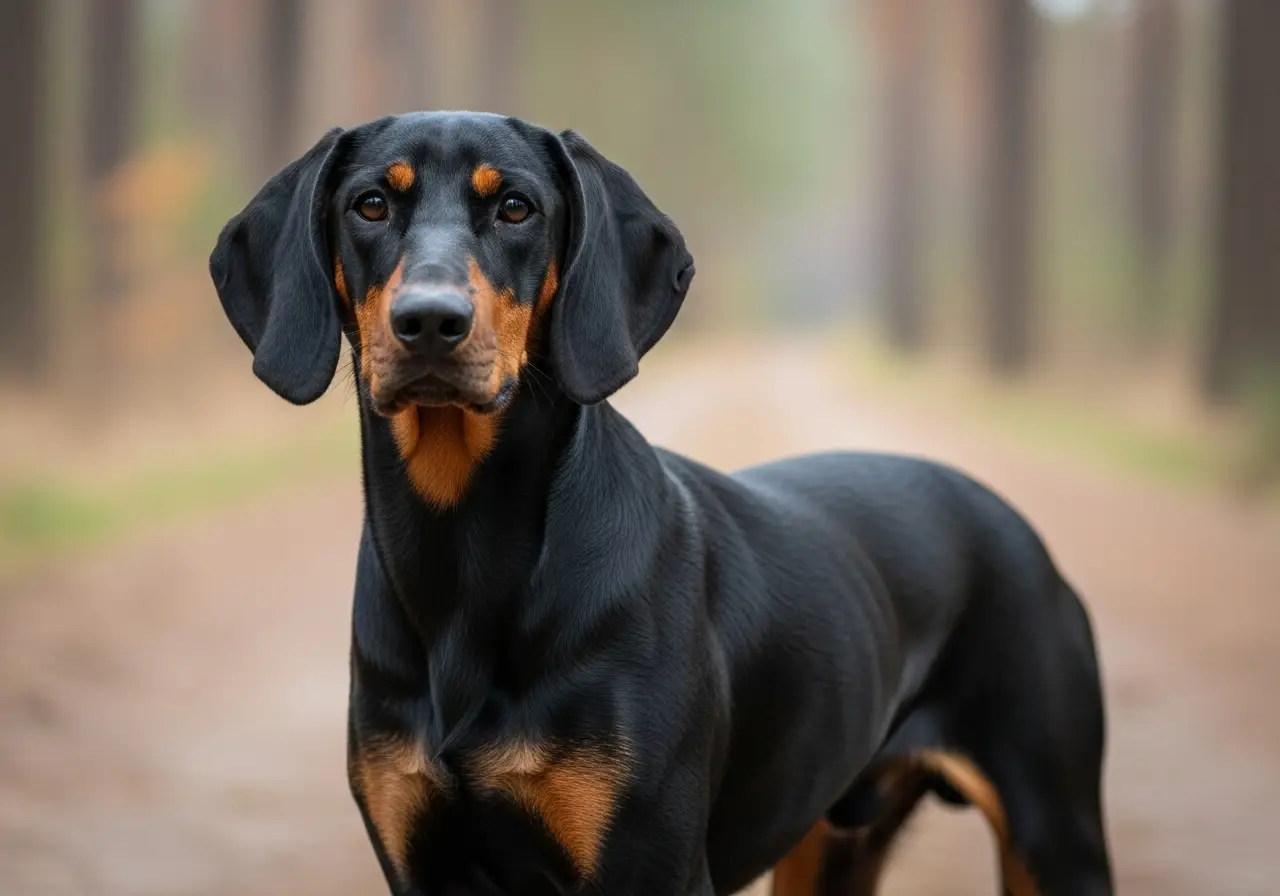
01Summary
In a paragraph
If you only have 30 seconds.
The Slovenský Kopov is a Slovakian hound that has been selected over centuries for a single task: to track wild boar by scent with endurance. This genetic focus shapes every aspect of its daily life. Anyone who keeps it without a hunting context or structured drive management fundamentally underestimates the breed. Experience with high-drive hunting dogs is not a recommendation; it is a prerequisite.
02Introduction
What makes the Slovensky Kopov (Slovak Black Boar Hound) special
Slovensky Kopov: black-tipped Slovakian hound, bred for boar hunting and highly enduring
03Profile
Key facts and suitability
- Origin
- Slowakei
- Original purpose
- Boar hunting
- FCI
- No. 244 · Group 6 · Section 1.2
- height at the withers
- 40–50 cm
- Weight
- 15–20 kg
- Life expectancy
- 12–14 Years
- Coat type
- Short-haired
- Minimum exercise
- 90 min/day
- Puppy price
- 800–1'500 CHF
- Waiting period
- 4 months
- Sports
- Scent work Mantrailing
04Temperament
How the Slovensky Kopov (Slovak Black Boar Hound) shows up in everyday life
Anyone who leaves the house in the morning with a Slovenský Kopov will quickly notice that the nose takes the lead. Even on the way to the meadow, the dog follows every scent trail—roe deer, wild boar, fox. This is not disobedience, but a genetically anchored work programme.
Internally (i.e., in terms of what the dog needs from itself), nose work takes first place. The need for mental stimulation is high: without scent-based activity, mantrailing, tracking work or hunting use, a dog will emerge that seeks its own enrichment. In practice, this means extensive independent initiative in open terrain, vocalising without any apparent reason for the owner, and behaviour when being left alone that deteriorates rapidly without gradual training. Four hours of being left alone is the realistic upper limit, and only then if the dog has been sufficiently stimulated beforehand.
Externally, i.e., in its reaction to stimuli from the environment, the Slovenský Kopov presents a different picture. It behaves reservedly towards strangers, not intrusively. It does not seek contact with unknown people, but generally tolerates them without escalation. This reserve is not a sign of insufficient socialisation, but is typical for the breed. Anyone expecting a sociable greeting dog is mistaken.
In everyday household life, it is calm if its needs are met. After an extensive tracking session or hunting deployment, it lies down and recovers with endurance. This alternation between high activity and genuine rest is characteristic. The two axes—high internal need and external reserve—must not be confused: a dog with strong family bonds is not automatically open to every visitor.
05Needs
What this breed needs daily
The Slovenský Kopov requires at least 120 minutes of active exercise daily, and this does not mean casual walking. Cross-country runs, tracking work, mantrailing or hunting use are the formats that correspond to its genetic profile. A city walk on a lead does not meet this need.
Nose work is at the centre of mental stimulation. The need for mental stimulation in this breed is high: laying trails, blood tracking, structured scent following—these activities engage the dog on a level that pure physical exercise does not reach. Anyone without a hunting licence can find a structured alternative in organised mantrailing groups or tracking dog clubs, which comes close to the drive profile.
Being left alone requires gradual training. The realistic tolerance limit is around four hours, provided the dog has been sufficiently stimulated beforehand and the training was carried out systematically. Longer absences without preparation lead to stress behaviour.
A rural or at least suburban environment with access to open terrain is not a matter of comfort, but a prerequisite for keeping the dog. Fenced-in areas are advisable, as prey drive in open terrain cannot be reliably interrupted by recall. Managing prey drive (i.e., consciously controlling when and where the dog is allowed to follow its nose) is a daily leadership task, not an occasional measure.
Social connection with the primary caregiver is important to the dog. It is not a kennel dog that tolerates isolation. The need for social contact is moderate to high; it wants to be part of everyday life, not just an object for exercise.
Exercise
High
mental work
A lot
Social needs
Medium
training
Demanding
06Sport & Mental and Physical Stimulation
What sports the Slovensky Kopov (Slovak Black Boar Hound) is suited for
Realistic in terms of physiology and genetics – not every breed suits every sport.
Structurally and physiologically suitable: Suitable for mantrailing, dummy work and tracking · CaniCross / bikejoring possible.
07Quick Check
08Suitability
Who this breed is suitable for – and who it isn't
✓Matches
The Slovenský Kopov suits owners who actively hunt and are looking for an independently working hound for wild boar hunting. Anyone who works regularly in the hunting ground and can enable hunting deployments for the dog creates the basis for functional ownership.
The breed is also suitable for very experienced dog owners without a hunting licence, provided that structured nose work (mantrailing, tracking, blood tracking) is offered daily, a rural environment with open terrain is available, and the owner brings experience in handling dogs with strong drives and independent thinking.
Specifically: anyone who spends at least two hours actively with the dog in the terrain daily, has a fenced exercise area available, understands drive management as a permanent leadership task, and does not expect the dog to be reliably recallable in open terrain, can build a resilient bond with this breed.
Families with older children (from 12 years) are possible if the adults take main responsibility for stimulation and leadership. The external reserve towards strangers must be actively considered in everyday family life when visitors are present.
×Doesn't match
The Slovenský Kopov does not suit owners who are looking for an approachable, socially open companion dog. Anyone who expects the dog to greet strangers warmly or interact without problems with unknown dogs in a dog park will be surprised by the breed-typical reserve.
The breed is unsuitable for first-time owners without prior experience with high-drive hunting dogs. The combination of a high need for exercise, a pronounced prey drive, and independent decision-making behaviour on the trail overwhelms owners who wish to base their leadership primarily on recall and praise.
Anyone who is away from home for more than four hours a day and does not have a reliable dog care plan should not choose this breed. The ability to be left alone can be improved, but it is not infinitely resilient.
Urban keeping (city apartment without a garden, without access to open land, with primarily paved walking paths) does not meet the minimum requirements of this breed. Anyone who regards the prey drive as an occasional problem that will settle down over time fundamentally underestimates the genetic depth of this trait. Likewise, anyone who equates the internal strength of family bonding with external openness towards strangers will encounter contradictions in everyday life.
10Line reality
Show line, working line, breeder market
The Slovenský Kopov exists practically exclusively in a single line: the working line. A split into show and working types, as has been observed for decades in breeds such as the German Shepherd Dog or the Labrador Retriever, has not occurred in this breed. There is a simple reason for this: The breed is so rare in Western Europe that the breeding pool does not support parallel development.
In Slovakia and the neighbouring Eastern European countries, the Slovenský Kopov is still primarily kept and bred as a working hunting dog today. Performance tests, particularly on wild boar, are an integral part of breeding approval in the countries of origin. This means that anyone who acquires a Slovenský Kopov will, with high probability, obtain a dog from work-oriented breeding, regardless of whether they themselves are engaged in hunting.
In the German-speaking region, the breed is looked after by the Schwarzwildbrackenverein (Slovenský Kopov) e.V. Litter numbers are low, and waiting periods are correspondingly long. Regional line differences within the working line exist; Slovakian breeding lines sometimes place greater emphasis on tracking ability, while Hungarian or Czech lines may vary slightly in body structure and barking characteristics. However, these differences are not so pronounced as to justify separate categorisation.
11Health · Reality
What you need to plan for medically with your Slovensky Kopov (Slovak Black Boar Hound)
The Slovenský Kopov is considered a robust, high-performance breed with a life expectancy of 12 to 14 years. Systematic population-wide health studies are hardly available for this rare breed; this is an information deficit that must be honestly acknowledged when choosing the breed.
Hip dysplasia (HD) is fundamentally relevant in hounds of this size class. Specific HD prevalence rates specifically for the Slovenský Kopov are not published in the scientific literature (as of 2024). Reputable breeders have parent dogs radiologically examined for HD and provide proof of findings; this is a minimum criterion when choosing a breeder.
Ear problems are elevated in a breed-typical manner: The drop ears favour moist conditions in the ear canal, especially after work in dense undergrowth or in wet conditions. Regular ear checks, at least weekly, and prompt veterinary investigation in case of redness, odour, or scratching are mandatory.
Injuries during hunting use (cuts from undergrowth, bruises, bite wounds from wild boar) are a real risk for actively working dogs. A hunting dog supplementary insurance policy that covers work-related injuries is sensible for dogs used in hunting.
Overweight is rarely a problem in sufficiently exercised individuals. However, the risk increases in dogs without adequate exercise and with uncontrolled feeding. Body weight should be checked regularly; visible rib contours under light pressure are the benchmark. Annual preventive examinations by the vet, dental checks, and parasite management (ticks after every field deployment) are standard.
12Structured data
Health by the numbers
Prone to diseases
Hip dysplasia Ear infections
Recommended health tests
Hip X-ray Ear check
13Myths ↔ Reality
What is often said incorrectly about this breed
Five myths, five realities, five sources.
„The Slovenský Kopov is like any other hunting dog; you can manage with enough exercise.”
The Slovenský Kopov was specifically selected for independent boar hunting. Its prey drive cannot be compensated by volume of exercise alone. Without structured drive management and hunting-related stimulation, behavioural problems such as uncontrolled bolting, vocalising and self-occupation at the owner’s expense arise.
„It is a family dog that integrates well into everyday life.”
The Slovenský Kopov bonds with its primary caregiver, but it is not an everyday companion in the classic sense. Its exercise requirement is at least two hours of active stimulation daily; its prey drive demands consistent management in every off-lead context. Families without hunting experience or a clear drive structure will overwhelm themselves and the dog.
„Scenthounds are loud and therefore unsuitable as companion dogs; you cannot train them.”
The Slovenský Kopov is trainable and responds to clear, consistent guidance. Its vocalisation on scent is a genetically anchored working performance, not a training deficit. In everyday life without game stimuli, it is significantly quieter. Crucially, the owner must bring realistic expectations regarding recall reliability off-lead.
„Black boar hounds are aggressive because they were bred for hunting dangerous game.”
Courage towards wild boar is a hunting trait, not aggression towards humans or conspecifics. The Slovenský Kopov shows more reserve than aggression towards strangers. In a hunting context, it works cooperatively with other dogs. Social aggression is not described as breed-typical.
„Because the breed is so rare, you have to wait a long time for a reputable breeder; animal welfare is no option.”
Hunting dogs with pronounced drive are disproportionately often surrendered when keeping requirements have been underestimated. Surrender cases also exist for the Slovenský Kopov, mediated through specialist hunting dog animal welfare organisations. A waiting time with a reputable breeder is no argument against checking rehoming options.
14animal welfare
The animal welfare perspective
Breeder market, designer versions, animal shelter reality — what no one writes in the puppy ad.
The Slovenský Kopov is a pronounced rarity in Germany and Switzerland. This protects the breed from the mass market, but it does not mean that animal welfare aspects are irrelevant.
Backyard breeders and unreliable offers
Especially with rare breeds, offers arise that advertise the rarity without disclosing breeding conditions. Anyone who offers a Slovenský Kopov via classifieds platforms without club membership, without proof of health examinations of the parent dogs, and without the possibility to inspect the rearing conditions is not acting in the interest of the breed. The Schwarzwildbrackenverein (Slovenský Kopov) e.V. is the first point of contact for finding reputable breeders in the German-speaking region.
Surrenders due to underestimated keeping requirements
Hunting dogs with a pronounced drive profile are disproportionately often surrendered when the reality of keeping does not match expectations. With the Slovenský Kopov, the pattern is known: The dog is assessed as a "robust, uncomplicated companion" and turns out to be a dog that, without hunting-related stimulation or structured drive management, actively shapes everyday life in a way that overwhelms owners without prior experience.
Rehoming as an equally valid option
Specialised hunting dog animal welfare organisations and breed club internal surrender lists occasionally rehome adult Slovenský Kopov. An adult dog has the advantage that drive intensity and character can already be assessed, an aspect that is harder to predict in puppies of this breed. Choosing a dog from rehoming is not a compromise solution, but an informed alternative.
Breeding-related issues
Vanity breeding traits are not typical of the Slovenský Kopov. The breed benefits from its appearance remaining functional, with no extreme anatomical features having been selected for. The main risk lies not in breeding itself, but in keeping: a dog bred for endurance work in the forest that does not receive this level of stimulation suffers from chronic stress due to under-stimulation, an animal welfare issue that cannot be resolved by good intentions alone.
15Costs · Transparency
What this breed realistically costs
A puppy from a reputable breeder typically costs between 800 and 1,500 EUR in the German-speaking region. Offers significantly below this without club membership and health certificates are a warning sign. Due to the small litter sizes, there is no established market price as with more common breeds.
The annual living costs for a medium-sized, active dog of this class realistically lie between 1,800 and 3,000 EUR. This includes: high-quality food (approx. 600–900 EUR/year), basic grooming, tick protection and parasite management (approx. 150–250 EUR/year) as well as basic equipment.
Veterinary costs for routine care (annual vaccination, preventive examination, dental check) average 200–400 EUR/year. In addition come unplanned treatment costs: ear problems, injuries during field work or orthopaedic assessments can result in individual bills of 300–1,500 EUR.
Dog health insurance or surgery cost insurance is recommended. Monthly premiums range between 30 and 80 EUR depending on the provider and scope of cover. For dogs used in hunting, additional liability insurance for hunting and injury coverage during deployment is advisable; costs vary depending on the association and scope of cover.
16Puppy search
What you need to consider when choosing a breeder
- Reputable breeders of the Slovenský Kopov are rare in the German-speaking region.
- The Schwarzwildbrackenverein (Slovenský Kopov) e.V.
- maintains a breeder list and is the recommended first point of contact.
- The SKG (Swiss Kynological Society) can also assist in finding recognised breeders.
- The following criteria characterise reputable breeding: The parent dogs have been radiologically examined for hip dysplasia (HD), and the findings are documented in writing.
- The breeder allows an inspection of the rearing conditions before handover.
- The puppy leaves the litter no earlier than eight weeks of age, is microchipped, vaccinated, and dewormed.
- The breeder asks questions about the planned keeping and answers their own questions about the breed substantively.
- Caution is advised with offers lacking club membership, without health certificates, and with immediate availability without a waiting period.
- Classifieds platforms are not a suitable starting point for searching for this breed.
- The rehoming of adult dogs through breed club internal surrender lists or specialised hunting dog animal welfare organisations is an equally valid option, particularly for owners who prefer a drive profile that can already be assessed.
FAQ
Frequently asked questions about the Slovensky Kopov (Slovak Black Boar Hound)
Is Slovensky Kopov (Slovak Black Boar Hound) a family dog?
Slovensky Kopov (Slovak Black Boar Hound) is considered suitable for families with good socialisation and species-appropriate care.
How much exercise does Slovensky Kopov (Slovak Black Boar Hound) need?
At least around 90 minutes of exercise per day. As an active breed, more so — plus mental stimulation.
Does Slovensky Kopov (Slovak Black Boar Hound) suit an apartment?
With enough exercise and enrichment, Slovensky Kopov (Slovak Black Boar Hound) can also be kept in an apartment.
What is the size and weight of Slovensky Kopov (Slovak Black Boar Hound)?
Fully grown, Slovensky Kopov (Slovak Black Boar Hound) reaches about 40–50 cm at the withers and weighs around 15–20 kg.
What is the life expectancy of Slovensky Kopov (Slovak Black Boar Hound)?
The life expectancy of Slovensky Kopov (Slovak Black Boar Hound) is approximately 12–14 years.
Which diseases are common in Slovensky Kopov (Slovak Black Boar Hound)?
Hip dysplasia Ear infections
17Breed clubs
Official breed clubs in DACH
19Related
Similar breeds – and their differences
You might also be interested in
Participate
Do you have a good photo of your Slovensky Kopov (Slovak Black Boar Hound)?
We are looking for expressive images for our breed profiles. Submit yours; the editorial team reviews every submission before publication.
Does this breed suit you?
Rare outside Slovakia – robust hunting dog for experienced owners