
01Summary
In a paragraph
If you only have 30 seconds.
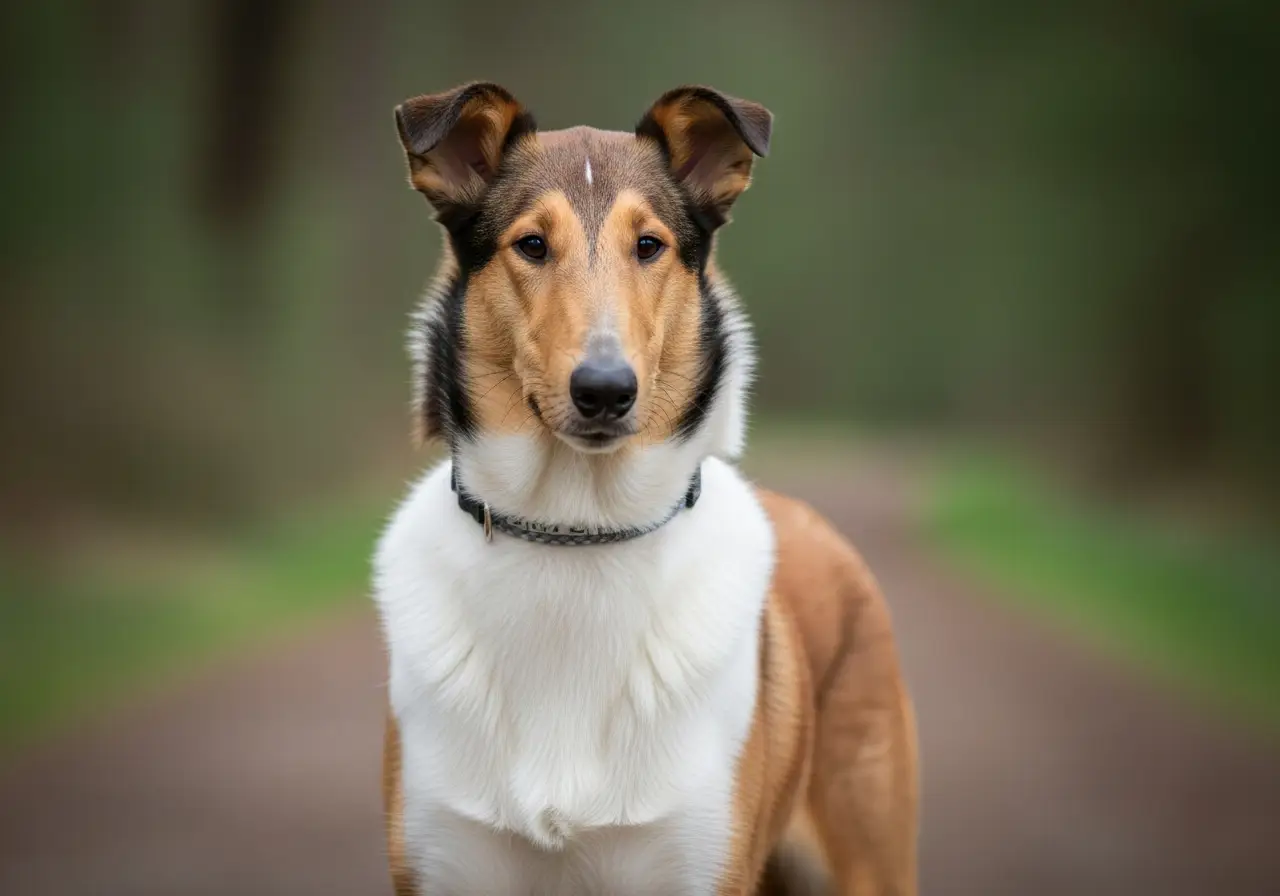
The short-haired collie is the short-haired variety of the Scottish Collie, outwardly simpler than its long-haired relative, but character-wise just as demanding. A herding dog with fine perception of stimuli, strong attachment orientation and a genuine need for mental work. Anyone who reduces it to a low-maintenance family member underestimates it. Anyone who understands its sensitivity as a strength gains an exceptional partner.
02Introduction
What makes the Smooth Collie special
The Smooth Collie is the low-maintenance variant of the Scottish Collie, FCI Group 1, friendly and family-friendly, withers height 51–61 cm.
03Profile
Key facts and suitability
- Origin
- Grossbritannien
- Original purpose
- Sheep herding in Scotland
- FCI
- No. 296 · Group 1 · Section 1
- height at the withers
- 51–61 cm
- Weight
- 18–34 kg
- Life expectancy
- 12–14 Years
- Coat type
- Short-haired
- Minimum exercise
- 60 min/day
- Puppy price
- 1'200–2'000 CHF
- Waiting period
- 9 months
- Sports
- Agility · Obedience · Herding work · Therapy dog
04Temperament
How the Smooth Collie shows up in everyday life
When you come home, the short-haired Collie does not wait barking loudly at the door; it observes you. It registers whether you are stressed, whether your step sounds different than usual, whether you go straight into the kitchen or pause briefly. This fine perception of stimuli is no coincidence, but genetic heritage from centuries of herding work.
**Internal axis, what the dog needs:** The need for social contact is high. The short-haired Collie orients itself strongly towards its primary caregiver and requires active involvement in everyday life, not just physical closeness, but shared tasks. Trick training, nose work or structured search games are not extras, but basic care. Anyone who offers it 15 to 20 minutes of targeted mental work daily will experience a balanced dog. Anyone who omits this will experience a dog that occupies itself, usually in a way that pleases no one.
**External axis, how the dog reacts:** The short-haired Collie shows moderate reserve towards strangers. It is not a dog that greets every visitor immediately. This has nothing to do with strangeness in the sense of aggression; it is herding dog reserve. With regular, calm contact, it builds trust. Children who act loudly and unpredictably can activate its herding instinct: circling, nudging or barking are then not malice, but herding behaviour without sheep.
These two axes must not be confused: A high need for social contact with the family does not mean that the dog is open to everyone. Anyone who misunderstands this will socialise it incorrectly, or interpret its reserve as a fault.
05Needs
What this breed needs daily
The short-haired Collie requires 60 to 90 minutes of active exercise daily. It is not just the distance that counts, but the quality: free running with search tasks, fetch training or controlled herding exercises demand more from it than a uniform walk on a lead.
Forms of exercise: Endurance activities such as jogging, cycling or hiking suit its fitness level well. Agility and obedience offer a meaningful combination of physical activity and mental work. Plain dog parks without structure are not sufficient; the dog needs a task, not just space.
Mental and physical stimulation: The need for mental work is high (CCT value 4/5). Daily 15 to 20 minutes of targeted training (nose work, trick training, search games or impulse control exercises) are not an addition, but a mandatory component. A Smooth Collie that is physically exercised but mentally under-stimulated develops stereotypies or excessive vigilance.
Being left alone: Being left alone for up to four hours is realistic with gradual training. The dog needs a clear routine and a quiet retreat. Abrupt changes in the daily schedule are perceived more strongly by many individuals of this breed than by other dogs.
Need for social contact: Inclusion in family life is not optional for this dog. It needs participation, not in the sense of constant attention, but in the sense of presence and shared activity. Isolation or permanent relegation to the garden contradicts its basic need.
Exercise
Medium
mental work
A lot
Social needs
High
training
Easy
06Sport & Mental and Physical Stimulation
What sports the Smooth Collie is suited for
Realistic in terms of physiology and genetics – not every breed suits every sport.
Structurally and physiologically suitable: Suitable for herding work, treibball and coursing · CaniCross / bikejoring possible.
07Quick Check
08Suitability
Who this breed is suitable for – and who it isn't
✓Matches
The short-haired collie suits owners who want to be actively involved in their dog's daily life, not as observers, but as partners. Specific profiles:
Active individuals or couples with at least 90 minutes of activity time daily, an interest in dog sports (agility, obedience, nose work) and a willingness to devote 15 to 20 minutes to training every day.
Families with children from about 8 years of age, where a calm, structured tone of interaction is maintained. Children who have learned to read the dog's body language get along well with this dog.
Experienced owners with prior experience of sensitive breeds, or first-time owners who plan to attend a dog training school using positive reinforcement from the start and commit to consistent, calm guidance.
Owners in rural or suburban environments with access to off-lead areas. Keeping the dog in a city is possible, but requires above-average organisational effort.
Those who understand the internal axis (high need for social contact, high need for mental work) and the external axis (moderate reserve towards strangers, remnants of herding instinct) and consciously integrate both into daily life will find an exceptionally cooperative dog in the short-haired collie.
×Doesn't match
The short-haired collie does not suit owners looking for a dog that occupies itself or manages with little attention. Specific counter-profiles:
Owners who are absent for more than 6 hours daily without reliable dog care. The need for social contact of this breed is high; prolonged periods of being left alone lead to stress behaviour.
Households with very young children under 5 years of age, where loud, unpredictable movements characterise daily life. The herding instinct can trigger undesirable behaviour in such situations.
Owners who interpret reserve towards strangers as a fault and want to make the dog "more open" through coercion or overstimulation. The result is not a more sociable dog, but an insecure one.
Owners who equate "cooperative" with "undemanding". The short-haired collie likes to work together, but it needs clear, calm guidance and daily structure for this. Anyone who mistakes willingness to cooperate for self-sufficient traits will be surprised by this dog.
Very hectic households with changing key persons, irregular daily routines and high noise levels. The short-haired collie's fine perception of stimuli makes it permanently stressed in such environments.
10Line reality
Show line, working line, breeder market
The short-haired Collie is bred predominantly from show lines in Germany and Switzerland. Pure working lines, as are clearly distinguishable in Border Collies or Australian Shepherds, hardly still exist in an organised form for the short-haired Collie.
Show line: The majority of short-haired Collie breeders registered in DACH orient themselves towards FCI Standard No. 296 with a focus on exterior and temperament assessment. These dogs generally show a balanced character with a moderate herding instinct. The drive to work is present, but rarely as intensely pronounced as in specialised working dogs.
Residual traits typical of working type: Short-haired Collies from show lines also show relics of the herding instinct: circling, fixating on movement stimuli, barking in uncontrolled situations. These behaviours are not faults, but an expression of genetic heritage; they require channelled enrichment.
Import and international differences: Dogs imported from Great Britain and Scandinavia can be more work-oriented. Anyone acquiring a puppy from such lines should specifically ask the breeder about the working drive of the parent animals.
A clear show/field separation as seen in Labradors or Golden Retrievers does not exist for the short-haired Collie in DACH. The line difference is subtler, but present, and a conversation with the breeder about the temperament of the parent animals remains indispensable.
11Health · Reality
What you need to plan for medically with your Smooth Collie
The short-haired collie is considered a robust breed with a life expectancy of 12 to 14 years. Nevertheless, there are breed-specific health risks that should be known before purchase.
MDR1 gene defect: The Multidrug Resistance 1 defect affects a significant proportion of the population in Collies and related breeds. Studies from the University of Veterinary Medicine Hannover show that up to 40% of animals in untested Collie populations can be heterozygous or homozygous affected (TiHo Hannover, status 2022). Affected dogs react with severe neurological symptoms to active ingredients such as ivermectin, loperamide, or certain chemotherapeutic agents. An MDR1 test before administering medication is mandatory.
Collie Eye Anomaly (CEA): This hereditary eye malformation occurs in the Smooth Collie with an estimated frequency of 70–90% in non-selected populations (Source: ECVO data, cited in VDH breeding regulations). Reputable breeding includes ECVO eye examinations of both parent animals. Mild forms (choroidal hypoplasia) often hardly impair vision; severe forms can lead to blindness.
Hip dysplasia (HD): HD screening is standard among reputable breeders. Exact prevalence rates for the Smooth Collie are not available across the board in DACH literature; the VDH recommends radiological HD examination of both parent animals.
Preventive care: Annual eye checks by an ophthalmologist, MDR1 testing before initial treatment, and weight control (overweight puts strain on joints) are the three most important preventive measures.
12Structured data
Health by the numbers
Prone to diseases
MDR1 mutation, Collie Eye Anomaly, epilepsy, hip dysplasia
Recommended health tests
DNA test for MDR1 and CEA, hip X-rays, eye examination
13Myths ↔ Reality
What is often said incorrectly about this breed
Five myths, five realities, five sources.
„The short-haired Collie is simply the long-haired Collie without long fur, identical in character.
Both varieties share the same FCI standard, yet show breeding differences in practice. The short-haired Collie was used for longer in working contexts and is considered by many breeders to be somewhat more sober in expression. Character differences are individual and line-dependent; a blanket equation is too simplistic.
„The short-haired Collie is easy to care for because it has no long fur.
The short, dense double coat of the short-haired Collie changes intensively twice a year. Daily brushing is necessary during the moult. The grooming effort for the coat is less than that of the long-haired Collie, but by no means negligible. The actual effort lies not in the coat anyway, but in daily mental stimulation.
„Collies are calm, undemanding family dogs.
The short-haired Collie is a herding dog with a need for mental work of 4 out of 5 points (CCT axis rundum.dog). Without structured mental stimulation, many dogs of this breed develop displacement behaviours: excessive barking, circling or fixating on movement stimuli. A calm nature in everyday life presupposes that the dog is sufficiently stimulated, not that it requires little.
„The MDR1 defect is a rare marginal problem.
The MDR1 gene defect (Multidrug Resistance Gene 1) occurs in Collies and related herding breeds with relevant frequency. Affected dogs react to certain medications (including ivermectin, loperamide) with severe neurological symptoms. An MDR1 test should be available before any drug treatment. Reputable breeders test both parent animals.
„Collies are suitable for beginners because they are so cooperative.
The short-haired Collie learns quickly and likes to work, but this presupposes that the owner provides clear, calm and consistent communication. Harsh, inconsistent or overly loud handling generates withdrawal, fear reactions or avoidance behaviour in this sensitive breed. Without prior experience with sensitive dogs, a dog training school using positive reinforcement is not an option, but a basic requirement.
14animal welfare
The animal welfare perspective
Breeder market, designer versions, animal shelter reality — what no one writes in the puppy ad.
The Smooth Collie appears less frequently in animal welfare than many other breeds, but it does appear. The most common reasons for surrendering are not aggression or illness, but underestimated sensitivity and unmet mental stimulation needs. Owners who expected a calm, low-maintenance companion dog reach their limits when the dog starts to occupy itself.
Backyard breeder market: The Smooth Collie is not a high-priced trend breed, but it is also not immune to irresponsible breeding. On classified ad platforms, puppies are occasionally offered without health tests, without pedigree, and without litter viewing, often significantly below the market price of reputable breeders. Missing MDR1 and CEA tests in the parent animals pose the greatest risk: The follow-up costs of an undetected drug intolerance or a progressive eye disease far exceed the savings on the purchase price.
Designer versions: Crossbreeds with the Smooth Collie as the base breed exist in isolated cases, but are not an established trend. More relevant is confusion with the Rough Collie: Anyone specifically looking for a Smooth Collie should know the FCI standard and ask breeders who explicitly breed this variety.
Breeding- and keeping-related problems: Overweight is an underestimated risk in the Smooth Collie; the breed loves movement, but is prone to weight gain under mental under-stimulation and free access to food. Adiposity puts strain on the joints and exacerbates existing HD problems.
Adoption as an option: Anyone who takes in an adult Smooth Collie from adoption often receives a dog with a known character and completed socialisation. Specialised foster homes for British herding dogs accompany the placement professionally. This is not a stopgap solution; it is an informed decision.
15Costs · Transparency
What this breed realistically costs
Getting a dog: A puppy from reputable VDH breeding with health tests (MDR1, CEA, HD) costs between 1,200 and 1,800 EUR in the DACH region. Offers significantly below this, especially without documentation of the parent animals, signal missing selection. Imported puppies from Great Britain or Scandinavia can be higher.
Running costs per year: Food (quality dry food or BARF) for a medium-sized Smooth Collie is 600 to 1,000 EUR annually, depending on weight and food quality. Grooming (brushing, occasional professional trimming) is cheaper compared to the Rough Collie, approx. 100 to 200 EUR/year.
Vet: Routine costs (vaccinations, parasite prevention, annual check-up) are 300 to 500 EUR/year. In addition come the initial MDR1 test (approx. 60–80 EUR one-off) and ECVO eye examination (approx. 80–120 EUR, recommended every 1–2 years). In case of illness, surgery costs of 2,000 to 5,000 EUR are realistic.
Insurance: Pet health insurance for this breed costs 40 to 90 EUR/month depending on provider and coverage. A surgery cost insurance is cheaper (approx. 20–40 EUR/month) and covers the largest individual risks.
Overall picture: The annual total costs are realistically 2,000 to 3,500 EUR, excluding unforeseen vet costs.
16Puppy search
What you need to consider when choosing a breeder
- A reputable short-haired collie breeder is a member of a recognised breed club (e.g.
- Club für Britische Hütehunde e.V.) and breeds under VDH/SKG/ÖKV licence.
- The following criteria help with assessment: **Health tests:** Both parent animals should be tested for the MDR1 gene defect, Collie Eye Anomaly (CEA) and hip dysplasia (HD).
- Results are provided in writing.
- Anyone who does not present these tests is breeding without basic standards.
- **Litter viewing on site:** A reputable breeder allows a visit to the litter, with the mother, in a home environment.
- Puppies handed over exclusively at car parks or without their mother are a clear warning sign.
- **Waiting time:** Reputable breeders have waiting lists.
- Immediate availability from unknown providers is not an advantage, but an indication of a lack of selection.
- **Adoption as an equally valid option:** Short-haired collies from animal welfare or rehoming organisations are rarer than long-haired collies, but available; they are often given up due to underestimated sensitivity or changed life circumstances of the previous owners.
- Organisations such as TASSO or breed-specific foster homes occasionally rehome individuals of this breed.
- A dog from a rehoming organisation needs a structured settling-in period, but is not an inferior choice.
FAQ
Frequently asked questions about the Smooth Collie
Is Smooth Collie suitable for beginners?
Smooth Collie is considered suitable for first-time dog owners.
Is Smooth Collie a family dog?
Smooth Collie is considered suitable for families with good socialisation and species-appropriate care.
How much exercise does Smooth Collie need?
At least around 60 minutes of exercise per day.
What is the size and weight of Smooth Collie?
Fully grown, Smooth Collie reaches about 51–61 cm at the withers and weighs around 18–34 kg.
What is the life expectancy of Smooth Collie?
The life expectancy of Smooth Collie is approximately 12–14 years.
Which diseases are common in Smooth Collie?
MDR1 mutation, Collie Eye Anomaly, epilepsy, hip dysplasia
17Breed clubs
Official breed clubs in DACH
19Related
Similar breeds – and their differences
You might also be interested in

Participate
Do you have a good photo of your Smooth Collie?
We are looking for expressive images for our breed profiles. Submit yours; the editorial team reviews every submission before publication.
Does this breed suit you?
Rarer smooth-haired variant of the Rough Collie (Lassie). Lower maintenance than the long-haired variant.