
01Summary
In a paragraph
If you only have 30 seconds.
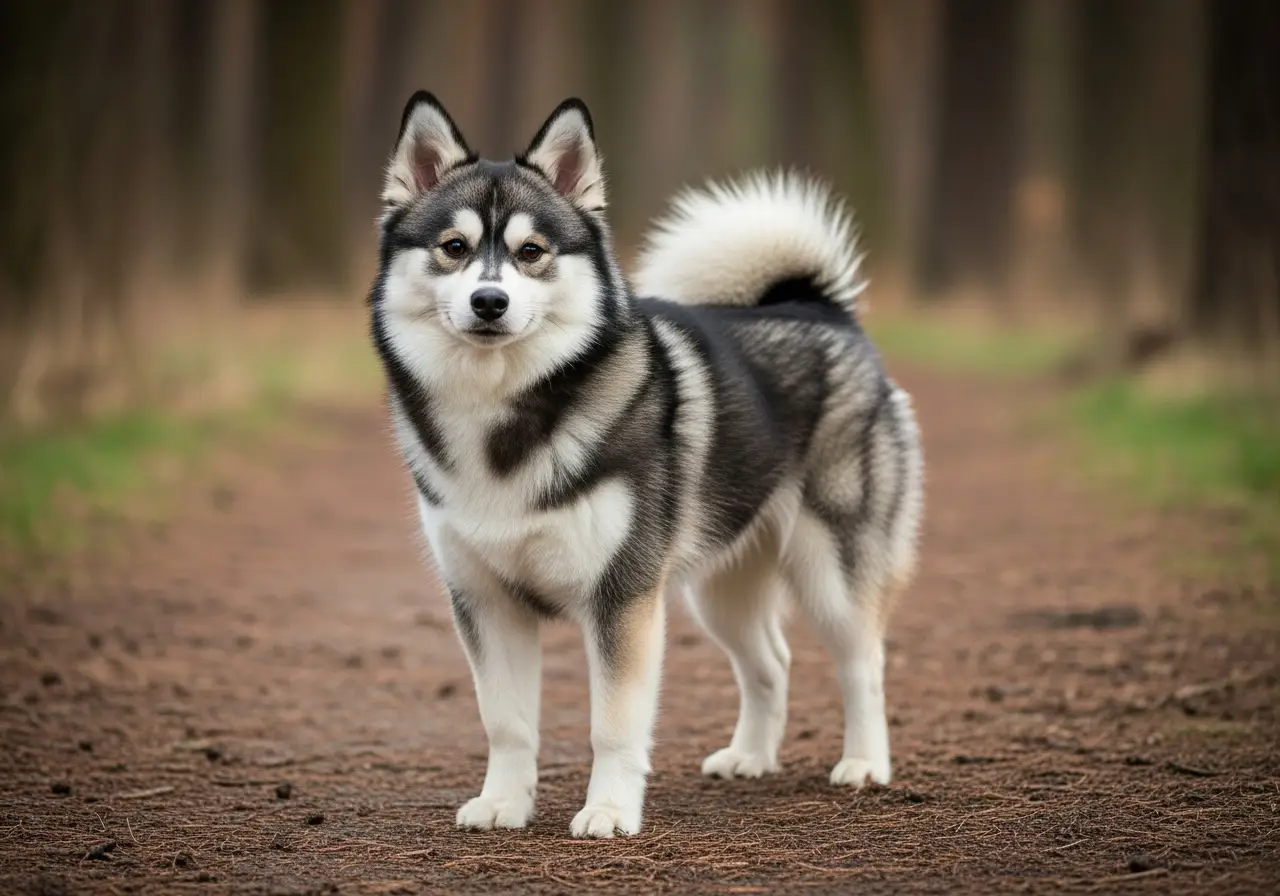
The Pomsky combines two genetically opposing dogs: the enduring, independent Siberian Husky and the watchful, temperamental Zwergspitz. The result varies considerably from litter to litter in size, coat, character and health risk. Those who let themselves be guided by the looks regularly underestimate daily life with this dog. Substance before aesthetics is the only sensible basis for decision-making.
02Introduction
What makes the Pomsky special
Pomsky: designer dog from Husky and Pomeranian, visually appealing but character and health strongly dependent on breeding
03Profile
Key facts and suitability
- Origin
- USA
- Original purpose
- Companion dog
- height at the withers
- 25–38 cm
- Weight
- 7–14 kg
- Life expectancy
- 12–15 Years
- Coat type
- Doppel
- Minimum exercise
- 45 min/day
- Puppy price
- 1'000–2'500 CHF
- Waiting period
- 3 months
- Sports
- Agility Tricks
04Temperament
How the Pomsky shows up in everyday life
The morning run shows which parent a Pomsky has inherited more strongly: an individual with a pronounced Husky component pulls on the lead, fixes birds and switches to its own programme when off-lead. An individual with a stronger Pomeranian component stays closer to the primary caregiver, alerts every jogger with short barks and observes the surroundings attentively.
Internally, what the dog needs: The need for social contact is high. The Pomseek seeks active inclusion in the daily routine, not just physical proximity. Mental work in the form of search games, nose work or structured training is part of every day, not optional. Being left alone for more than three hours is difficult for many Pomskys and should be systematically built up over months, not assumed.
Externally, how the dog reacts to stimuli: The Pomsky often shows reserve towards strangers. This is not a deficiency but an expression of both parent breeds: the Husky is selectively social, the Pomeranian naturally watchful. Anyone expecting visitors to be greeted by a friendly welcome dog must socialise early and consistently, without guaranteeing a specific result.
The prey drive is clearly pronounced in Husky-emphasised animals. A secure area and a reliable recall are not recommendations but prerequisites. In everyday life this means: no unsecured off-lead walking near wildlife crossings, consistent lead training from the start.
05Needs
What this breed needs daily
The Pomsky requires between 60 and 120 minutes of active movement daily; the range depends directly on the genetic contribution of the parent animals. An animal with a strong Husky heritage is more likely to be at 90 to 120 minutes, a Pomeranian-emphasised individual manages with 60 to 90 minutes. Walks alone are not enough: the dog needs activities with changes of direction, scent work and mental demands.
Mental work is not a bonus, but an essential part of the day. Nose work, search games, structured training of everyday commands or trick training for 15 to 20 minutes daily reduce frustration signals such as excessive barking, destructive behaviour or restlessness in the apartment.
The need for social contact is high: The Pomsky requires active involvement in family life. Long periods alone, more than three hours, overwhelm many animals, especially if being left alone has not been trained systematically. A gradual build-up over weeks is necessary before regular absences are possible.
A securely fenced area is not a comfort solution for animals with a pronounced prey drive, but a safety measure. The recall must work reliably under distraction; this requires continuous training, not a one-off exercise.
Grooming takes time two to three times a week depending on the coat type, and daily during moulting. Underestimating this risks matting and skin problems.
Exercise
High
mental work
A lot
Social needs
High
training
Demanding
06Sport & Mental and Physical Stimulation
What sports the Pomsky is suited for
Realistic in terms of physiology and genetics – not every breed suits every sport.
Structurally and physiologically suitable: Suitable for mantrailing, dummy work and tracking.
07Quick Check
08Suitability
Who this breed is suitable for – and who it isn't
✓Matches
The Pomsky suits owners who can plan 90 to 120 minutes of active exercise daily, not as an exception, but as the norm. Professionals with a flexible home office component or part-time model who integrate the dog into their daily routine are better positioned than full-time employees without a care solution.
Families with children from around 8 years of age, who already have experience in dealing with dogs, are suitable, provided that clear rules apply in the household and the children are involved in training. Toddlers and a Pomsky with a pronounced Husky temperament require constant supervision.
Active individuals or couples interested in dog sports, nose work or structured training benefit from the dog's willingness to learn. A securely fenced property or regular access to a secured exercise area is necessary for animals with a strong prey drive.
Those who have already gained experience with Nordic breeds or independent dogs understand the Pomsky more quickly. First-time owners are not fundamentally excluded, but need a supporting dog training school from the start and realistic expectations regarding the training effort.
×Doesn't match
The Pomsky does not suit owners who are away from home for more than six to eight hours daily and cannot organise a reliable care solution. Being left alone for several hours is a considerable burden for many animals of this crossbreed.
Those who expect a calm, low-demand companion dog that is satisfied with short walks will regularly be overwhelmed by a Pomsky, regardless of how small the animal appears. Body size and level of demand do not correlate here.
Owners who expect an open, greeting-friendly dog towards strangers should take the external behavioural axis seriously: reserve towards unknown people is common in this crossbreed, not an exception. Those who perceive this as a problem and do not have time for consistent socialisation are making a poor choice with this breed.
Households without prior experience with independent or Nordic dogs that do not wish to use professional training support tend to underestimate the effort. Those who choose the Pomsky for its looks and consider character secondary risk a surrender situation, to the detriment of the animal.
10Line reality
Show line, working line, breeder market
The Pomsky has no breeding lines in the classical sense; there is no FCI standard, no working line concept and no institutionally anchored differentiation between show and utility dogs.
The relevant distinction runs along the generational designations and the parent animal contribution. An F1 Pomsky (50% Husky, 50% Pomeranian) shows the greatest variation: two puppies from the same litter can differ considerably in size, coat type and temperament. F1b backcrosses, for example with a Pomeranian, tend to produce smaller, more Pomeranian-emphasised animals; backcrosses with the Husky emphasise endurance and prey drive more strongly.
F2 pairings (two F1 parents) promise more predictability but only deliver it if both parent animals have documented health tests and the breeder maintains multi-year breeding documentation.
Reputable providers communicate parent animal weights, coat types and character descriptions transparently. Dubious providers use terms like "Teddy Pomsky", "Mini Pomsky" or "Toy Pomsky" without defined criteria; these designations are marketing-driven and have no breeding basis.
11Health · Reality
What you need to plan for medically with your Pomsky
The Pomsky carries the disease potential of both parent breeds. Eye diseases — particularly Progressive Retinal Atrophy (PRA) and hereditary cataracts — are documented in the Siberian Husky. The CAER database (Canine Eye Registry Foundation) records a PRA prevalence of approx. 3–5% in tested populations for the Husky (as of 2022). Hip dysplasia (HD) occurs in the Husky with approx. 4–6% (OFA database, 2023).
The Zwergspitz shows increased rates of patellar luxation (kneecap dislocation): According to OFA analysis, the prevalence in Spitz breeds is between 8 and 15%. Additionally, tracheal problems (tracheal collapse) and crowding due to the small jaw are typical for the breed.
A Pomsky without documented parent animal health tests carries the risk of both breeds cumulatively. Recommended preventive examinations include: ophthalmological examination (CAER/ECVO) of both parent animals, patella assessment, X-rays for HD/ED and DNA tests for PRA mutations.
Life expectancy is 12 to 15 years, provided that weight and exercise are managed consistently. Overweight significantly increases the risk of patellar and joint issues and occurs in Pomskys that receive too little exercise. Regular weight checks at the vet (at least twice a year) are advisable. Dental care from puppyhood reduces the risk of gum disease, which is common in small breeds.
12Structured data
Health by the numbers
Prone to diseases
Hip dysplasia Eye problems Tracheal problems
Recommended health tests
Hip X-ray Eye examination
13Myths ↔ Reality
What is often said incorrectly about this breed
Five myths, five realities, five sources.
"The Pomsky is a mini-Husky in pocket format, same character, just smaller.
The Pomeranian brings an independent temperament: pronounced alertness, alarm behaviour and a close bond with the primary caregiver. The Husky component adds endurance, prey drive and independence. The result is not a miniaturised Husky, but a dog with two partly opposing behavioural tendencies, whose weighting varies from litter to litter.
"Pomskys stay small, maximum 5 to 6 kilograms.
Without a binding FCI standard, there is no size guarantee. Adult Pomskys reach between 4 and 14 kg depending on the parent animals and generation, occasionally more. Buyers who rely on photos of puppies often experience surprises. Reputable breeders weigh both parent animals and communicate ranges, not fixed values.
"As a crossbreed, the Pomsky is automatically healthier than purebred dogs (heterosis effect).
The heterosis effect applies under controlled conditions for specific traits. In designer crosses without health screening of the parent animals, hereditary diseases from both breeds — in Huskies eye diseases (PRA, cataracts) and hip dysplasia, in Pomeranians patellar luxation and tracheal problems — can occur in the offspring. Without documented parent animal tests, the health advantage is not proven.
"Due to its size, the Pomsky is well suited for apartment living without much effort.
Body size and exercise needs do not correlate in this crossbreed. A Pomsky with a strong Husky component requires 90 to 120 minutes of active stimulation daily plus mental enrichment. Apartment living is possible but requires a consistent daily structure. Underestimated exercise needs are among the most common reasons for surrendering dogs.
"Pomskys are easy to train due to their size.
Both parent breeds are considered intelligent but independent. The Pomeranian tends towards stubbornness and alarm behaviour, the Husky towards selective obedience. A Pomsky actively tests boundaries and requires consistent, calm leadership with clear communication, regardless of its body weight. Small stature often leads to tolerating misbehaviour, which reinforces problems in the long term.
14animal welfare
The animal welfare perspective
Breeder market, designer versions, animal shelter reality — what no one writes in the puppy ad.
The Pomsky market is one of the clearest examples of how a visual trend creates commercial structures before breeding standards exist. Puppy farms in Eastern Europe and private sales via social media channels without any health documentation dominated the supply in the DACH region from around 2016 onwards. Parent dogs are often bred without health screening, litters are given away too early, and buyers are approached with photos of puppies rather than facts about the parent animals.
The result: Pomskys end up in animal shelters and rescue stations disproportionately often, often due to underestimated exercise needs, behavioural problems resulting from a lack of socialisation, or health-related follow-up costs that buyers had not factored in. Animal welfare organisations in Germany and Switzerland have reported a significant increase in surrendered designer dogs of this crossbreed since 2018.
Taking in a Pomsky from an animal shelter or foster home is an equally valid decision. Many of these animals are young, basic socialised and looking for a structured environment. Placement organisations such as BARF-independent animal welfare associations or specialised Husky rescue stations regularly place Pomskys.
Anyone buying a puppy should demand the following minimum criteria: documented CAER/ECVO eye examination of both parent animals, patella assessment, HD X-ray, DNA test for PRA, proof of vaccination and deworming, inspection of the mother at the breeder's premises. Breeders who ship puppies without a personal visit or advertise prices below 800 euros generally do not meet these criteria.
Designer variants such as "Teddy Pomsky" or "Toy Pomsky" are not recognised breeding forms, but marketing terms without a standard. They often signal that body size has been prioritised over health.
15Costs · Transparency
What this breed realistically costs
The acquisition costs from a reputable breeder range between 1,500 and 2,500 euros. Offers below this almost always involve missing health tests; follow-up costs due to hereditary diseases can quickly exceed these savings.
Annual living costs consist of: food 400–700 euros (depending on size and type of food), grooming 200–400 euros (professional trimming recommended two to four times a year), basic vet cost package (vaccinations, parasite prophylaxis, annual check-up) 300–500 euros. In addition, dog training school in the first year: 300–600 euros for the basic course and further training.
For patellar luxation (typical for the breed), surgery costs range between 1,500 and 3,500 euros per joint. Eye surgery for PRA-related complications can cost 1,000–2,500 euros. Dog health insurance with surgical cover costs 40–90 CHF/euros per month for a Pomsky, depending on the provider and scope of benefits, and is recommended for this crossbreed without documented parent animal tests.
Total costs in the first year (including acquisition): realistically 3,500–5,500 euros. From the second year: 1,500–2,500 euros annually without major vet costs.
16Puppy search
What you need to consider when choosing a breeder
- A reputable Pomsky breeder presents health certificates for both parent animals before purchase: CAER/ECVO eye examination, patella assessment and HD X-rays are the minimum standard.
- DNA tests for PRA mutations are recommended.
- Anyone who does not show these documents or evades requests for them is ruled out as a supplier.
- The mother of the litter must be viewable on site.
- Puppies offered via shipping or through intermediaries statistically often come from conditions that do not allow for reputable breeding.
- An age of surrender under eight weeks is legally inadmissible in Germany and Switzerland and a clear warning signal.
- Prices under 800 euros for a Pomsky puppy are not a bargain; they signal missing investments in health tests and rearing.
- Reputable breeders charge between 1,500 and 2,500 euros and maintain waiting lists.
- Adopting a Pomsky from an animal shelter or foster home is an equally valid alternative.
- Specialised Husky rescue stations and general animal welfare associations regularly place animals of this crossbreed.
- Age, background and character are usually better documented there than in spontaneous purchases from the internet.
FAQ
Frequently asked questions about the Pomsky
Is Pomsky suitable for beginners?
Pomsky is considered suitable for first-time dog owners.
Is Pomsky a family dog?
Pomsky is considered suitable for families with good socialisation and species-appropriate care.
How much exercise does Pomsky need?
At least around 45 minutes of exercise per day.
Does Pomsky suit an apartment?
With enough exercise and enrichment, Pomsky can also be kept in an apartment.
What is the size and weight of Pomsky?
Fully grown, Pomsky reaches about 25–38 cm at the withers and weighs around 7–14 kg.
What is the life expectancy of Pomsky?
The life expectancy of Pomsky is approximately 12–15 years.
Which diseases are common in Pomsky?
Hip dysplasia Eye problems Tracheal problems
17Breed clubs
Official breed clubs in DACH
19Related
Similar breeds – and their differences
You might also be interested in
Participate
Do you have a good photo of your Pomsky?
We are looking for expressive images for our breed profiles. Submit yours; the editorial team reviews every submission before publication.
Does this breed suit you?
Crossbreed between Siberian Husky and Pomeranian – size and character highly variable depending on parent animals