
01Summary
In a paragraph
If you only have 30 seconds.
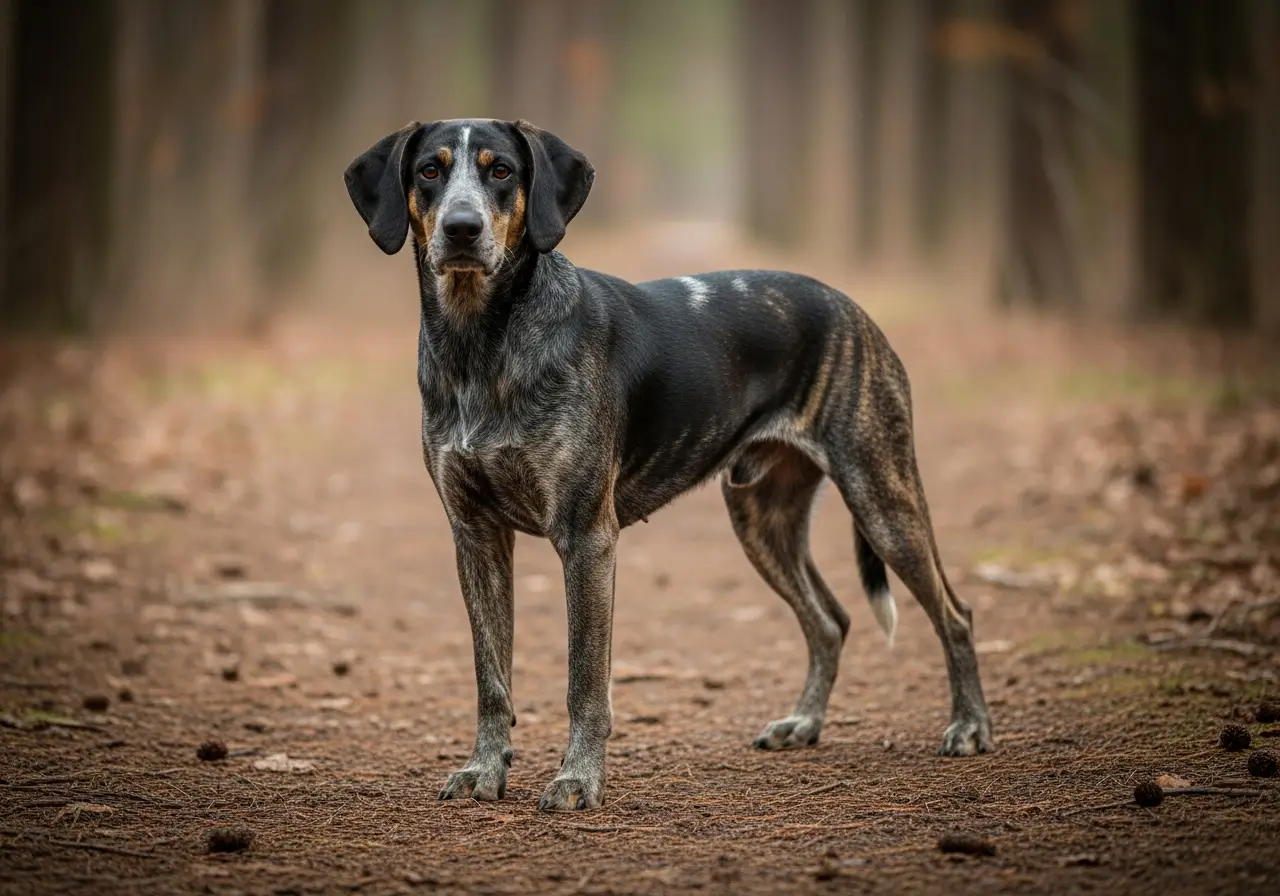
The Plott Hound is a North American hound with German roots, bred for hunting bears and wild boar. Its exercise need is at least 120 minutes daily, its prey drive is deeply rooted in its genetics, and its independent working style demands an owner with genuine understanding of hounds. In Europe, it counts among the rarest breeds overall.
02Introduction
What makes the Plott Hound special
Plott Hound: North American scent hound with German roots, tough and enduring, designed for big game
03Profile
Key facts and suitability
- Origin
- USA
- Original purpose
- Bear hunting Wild boar hunting
- height at the withers
- 51–61 cm
- Weight
- 18–27 kg
- Life expectancy
- 12–14 Years
- Coat type
- Short-haired
- Minimum exercise
- 120 min/day
- Puppy price
- 600–1'200 CHF
- Waiting period
- 3 months
- Sports
- Mantrailing Scent work
04Temperament
How the Plott Hound shows up in everyday life
The morning run shows what makes the Plott Hound unique: As soon as a scent reaches its nose, it switches to work mode. Eye contact with the owner breaks off, the body tenses, and the dog pulls in the direction of the trail. This is not disobedience; this is the behavioural programme for which it was selected over generations.
Internally, the Plott Hound needs at least 120 minutes of intensive exercise daily, supplemented by structured scent work. Mantrailing, tracking or hunting exercises meet its need for mental work. Without this stimulation, it accumulates arousal that discharges in vocalisation, restlessness or destructive behaviour.
Externally, it behaves reservedly to neutrally towards strangers. It does not greet unknown people enthusiastically; it observes first. This is not a sign of aggression but the typical behaviour of a working dog that has learned to assess situations independently. These two poles, high need for social contact with the primary caregiver and reserve towards strangers, must not be confused.
In the home environment, it shows itself calm and affectionate when sufficiently stimulated. It seeks the proximity of its primary caregiver without being intrusive. In the evening, after a long day’s work outside, it lies down and recovers. This switch between high activity and genuine rest is characteristic.
It can stay alone for a maximum of four hours without problems, provided that the build-up was structured and it is sufficiently stimulated. Being alone longer means stress for it, which becomes audible.
05Needs
What this breed needs daily
The Plott Hound needs at least 120 minutes of intensive exercise daily; walks at a walking pace do not meet this need. Running, cycling, terrain work or hunting exercises are the suitable forms of movement. An enclosed area with a fence height of at least 1.80 metres is necessary for keeping without off-leash restrictions, as the prey drive reliably overrides when scent is present.
Scent work is not an optional addition but a core need. Tracking, mantrailing or structured search games meet the high need for mental work. A Plott Hound that is physically exercised but not mentally challenged is not a balanced dog.
Its need for social contact with its primary caregiver is high. It requires a clear, consistent primary caregiver with experience in handling prey-driven dogs. Changing caregivers or inconsistent rules destabilise it. Training demands patience, consistency and an understanding that its independent working behaviour is not a dominance problem but genetically programmed behaviour.
Being left alone is possible for up to four hours with structured preparation. Longer absences require a care solution. Keeping it in an apartment is only acceptable if its daily need for exercise and scent work is fully met; a house with a secure garden significantly eases keeping.
Ears require regular checking and cleaning, as drop ears combined with exposure during hunting increase the risk of infection.
Exercise
Very high
mental work
A lot
Social needs
Medium
training
Demanding
06Sport & Mental and Physical Stimulation
What sports the Plott Hound is suited for
Realistic in terms of physiology and genetics – not every breed suits every sport.
Structurally and physiologically suitable: Suitable for mantrailing, dummy work and tracking · CaniCross / bikejoring possible.
07Quick Check
08Suitability
Who this breed is suitable for – and who it isn't
✓Matches
The Plott Hound suits owners with proven experience in handling hounds or prey-driven breeds. Hunters looking for an active hunting companion will find a high-performance partner in it, provided that its use for hunting complies with the legal regulations of the respective canton.
Sporty owners who can dedicate at least two hours daily to intensive exercise and have access to suitable terrain are suitable candidates. Canicross, trail running or structured scent work meet its needs.
A secure property with a stable, sufficiently high fence is not a recommendation but a prerequisite. Owners who are prepared to build recall training over the long term with realistic expectations and who can permanently restrict off-leash freedom get along with the Plott Hound.
Families with older children from ten years upwards, in which all household members understand how to handle an enduring, high-drive dog, are also suitable, provided that the exercise requirements are met. Experience with hounds or attending a dog training school with a focus on hunting dogs is advisable in this case.
×Doesn't match
The Plott Hound is not suitable for first-time owners. Its independent working behaviour and intense prey drive regularly overwhelm owners without prior experience of high-drive breeds.
Anyone who is away from home for more than four hours daily and does not have a reliable care solution should not choose this breed. Anyone who cannot permanently meet the exercise requirements of at least 120 minutes daily (for reasons of time, health or infrastructure) will not do justice to the dog.
Urban keeping without secure terrain, without access to open areas for scent work and without the possibility for intensive exercise is incompatible with the Plott Hound. Anyone who expects the dog to give up its prey drive through affection and basic obedience fundamentally underestimates the genetic imprinting of this breed.
Households with small animals such as cats, rabbits or rodents carry a permanently increased risk, as the prey drive remains active even in a domestic environment. Owners who expect an open-friendly dog towards strangers will be disappointed by its reserved nature; this characteristic is typical of the breed and cannot be trained away.
10Line reality
Show line, working line, breeder market
The Plott Hound does not have a pronounced separation between show and working lines, as exists for example with the Labrador Retriever or the German Shepherd Dog. The breed is still bred primarily as a working dog, and the AKC recognition in 2006 has not produced any significant show line.
In the USA, there are regional differences in breeding: Some breeders in the South and South-East continue to select consistently for hunting performance, tracking ability, endurance, pointing behaviour and voice. These dogs are oriented towards maximum work performance in terms of physique and temperament. Other breeders, responding to the growing market for companion dogs, select more strongly for social compatibility and amiability, without completely giving up work performance.
In Europe, there is no established breeding structure. Anyone looking for a Plott Hound in Germany, Austria or Switzerland depends on import from the USA. The origin of the dog, whether working line or companion-dog-oriented breeding, has a considerable influence on the actual drive and activity level. Transparent communication from the breeder about the breeding focus is therefore an important criterion of reliability.
11Health · Reality
What you need to plan for medically with your Plott Hound
The Plott Hound is considered a comparatively robust breed with a life expectancy of 12 to 14 years (AKC Health Statement, as of 2023). Systematic health data from European breeding associations are lacking due to the small population size outside the USA.
Gastric dilatation-volvulus (GDV) is a documented risk in deep-chested, large dogs. Studies by Purdue University (Glickman et al., 2000) show that deep-chested breeds carry a significantly increased GDV risk. As a preventive measure, it is advisable to split the daily ration into at least two meals and to allow a rest period of 60 minutes before and after intensive exercise.
Ear problems occur more frequently in drop-eared breeds, particularly when used for hunting in damp terrain. Weekly ear checks and regular cleaning with a suitable ear cleaner are necessary as a preventive measure. In the case of chronic inflammation, veterinary investigation for allergies or anatomical causes is indicated.
Hip dysplasia (HD) is documented in the breed; reliable breed rates from OFA databases (Orthopedic Foundation for Animals) are approximately 6–8% of dogs tested for the Plott Hound (OFA database, as of 2022). HD X-rays of both parent animals should be available before purchase.
Preventive examinations: annual vet check-up, weekly ear checks, HD screening of parent animals before purchase, weight monitoring with reduced activity in old age.
12Structured data
Health by the numbers
Prone to diseases
Hip dysplasia Gastric torsion
Recommended health tests
Hip X-ray
13Myths ↔ Reality
What is often said incorrectly about this breed
Five myths, five realities, five sources.
"The Plott Hound is like any other hunting dog, with enough love it will become a calm family dog.
The Plott Hound has been selected over centuries for independent big-game hunting. Its prey drive is not a training issue but a genetically anchored work programme. Without consistent mental and physical stimulation through scent work and exercise, it develops behavioural problems such as vocalisation, destruction or uncontrolled escape attempts. Affection does not replace species-appropriate enrichment.
“Because it worked in packs, it gets along without problems with all dogs.
Pack keeping means that the Plott Hound works with familiar conspecifics under structured conditions, not that it is generally socially compatible with unfamiliar dogs. Without early and consistent socialisation, it can behave dominantly or reactively towards unknown dogs. Pack experience is no substitute for individual socialisation.
“Its strong prey drive can be completely suppressed through training.
Prey drive is not a behaviour that can be eliminated through training; it can be channelled and controlled, but remains active for life. In the Plott Hound, the desire to track is particularly intense. Off-leash exercise without secure terrain or a long line is permanently risky. Recall training rarely achieves the reliability in the Plott Hound that is possible with other breeds.
“The Plott Hound is a robust breed without significant health problems.
Although the breed is considered relatively robust, hip dysplasia, ear problems (due to drop ears and hunting exposure) and gastric dilatation-volvulus (GDV) in large, deep-chested dogs are documented risks. Regular ear checks and structured feeding (no large meals before intense exercise) are necessary for prevention.
“In Europe, you can easily buy a Plott Hound from a local breeder.
The Plott Hound is extremely rare in Europe. The FCI does not recognise it, and reputable breeders with documented health care hardly exist. Anyone looking for a Plott Hound in Europe must expect long waiting times, import from the USA and an increased risk of dubious offers. A thorough check of the breeder is essential.
14animal welfare
The animal welfare perspective
Breeder market, designer versions, animal shelter reality — what no one writes in the puppy ad.
The Plott Hound is a marginal phenomenon in Europe, and precisely this makes it vulnerable to a specific animal welfare context: rarity creates demand, and demand without regulated breeding structures attracts unscrupulous providers.
Anyone who finds an advertised Plott Hound in Germany, Austria or Switzerland should exercise increased caution. Without FCI recognition, there is no binding breeding standard, no obligation for health examinations and no studbook control. Providers who sell puppies without health certificates of the parent animals, without a vaccination passport and without personal inspection are to be regarded as unscrupulous, regardless of how the advertisements are worded.
In the USA, Plott Hounds are occasionally placed via rescue organisations. The most common reason for surrender: owners have underestimated the need for exercise and the prey drive. Dogs from rehoming are an equally valid option, provided that history and behaviour are transparently documented. Organisations such as the National Plott Hound Association or American hound rescues occasionally also place dogs abroad.
Keeping-related problems with the Plott Hound arise almost exclusively from under-stimulation. A dog that requires 120 minutes of intensive exercise and nose work daily, but lives in a city apartment without sufficient mental and physical stimulation, develops stress behaviour, loud barking, destruction, escape attempts. This is not a character flaw of the dog, but a keeping error.
Breeding-related extreme traits such as brachycephaly or excessive coat volume play no role in the Plott Hound. The breed is functionally bred and shows no structural breeding for harmful traits (Qualzucht) characteristics. The animal welfare risk here lies not in breeding, but in incorrect placement.
15Costs · Transparency
What this breed realistically costs
A Plott Hound puppy from a reputable breeder in the USA costs between 500 and 1,200 USD (approx. 460–1,100 EUR, as of 2024). Import costs are added: air freight charges, veterinary certificates, entry documents and possibly quarantine costs total 800–1,500 EUR. Total acquisition costs for import thus realistically lie between 1,300 and 2,600 EUR.
The annual living costs consist of: food (high-quality dry food for medium to large active dogs) approx. 600–900 EUR/year, basic vet care (vaccinations, parasite prophylaxis, annual check-up) approx. 300–500 EUR/year, ear cleaning and grooming supplies approx. 80–120 EUR/year.
Unforeseen vet costs — for example in the case of GDV emergency surgery (2,000–5,000 EUR) or hip problems — must be factored in. Pet insurance for this breed costs in Germany approx. 50–100 EUR/month depending on provider and scope of cover (comparison portals such as Finanztest, as of 2023). Given the GDV risk, surgery cost insurance is recommended.
Total costs per year (without insurance): approx. 1,000–1,500 EUR. With insurance: approx. 1,600–2,700 EUR.
16Puppy search
What you need to consider when choosing a breeder
- As the Plott Hound is not FCI-recognised in Europe, there is no binding breeding standard.
- Reputable breeders, almost exclusively based in the USA, can be identified by the following criteria: both parent dogs have been X-rayed for hip dysplasia (OFA certificate), puppies are only given away from the 8th week of life onwards, a personal viewing or at least a video call is made possible, and the breeder asks questions about the living conditions.
- Anyone who finds advertised puppies in Europe without import documentation, without health records of the parent dogs or at unusually low prices should be sceptical.
- Reputable imports from the USA involve costs; cheap offers point to puppy farming.
- Placement via American rescue organisations is an equally valid alternative.
- Dogs from placement often come with a documented behaviour assessment, which facilitates the decision.
- Contact with hound clubs in the USA can help when looking for reputable sources.
- No named breeder recommendation is given here; verification is the responsibility of the owner.
FAQ
Frequently asked questions about the Plott Hound
Is Plott Hound a family dog?
Plott Hound is considered suitable for families with good socialisation and species-appropriate care.
How much exercise does Plott Hound need?
At least around 120 minutes of exercise per day. As an active breed, more so — plus mental stimulation.
What is the size and weight of Plott Hound?
Fully grown, Plott Hound reaches about 51–61 cm at the withers and weighs around 18–27 kg.
What is the life expectancy of Plott Hound?
The life expectancy of Plott Hound is approximately 12–14 years.
Which diseases are common in Plott Hound?
Hip dysplasia Gastric torsion
17Breed clubs
Official breed clubs in DACH
19Related
Similar breeds – and their differences
You might also be interested in
Participate
Do you have a good photo of your Plott Hound?
We are looking for expressive images for our breed profiles. Submit yours; the editorial team reviews every submission before publication.
Does this breed suit you?
American hunting dog with pronounced prey drive – needs experience and secure fencing