
01Summary
In a paragraph
If you only have 30 seconds.
The Grand Anglo-Français Tricolore is not a companion dog with a hunting background; it is a highly specialised working dog that remains permanently under-stimulated without hunting guidance and extensive terrain. Its exercise requirement is at least two hours daily, and its prey drive is genetically ingrained. The breed exists in very small numbers in DACH and is kept almost exclusively by experienced hunters.
02Introduction
What makes the Large Anglo-French Tricolour Hound special
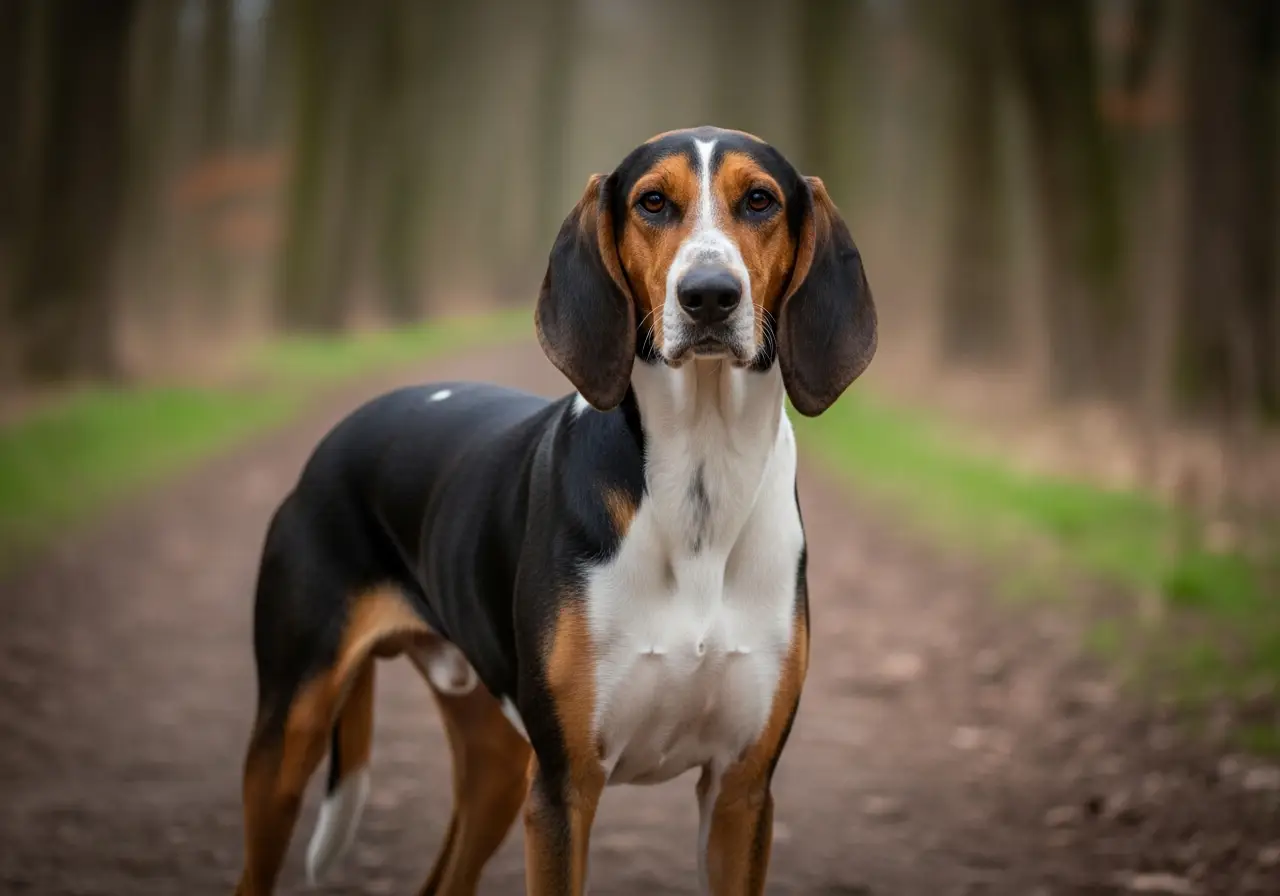
The Large Anglo-French Tricolour Hound is a rare pack dog, FCI Group 6, tricoloured and enduring, withers height 60–72 cm.
03Profile
Key facts and suitability
- Origin
- Frankreich
- Original purpose
- Red deer hunting in the pack
- FCI
- No. 322 · Group 6 · Section 1.1
- height at the withers
- 60–72 cm
- Weight
- 30–40 kg
- Life expectancy
- 11–13 Years
- Coat type
- Short-haired
- Minimum exercise
- 120 min/day
- Puppy price
- 800–1'400 CHF
- Waiting period
- 12 months
- Sports
- Hunting · Tracking
04Temperament
How the Large Anglo-French Tricolour Hound shows up in everyday life
On the morning run in the forest, what makes this breed special becomes apparent: the dog picks up a trail, lowers its head and works, concentrated, vocal, independent. At this moment the owner is a companion, not a leader. This is not a mistake but the result of decades of targeted selection.
In the household routine, the Grand Anglo-Français Tricolore behaves calmly and evenly, provided its need for movement is met. It does not show pronounced attachment but regularly seeks proximity to conspecifics. Anyone keeping it as the only dog must compensate for this need for social contact through intensive interaction with other dogs.
Towards strangers, it appears comparatively open according to the FCI axis; it does not react shyly or aggressively, nor is it effusive. The friendliness towards strangers is functional, not bond-based. Anyone receiving visitors will experience a dog that briefly registers them and then returns to its own enrichment.
Here lies an important difference between the two behavioural axes: The internal need for social contact applies primarily to conspecifics, not to humans. The dog requires a pack, or at least another dog. External friendliness towards people is present but is not the centre of its motivation.
It perceives children calmly as long as they do not make abrupt movements that activate its hunting instinct. A calm basic atmosphere in the household supports its well-being. Noise and haste disturb it less than permanent under-stimulation.
05Needs
What this breed needs daily
The Grand Anglo-Français Tricolore requires at least 120 to 180 minutes of active movement daily, not in the form of walks but through structured nose work, hunting guidance or mantrailing. Pure running rounds without mental and physical stimulation do not meet its needs.
The need for movement (CCT score 5 out of 5) is the dominant keeping criterion. A dog of this breed that receives less than two hours of genuine stimulation daily will develop behavioural abnormalities: vocalisations, escape attempts, destructive behaviour in the enclosure.
The need for mental work (score 4 out of 5) is also high. Nose work, tracking or hunting exercises meet this need most effectively. Classic obedience exercises alone are insufficient, as the dog is conditioned to independent problem-solving.
Being left alone poses a particular challenge: More than three hours without conspecifics or enrichment are not species-appropriate for this breed. Keeping it as a single dog without a hunting context is critically assessable from an animal welfare perspective.
The enclosure or garden must be absolutely escape-proof; fences under 1.80 metres in height and without dig protection are insufficient. Free running in unsecured terrain is not justifiable due to the pronounced hunting drive. The dog also requires regular contact with conspecifics, as it was selected for pack hunting and isolation acts as a stressor.
Exercise
Very high
mental work
A lot
Social needs
Medium
training
Demanding
06Sport & Mental and Physical Stimulation
What sports the Large Anglo-French Tricolour Hound is suited for
Realistic in terms of physiology and genetics – not every breed suits every sport.
Structurally and physiologically suitable: Suitable for mantrailing, dummy work and tracking · CaniCross / bikejoring possible.
07Quick Check
08Suitability
Who this breed is suitable for – and who it isn't
✓Matches
The Grand Anglo-Français Tricolore suits owners with active hunting practice and access to extensive, secured terrain. Anyone who regularly hunts red deer or wild boar and is looking for an enduring pack hound will find a functional partner in this breed.
The breed is also suitable for very active owners with sound knowledge of hound behaviour who are willing to offer at least two hours of structured nose work or tracking daily. A rural environment with an escape-proof enclosure is not an option but a basic requirement.
Owners who already have experience with independently working hunting dogs cope well with the low human orientation of this breed. Anyone who understands that pack sociality does not mean human-orientation and keeps the dog accordingly, ideally with at least one other conspecific, creates a species-appropriate basis for keeping.
The breed also suits owners who practise mantrailing or tracking at a high level and are looking for a dog with genetically anchored scent motivation. The prerequisite remains in every case: sufficient time, terrain and realistic expectations regarding recall reliability and bonding behaviour.
×Doesn't match
The Grand Anglo-Français Tricolore does not suit owners looking for a strongly bonded everyday companion. Anyone who expects the dog to fixate strongly on persons, react emotionally dependent or be reliably recallable in open country will be permanently disappointed.
The breed is not suitable for urban or suburban keeping without access to extensive terrain. A city household with daily park walks does not come close to meeting the movement and mental work needs of this breed.
Owners who have to leave the dog alone regularly for longer than three hours should not choose this breed. Equally unsuitable are households where the dog is kept as a single dog without contact with conspecifics.
Anyone who misinterprets friendliness towards strangers as a sign of general sociability and trainability underestimates the independent character of this breed. A dog that reacts openly to strangers is by no means necessarily a dog that is easy to handle in everyday life. This confusion of the two behavioural axes leads to keeping errors. First-time owners without experience with hunting dogs are overwhelmed by this breed.
10Line reality
Show line, working line, breeder market
A formal separation into show and working lines does not exist for the Grand Anglo-Français Tricolore to the extent known, for example, in the German Shepherd Dog or Labrador Retriever. The breed is still predominantly used as a working dog in pack hunting in France, and the FCI standard requires a working test. The breeding goal is thus clearly work-oriented.
However, regional differences exist within the working population: some lines are selected for special endurance in red deer hunting, others for vocalness and scent fidelity in wild boar hunting. These differences are relevant for the owner as they can influence temperament and the intensity of the hunting drive.
Show lines in the classic sense are marginal. The few dogs shown at exhibitions almost without exception come from active hunting operations. Pure show breeding without a working background is hardly established for this breed.
For interested parties in the DACH region, this means: puppies almost always come from French hunting operations with active working use of the parent animals. Checking the working test results of the parent animals is sensible and self-evidently available from a reputable breeder.
11Health · Reality
What you need to plan for medically with your Large Anglo-French Tricolour Hound
There are no extensive breed-specific health studies for the Grand Anglo-Français Tricolore, which is due to the very small population size outside France. According to experienced owners and the breed club, life expectancy is approximately 10 to 12 years.
Hip dysplasia (HD) is a known risk factor in large scenthounds. Specific HD prevalence studies for this breed are not available; however, the FCI standard explicitly recommends using only functionally and clinically healthy dogs for breeding. Radiological HD screening of parent animals before mating is standard practice in reputable breeding.
Ear infections (otitis externa) occur disproportionately frequently in dogs with floppy ears. The Grand Anglo-Français Tricolore has medium-sized, flat-lying ears that require regular checking and cleaning, particularly after work in damp terrain.
Overweight is not a typical problem for this breed as long as its exercise needs are met. For dogs taken out of active hunting work (e.g., in old age), the amount of food must be adjusted, as energy requirements drop significantly.
Preventive examinations should include annual general check-ups, ear checks, and regular orthopaedic checks from the fifth year of life onwards. In cases of lameness or decline in performance, veterinary assessment should be initiated promptly.
12Structured data
Health by the numbers
Prone to diseases
Hip dysplasia, ear problems
Recommended health tests
Hip X-ray
13Myths ↔ Reality
What is often said incorrectly about this breed
Five myths, five realities, five sources.
The Grand Anglo-Français Tricolore can be kept without problems even without a hunting connection, provided there is enough exercise.
The breed has been selected over generations for independent tracking work in the pack. This drive cannot be fully compensated by walks or dog sports. Without hunting guidance or structured nose work, many specimens show pronounced symptoms of frustration. Experienced hound owners report consistently that the lack of tracking work leads to restlessness and uncontrolled searching behaviour.
Hounds are particularly people-oriented and affectionate due to their pack sociality.
Pack sociality means compatibility with conspecifics, not emotional dependence on humans. The Grand Anglo-Français Tricolore primarily orients itself by scent trails in open country and works independently. The bond with the owner is significantly less pronounced than in classic companion dogs. Anyone looking for a close everyday companion who strongly focuses on people will be disappointed by this dog.
Recall works reliably if the dog has been well trained.
When in contact with game or on an active trail, recall for hounds of this category cannot be guaranteed reliably. This is not a question of training but a genetic reality: independent decision-making ability in the field was the breeding goal. Owners without hunting experience regularly underestimate this point. Free running without secured terrain or hunting management is not justifiable with this breed.
The breed is particularly healthy and free from hereditary diseases due to its rarity.
Rarity does not automatically protect against genetic diseases. In small breeding populations, there is on the contrary a risk of inbreeding depression and limited genetic diversity. No extensive health studies are available for the breed, which makes a serious assessment difficult. Hip dysplasia and ear infections are known risk factors in large hounds that also deserve attention here.
A large garden completely replaces the necessary exercise.
A garden offers space but does not replace structured stimulation. The Grand Anglo-Français Tricolore needs at least 120 to 180 minutes of active exercise with nose work or hunting use daily. A dog left to its own devices in the garden often develops digging behaviour, vocalisations and escape attempts, classic signs of chronic under-stimulation.
14animal welfare
The animal welfare perspective
Breeder market, designer versions, animal shelter reality — what no one writes in the puppy ad.
The Grand Anglo-Français Tricolore is so rare in DACH that an organised backyard breeder market practically does not exist. It is one of the few breeds where the risk of buying a dog from questionable backyard breeding is comparatively low, simply because demand and commercial interest are lacking.
Nevertheless, risks exist: Occasionally, scenthounds are sold from French or Spanish hunting operations to DACH countries without the buyer knowing the keeping requirements. These dogs then end up in households that do not bring the terrain, time or expertise. The result is dogs with chronic under-stimulation, escape attempts and behavioural problems, not because the breed is difficult, but because the basis for keeping them is missing.
Designer versions or trend crosses do not exist for this breed. This protects the breed from another risk factor that causes significant animal welfare problems in more popular breeds.
A real animal welfare problem arises when hunting operations in France or Spain are closed down and entire packs must be rehomed. These dogs are often well-socialised with conspecifics but hardly prepared for single-dog keeping or urban life. Specialised scenthound animal welfare organisations in France and Spain take in such dogs. Those seeking an adult dog with a known working background will find an equivalent alternative to buying a puppy there.
Keeping a Grand Anglo-Français Tricolore without a hunting context is not a matter of personal preference but an animal welfare issue. A dog genetically designed for pack hunting and kept permanently without tracking work and conspecifics suffers from chronic stress. This is not moralising but a behavioural biological assessment shared unanimously by experienced scenthound owners and veterinarians.
15Costs · Transparency
What this breed realistically costs
The purchase price for a puppy of the Grand Anglo-Français Tricolore from reputable breeding is approximately 800 to 1,500 euros, depending on origin and the working test status of the parent animals. Offers significantly below this range indicate missing health examinations or insufficient breeding documentation.
Annual keeping costs consist of food (approx. 600 to 900 euros/year for a large, active dog), basic care (ear cleaning, nail trimming, occasional grooming: approx. 100 to 200 euros/year) and veterinary costs for preventive examinations, vaccinations and parasite treatment (approx. 300 to 500 euros/year under normal circumstances).
Additional costs apply for keeping infrastructure: An escape-proof enclosure with sufficient height and dig protection can cost between 1,000 and 3,000 euros in initial investment, depending on the property.
Dog liability insurance is strongly recommended and costs between 50 and 120 euros/year depending on provider and coverage amount. Dog health insurance ranges from 400 to 800 euros/year and can cushion considerable costs in case of orthopaedic diseases in old age.
Total costs under normal circumstances: 1,200 to 1,800 euros/year in running costs, excluding extraordinary veterinary costs.
16Puppy search
What you need to consider when choosing a breeder
- Reputable breeders of the Grand Anglo-Français Tricolore are almost exclusively based in France and active in working hunting operations.
- A first point of contact in the German-speaking area is the Association for French and Swiss Hounds e.V.
- (laufhunde.eu), which can facilitate contacts with tested breeders.
- Characteristics of reputable breeding: Both parent animals have completed a working test, the results are documented and accessible.
- The breeder allows a visit on site, shows the mother with the puppies and answers questions about keeping and use openly.
- Puppies are handed over no earlier than eight weeks of age.
- Warning signs: No on-site visit possible, no proof of working tests, puppies from multiple breeds available simultaneously, handover at car parks or via freight forwarder.
- As the breed is rare in DACH, rehoming via animal welfare organisations is uncommon but not impossible.
- Scenthounds from France or Spain occasionally end up in rescue centres when hunting operations are closed down.
- Those open to an adult dog may find a suitable dog with a known working background through specialised scenthound animal welfare organisations.
FAQ
Frequently asked questions about the Large Anglo-French Tricolour Hound
How much exercise does Large Anglo-French Tricolour Hound need?
At least around 120 minutes of exercise per day. As an active breed, more so — plus mental stimulation.
What is the size and weight of Large Anglo-French Tricolour Hound?
Fully grown, Large Anglo-French Tricolour Hound reaches about 60–72 cm at the withers and weighs around 30–40 kg.
What is the life expectancy of Large Anglo-French Tricolour Hound?
The life expectancy of Large Anglo-French Tricolour Hound is approximately 11–13 years.
Which diseases are common in Large Anglo-French Tricolour Hound?
Hip dysplasia, ear problems
17Breed clubs
Official breed clubs in DACH
19Related
Similar breeds – and their differences
You might also be interested in
Participate
Do you have a good photo of your Large Anglo-French Tricolour Hound?
We are looking for expressive images for our breed profiles. Submit yours; the editorial team reviews every submission before publication.
Does this breed suit you?
Very rare large pack dog. Almost exclusively kept for hunting in France.