
01Summary
In a paragraph
If you only have 30 seconds.
The Kritikos Lagonikos is one of Europe's oldest dog breeds, originating in Crete and shaped by millennia of hunting selection in the mountains. It combines sight and scent hounding in a slender, robust body. Outside Greece, it is a rarity without FCI recognition. Anyone who keeps one takes on a dog with strong independence, pronounced prey drive, and an exercise requirement that demands daily consistency, not compromises.
02Introduction
What makes the Kritikos Lagonikos special
The Kritikos Lagonikos is a landrace from Crete over 4,000 years old, not recognised by the FCI, combining sighthound and scent hound traits, withers height 45–60 cm.
03Profile
Key facts and suitability
- Origin
- Griechenland (Kreta)
- Original purpose
- Sight and scent hunting of hares and wild rabbits in the mountains of Crete
- height at the withers
- 50–60 cm
- Weight
- 15–25 kg
- Life expectancy
- 12–14 Years
- Coat type
- Short-haired
- Minimum exercise
- 90 min/day
- Puppy price
- 800–1'500 CHF
- Waiting period
- 18 months
- Sports
- Coursing · sighthound racing · mantrailing · tracking work
04Temperament
How the Kritikos Lagonikos shows up in everyday life
When returning home, the Kritikos Lagonikos shows selective greeting: The primary caregiver receives attentive attention, an unknown visitor is registered with clear distance. This is not a training error; it is the result of millennia-old selection for vigilance and independence.
In the house, the dog is calm and reserved. It seeks closeness to the primary caregiver without being intrusive. It lies relaxed on the sofa until a movement outside the window activates its attention. Then it is highly concentrated and ready to react within seconds.
Outside, the picture changes fundamentally. The Kritikos Lagonikos switches to hunting mode: nose on the ground, gaze into the distance, high body tension. A flushed hare means that the dog accelerates to maximum speed in fractions of a second, without regard for calls or signals. Free running without secure fencing is not an acceptable option under these conditions.
Internally, the breed requires intensive daily exercise and mental stimulation. The need for mental work is at a medium level; classic obedience exercises motivate it little, whereas nose work and coursing-like activities motivate it significantly more. Anyone offering 90 minutes of structured stimulation daily receives a balanced dog. Anyone failing to do so receives a dog that seeks its own enrichment.
Externally, he reacts to strangers with reserve or even rejection. He gets along with children from his own family if socialisation was carried out early and consistently. Towards other dogs, he generally appears neutral to indifferent, provided no prey drive is triggered. These two axes (close family bond internally, clear reserve externally) must not be confused.
05Needs
What this breed needs daily
The Kritikos Lagonikos requires at least 90 minutes of active exercise daily. A significant portion of this should consist of free running in secure terrain; a fenced garden with a fence height of at least 1.80 m is not a comfort option, but a basic prerequisite. The breed jumps high and is capable of navigating rough terrain; commercially available standard fences are often insufficient.
Leash walks alone do not meet the exercise needs. The dog requires phases in which it can express its natural gait (galloping, changing direction, tracking). Coursing, lure coursing, or controlled nose work within a secure framework are suitable forms of stimulation.
The need for mental work is at a medium level. Classic obedience exercises motivate the breed little; it requires tasks that connect to its original function. Nose work, mantrailing, or hunt-like search games are significantly more effective than fetching exercises.
The dog tolerates being left alone for up to about four hours, provided it has been sufficiently stimulated beforehand. Longer phases without enrichment and companionship lead to restlessness and undesirable behaviour.
Training requires experience with independent, primitive breeds. The Kritikos Lagonikos makes decisions independently; this is genetically determined and not a sign of lacking intelligence. Consistency, clarity, and positive reinforcement work; pressure and punishment lead to withdrawal or refusal. A dog training school with experience in primitive breeds is recommended but does not replace the owner's daily work.
Exercise
Very high
mental work
Medium
Social needs
Medium
training
Demanding
06Sport & Mental and Physical Stimulation
What sports the Kritikos Lagonikos is suited for
Realistic in terms of physiology and genetics – not every breed suits every sport.
Structurally and physiologically suitable: Suitable for mantrailing, dummy work and tracking · CaniCross / bikejoring possible.
07Quick Check
08Suitability
Who this breed is suitable for – and who it isn't
✓Matches
The Kritikos Lagonikos suits owners who have already gained experience with primitive or original hunting dog breeds. Those who know how an independent dog with a strong drive communicates and makes decisions will find a loyal, robust companion in this breed.
Suitable are owners with access to secure open space, at least one fenced garden with sufficient height, ideally access to coursing or nose work offerings in the region. Those who can provide 90 minutes of structured stimulation daily and are willing to meet this requirement permanently create the basic prerequisite.
People living in rural or semi-rural environments who enjoy working with a hunt-motivated dog will find a functional partner in him. Owners who actively practice lure coursing or comparable dog sports can also meaningfully stimulate the breed.
Households with children from about ten years of age, where handling dogs has already been practised and the dog was socialised early, are generally suitable, provided the adults clearly take on the leadership role. The breed tolerates calm, respectful interaction well; loud, unpredictable situations less so.
×Doesn't match
The Kritikos Lagonikos does not suit owners keeping a dog for the first time. The breed's independence and pronounced prey drive require an owner who can categorise the behaviour of primitive dogs and react situationally; this is not a matter of good will, but of experience.
Those who are away from home for eight hours daily and do not have a reliable dog care plan should not choose this breed. The dog tolerates being left alone only to a limited extent, and insufficient stimulation leads to problems that cannot be compensated for by occasional weekend activities.
City dwellers without access to secure open space quickly encounter structural limits. Those who believe they can fully control the prey drive through training underestimate the genetic anchoring of this behaviour. Free running in unsecured terrain remains a permanent risk; this is not a phase that will pass.
Households with very young children or with frequently changing, unknown visitors do not suit the temperament of this breed. The pronounced reserve towards strangers is not a training problem that can be trained away; it is breed character. Those looking for an open, sociable dog for city life will find a more suitable partner in other breeds.
09Character
Character and editorial background
The Kritikos Lagonikos, also known as the Cretan Sighthound or Cretan Hound, is an old Greek landrace from the island of Crete. Genetic and archaeological evidence suggests an age of over 4,000 years, making it one of Europe’s oldest dog breeds. The breed combines sighthound and scent hound traits in a robust working dog that is still primarily kept as a hunting dog on Crete today.
Origin and History
The Kritikos Lagonikos originates from the mountainous hinterland of Crete. Similar dogs already appear on Minoan frescoes and coins from antiquity. For millennia, the breed was bred in isolation on the island, which largely preserved its type unchanged. The Greek Kennel Club (KOE) recognises the breed, whereas the FCI does not. Consequently, there is also no recognition by the SKG, VDH, or ÖKV. Outside Greece, the population is minimal; worldwide, an estimated few thousand individuals exist. It has been and continues to be used for hunting hares and wild rabbits in Crete’s stony, steep terrain. In doing so, it works both by scent and on sight, distinguishing it from pure sighthounds.
Appearance
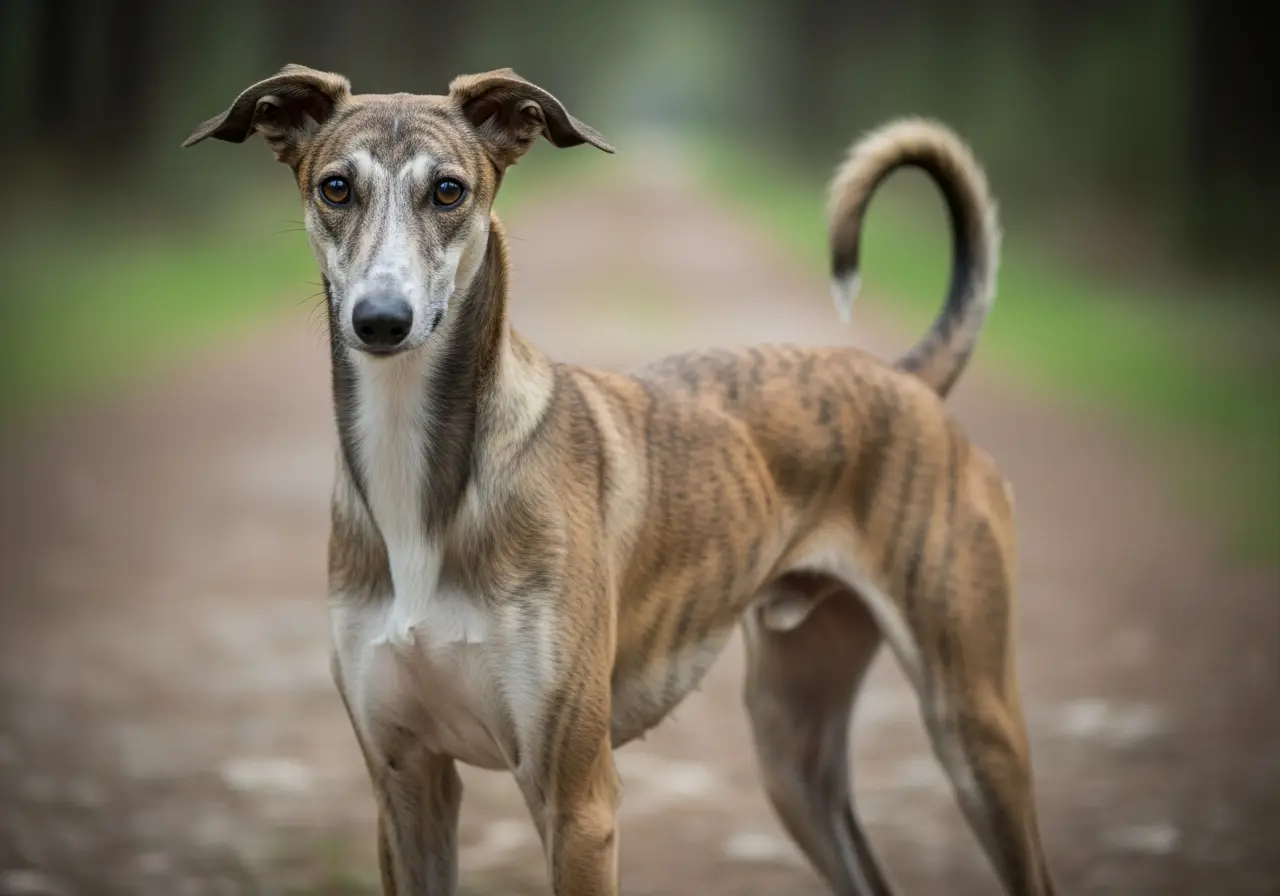
The Kritikos Lagonikos is a medium-sized, light dog with a slender, square to slightly elongated build. Males reach a withers height of 52 to 60 cm, females 50 to 58 cm. The weight ranges from 15 to 25 kg. The coat is short, dense, and lies close to the body. All colours are permissible; white, sandy, brindle, or black with markings are common. A characteristic feature is the high-carried tail, often rolled over the back, a clear distinguishing trait from classic sighthounds.
Nature and Character
The Kritikos Lagonikos is alert, independent, and strongly motivated by hunting instincts. The bond with the primary caregiver is close, while it shows reserve towards strangers. It is not a submissive dog. It often makes decisions independently, consistent with its selection as a hunting dog. The prey drive is strongly pronounced, typical of the breed, and cannot be trained away. At home, it is calm and reserved; outdoors, it is highly attentive and fast. It gets along with children in its own family if socialised early.
Keeping and Training
The daily exercise requirement is at least 90 minutes, ideally with free running in secure terrain. Leash walks alone are insufficient. Due to the prey drive, off-leash activity outside fenced areas is hardly responsible. A securely fenced garden is recommended, as the breed jumps high and is capable of navigating rough terrain. Training requires experience with primitive, independent breeds. Classic obedience training quickly reaches its limits. The Kritikos Lagonikos is not suitable for first-time dog owners.
Care
The short coat is easy to care for and requires only weekly brushing. The breed is adapted to hot, dry climates and tolerates cold and wet conditions poorly.
Health
As a landrace with a broad genetic base, the Kritikos Lagonikos is considered robust and comparatively healthy. Life expectancy is 12 to 14 years. Breed-specific health tests are not established, as organised breeding structures hardly exist outside Crete.
Suitable for whom?
The Kritikos Lagonikos suits people with experience in keeping primitive hunting dogs, ideally with access to coursing or hunting-like forms of stimulation. It is only conditionally suitable for classic family or city living conditions.
10Line reality
Show line, working line, breeder market
The Kritikos Lagonikos is not kept in organised breeding lines outside Greece. A differentiation between working and show lines, as is common with FCI-recognised breeds, does not exist for this breed in a comparable form.
On Crete itself, the breed is primarily kept and bred as a utility hunting dog. Selection takes place based on hunting performance (tracking ability, endurance in mountains, suitability for sight hunting) and not according to aesthetic criteria of a show standard. This means: Dogs from Cretan working breeding are functionally selected but show considerable individual variation in body build and temperament.
Outside Crete, there are scattered owners in other European countries who have imported dogs directly from the island. A coordinated breeding structure with a health database or stud book does not exist there. Anyone acquiring a Kritikos Lagonikos outside Greece generally receives a dog without traceable line documentation.
This lack of line differentiation is not a quality feature; it is an indication that the origin check at purchase must be carried out particularly carefully. A dog from Cretan hunting working breeding with traceable pedigree is clearly preferable to a dog of unknown origin.
11Health · Reality
What you need to plan for medically with your Kritikos Lagonikos
The Kritikos Lagonikos is considered a robust landrace with a broad genetic base. According to Cretan breeder circles, the life expectancy is between 12 and 14 years, a range that is realistic for medium-sized dogs of this size class, but which cannot be substantiated by independent studies outside Greece due to a lack of systematic data collection.
Breed-specific health tests are not established outside Crete. Organised breeding structures with a health database do not exist, which means that statements about HD/ED prevalence or hereditary diseases cannot be substantiated with concrete figures for this breed. This is a structural deficit, not a free pass.
For imported dogs from Crete, the following applies: Before purchase, an up-to-date X-ray of the hips and a general health check by a vet should be available. Parasite infestation (particularly leishmaniasis, heartworm, and tick-borne diseases) is a relevant issue for dogs from the Mediterranean region. A serological test for leishmaniasis before entry is strongly recommended (status: 2024, according to recommendations of the German Society for Tropical Medicine).
The breed is adapted to hot, dry climates. In Central European winters, it reacts sensitively to cold and wetness; a dog coat at temperatures below five degrees is not an exaggeration but a sensible measure. Overweight is rarely a problem in sufficiently exercised specimens; however, it can develop with under-stimulation and constant food intake.
12Structured data
Health by the numbers
Prone to diseases
no documented breed-specific clusters, generally robust landrace
Recommended health tests
hip dysplasia (HD), eye examination (ECVO)
13Myths ↔ Reality
What is often said incorrectly about this breed
Five myths, five realities, five sources.
Due to its slender body, the Kritikos Lagonikos is a calm, low-activity dog.
The slender build deceives regarding the actual exercise requirement. The breed requires at least 90 minutes of active stimulation daily, with a significant portion ideally allowing for free running in secure terrain. Pure leash walks do not meet this need. In the house, the dog is calm; outside, it switches to high operating temperature.
The pronounced prey drive can be completely eliminated through consistent training.
The prey drive of the Kritikos Lagonikos is the result of over 4,000 years of selection for sight and scent hunting. It is genetically anchored and cannot be eliminated by training, but at best channelled. Free running outside secured areas remains a considerable risk permanently. Owners who underestimate this endanger the dog and the surroundings.
As an old landrace, the Kritikos Lagonikos is completely robust and requires no veterinary preventive care whatsoever.
The broad genetic basis of the breed reduces the risk of hereditary diseases compared to highly bred fashion dogs. However, this does not mean that preventive examinations can be dispensed with. Especially with imported dogs from Crete, health certificates and breeding documentation are often missing. Regular parasite checks are particularly relevant due to hunting use.
The Kritikos Lagonikos is suitable as a family dog because it is calm and reserved in the house.
Calmness in the house is not an indicator of suitability as a classic family dog. The breed shows pronounced reserve towards strangers, requires intensive socialisation and demands consistent, experienced handling from all household members. For households with small children and frequently changing visitors, the breed is only suitable under very specific conditions.
Because the breed is not FCI-recognised, the origin of the puppy does not matter.
Lack of FCI recognition means the opposite: Without international breeding standards and control structures, checking the origin is even more important. Unscrupulous backyard breeders deliberately exploit the reputation of old landraces. Anyone acquiring a Kritikos Lagonikos should seek direct contact with Cretan breeders with traceable breeding documentation and insist on health certificates.
14animal welfare
The animal welfare perspective
Breeder market, designer versions, animal shelter reality — what no one writes in the puppy ad.
Outside Greece, the Kritikos Lagonikos is an absolute rarity. Precisely this makes it vulnerable to a market that uses scarcity as a sales argument. Anyone looking for a puppy in the German-speaking region will quickly come across offers that advertise with terms such as old landrace or original dog, without any comprehensible breeding documentation behind them.
The risk is concrete: dogs of unknown origin, poorly socialised, without health certificates, given away too early. Backyard breeders who exploit the exotic factor of the breed are not a theoretical problem; they are a real phenomenon with all rare, non-FCI-recognised breeds.
On Crete itself, there is another problem: The handling of hunting dogs partly follows different standards there than in Central Europe. Dogs that are no longer capable of working as hunting dogs (due to age, injury, or lack of suitability) are occasionally culled. This means that adult dogs from active hunting households are regularly available for rehoming on the island.
These dogs are not a worse choice. An adult Kritikos Lagonikos from reputable rehoming already shows its character, is usually assessed health-wise, and requires an experienced owner, whom it will also find through a rehoming organisation with expertise. Anyone who really wants to get to know the breed should contact organisations working with hunting dogs on Crete before considering a puppy.
Designer versions or targeted crosses of the Kritikos Lagonikos do not currently exist as an established phenomenon. This may change once the breed receives more attention. The decision for a dog of comprehensible origin protects not only the animal but also contributes to preserving the breed in its original form.
15Costs · Transparency
What this breed realistically costs
A puppy from reputable Cretan breeding usually costs between 800 and 1,500 euros. In addition, travel or transport costs apply when importing from Greece, which can range between 200 and 600 euros depending on the route. Offers significantly below this range are a warning signal.
The annual living costs for a medium-sized dog of this size class are typically between 1,500 and 2,500 euros in the German-speaking region. This includes food (high-quality dry food or raw feeding: 600–1,000 euros/year), care (low with short coat: approx. 50–100 euros/year), accessories, dog tax, and basic equipment.
Vet costs vary greatly. Routine examinations, vaccinations, and parasite prevention cost approximately 200–400 euros annually. For imported dogs from the Mediterranean region, a leishmaniasis test should be budgeted (approx. 50–80 euros one-off). In case of illness, costs can quickly rise into the four-digit range.
Pet insurance for a medium-sized dog costs between 40 and 100 euros monthly, depending on the provider and scope of cover. Given the lack of health data for the breed, coverage is advisable. The total costs over the dog's lifespan, at 12 to 14 years, realistically lie between 20,000 and 35,000 euros.
16Puppy search
What you need to consider when choosing a breeder
- Serious Kritikos Lagonikos breeding operations exist almost exclusively on Crete.
- Anyone looking for a puppy should aim for direct contact with breeders on the island and not rely on intermediaries who offer dogs without personal inspection.
- The following criteria help in assessing seriousness: The breeder allows an inspection of the mother bitch and the rearing conditions.
- Puppies are handed over no earlier than eight weeks of age.
- Health certificates and verifiable pedigree documentation are available.
- The breeder asks questions about the living conditions and refuses a sale if the conditions do not match.
- Caution is advised with offers on classifieds portals without the possibility of an on-site inspection, with suspiciously low prices, and with sellers who do not ask questions about the keeping conditions.
- Adopting an adult dog from animal welfare or a rescue station on Crete is an equally valid option.
- Adult dogs already show their character, which reduces surprises.
- Organisations working with hunting dogs on Crete occasionally place animals that have retired from hunting use.
- This requires experience in handling the breed but can be a responsible decision.
FAQ
Frequently asked questions about the Kritikos Lagonikos
Is Kritikos Lagonikos suitable for beginners?
Kritikos Lagonikos is only suitable for first-time dog owners to a limited extent and is better suited to people with dog experience.
Is Kritikos Lagonikos a family dog?
Kritikos Lagonikos is only recommended as a family dog to a limited extent and is better suited to a household without small children.
How much exercise does Kritikos Lagonikos need?
At least around 90 minutes of exercise per day. As an active breed, more so — plus mental stimulation.
Does Kritikos Lagonikos suit an apartment?
Kritikos Lagonikos needs more space and plenty of exercise and feels less comfortable in an apartment.
What is the size and weight of Kritikos Lagonikos?
Fully grown, Kritikos Lagonikos reaches about 50–60 cm at the withers and weighs around 15–25 kg.
What is the life expectancy of Kritikos Lagonikos?
The life expectancy of Kritikos Lagonikos is approximately 12–14 years.
Which diseases are common in Kritikos Lagonikos?
no documented breed-specific clusters, generally robust landrace
17Breed clubs
Official breed clubs in DACH
19Related
Similar breeds – and their differences
You might also be interested in
Participate
Do you have a good photo of your Kritikos Lagonikos?
We are looking for expressive images for our breed profiles. Submit yours; the editorial team reviews every submission before publication.
Does this breed suit you?
Primitive Cretan hunting dog with combined sighthound and scent hound traits. Suitable for experienced owners with access to species-appropriate hunting stimulation or coursing. Not suitable for classic family or city living conditions.