
01Summary
In a paragraph
If you only have 30 seconds.
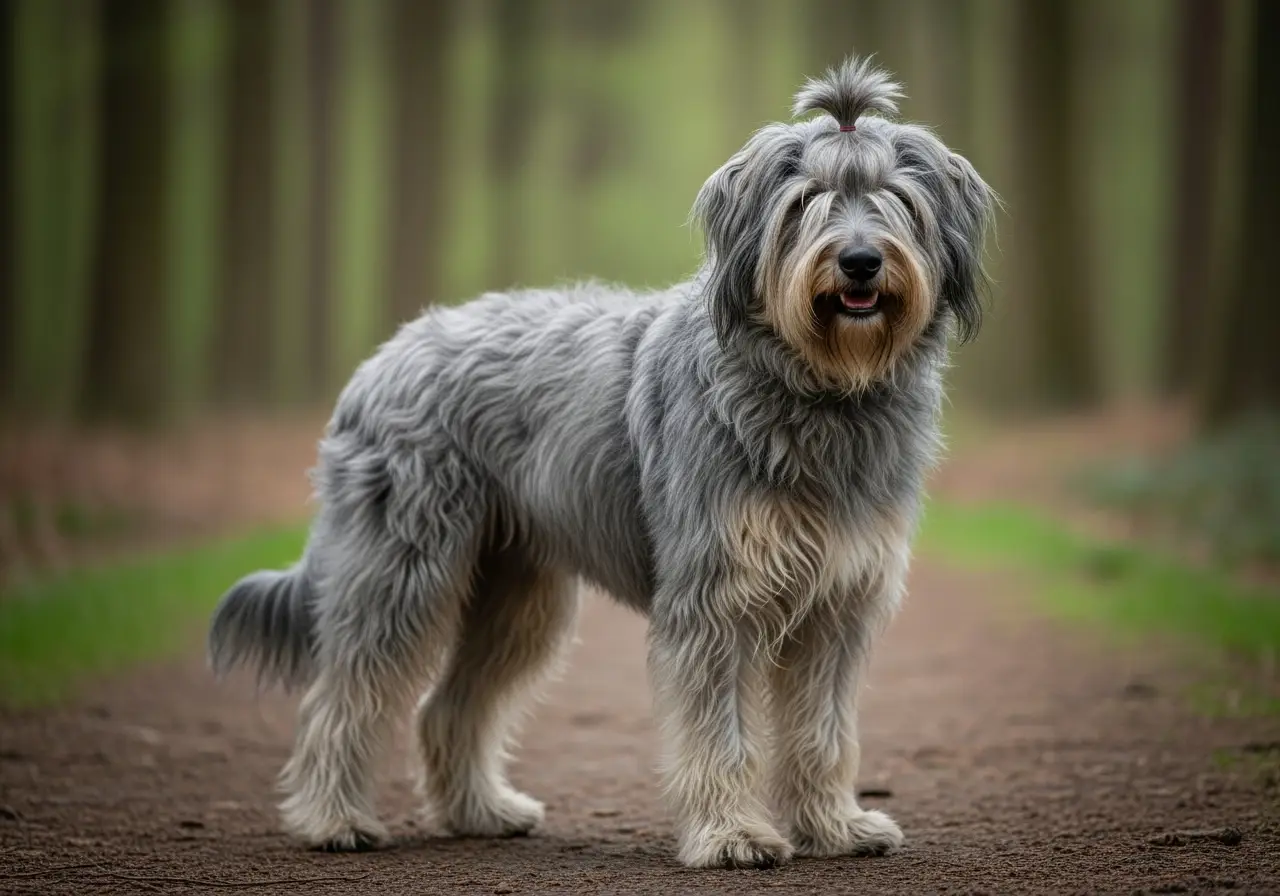
The Schapendoes is a Dutch herding dog with shaggy coat, springy gait and a work ethic that is noticeably present in everyday life. Anyone planning it as a cosy companion fundamentally underestimates it. The breed demands structured stimulation, clear leadership and an owner who brings joy in genuine collaboration, not just walks.
02Introduction
What makes the Schapendoes special
Schapendoes: shaggy Dutch herding dog, agile independent and today mainly kept as a family and sport dog
03Profile
Key facts and suitability
- Origin
- Niederlande
- Original purpose
- Sheep herding
- FCI
- No. 313 · Group 1 · Sektion 1: Schäferhunde
- height at the withers
- 43–50 cm
- Weight
- 12–20 kg
- Life expectancy
- 12–15 Years
- Coat type
- Long-haired
- Minimum exercise
- 60 min/day
- Puppy price
- 1'200–2'000 CHF
- Waiting period
- 5 months
- Sports
- Agility Obedience Herding work
04Temperament
How the Schapendoes shows up in everyday life
The morning run shows what makes the Schapendoes special: it does not simply run alongside you, but observes, anticipates and reacts to every change of direction. This behaviour is no coincidence; it is genetically anchored herding work that manifests itself permanently in everyday life.
Internally, the Schapendoes requires high stimulation on two levels daily: movement and mental work. At least 90 minutes of active exercise per day are a basic requirement, not an exception. In addition, there are training sessions that challenge its mind, nose work, obedience training, agility or herding sports. A Schapendoes that is physically stimulated but mentally under-stimulated will find its own solutions. These rarely turn out to be pleasant.
Externally, the Schapendoes behaves watchfully and attentively towards strangers, not openly or enthusiastically. It does not automatically greet new people joyfully; it observes first. Towards known people, it develops deep affection and loyalty. These two poles, a high need for social contact within the reference group and reserve towards unknown people, must not be confused. A Schapendoes that is closely attached to its family is therefore not necessarily sociable with every visitor.
With conspecifics, it generally shows itself to be compatible, provided that socialisation has taken place early and consistently. Its herding instinct can manifest as driving and controlling behaviour towards other animals or children, especially with fast movements. This is not an aggression problem, but instinctive behaviour that must be channelled through training.
In household everyday life, it is present and attentive. It accepts rest phases if they are introduced in a structured manner; it rarely switches off on its own.
05Needs
What this breed needs daily
The Schapendoes requires at least 90 minutes of active exercise daily, and this does not mean a leisurely walk. Running, sprinting, changes of direction, terrain work: the dog is bred for endurance and agility and demands forms of movement that engage these characteristics.
In addition to physical stimulation, it requires daily mental enrichment. Nose work, search games, structured obedience training or dog sports such as agility and obedience are suitable formats. Mental work is not a bonus; it is a basic need. A Schapendoes that is only physically stimulated remains internally restless.
Being left alone is possible, but must be built up gradually and consistently. Due to its high need for social contact and intensity of bonding, the maximum time alone should not regularly exceed four hours. Anyone planning longer absences requires a reliable care solution.
The herding instinct of the Schapendoes is pronounced. In everyday life, it manifests as controlling behaviour towards movement stimuli, children, other animals, bicycles. Impulse control training therefore belongs in the training plan from the start. A dog training school with experience in herding dogs is recommended.
The primary caregiver must be present, consistent and keen to train. The Schapendoes reacts sensitively to mood and body language; inconsistent leadership creates insecurity and over-arousal behaviour. Clear structures in the daily routine help it to regulate itself. Keeping it in an apartment is possible, but presupposes a high level of daily stimulation.
Exercise
High
mental work
A lot
Social needs
High
training
Medium
06Sport & Mental and Physical Stimulation
What sports the Schapendoes is suited for
Realistic in terms of physiology and genetics – not every breed suits every sport.
Structurally and physiologically suitable: Suitable for herding work, treibball and coursing · CaniCross / bikejoring possible.
07Quick Check
08Suitability
Who this breed is suitable for – and who it isn't
✓Matches
The Schapendoes suits owners who can plan at least 90 minutes of active exercise daily and additionally have time for structured training. Specifically: people who engage in or wish to engage in dog sports (agility, obedience, herding sports, nose work) will find a motivated partner in it.
Families with children from about eight years of age are suitable if the children are guided in handling the dog and the dog's herding instinct is channelled through training. Crucially, at least one adult must take primary responsibility for stimulation and leadership.
Owners with prior experience in working with herding dogs or other high-drive breeds are clearly at an advantage. First-time owners are not excluded in principle, but must involve a dog training school with herding dog experience from the start and bring a high willingness for active engagement.
A rural or suburban environment with access to open spaces significantly eases keeping. Those who regularly go out in the countryside (hiking, jogging, cycling with the dog) provide the Schapendoes with a suitable environment. Owners who are professionally flexible or work from home also benefit: the dog needs proximity and structure distributed throughout the day.
×Doesn't match
The Schapendoes does not suit owners who are regularly away from home for more than four hours a day and cannot organise reliable dog care. Its high need for social contact and intensity of bonding do not tolerate permanent isolation.
Those looking for a calm, independent companion that occupies itself after a short walk will not be happy with the Schapendoes. The breed demands active involvement, not occasionally, but daily.
Owners who equate the dog's cheerful expression with friendliness towards strangers underestimate the external axis: the Schapendoes is watchful and reserved towards unknown people. Anyone expecting a dog that enthusiastically greets every visitor should correct this expectation before purchase.
Households with very small children under six years of age, where no consistent supervision and no active herding instinct management are possible, pose a risk, not due to aggression, but due to pronounced driving and controlling behaviour.
People unwilling to attend dog training school or engage in structured training should not choose this breed. A Schapendoes that is not challenged develops its own initiatives, which become burdensome in everyday life. People who are physically unable to complete intensive exercise sessions daily are also overwhelmed by this breed.
10Line reality
Show line, working line, breeder market
The Schapendoes is kept today predominantly as a family and sport dog. A pronounced differentiation between working lines and show lines, such as exists for example in the Border Collie or the German Shepherd Dog, is not established to a comparable degree in the Schapendoes. The number of litters is too low to develop broadly differentiated lines.
Nevertheless, there are differences between dogs from active sport breeding and those bred primarily for conformation. Dogs from sport breeding (agility, obedience, herding sports) tend to show higher drive strength and greater willingness to work. Dogs from conformation-oriented pairings can be calmer in their basic tempo, without completely losing the herding instinct.
Interested parties should specifically ask the breeder about the orientation of the parent dogs: Are the dogs used in sport? Which titles or tests are available? This information provides clues as to the temperament to be expected from the puppies. A breeder who cannot or will not answer these questions provides little basis for planning.
Regional differences between Dutch origin breeding and German or Austrian breeding are possible, but not systematically documented. The Interessengemeinschaft Schapendoes e.V. is the central point of contact for information on breeding orientation in the German-speaking area.
11Health · Reality
What you need to plan for medically with your Schapendoes
The Schapendoes is considered a robust breed with a life expectancy of 12 to 14 years. This range is realistic for a medium-sized herding dog and supported by breeder reports and breed club information.
Known breed-specific health risks include hip dysplasia (HD) and progressive retinal atrophy (PRA). HD screenings of parent animals are standard with reputable breeders; concrete population data on HD prevalence in the Schapendoes population is not available in the same form as for more common breeds due to low litter numbers. The Interessengemeinschaft Schapendoes e.V. recommends X-ray examinations of both parent animals before mating.
PRA is a hereditary eye disease that can lead to blindness. For the Schapendoes, a DNA test exists that identifies carriers and affected dogs. Reputable breeders test their breeding stock and disclose the results. Buyers should request this documentation.
The coat requires regular checking for skin irritations and parasite infestation, as the dense hair can hide problems. Ears should be regularly checked for inflammation, as the coat covers the ear canal.
Overweight is rarely a primary problem in sufficiently stimulated Schapendoes, but can occur with lack of exercise or incorrect feeding. Regular weight checks at the vet, at least once a year, are recommended. Preventive examinations including eye and hip checks should be documented in the stud book.
12Structured data
Health by the numbers
Prone to diseases
Hip dysplasia Eye problems
Recommended health tests
Hip X-ray Eye examination
13Myths ↔ Reality
What is often said incorrectly about this breed
Five myths, five realities, five sources.
“The Schapendoes is an uncomplicated family dog for everyone due to its cheerful nature.
The Schapendoes is indeed cheerful and people-oriented, but this does not mean that it regulates itself. Its herding instinct and high need for exercise and mental work require daily structured stimulation. Without this, it develops restlessness, over-arousal behaviour or begins to herd children and other animals. Cheerfulness does not replace leadership.
“The shaggy coat of the Schapendoes is extremely high-maintenance and constantly mats.
The coat of the Schapendoes is dense and wavy, but mats less severely than it appears optically. Regular combing through, about once or twice a week, is usually sufficient to prevent matting. Extensive daily care is not necessary with correct coat structure. It is crucial to start early with getting used to care measures.
“The Schapendoes is so intelligent that it occupies itself.
High intelligence in the Schapendoes does not mean self-sufficiency, but rather the opposite: the dog actively seeks tasks. If it is not given meaningful opportunities, it will invent its own, which can manifest as herding behaviour towards children, barking at movement stimuli, or destructive behaviour. Mental work must be actively provided by the owner.
“Schapendoesh are open towards strangers and greet everyone warmly.
The FCI standard describes the Schapendoes as attentive and watchful. Towards strangers, it is neither aggressive nor automatically open. The reaction to unknown people depends heavily on socialisation and lineage. Anyone expecting a dog that enthusiastically greets every visitor should critically examine this expectation before purchase.
“As a rare breed, the Schapendoes is particularly healthy and free from hereditary diseases.
Rarity does not automatically protect against hereditary diseases. In the Schapendoes, hip dysplasia and progressive retinal atrophy (PRA) are known as breed-typical risks. Reputable breeders carry out appropriate preventive examinations and disclose the results. A small gene pool can even increase the risk of recessive hereditary diseases if diversity is not carefully maintained.
14animal welfare
The animal welfare perspective
Breeder market, designer versions, animal shelter reality — what no one writes in the puppy ad.
The Schapendoes is a rare breed in Germany and Switzerland. This means that the market for backyard breeders is less pronounced than for trendy breeds, but not non-existent. Anyone offering a Schapendoes via classifieds platforms without pedigree registration, without health documentation, and at suspiciously low prices is operating outside of reputable breeding structures. The low profile of the breed does not automatically protect against dubious offers; it merely makes assessment more difficult for potential buyers who lack comparative knowledge.
Designer versions of the Schapendoes are currently not a widespread phenomenon. This could change if the breed gains more attention through social media. Its shaggy appearance and cheerful expression make it visually attractive, posing a risk factor for impulse purchases.
The biggest keeping-related problem with the Schapendoes is structural under-stimulation. According to animal welfare guidelines, most surrenders occur because owners have underestimated the dog's need for exercise and mental stimulation. They expected a calm family dog but received an enduring working dog with a pronounced herding instinct. This mismatch is not a character flaw of the dog; it is the result of insufficient prior information. Education before purchase is therefore the most effective form of animal welfare.
Adoption is a fully valid option for the Schapendoes. Surrendered dogs often come with a known behavioural and health profile. Animal welfare organisations and breed-specific networks can assess the dog's character and facilitate targeted placement. Anyone open to an adult dog often receives a dog whose true nature is already visible, without the uncertainty of puppy development.
15Costs · Transparency
What this breed realistically costs
A Schapendoes puppy from reputable breeding costs between 1,200 and 1,800 euros in Germany. Offers significantly below this, under 800 euros, should be scrutinised critically: missing health documents, no pedigree registration, or unknown origin are common accompanying circumstances.
Annual living costs consist of several items. Food for a medium-sized active dog ranges from 600 to 1,000 euros per year, depending on quality. Grooming, whether done yourself or by a groomer, incurs an additional 100 to 300 euros annually. Basic equipment (leash, collar, transport box, sleeping area) is a one-off cost of 200 to 400 euros.
Veterinary costs for basic care (annual vaccinations, parasite prevention, routine check-ups) amount to 200 to 400 euros per year. In the event of illness or surgery, individual costs can quickly reach 1,000 to 3,000 euros. Pet insurance costs between 40 and 100 euros monthly, depending on the provider and scope of cover, and is a sensible safeguard for a breed with known hereditary disease risks.
Dog training school and training are not optional items for the Schapendoes. A basic course plus advanced courses cost between 300 and 600 euros in the first year, depending on the region. Anyone engaging in dog sports should budget for additional club fees and course charges.
16Puppy search
What you need to consider when choosing a breeder
- Reputable Schapendoes breeders can be found in Germany via the Interessengemeinschaft Schapendoes e.V.
- A reputable breeder discloses health results of the parent animals, particularly hip dysplasia (HD) X-ray findings and eye examinations for progressive retinal atrophy (PRA).
- Anyone who does not show or cannot show these documents is not a reliable contact.
- On-site visits to the breeder are mandatory, not optional.
- The puppy should be observed in the litter environment, together with the mother, who significantly shapes the puppies' temperament.
- Breeders offering puppies without a visit or against advance payment by bank transfer should be rejected.
- Due to the rarity of the breed in Germany and Switzerland, waiting times of several months are normal.
- Anyone finding a Schapendoes on short notice via classifieds platforms should check particularly critically.
- Placement through animal welfare organisations is an equally valid option.
- According to animal welfare guidelines, surrenders often occur due to underestimated exercise and stimulation needs, so a placed Schapendoes often comes with a known profile that can be specifically assessed.
- Organisations such as DOGS WITHOUT BORDERS or breed-specific placement networks are points of contact.
FAQ
Frequently asked questions about the Schapendoes
Is Schapendoes suitable for beginners?
Schapendoes is considered suitable for first-time dog owners.
Is Schapendoes a family dog?
Schapendoes is considered suitable for families with good socialisation and species-appropriate care.
How much exercise does Schapendoes need?
At least around 60 minutes of exercise per day.
Does Schapendoes suit an apartment?
With enough exercise and enrichment, Schapendoes can also be kept in an apartment.
What is the size and weight of Schapendoes?
Fully grown, Schapendoes reaches about 43–50 cm at the withers and weighs around 12–20 kg.
What is the life expectancy of Schapendoes?
The life expectancy of Schapendoes is approximately 12–15 years.
Which diseases are common in Schapendoes?
Hip dysplasia Eye problems
17Breed clubs
Official breed clubs in DACH
19Related
Similar breeds – and their differences
You might also be interested in

Participate
Do you have a good photo of your Schapendoes?
We are looking for expressive images for our breed profiles. Submit yours; the editorial team reviews every submission before publication.
Does this breed suit you?
Dutch herding dog with long shaggy coat – lively eager to learn and good for active families