
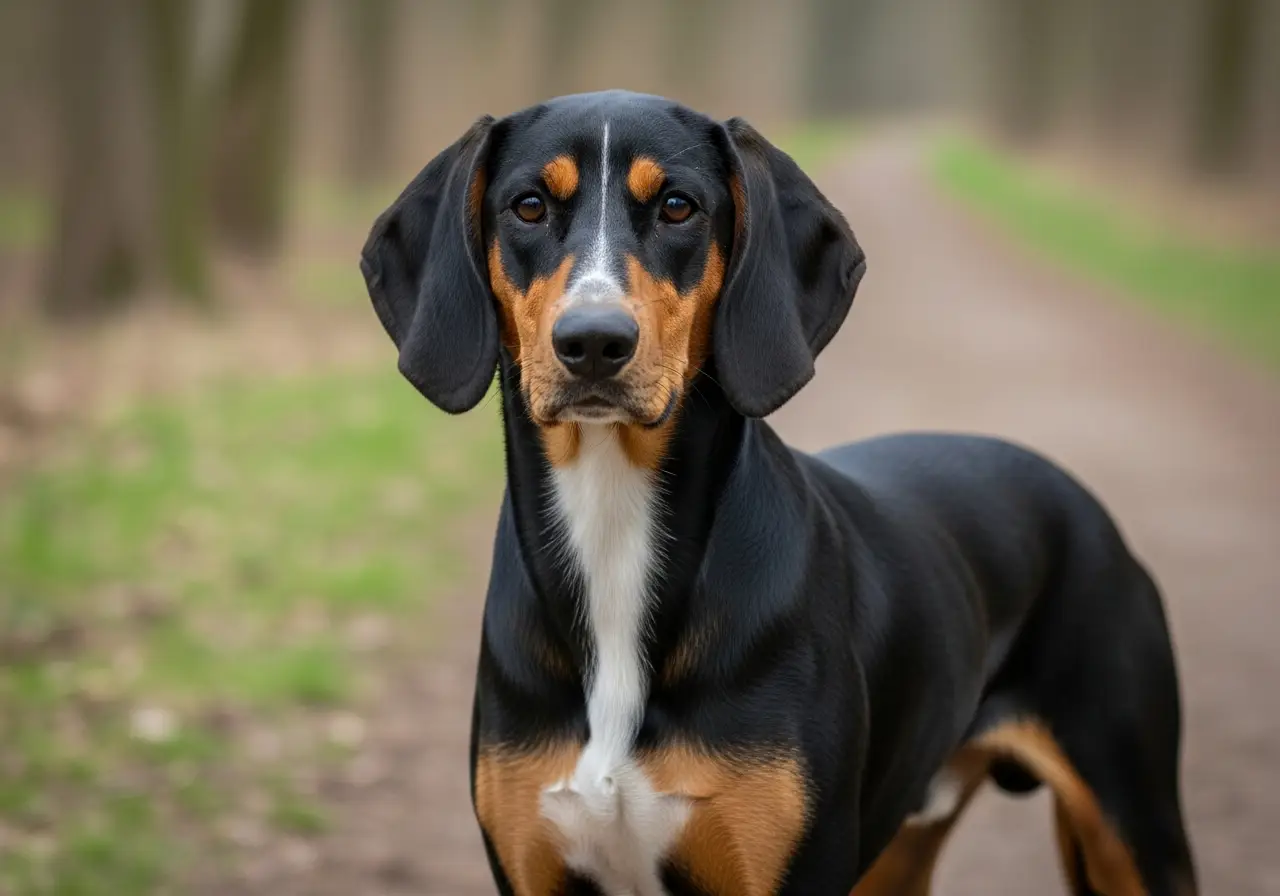
01Summary
In a paragraph
If you only have 30 seconds.
The Erdélyi Kopó is an old Transylvanian scent hound that has been bred for centuries for independent tracking work in difficult terrain. This background shapes its everyday life to this day: high need for exercise, pronounced independence and a prey drive that cannot be trained away. As a pure companion dog without hunting or equivalent substitute tasks, it is permanently under-stimulated, with corresponding consequences for owner and animal.
02Introduction
What makes the Hungarian Hound (Erdélyi Kopó, Transylvanian Scenthound) special
Hungarian Hound (Erdélyi Kopó): ancient Transylvanian hunting dog, weather-resistant, enduring, and little widespread
03Profile
Key facts and suitability
- Origin
- Ungarn
- Original purpose
- Small game hunting
- FCI
- No. 241 · Group 6 · Section 1.2
- height at the withers
- 55–65 cm
- Weight
- 20–25 kg
- Life expectancy
- 10–14 Years
- Coat type
- Short-haired
- Minimum exercise
- 90 min/day
- Puppy price
- 1'000–1'800 CHF
- Waiting period
- 4 months
- Sports
- Scent work Mantrailing
04Temperament
How the Hungarian Hound (Erdélyi Kopó, Transylvanian Scenthound) shows up in everyday life
Anyone who sets off in the morning with an Erdélyi Kopó experiences a dog that immediately scans its surroundings. Not searching like a Retriever waiting for a signal, but evaluating independently. As soon as there is an interesting scent, the dog switches to a concentrated work mode. Vocalisation upon contact with game is not a learned behaviour, but a genetically anchored signal that cannot be switched off.
Internally, what the dog needs: The need for movement is at least 120 minutes daily, with a considerable proportion involving genuine nose work or hunting-related enrichment. The need for mental work is high; pure running distances without mental stimulation are not sufficient. The dog tolerates being left alone only to a limited extent; more than four hours daily is problematic in the long term. The need for social contact is pronounced: the Erdélyi Kopó seeks proximity to its primary caregiver, but prefers to work with them rather than alongside them.
Externally, how the dog reacts to its environment: It shows reserve towards strangers. It is not a dog that joyfully greets every visitor. This restraint is not a sign of insecurity, but a typical characteristic of a working dog that focuses on the task. It accepts children who handle it calmly and respectfully; hectic situations with many strangers are stressful for it.
In daily domestic life, the Erdélyi Kopó is calm and balanced, provided its stimulation needs are met. A dog that has worked sufficiently every day lies down relaxed in the evening. A dog that has not had this will seek out its own enrichment, and rarely to the advantage of the household.
05Needs
What this breed needs daily
The Erdélyi Kopó requires at least 120 minutes of intensive exercise daily. It is not just the distance that counts, but the type of stimulation: nose work, tracking, mantrailing or hunting-related enrichment are necessary supplements to pure running distances. A walk on a lead through the city park does not fulfil this need.
The need for mental work is very high, with a value of 4 out of 5. The dog was selected over centuries for independent decision-making in the terrain; it needs situations where it can think and act independently. Structured nose work, tracking according to FCI rules or collaboration with a hunting guide offer this possibility. Pure obedience exercises are not sufficient as mental stimulation.
Being left alone is limited to a maximum of four hours daily. Longer phases without the primary caregiver lead to stress reactions in this breed, which can manifest in vocalisation – the Erdélyi Kopó is a vocal hunter – or destructive behaviour.
A rural environment with access to large areas of securely fenced terrain is almost a prerequisite. Free running in open, unsecured areas is not responsible due to the tracking drive. Keeping it in a city apartment without daily access to forest or field terrain is incompatible with the needs of this breed.
Social contact with conspecifics has a positive effect on well-being. Keeping it with a second dog, ideally also a hound or a similarly structured working dog, can partially cover the need for social contact, but does not replace active work with the owner.
Exercise
Very high
mental work
A lot
Social needs
Medium
training
Demanding
06Sport & Mental and Physical Stimulation
What sports the Hungarian Hound (Erdélyi Kopó, Transylvanian Scenthound) is suited for
Realistic in terms of physiology and genetics – not every breed suits every sport.
Structurally and physiologically suitable: Suitable for mantrailing, dummy work and tracking · CaniCross / bikejoring possible.
07Quick Check
08Suitability
Who this breed is suitable for – and who it isn't
✓Matches
The Erdélyi Kopó suits owners who lead an active, nature-oriented lifestyle and can plan at least two hours daily for intensive exercise and nose work. A rural residence with access to forest and field terrain is necessary, not an optional bonus.
Owners who are active in hunting and have experience handling scent hounds will find an enduring, independent working partner in this breed. Owners without a hunting licence who are willing to engage intensively with tracking work, mantrailing or comparable sports can also provide the dog with a meaningful task, provided they understand the limits of this substitute activity.
Families with older children from around ten years of age, in whom all members show a calm and respectful attitude towards the dog, are suitable as owners, provided that the dog's need for exercise and work is met consistently. Care by a dog training school specialising in hunting dogs is strongly recommended for owners without experience with scent hounds.
Owners who have already gained experience with another hound or scent hound and know and appreciate the independence of these dogs are well prepared. An understanding of the drive to follow a scent (and a willingness to align husbandry management consistently with this) is the most important prerequisite.
×Doesn't match
The Erdélyi Kopó is not suitable for owners looking for an adaptable everyday companion that fits flexibly into various living situations. Anyone who is away from home for eight hours a day and cannot organise reliable dog care will not do justice to this dog.
City dwellers without regular access to large areas of terrain should not consider this breed. Keeping the dog in an apartment without a garden or daily excursions into forest and field terrain does not meet the dog's needs.
Anyone who interprets the calm house character of the Erdélyi Kopó as a sign of low stimulation requirements fundamentally underestimates the breed. This confusion of the internal axis of need with external behaviour – being calm in the house does not mean little need – is a common mistake.
Owners without prior experience with hunting-motivated dogs who view the drive to follow a scent as a trainable problem will be permanently frustrated. Owners who expect an open, sociable dog towards strangers will also be disappointed: The Erdélyi Kopó remains reserved towards strangers; this is typical of the breed, not a training deficit. Households with small animals such as rabbits or cats without secure separation are also unsuitable.
10Line reality
Show line, working line, breeder market
The Erdélyi Kopó is now bred exclusively in the high-legged variety; the low-legged variety has disappeared since the 20th century. A pronounced differentiation between working and show lines, as exists with more popular breeds such as the Labrador or the German Shepherd Dog, is hardly present in the Erdélyi Kopó due to the small total population.
The majority of breeding is concentrated in Hungary and Romania, where the breed is still used as a hunting dog. These dogs are presented at working tests; the FCI classification in Group 6 with working test reflects this. Breeders outside the region of origin, particularly in Germany, Austria and Switzerland, are extremely rare and often work closely with Hungarian or Romanian breeding associations.
Anyone who acquires an Erdélyi Kopó from an active working dog breeding programme receives a dog with strong work motivation and pronounced tracking drive. Dogs from breedings primarily oriented towards show success may be somewhat calmer in drive, but reliable statements on this are difficult to make due to the small population size. The recommendation is: actively ask the breeder about the origin and purpose of the parent dogs and request proof of working tests.
11Health · Reality
What you need to plan for medically with your Hungarian Hound (Erdélyi Kopó, Transylvanian Scenthound)
The Erdélyi Kopó is considered a robust breed with a life expectancy of around 12 to 14 years. This range is based on breeder information and population observations from the region of origin; reliable epidemiological studies do not yet exist due to the small population size.
Hip dysplasia (HD) is the most frequently mentioned orthopaedic issue. Concrete HD prevalence rates for the Erdélyi Kopó are not available; the population is too small for representative surveys. Reputable breeders have breeding animals examined radiologically for HD and share the results openly. Interested parties should actively request HD findings for the parent animals.
Ear problems occur more frequently in drop-eared dogs in general than in prick-eared dogs. Regular ear checks (at least weekly, immediately after field work) are necessary. Recurrent ear infections require veterinary investigation, as they may indicate allergies or anatomical peculiarities.
As an active hunting dog, the Erdélyi Kopó is exposed to an increased risk of injury: paw injuries, cuts from undergrowth and tick bites are common during field work. Regular tick prophylaxis and checks after every outing in the terrain are mandatory.
Overweight is rare in sufficiently exercised individuals but can occur in dogs whose need for stimulation is not met. Weight should be checked regularly; a palpable ribcage without visible ribs serves as a guideline. Preventative examinations by the vet are recommended annually.
12Structured data
Health by the numbers
Prone to diseases
Hip dysplasia Ear infections
Recommended health tests
Hip X-ray Ear check
13Myths ↔ Reality
What is often said incorrectly about this breed
Five myths, five realities, five sources.
The Hungarian Hound can be reliably recalled with enough training once it has picked up a scent.
The tracking drive of the Erdélyi Kopó is genetically deeply rooted and was selected over centuries for independent working without handler contact. As soon as the dog picks up a fresh trail, an autonomous hunting programme kicks in that cannot be reliably interrupted by obedience training alone. Secure management (fenced areas, long lines, structured free runs) is not an addition but a basic prerequisite for keeping.
As a calm dog at home, the Erdélyi Kopó is satisfied with a normal amount of daily exercise.
The breed does indeed show a calm basic temperament in the domestic environment, but this deceives regarding its actual utilisation needs. The FCI standard describes it as an endurance hunter with an athletic build designed for endurance work. Less than 120 minutes of intensive exercise daily, supplemented by nose work, leads to behavioural issues such as restlessness, vocalisation, or destructive behaviour in the medium term.
The Hungarian Hound is particularly exclusive due to its rarity and therefore an uncomplicated companion dog.
Rarity is not an indication of ease of keeping. The Erdélyi Kopó is rare because it is a highly specialised working hunting dog with strict keeping requirements, not because it is a reserved companion dog. Interested parties looking for it as a status dog or uncomplicated family dog regularly underestimate its work demands.
Because the breed was previously kept in packs, it gets along without problems with all other dogs.
The pack history means that the Erdélyi Kopó is familiar with social structures among conspecifics and can be fundamentally compatible. However, this presupposes early and consistent socialisation. Towards unknown dogs, it displays a reserved to self-confident attitude. A blanket compatibility with every dog cannot be derived from its pack past.
The Hungarian Hound is easy to keep for experienced dog owners without a hunting background.
General dog experience is not sufficient for this breed. The Erdélyi Kopó requires owners who are familiar with the behaviour of hunting-motivated hounds: tracking work, vocalisation, independence in the terrain. Anyone who does not know these behaviours and does not plan for them will do neither the dog nor themselves justice. A hunting background or intensive preparation through specialised dog schools is necessary.
14animal welfare
The animal welfare perspective
Breeder market, designer versions, animal shelter reality — what no one writes in the puppy ad.
The Erdélyi Kopó is so rare in the German-speaking region that the backyard breeder market, unlike with popular breeds, plays no significant role. This protects the breed from certain problems but creates others: the limited availability tempts some interested parties to accept offers from abroad without sufficient verification. Dogs from uncontrolled breeding operations in Eastern Europe, advertised on classifieds portals, are often insufficiently socialised and not health-checked.
Designer versions or trend crossbreeds currently do not exist for the Erdélyi Kopó to any relevant extent. The breed is too unknown to be instrumentalised as a fashion dog, though this could change if the breed gains popularity through social media presence.
The central husbandry-related problem is the misjudgement of needs. Owners who confuse the dog’s calm home character with low exercise requirements keep it permanently below its capabilities. This does not lead to a relaxed dog, but to a frustrated one, with all consequences for behaviour and well-being. This misjudgement is the most common reason why Erdélyi Kopós are given up.
Rehoming via animal welfare organisations is rare for the Erdélyi Kopó, but not excluded. Specialised hound and scent hound rescue organisations occasionally take in dogs of this or related breeds. An animal welfare dog of this breed places the same demands on keeping and experience as a puppy; those who meet the prerequisites find rehoming a fully valid alternative to buying from a breeder. A dog’s origin does not change its genetic needs.
15Costs · Transparency
What this breed realistically costs
The purchase price for an Erdélyi Kopó from reputable, association-affiliated breeding in the German-speaking region, if available at all, is typically between 1,200 and 2,000 EUR. Cheaper offers from abroad without kennel club affiliation and health certificates carry increased risk.
Annual living costs consist of several items: high-quality food for a medium-sized, active dog costs between 600 and 1,000 EUR per year. Grooming is uncomplicated for the short-haired Erdélyi Kopó and incurs hardly any external costs. Equipment for nose work, tracking, or hunting use (drag lines, tracking harnesses, GPS trackers for field use) totals 200 to 500 EUR initially.
Veterinary costs for basic care (vaccinations, parasite prevention, annual check-up) are between 300 and 600 EUR annually. Orthopaedic examinations or treatments for injuries during field use can significantly increase individual annual costs. Pet insurance or a health budget of 1,000 to 2,000 EUR as a reserve is recommended. Dog liability insurance costs between 50 and 150 EUR annually depending on the provider and state, and is mandatory in several states.
16Puppy search
What you need to consider when choosing a breeder
- The Erdélyi Kopó is an exceptionally rare breed in Germany, Austria and Switzerland.
- Reputable breeders are scarce; waiting times of a year or more are realistic.
- Anyone looking for this breed should contact the responsible breed club early on; in Germany, the VDH is the first point of contact for affiliated breeders.
- A reputable breeder will only part with puppies after the eighth week of life, present both parent animals or at least the mother, provide evidence of health checks and ask questions about the planned living environment.
- Anyone who does not ask questions is not a reliable contact.
- Offers on general classifieds portals without affiliation to a breeding association should be treated with great caution.
- The price pressure from cheap offers from abroad often reflects missing health checks and insufficient socialisation.
- Placement through animal welfare organisations is an equally valid option.
- Although the Erdélyi Kopó rarely appears in German-speaking animal welfare, specialised hound and scent hound rescue organisations exist that occasionally place dogs of this or related breeds.
- An animal welfare dog requires the same keeping competence as buying a puppy; the origin does not change the requirements of the breed.
FAQ
Frequently asked questions about the Hungarian Hound (Erdélyi Kopó, Transylvanian Scenthound)
Is Hungarian Hound (Erdélyi Kopó, Transylvanian Scenthound) a family dog?
Hungarian Hound (Erdélyi Kopó, Transylvanian Scenthound) is considered suitable for families with good socialisation and species-appropriate care.
How much exercise does Hungarian Hound (Erdélyi Kopó, Transylvanian Scenthound) need?
At least around 90 minutes of exercise per day. As an active breed, more so — plus mental stimulation.
Does Hungarian Hound (Erdélyi Kopó, Transylvanian Scenthound) suit an apartment?
With enough exercise and enrichment, Hungarian Hound (Erdélyi Kopó, Transylvanian Scenthound) can also be kept in an apartment.
What is the size and weight of Hungarian Hound (Erdélyi Kopó, Transylvanian Scenthound)?
Fully grown, Hungarian Hound (Erdélyi Kopó, Transylvanian Scenthound) reaches about 55–65 cm at the withers and weighs around 20–25 kg.
What is the life expectancy of Hungarian Hound (Erdélyi Kopó, Transylvanian Scenthound)?
The life expectancy of Hungarian Hound (Erdélyi Kopó, Transylvanian Scenthound) is approximately 10–14 years.
Which diseases are common in Hungarian Hound (Erdélyi Kopó, Transylvanian Scenthound)?
Hip dysplasia Ear infections
17Breed clubs
Official breed clubs in DACH
19Related
Similar breeds – and their differences
You might also be interested in
Participate
Do you have a good photo of your Hungarian Hound (Erdélyi Kopó, Transylvanian Scenthound)?
We are looking for expressive images for our breed profiles. Submit yours; the editorial team reviews every submission before publication.
Does this breed suit you?
Rare Hungarian hunting breed – enduring and with good character in the family