
01Summary
In a paragraph
If you only have 30 seconds.
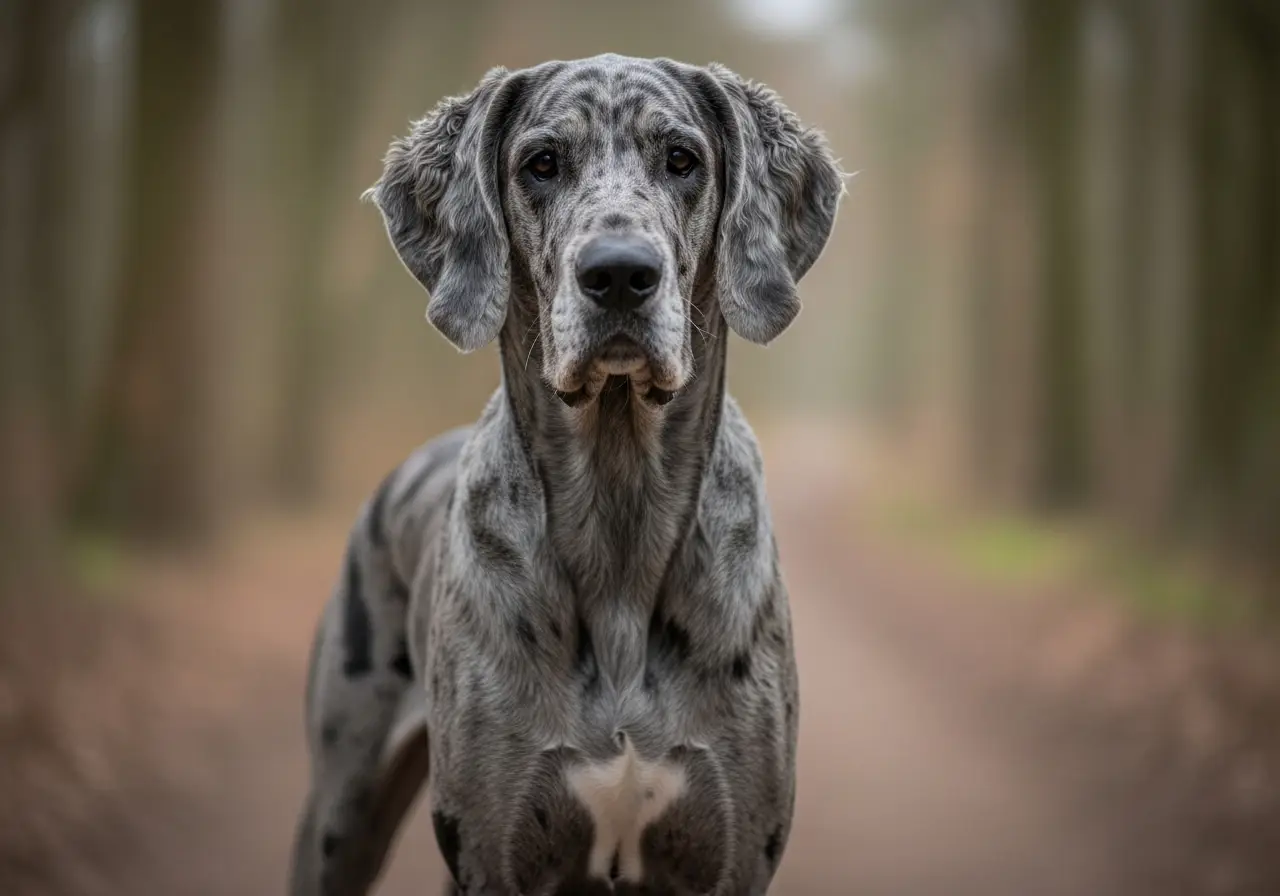
The Great Danoodle is a hybrid breed from the Great Dane and Standard Poodle, without FCI recognition and without a binding breed standard. Withers height, temperament, and health profile vary considerably depending on the parent animals. Anyone considering this dog needs experience with large dogs, sufficient space, 90 to 120 minutes of activity time daily, and financial reserves for possible health costs from both parent breeds.
02Introduction
What makes the Great Danoodle special
The Great Danoodle is an FCI-unrecognised cross between a Great Dane and a Poodle, very rare in Europe, with a withers height of 60–90 cm.
03Profile
Key facts and suitability
- Origin
- USA
- Original purpose
- Companion dog (Great Dane × Poodle)
- height at the withers
- 60–90 cm
- Weight
- 34–63 kg
- Life expectancy
- 8–13 Years
- Coat type
- Gelockt
- Minimum exercise
- 60 min/day
- Puppy price
- 1'500–3'500 CHF
- Waiting period
- 9 months
- Sports
- Agility · Obedience
04Temperament
How the Great Danoodle shows up in everyday life
When you come home, a well-socialised Great Danoodle typically shows a calm but distinct greeting—no hysterical jumping, but clear interest in the presence of its key people. The need for social contact is high: this dog wants to be near the family, not in a kennel or permanently alone in the garden.
Internally, i.e. due to its genetic predisposition, it needs 90 to 120 minutes of exercise daily, divided into several sessions. Mental stimulation is also required: search games, nose work or structured obedience training. The Poodle component ensures that purely physical exertion is not sufficient.
Externally, i.e. in its reaction to stimuli, the Great Danoodle often behaves openly to neutrally towards strangers, but can also react reservedly depending on the lineage. These two axes must not be confused: a high need for social contact with your own family does not automatically mean that the dog will greet every visitor joyfully.
In everyday life with children, the following applies: the sheer body size makes accidental bumps likely. Children who grow up with the dog learn early on to give it space. Toddlers and a 60-kilogram dog without clear rules are a combination that produces accidents—not out of aggression, but simply due to mass.
Compatibility with other dogs varies individually and depends heavily on early socialisation. A structured, calm daily routine with clear routines suits this dog well.
05Needs
What this breed needs daily
The Great Danoodle needs 90 to 120 minutes of active exercise daily. These sessions should be spread over two to three walks, as a single long march is less favourable for joints and the digestive tract—particularly with regard to the risk of gastric torsion—than several shorter sessions.
Mental stimulation is not an optional addition. The Poodle component brings a pronounced eagerness to learn, which leads to frustration without an outlet. Suitable forms of activity include structured obedience training, nose work, search games and simple trick sequences. Agility is only sensible due to the body size if joint-friendly setups are used.
The living environment must correspond to the size of the dog. A city apartment without regular access to open spaces is possible, but requires significantly more organisational effort. A garden makes everyday life easier, but does not replace guided walks.
Being left alone should be trained early and gradually. Four hours are a realistic upper limit; longer absences without a care solution are incompatible with the need for social contact of this dog.
During growth, usually up to the 18th to 24th month of life, climbing stairs should be reduced and intensive jumping load avoided. The joints of large dogs are particularly vulnerable during this phase. Nutritional advice from a vet for puppies of large breeds is recommended.
Exercise
High
mental work
Medium
Social needs
High
training
Medium
07Quick Check
08Suitability
Who this breed is suitable for – and who it isn't
✓Matches
The Great Danoodle suits owners who have already gained experience with large or very large dogs and know what it means to lead a dog weighing 40 to 70 kilograms on a leash, load it into the car and handle it at the vet.
Suitable are active individuals or families with children from about 10 years old who can plan 90 to 120 minutes of activity time daily, even in bad weather. A generous living environment with access to open spaces makes everyday life considerably easier.
Anyone who enjoys structured training and is willing to work consistently on loose-leash walking and impulse control will find a willing-to-learn partner in this dog. Households where at least one person is present during the day or where a reliable care solution exists meet the need for social contact of this dog.
Financially, a reserve for possible health costs from both parent breeds should be planned; heart examinations, joint checks and emergency stomach operations are not rare scenarios. Anyone who meets these conditions and consciously decides on a dog without a guaranteed breed standard makes an informed choice.
×Doesn't match
The Great Danoodle does not suit owners keeping a dog for the first time and letting themselves be guided by the supposed gentleness of large dogs. Body size amplifies every lapse in training; a poorly leash-trained 65-kilogram dog is no small matter.
This dog is not suitable for households where all people are away from home for eight or more hours daily and no care solution exists. The need for social contact is high; permanent solitude leads to behavioural problems.
Anyone looking for a dog with a predictable temperament, guaranteed size and reliable health profile should choose an FCI-recognised breed with an established breeding standard. The Great Danoodle does not offer this predictability structurally.
Families with toddlers under six years old should carefully weigh the combination of uncontrolled body mass and ongoing training phase. Anyone who also expects a hybrid dog to automatically mean less care, lower vet costs and less training effort fundamentally underestimates this dog and risks rehoming that harms the animal.
10Line reality
Show line, working line, breeder market
Since the Great Danoodle is not an FCI-recognised breed, there are no official breeding lines in the sense of working line, show line or field trial line. The variability instead arises from the choice of parent animals.
In practice, two types can roughly be distinguished: Firstly, litters from Great Danes with FCI papers and health-tested Standard Poodles; here, at least the parent animals are bred according to association standards, providing a certain basis for health prognoses. Secondly, litters from non-association-tested parent animals, where neither size nor temperament nor health status of the source animals is documented.
The coat type varies considerably: some puppies inherit the short, smooth coat of the Great Dane, others a curly to wavy Poodle coat that requires regular care and clipping. Both are possible in a single litter. Anyone expecting a specific coat should be aware that no guarantee exists.
Temperament-wise, the calmness of the Great Dane sometimes dominates, sometimes the activity and eagerness to learn of the Poodle, or both in combination. This unpredictability is not a fault of the individual dog, but rather the structural characteristic of non-standardised hybrid breeding.
11Health · Reality
What you need to plan for medically with your Great Danoodle
The Great Danoodle can inherit diseases from both parent breeds. This necessitates a differentiated assessment.
From the Great Dane comes the risk of gastric dilatation-volvulus (gastric torsion), a life-threatening condition that, according to a study by Purdue University (2000), with an incidence of up to 6% per year, is one of the most common causes of death in Great Danes. Dilated cardiomyopathy (DCM) and osteosarcoma are also factors. According to VDH data, the life expectancy of the Great Dane is between 7 and 10 years.
From the Standard Poodle, patellar luxation, progressive retinal atrophy (PRA), Addison's disease, and hip dysplasia (HD) can be inherited. According to the OFA database (Orthopedic Foundation for Animals, status 2023), around 12% of examined Standard Poodles show HD findings.
An automatic hybrid advantage is not scientifically proven. Without health tests for both parent animals (cardiac examination, hip/elbow X-rays, eye examination), the individual risk profile of a puppy cannot be assessed.
The life expectancy of the Great Danoodle realistically lies between 8 and 12 years, strongly dependent on final size and genetic predisposition. Larger specimens tend to have a shorter life expectancy.
Preventive examinations: annual cardiac auscultation from the 3rd year of life, joint checks during growth (6th, 12th, 18th month), eye examination for the puppy. Overweight increases the risk of gastric torsion and places a disproportionate strain on the joints; in a 60-kilogram dog, 5 kilograms of overweight correspond to a considerable additional load.
12Structured data
Health by the numbers
Prone to diseases
Gastric torsion (from the Great Dane line), heart problems, hip dysplasia
Recommended health tests
Cardiac examination, hip X-ray
13Myths ↔ Reality
What is often said incorrectly about this breed
Five myths, five realities, five sources.
„The Great Danoodle automatically has a hybrid vigour advantage and is healthier than its parent breeds.
A genetic hybrid vigour advantage (heterosis) does not occur automatically with every cross. The Great Danoodle can inherit diseases from both parent breeds: gastric torsion, dilated cardiomyopathy and osteosarcoma from the Great Dane, as well as patellar luxation, progressive retinal atrophy and Addison's disease from the Poodle. Without health tests of the parent animals, the individual risk is not calculable.
„The Great Danoodle sheds hardly at all and is suitable for allergy sufferers.
Whether a puppy inherits the coat of the Poodle or the Great Dane cannot be reliably predicted before birth. Even with a poodle-like coat, dogs produce allergens via saliva, skin flakes and urine, not just via the coat. No breeder can guarantee suitability for allergy sufferers.
„As a large dog, it does not need intensive exercise; it is naturally calm.
Although the Great Dane is considered comparatively calm indoors, it still requires 60 to 90 minutes of structured exercise daily. The Poodle component additionally increases the need for mental stimulation. A Great Danoodle that is neither physically nor mentally stimulated develops behavioural issues such as destruction or excessive barking.
„The Great Danoodle remains medium-sized, as large as a Labrador.
Without a binding breeding standard, the adult size is unpredictable. In crosses with Standard Poodles and Great Danes, withers heights of 60 to 90 cm and weights of 30 to 70 kg are possible. Many buyers are surprised by the actual adult size, leading to rehoming.
„Hybrid breeding means that no health tests of the parent animals are necessary.
Precisely because no breeding association prescribes minimum standards, the responsibility lies entirely with the buyer. Reputable providers present X-ray reports (hips, elbows), heart examinations and eye tests for both parent animals. If these proofs are missing, the health risk for the puppy cannot be assessed.
14animal welfare
The animal welfare perspective
Breeder market, designer versions, animal shelter reality — what no one writes in the puppy ad.
The Great Danoodle belongs to the designer hybrids that have gained significant popularity over the last two decades, often fuelled by social media images of large, fluffy dogs marketed as family-friendly and suitable for allergy sufferers. This representation considerably simplifies reality.
Backyard breeder market: As no kennel club prescribes minimum standards, the market for Great Danoodles is largely unregulated. Many providers dispense with health tests for parent animals, do not keep stud books, and hand over puppies without an initial veterinary examination. Price alone is not a quality indicator; both very cheap and very expensive puppies can come from litters that have not been health-tested.
Designer versions and trends: The Great Danoodle is occasionally advertised as a "Gentle Giant with Poodle intelligence". Such descriptions conceal the fact that temperament and size are not predictable without a standard. Anyone buying a dog based on marketing promises bears the full risk of disappointment, and the dog bears the consequences of a possible rehoming.
Housing-related problems: According to animal welfare organisations, underestimating size and underestimated food costs are among the most common reasons for surrendering large hybrid dogs. An adult Great Danoodle consumes 600 to 900 grams of high-quality dry food daily, corresponding to annual costs of 800 to 1,500 euros solely for nutrition.
Rehoming as an equivalent option: In animal shelters and via breed protection associations, large mixed-breed dogs and occasionally Great Danoodles that have been surrendered due to housing overload are regularly found. An adult dog from rehoming has the advantage that size, temperament, and health status are already assessable, which is precisely not the case with a puppy without a standard. The platform rundum.dog links to reputable rehoming centres.
15Costs · Transparency
What this breed realistically costs
The acquisition costs for a Great Danoodle vary considerably: Reputable providers with health-tested parent animals charge between 1,500 and 3,000 euros. Offers under 800 euros often come from untested litters with a correspondingly higher health risk.
The annual living costs are considerable for this size class. Nutrition alone with high-quality dry food costs between 800 and 1,500 euros per year. Care, for poodle-like fur every 8 to 12 weeks at the dog groomer, adds up to 400 to 800 euros annually.
Basic veterinary costs (vaccinations, parasite prevention, annual check-up) are between 300 and 500 euros per year. In addition come possible specialist examinations: a cardiac examination by a cardiologist costs 150 to 300 euros, an X-ray examination of the joints 200 to 400 euros.
In the event of illness, costs for stomach operations (gastric torsion) can reach between 3,000 and 6,000 euros. For this breed, dog health insurance or a health savings plan is not a luxury option but a sensible form of protection. Monthly premiums for large dogs range from 60 to 120 euros depending on the provider and scope of cover.
16Puppy search
What you need to consider when choosing a breeder
- As the Great Danoodle is not subject to kennel club control, the duty of care rests entirely with the buyer.
- Reputable providers supply health certificates for both parent animals upon request: X-ray findings for hips and elbows, a current cardiac examination by a cardiologist, and an eye test.
- If these documents are missing, the risk is incalculable.
- A reputable provider allows you to visit the litter, with the female dog present on site, in a clean, stimulating environment.
- Puppies presented without the female dog or whose origin remains unclear often come from backyard breeding.
- Questions that should be asked: How old are the parent animals?
- Which health tests are available?
- How many litters has the female dog already had?
- Is there a purchase contract with a return policy?
- As an equivalent alternative, searching via animal shelters and breed protection associations is recommended.
- Adult dogs from rehoming come with an assessable temperament and known health status, a structural advantage over a puppy without a breed standard.
- No named breeder recommendation is provided here; rundum.dog refers to verified rehoming platforms.
FAQ
Frequently asked questions about the Great Danoodle
Is Great Danoodle suitable for beginners?
Great Danoodle is considered suitable for first-time dog owners.
Is Great Danoodle a family dog?
Great Danoodle is considered suitable for families with good socialisation and species-appropriate care.
How much exercise does Great Danoodle need?
At least around 60 minutes of exercise per day.
What is the size and weight of Great Danoodle?
Fully grown, Great Danoodle reaches about 60–90 cm at the withers and weighs around 34–63 kg.
What is the life expectancy of Great Danoodle?
The life expectancy of Great Danoodle is approximately 8–13 years.
Which diseases are common in Great Danoodle?
Gastric torsion (from the Great Dane line), heart problems, hip dysplasia
17Breed clubs
Official breed clubs in DACH
19Related
Similar breeds – and their differences
You might also be interested in
Participate
Do you have a good photo of your Great Danoodle?
We are looking for expressive images for our breed profiles. Submit yours; the editorial team reviews every submission before publication.
Does this breed suit you?
Extremely rare giant designer dog. Hard to find in Europe. High space requirement, short life expectancy.