
01Summary
In a paragraph
If you only have 30 seconds.
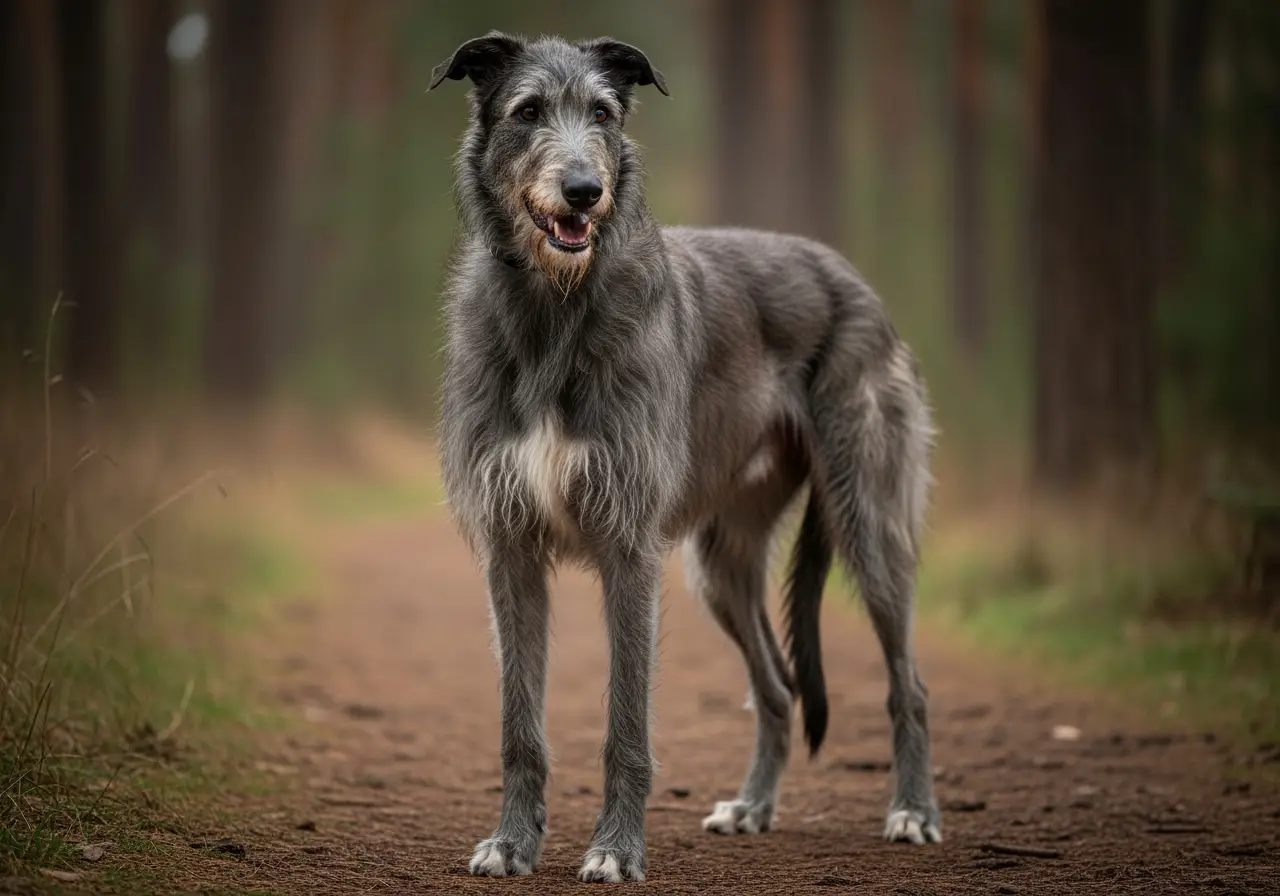
The Scottish Deerhound is a rough-coated sighthound of impressive stature and calm dignity, reserved and gentle at home, a consistent sight-hunter outdoors. Anyone keeping this breed needs secure free-run areas, experience with high-drive dogs, and the willingness to enable at least 90 minutes of active exercise daily. For calm, nature-connected owners with space, it is an exceptional companion.
02Introduction
What makes the Scottish Deerhound special
Scottish Deerhound (Scottish Deerhound): elegant Scottish sighthound for deer hunting, calm, kind and of huge stature
03Profile
Key facts and suitability
- Origin
- Schottland
- Original purpose
- Deer hunting
- FCI
- No. 164 · Group 10 · Sektion 2: Rauhhaarige Windhunde. Ohne Arbeitsprüfung.
- height at the withers
- 71–76 cm
- Weight
- 34–50 kg
- Life expectancy
- 8–11 Years
- Coat type
- Wire-haired
- Minimum exercise
- 90 min/day
- Puppy price
- 2'000–3'000 CHF
- Waiting period
- 6 months
- Sports
- Lure Coursing
04Temperament
How the Scottish Deerhound shows up in everyday life
Upon returning home, the Scottish Deerhound shows a calm, dignified greeting, no jumping, no barking, no chaos. It seeks closeness without being pushy. On the sofa or its favourite spot in the living room, it spends hours relaxing, provided its exercise needs are met.
Internal axis (what the dog needs): The need for social contact is medium to high; the Deerhound is not a loner and requires regular contact with its primary caregiver. Mental work plays a subordinate role; classic search games or nose work interest it less than physical stimulation. The exercise requirement is high: without daily opportunities to sprint on secure terrain, it will become restless. Being left alone for up to five hours is possible if it has been built up gradually.
External axis (how the dog reacts): Towards strangers, the Deerhound behaves neutrally to reservedly; it is not a dog that joyfully greets every visitor, but also not a suspicious guard dog. It is considered compatible with conspecifics, provided the socialisation process was solid. Caution is advised regarding small animal keeping in the household: the prey drive does not distinguish between wildlife and domestic rabbits.
Outside, the picture changes abruptly. As soon as the Deerhound perceives fast movement (a fleeing deer, a jogger, a bicycle), it switches into hunting mode. This change happens reflexively and is hardly interruptible by calling. Anyone who interprets this as disobedience misunderstands the genetic basis of this dog. The prey drive is not an upbringing problem; it is the profile.
05Needs
What this breed needs daily
The Scottish Deerhound requires at least 90 minutes of active exercise daily. Part of this should take place on secured, fenced terrain that offers real opportunities to sprint. A fence of at least 1.80 metres in height is considered the minimum measure; the Deerhound is a powerful jumper.
Forms of exercise: Long walks in nature form the basis. In addition, regular free runs on secure terrain are needed, where the dog can unleash its speed. Lure coursing, chasing an artificial lure, offers a species-appropriate way to express the sight-hunting drive in a controlled manner and is used by many Deerhound owners. Jogging or cycling as a companion dog is possible, but only suitable for fully grown animals from about 18 months onwards, as the young dog's skeleton needs time to mature.
Mental stimulation: The need for mental work is low compared to herding dogs or terriers. Classic obedience exercises and structured training sessions are useful, but should be kept short; the Deerhound loses interest during long repetition sequences. Calm, clear signals and positive reinforcement work better than pressure.
Social needs: The Deerhound requires regular contact with its primary caregiver. Isolated keeping without human interaction is poorly tolerated. Being left alone for up to five hours is possible if it has been built up in small steps; abrupt leaving alone for long periods leads to restlessness.
Living environment: A secure garden significantly facilitates daily management. Keeping in an apartment works if the owner consistently ensures sufficient exercise.
Exercise
High
mental work
Something
Social needs
Medium
training
Medium
06Sport & Mental and Physical Stimulation
What sports the Scottish Deerhound is suited for
Realistic in terms of physiology and genetics – not every breed suits every sport.
Structurally and physiologically suitable: Suitable for mantrailing, dummy work and tracking · CaniCross / bikejoring possible.
07Quick Check
08Suitability
Who this breed is suitable for – and who it isn't
✓Matches
The Scottish Deerhound suits owners who already have experience with large or high-drive dogs. First-time owners without prior experience with sighthounds or sight-hunting breeds face a steep learning curve.
Specific profiles where keeping works well:
Owners with access to secure open areas, at least one fenced area of 1.80 metres in height, where the dog can sprint regularly. Owners who can plan 90 to 120 minutes of active exercise daily, including longer hikes or lure coursing sessions. Calm, structured people who are not looking for a dog with permanent activity drive, but rather a companion with a clear on-off switch. Owners in rural or semi-rural environments where contact with wildlife is manageable and secure areas are available. Families with older children from about ten years old who understand calm handling of a large dog; the Deerhound is not a playmate for toddlers. Owners who are willing to integrate lure coursing or similar sighthound sports as a fixed part of everyday life.
×Doesn't match
The Scottish Deerhound does not suit owners who expect a reliably recallable dog off-leash in areas rich in wildlife. The chase drive is genetically anchored and cannot be neutralised by training alone.
Specific profiles where keeping becomes problematic:
Owners without access to secure open areas; those who rely exclusively on public parks or unsecured areas cannot meet the exercise needs in a species-appropriate manner. Owners who can plan less than 90 minutes of active exercise daily. Households with small animals such as rabbits, guinea pigs or cats without secure separation; the chase drive does not distinguish between animal species. Owners looking for a socially open, everyone-greeting dog: The Deerhound is neutral to reserved towards strangers, not a sociable all-rounder. Owners who equate the calm character at home with low exercise needs; this confusion of the internal and external axis leads to under-provision. City dwellers without regular access to rural environments or sighthound sports offerings that can compensate for the sight-hunting drive.
10Line reality
Show line, working line, breeder market
The Scottish Deerhound is kept today predominantly as a show and companion dog. A pronounced separation into working lines and show lines, such as exists for example with the Labrador Retriever or the Irish Red Setter, is not documented to a comparable extent in the Deerhound.
Historically, the Deerhound was a pure utility dog: speed, endurance and courage in deer hunting determined selection. With the decline of traditional Highland hunting in the 19th century, the focus shifted to the show ring. The type remained remarkably stable during this process; the modern Deerhound closely resembles the historical hunting dog in proportions and character.
In lure coursing and sighthound racing, the Deerhound is actively represented. The German Sighthound Breeding and Racing Association (DWZRV) organises corresponding events, at which Deerhounds regularly participate. This sport offers one of the few opportunities to express the sighthound instinct in a controlled and species-appropriate manner.
Regional differences in breeding exist, but are difficult for outsiders to assess. The breed is so rare in Germany and Switzerland that the choice of breeder depends less on line preferences than on availability and breeding health. Interested parties should actively inquire about health tests (heart examination, eyes) and litter numbers with the respective breeder.
11Health · Reality
What you need to plan for medically with your Scottish Deerhound
The Scottish Deerhound reaches a life expectancy of an average of 8 to 11 years, a typical value for a breed of this size, but shorter than for medium-sized dogs.
Heart diseases represent the most significant health risk. Cardiomyopathies — particularly dilated cardiomyopathy (DCM) — are documented in the breed and are considered a common cause of death. The Deerhound Health Survey by the UK Kennel Club (2004) identified heart diseases as one of the leading causes of death in the breed. Regular cardiological examinations from the fourth year of life onwards are recommended.
Osteosarcomas (bone tumours) occur disproportionately frequently in large and giant breeds. In the Deerhound, the risk is significantly higher compared to medium-sized breeds. Early symptoms such as lameness or swelling of the limbs should be checked by a vet immediately.
Gastric torsion (gastric dilatation-volvulus, GDV) is a serious risk in deep-chested large breeds. Preventive measures include several small meals daily, no intense exercise immediately after eating, and knowing the early symptoms (restlessness, unproductive retching, distended abdomen).
Joint-friendly training is essential in puppyhood: The Deerhound's skeleton matures slowly, so intense jumping and long running distances should be avoided until the age of 18 months.
Preventive examinations: heart examination (annually from the 4th year of life), eye examination, thyroid values. Overweight is rarely a problem in this breed; rather the opposite: underweight due to insufficient food despite high energy requirements.
12Structured data
Health by the numbers
Prone to diseases
Heart problems Liver shunts Bone cancer
Recommended health tests
Cardiac examination Blood count
13Myths ↔ Reality
What is often said incorrectly about this breed
Five myths, five realities, five sources.
„The Scottish Deerhound is an uncomplicated beginner’s dog due to its gentleness.
Gentleness in the home does not mean simplicity in keeping. The pronounced prey drive requires consistent management, secure fencing and owners with experience in handling sighthounds. Anyone who underestimates the prey drive risks dangerous situations in open areas.
„As a sighthound, the Deerhound needs little exercise; it is a couch dog.
Sighthounds have a different rhythm of movement than endurance dogs, but they require regular opportunities to sprint on secure terrain. The Scottish Deerhound was bred for endurance in deer hunting; daily exercise of at least 90 minutes plus safe off-leash runs are not optional, but a basic requirement.
„The prey drive can be reliably switched off through consistent training.
The sighthound instinct is deeply rooted genetically and cannot be eliminated by training alone. Fast movements (wildlife, bicycles, joggers) activate the instinct reflexively. Reliable recall upon sighting wildlife is not realistic for this breed. Management through secured areas does not replace training, but must complement it.
„Scottish Deerhounds are aggressive because they were bred for hunting.
The FCI standard explicitly describes the Deerhound as gentle, friendly, never suspicious, aggressive or shy. The hunting function was directed against wildlife, not against people or other dogs. Aggression towards people is not typical of the breed and is considered a serious character fault.
„Due to its size, the Deerhound strictly requires a house with a large garden.
Keeping in an apartment is possible if sufficient daily exercise and regular opportunities to sprint on secure terrain are guaranteed. The decisive factor is not the living space, but the quality and safety of the exercise area. A secured garden significantly facilitates management, but is not a strict prerequisite.
14animal welfare
The animal welfare perspective
Breeder market, designer versions, animal shelter reality — what no one writes in the puppy ad.
The Scottish Deerhound is not a breed that is affected on a large scale by backyard breeders or the pet trade. Its extreme rarity partly protects it from the worst excesses of the puppy trade, but also makes the search more vulnerable to dubious offers that specifically respond to demand without supply.
Backyard breeder market: Because reputable breeders have long waiting lists, gaps arise that are filled by dubious providers. Puppies from abroad, particularly from Eastern European countries without studbook affiliation, are occasionally offered via animal markets or social media channels. These animals often lack documented health tests of the parent dogs. The risk of genetically determined heart diseases or skeletal problems in such lines is not assessable.
Breeding and keeping-related problems: The Deerhound is not a fashion breed in the classical sense, with no brachycephalic features, no exaggerated proportions. The challenges lie in its size: heart diseases, bone tumours and gastric torsion are breed-typical risks that can be minimised by careful breeding and prevention, but not eliminated. The biggest animal welfare problem arises from keeping conditions due to underestimating the need for movement; a Deerhound without sufficient exercise and secured sprinting opportunities suffers in silence.
Adoption as an equal option: Adult Deerhounds from rehoming are rare, but available. An adult dog from a secure background offers the advantage that its character and health status are already known. The DWZRV and the Deerhound Club of Switzerland are the first points of contact for rehoming inquiries. Those willing to wait and flexible regarding age will occasionally find a dog looking for a new home here.
15Costs · Transparency
What this breed realistically costs
The purchase price for a Deerhound puppy from reputable breeding in Germany and Switzerland is between 1,500 and 2,500 euros. Offers significantly below this without studbook proof and health tests of the parent dogs are a warning sign.
Running costs per year: As a large breed weighing up to 50 kg, the Deerhound requires correspondingly sized amounts of food. High-quality dry food or BARF for an adult Deerhound costs between 800 and 1,400 euros annually, depending on the product. In addition, there are grooming costs for the rough coat; professional trimming two to three times a year costs 80 to 150 euros per session.
Veterinary costs: Routine examinations, vaccinations and parasite prevention cost 300 to 600 euros annually. Cardiological preventive examinations from the fourth year of life (echocardiography) cost 150 to 300 euros per examination, depending on the practice. For more serious illnesses such as osteosarcoma or gastric torsion, treatment costs can quickly reach 3,000 to 8,000 euros.
Pet insurance: Health insurance for a Deerhound costs between 80 and 180 euros monthly, depending on the provider and scope of benefits. Given the breed-typical health risks, coverage is recommended. The total costs of ownership over its lifetime add up to 20,000 to 40,000 euros, depending on the health course and insurance model.
16Puppy search
What you need to consider when choosing a breeder
- The Scottish Deerhound is one of the rarest dog breeds in the German-speaking region.
- Only a few litters are registered annually in Germany and Switzerland.
- Long waiting times of a year or more are the rule, not the exception.
- You can recognise reputable breeders by the following characteristics: They are members of a recognised breeding association (e.g., DWZRV or Deerhound Club of Switzerland) and breed under the VDH or SKG umbrella.
- They provide health certificates for the parent animals; for the Deerhound, heart examinations and eye examinations are relevant.
- They ask questions about your living situation and refuse a sale if the prerequisites do not match.
- The puppy leaves the litter no earlier than eight weeks, preferably nine to ten weeks.
- Warning signs: No proof of parent animals, no breeding association, multiple breeds at once, immediate availability without a waiting list, sale via animal markets or mediation platforms without breeder verification.
- Rescue as an equally valid option: Adult Deerhounds from rescue or breed-specific rescue organisations are rare, but not excluded.
- An adult dog has the advantage that temperament and health status are already assessable.
- The Deerhound Club of Switzerland and the DWZRV can assist in finding rescue dogs.
FAQ
Frequently asked questions about the Scottish Deerhound
Is Scottish Deerhound a family dog?
Scottish Deerhound is considered suitable for families with good socialisation and species-appropriate care.
How much exercise does Scottish Deerhound need?
At least around 90 minutes of exercise per day.
Does Scottish Deerhound suit an apartment?
With enough exercise and enrichment, Scottish Deerhound can also be kept in an apartment.
What is the size and weight of Scottish Deerhound?
Fully grown, Scottish Deerhound reaches about 71–76 cm at the withers and weighs around 34–50 kg.
What is the life expectancy of Scottish Deerhound?
The life expectancy of Scottish Deerhound is approximately 8–11 years.
Which diseases are common in Scottish Deerhound?
Heart problems Liver shunts Bone cancer
17Breed clubs
Official breed clubs in DACH
19Related
Similar breeds – and their differences
You might also be interested in
Participate
Do you have a good photo of your Scottish Deerhound?
We are looking for expressive images for our breed profiles. Submit yours; the editorial team reviews every submission before publication.
Does this breed suit you?
Gentle giant with high prey drive – off-lead only in secured areas