
01Summary
In a paragraph
If you only have 30 seconds.
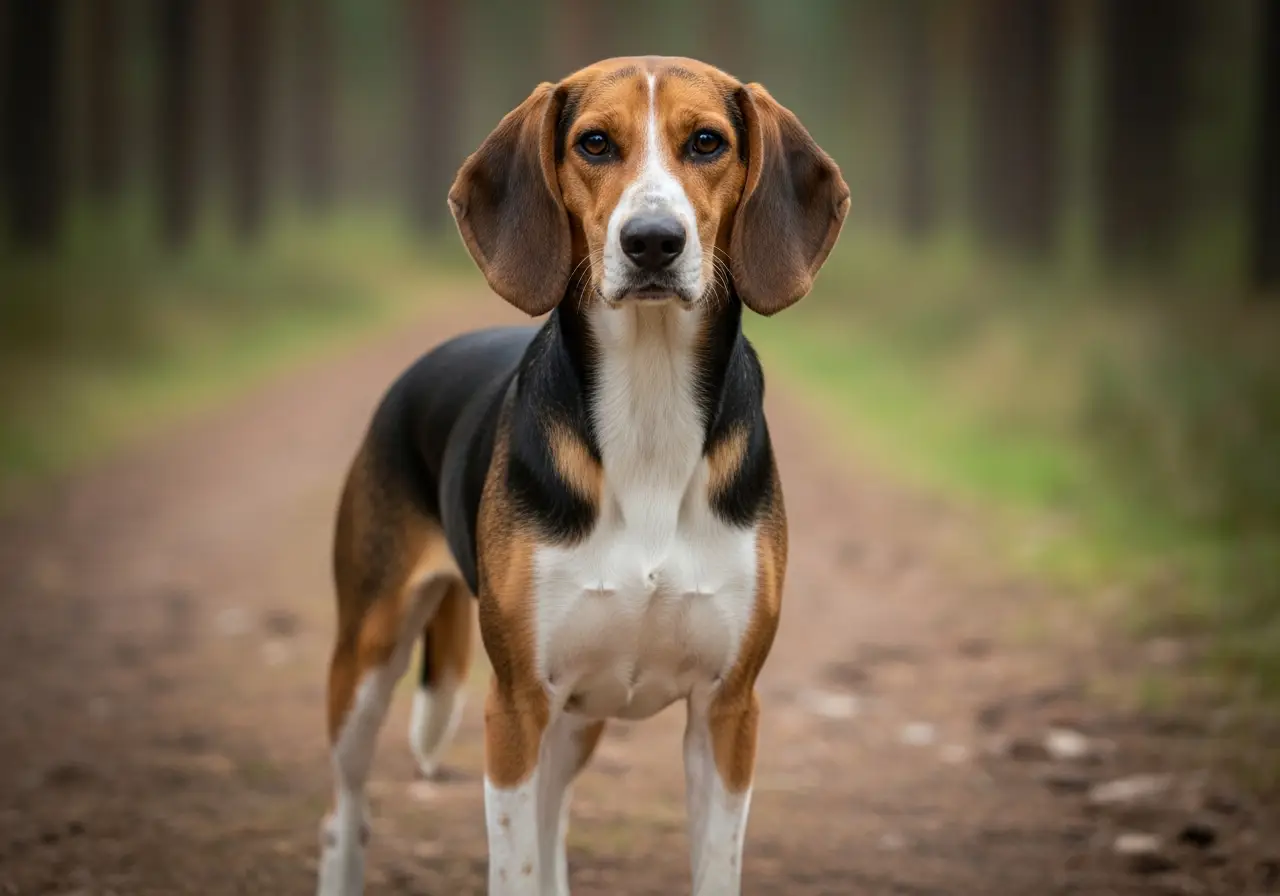
The Estonian Hound is a Baltic hound with a clear specialisation: fine nose, pronounced scenting passion and high endurance. Anyone keeping this dog takes on a working partner that wants to be challenged daily, mentally as well as physically. Friendly in the house, relentless on the trail. This combination demands owners with a realistic view of hunting-motivated dogs and the will to implement consistent management permanently.
02Introduction
What makes the Estonian Hound (Eesti Hagijas) special
The Estonian Hound (Eesti Hagijas) is a rare Baltic scenthound, FCI Group 6, bred for hare and fox, with a height at the withers of 45–52 cm.
03Profile
Key facts and suitability
- Origin
- Estland
- Original purpose
- Hunting hare and fox
- FCI
- No. 366 · Group 6 · Section 1.2
- height at the withers
- 45–52 cm
- Weight
- 13–20 kg
- Life expectancy
- 12–14 Years
- Coat type
- Short-haired
- Minimum exercise
- 90 min/day
- Puppy price
- 600–1'200 CHF
- Waiting period
- 12 months
- Sports
- Hunting · Tracking · Mantrailing
04Temperament
How the Estonian Hound (Eesti Hagijas) shows up in everyday life
The dual profile of the Estonian Hound becomes clearly apparent during the morning walk: inside the house, the dog greets acquaintances in a friendly manner, seeks physical contact, and follows its owner from room to room. Outside, the orientation changes. As soon as an interesting scent trail appears, all attention is directed towards the ground, and the owner recedes into the background.
This separation is not a training deficit but rather an expression of genetic programming. Internally, the dog requires intensive nose work and extensive exercise daily to remain balanced. Externally, it shows itself to be comparatively open towards strangers; friendliness towards people is explicitly described in the FCI standard. It generally gets along well with other dogs, provided that socialisation has taken place at an early stage.
The prey drive is strongly pronounced and not situation-dependent. A hare at the edge of the forest, a fresh fox track on the field path – the dog reacts to these with full concentration. The resonant vocalisation, which serves as a location aid during hunting use, also occurs in everyday life when the dog is frustrated or under-stimulated.
Anyone keeping the Estonian Hound purely as a companion dog without a hunting context must channel this drive through structured nose work, mantrailing, or comparable enrichment. An evening on the sofa after a short walk is not sufficient to satisfy this dog. The calmness that a well-stimulated dog shows in the house is the result of consistent daily work, not the starting state.
05Needs
What this breed needs daily
The Estonian Hound requires at least 120 minutes of active exercise daily. Pure walks on paved paths only count to a limited extent; the dog needs terrain where it can sniff, search, and follow its scent orientation. Forest paths, meadows, and unstructured terrain are more suitable than city parks with leash requirements.
The need for mental work is high. Nose work in the form of mantrailing, tracking, or structured search games belongs to daily basic care. Anyone who cannot or does not wish to provide a hunting context must replace this enrichment with targeted training sessions, at least three to four times per week, in addition to physical exercise.
Being left alone is possible with sufficient stimulation, but should not permanently exceed four hours daily. An under-stimulated dog that additionally remains alone for long periods develops frustration-related behaviours such as vocalisation, destruction, or excessive restlessness.
The need for social contact is moderate to high. The Estonian Hound orients itself towards its primary caregiver and seeks closeness in the house. It is not a dog that tolerates isolation well. A household with regular presence and active inclusion of the dog in everyday life corresponds better to its needs profile than a household with long absences.
For training, the dog requires calm, clear guidance without pressure. It reacts sensitively to stress signals and learns cooperatively as long as no wild scent trails are competing. Impulse control training and realistic expectation management regarding recall in open areas are central training objectives.
Exercise
High
mental work
A lot
Social needs
Medium
training
Demanding
06Sport & Mental and Physical Stimulation
What sports the Estonian Hound (Eesti Hagijas) is suited for
Realistic in terms of physiology and genetics – not every breed suits every sport.
Structurally and physiologically suitable: Suitable for mantrailing, dummy work and tracking · CaniCross / bikejoring possible.
07Quick Check
08Suitability
Who this breed is suitable for – and who it isn't
✓Matches
The Estonian Hound suits owners who can plan at least two hours of active exercise in nature-like terrain daily, not as an occasional exception but as a structured part of everyday life. Hunters or owners with a hunting environment provide the optimal framework, as the dog can meaningfully apply its tracking work there.
Very active owners without a hunting background are also suitable if they are willing to establish nose work and mantrailing as a fixed training routine. Experience with high-drive or hunting-motivated dogs is a clear advantage; anyone who already knows that a hound on a scent trail cannot be recalled sets realistic expectations.
A rural or at least suburban environment with access to secure open areas or extensive forest regions significantly facilitates keeping. Households with a garden are advantageous but do not replace active exercise sessions.
The breed gets along well with other dogs if socialisation occurs early. Owners who already have a dog and are looking for a second one that fits into an active group will find a compatible partner in the Estonian Hound, provided that the activity levels match. Families with children of school age who actively include the dog in exercise sessions are also suitable.
×Doesn't match
The Estonian Hound does not suit owners who are away from home for eight or more hours daily and do not have a reliable dog care plan. The dog tolerates being alone only with sufficient stimulation; both together, long absence and under-stimulation, lead to problems.
Anyone who equates the breed's friendliness towards people with easy manageability underestimates the internal need. A dog that reacts openly towards strangers still requires intensive enrichment daily; these two axes are independent of each other.
Urban owners without access to natural terrain and without the opportunity to offer structured nose work will not do justice to the dog in the long term. Owners who expect a reliably recallable dog in open areas should also not choose this breed, as the prey drive is genetically ingrained and not a training issue.
First-time owners without prior experience with high-drive dogs face a steep learning curve. The breed is not unsuitable for committed first-time owners, but requires professional guidance from the outset by a dog training school with experience in hounds or hunting-motivated breeds. Those who do not plan for this guidance risk frustration on both sides.
10Line reality
Show line, working line, breeder market
In the German-speaking world, the Estonian Hound is bred exclusively as a working dog; a differentiation into show and working lines, as exists for more popular breeds such as the Labrador or the German Shepherd Dog, is not relevant for this breed. The FCI standard requires a working test, meaning that breeding approval is tied to proof of hunting suitability.
In Estonia and the Baltic neighbouring countries, hunting use dominates. Dogs are used on hare, fox, and lynx and assessed according to performance criteria: tracking ability, baying, endurance, and terrain suitability. This orientation shapes the breed's gene pool to this day.
A regional differentiation within the breed exists in that Estonian breeders traditionally select for endurance and scenting performance, while slight differences in build and temperament are occasionally observed in other Baltic countries. However, these differences are not formalised and do not correspond to any recognised line separation.
Anyone acquiring a dog of this breed will, with high probability, obtain a dog with a functional working background, regardless of whether they themselves are engaged in hunting. This must be factored into the planning of keeping and enrichment from the outset.
11Health · Reality
What you need to plan for medically with your Estonian Hound (Eesti Hagijas)
The Estonian Hound is considered a robust breed with a life expectancy of approximately 12 to 15 years. Reliable breed-specific health statistics from large population studies do not exist due to the low prevalence in the German-speaking region. The following assessments are based on the FCI standard, general knowledge about hounds, and information from Estonian breeding associations.
Hip dysplasia (HD) is fundamentally possible in medium-sized hounds. No published HD rates from systematic screenings are available for the Estonian Hound. Reputable breeders have parent animals examined radiologically; this proof should be requested when buying a puppy.
Ear infections pose an increased risk in drop-eared dogs. The hanging, close-fitting ears of the Estonian Hound favour heat and moisture accumulation in the ear canal. Regular ear checks, at least once a week, and cleaning after water contact demonstrably reduce the risk.
Overweight is rarely a primary problem in well-provided hounds that are sufficiently exercised. However, the risk increases with decreasing activity in old age or after injuries. Body weight should be checked regularly, as overweight puts strain on joints and the cardiovascular system.
Preventive examinations by the vet on an annual basis, dental checks (the FCI standard describes a complete scissor bite with 42 teeth as normal), and parasite management for dogs with regular forest use are recommended. In cases of lameness, performance decline or recurring ear problems, veterinary clarification should be initiated promptly.
12Structured data
Health by the numbers
Prone to diseases
Hip dysplasia, generally robust
Recommended health tests
Hip X-ray
13Myths ↔ Reality
What is often said incorrectly about this breed
Five myths, five realities, five sources.
The Estonian Hound is an uncomplicated family dog without special requirements due to its friendliness.
The breed does indeed appear balanced and people-oriented in the house. However, outside, the genetically anchored hunting and tracking drive dominates. Without consistent management and sufficient stimulation, behavioural problems arise. Friendliness and ease of keeping are two different concepts that do not coincide for this breed.
A scenthound of this size can manage with just one hour of walking per day.
The FCI standard describes the Estonian Hound as an agile dog with pronounced hunting passion and high endurance. The actual exercise requirement is at least 120 minutes of active movement daily, supplemented by nose work or tracking-oriented enrichment. Underestimating the exercise need leads to frustration and undesirable behaviour.
With enough training, hounds can be reliably recalled, even when game is nearby.
The prey drive of the Estonian Hound is genetically firmly anchored and has been selected over decades for independent work on the trail. In contact with game, the dog prioritises olfactory stimuli over auditory signals. A completely reliable recall in such situations is realistically unattainable. Secure terrain and leashing in uncontrolled areas are permanent management measures, not a temporary training step.
The breed is so rare that you can only obtain it through foreign breeding or dubious sources.
The Estonian Hound is indeed very rare in the German-speaking world; however, reputable breeders exist in Estonia and the Baltic neighbouring countries who work through FCI-affiliated breeding associations. Careful research via national kennel clubs and direct contact with Estonian hunting dog clubs leads to verifiable sources. Long waiting times should be realistically planned for.
Because the breed appears calm in the house, it does not require mental stimulation.
Calmness in the house is a sign of balance in sufficiently stimulated dogs, not of low mental workload. The Estonian Hound has a high mental workload derived from its tracking work. Nose work, mantrailing, or hunting-related enrichment are not extras but necessary components of keeping.
14animal welfare
The animal welfare perspective
Breeder market, designer versions, animal shelter reality — what no one writes in the puppy ad.
In Switzerland, the Estonian Hound is one of the rarest FCI-recognised breeds in the German-speaking region. It practically does not appear in animal welfare and rescue stations; anyone looking for a dog of this breed will hardly find one through adoption. This is a realistic assessment, not a value judgement.
Nevertheless, it is worth taking a look at the structural risks associated with rare breeds. Because supply is low, grey areas arise: individual providers without association membership, imports from uncontrolled stocks or crosses marketed as purebred Estonian Hounds. Anyone who does not receive proof of lineage (FCI pedigree) and health certificates for the parent animals should not finalise the purchase.
Another risk lies in keeping itself. The Estonian Hound is occasionally described as a calm, friendly family dog, creating the impression that it is easy to keep. Dogs given up due to unrealistic expectations often end up in rescue stations for hounds or with specialised animal welfare associations. This cycle begins with insufficient information before acquisition.
Anyone fundamentally open to a hound with a similar profile will occasionally find dogs from abroad, such as from Spain or Eastern Europe, where hounds are frequently abandoned, through animal welfare organisations specialising in hunting dogs. These dogs have comparable needs and require experienced owners with the same activity profile. Adoption through reputable organisations such as Laufhundrettung e.V. or comparable associations is an equally valid option to buying a puppy and deserves the same serious consideration.
15Costs · Transparency
What this breed realistically costs
The purchase price for a puppy of the Estonian Hound from reputable breeding with FCI pedigree and health certificates is typically between 800 and 1,500 EUR in the German-speaking region, depending on the breeder, country of origin, and availability. Offers significantly below this range without complete documentation should be viewed with caution.
Annual living costs consist of food (high-quality dry food or fresh meat diet for a medium-sized active dog: approx. 600–1,000 EUR/year), veterinary costs for routine check-ups, vaccinations, and parasite treatment (approx. 300–500 EUR/year on average, excluding emergencies), as well as grooming needs (low for this short-haired type, approx. 50–100 EUR/year).
Pet insurance for a medium-sized dog costs between 40 and 100 EUR per month in Germany, depending on the provider and scope of coverage (480–1,200 EUR/year). For a rare breed with limited data on hereditary diseases, having insurance is advisable.
Additional costs arise from dog training school (particularly recommended for this breed: 200–500 EUR for basic course), nose work or mantrailing courses, and possibly dog care during absences. Overall, annual costs of 2,000–3,500 EUR should be realistically calculated.
16Puppy search
What you need to consider when choosing a breeder
- Reputable breeders of the Estonian Hound can be found through the FCI-affiliated Estonian Kennel Union (Eesti Kennelliit) or through national cynological associations in the DACH region.
- The VDH lists recognised breeding clubs, via which contact can be made.
- Long waiting times of a year or more are realistic for this rare breed.
- The following points should be checked during the breeder visit: health certificates for both parent animals (at least hip dysplasia X-rays), FCI pedigree for the puppy, living conditions with socialisation in an active household, and evidence of working tests according to the FCI standard.
- A breeder who does not provide health documents or ships puppies without inspection does not meet the minimum requirements.
- Caution is advised with offers on general classifieds portals, especially if the price is significantly below market level or no proof of lineage is offered.
- Adopting an adult hound through specialised animal welfare organisations is an equally valid alternative.
- Adult dogs come with an assessable temperament and require experienced owners, which is a prerequisite for this breed anyway.
- Organisations specialising in hunting dogs or hounds have the necessary expertise for placement.
FAQ
Frequently asked questions about the Estonian Hound (Eesti Hagijas)
Is Estonian Hound (Eesti Hagijas) a family dog?
Estonian Hound (Eesti Hagijas) is considered suitable for families with good socialisation and species-appropriate care.
How much exercise does Estonian Hound (Eesti Hagijas) need?
At least around 90 minutes of exercise per day. As an active breed, more so — plus mental stimulation.
What is the size and weight of Estonian Hound (Eesti Hagijas)?
Fully grown, Estonian Hound (Eesti Hagijas) reaches about 45–52 cm at the withers and weighs around 13–20 kg.
What is the life expectancy of Estonian Hound (Eesti Hagijas)?
The life expectancy of Estonian Hound (Eesti Hagijas) is approximately 12–14 years.
Which diseases are common in Estonian Hound (Eesti Hagijas)?
Hip dysplasia, generally robust
17Breed clubs
Official breed clubs in DACH
19Related
Similar breeds – and their differences
You might also be interested in
Participate
Do you have a good photo of your Estonian Hound (Eesti Hagijas)?
We are looking for expressive images for our breed profiles. Submit yours; the editorial team reviews every submission before publication.
Does this breed suit you?
Very rare Estonian scenthound. Primarily kept for hunting purposes. Hardly found outside the Baltic region.